
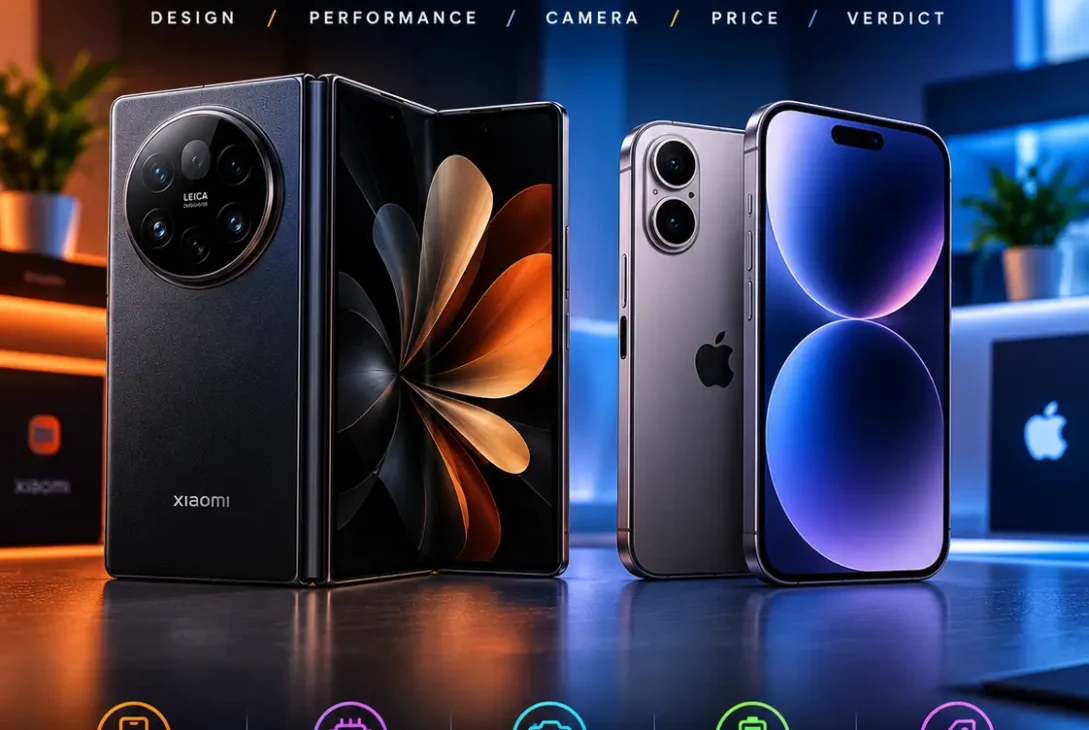
The Xiaomi 18 Fold vs iPhone Duo comparison is one of the most interesting foldable-phone matchups of 2026. Xiaomi and Apple have taken different approaches to the foldable smartphone market, with the Xiaomi 18 Fold focusing heavily on display technology, battery capacity, fast charging, and Leica cameras, while Apple’s iPhone Duo combines a foldable design with the A20 Pro chip, iOS 27, Apple Intelligence, and Apple’s wider ecosystem.
The Xiaomi 18 Fold was officially launched in China on September 7, 2026. It features a 7.58-inch internal display, a 5.38-inch cover screen, an Xring O3 processor, a 6,000mAh battery, and a triple Leica camera system.
Apple introduced the iPhone Duo on September 9, 2026, making it the company’s first foldable iPhone. It has a 7.6-inch internal display, a 5.4-inch outer display, the A20 Pro chip, dual 48MP rear cameras, and iOS 27. Apple says the phone is designed around a new hinge and dual-battery architecture.
This Xiaomi 18 Fold vs iPhone Duo guide compares their displays, processors, cameras, batteries, charging, design, software, prices, availability, and other important differences.
Table of Contents
- Xiaomi 18 Fold vs iPhone Duo: Quick Comparison
- Design and Foldable Form Factor
- Display Comparison
- Performance and Processors
- Camera Comparison
- Battery and Charging
- Software and AI Features
- Durability and Hinge Design
- Storage and Memory
- Price Comparison
- Availability
- Xiaomi 18 Fold vs iPhone Duo for Gaming
- Xiaomi 18 Fold vs iPhone Duo for Photography
- Xiaomi 18 Fold vs iPhone Duo for Productivity
- Which Phone Fits Different Users?
- Frequently Asked Questions
- Conclusion
- External Links
Xiaomi 18 Fold vs iPhone Duo: Quick Comparison
The Xiaomi 18 Fold vs iPhone Duo comparison starts with two phones that share the same basic concept: a conventional smartphone-sized device that opens into a larger tablet-like screen.
| Feature | Xiaomi 18 Fold | iPhone Duo |
|---|---|---|
| Launch | September 7, 2026 | September 9, 2026 |
| Inner Display | 7.58 inches | 7.6 inches |
| Outer Display | 5.38 inches | 5.4 inches |
| Refresh Rate | Up to 120Hz LTPO | ProMotion |
| Processor | Xring O3 | A20 Pro |
| Main Camera | 200MP Leica | 48MP |
| Rear Cameras | Triple camera | Dual camera |
| Battery | 6,000mAh | Dual-battery architecture |
| Wired Charging | 67W | Fast charging |
| Wireless Charging | 50W | MagSafe |
| Operating System | Xiaomi HyperOS | iOS 27 |
| Starting Price | ¥10,999 in China | $1,999 |
| Availability | China | International markets announced by Apple |
The two phones are surprisingly close in physical screen size, but their hardware strategies are quite different.
Design and Foldable Form Factor
The Xiaomi 18 Fold uses a book-style folding design. When closed, it has a 5.38-inch external display, while opening the device reveals a 7.58-inch internal screen.
Xiaomi has designed the phone around a relatively wide internal display with a 2:1 aspect ratio. The company also introduced a redesigned hinge structure and strengthened frame to improve durability.
The iPhone Duo follows a similar book-style concept.
Apple’s foldable phone has a 5.4-inch outer display and a 7.6-inch internal display. Apple says the outer display provides 90% of the screen area of the iPhone 18 Pro, while both displays use the same aspect ratio for smoother transitions between the two screens.
Apple has also focused heavily on thickness.
The company describes the iPhone Duo as its thinnest iPhone when opened, while the hinge is designed to provide a smooth folding experience.
The Xiaomi 18 Fold vs iPhone Duo design comparison therefore comes down to two similar concepts with different engineering priorities.
Display Comparison
Display technology is one of the most important parts of any foldable smartphone.
The Xiaomi 18 Fold features a 7.58-inch internal display and a 5.38-inch external display. Both screens use LTPO technology and can reach a refresh rate of up to 120Hz. Xiaomi also advertises peak brightness of up to 4,000 nits under specified conditions.
The iPhone Duo has a slightly larger 7.6-inch internal display and a 5.4-inch outer display.
Apple says both displays support ProMotion, always-on functionality, and up to 3,000 nits peak brightness. The internal display also uses a nano-texture finish intended to reduce glare.
The dimensions are therefore extremely similar.
The main difference is how the two manufacturers approach the display experience. Xiaomi emphasizes high peak brightness and its HyperRGB/LTPO technology, while Apple focuses on ProMotion, nano-texture treatment, and tight integration with iOS 27.
https://www.apple.com/ca/newsroom/2026/09/apple-unveils-iphone-duo
Performance and Processors
The processor is another major difference in the Xiaomi 18 Fold vs iPhone Duo comparison.
Xiaomi’s foldable is powered by the company’s Xring O3 chip. The processor is manufactured using a 3nm process and contains 24 billion transistors, according to reporting around the launch.
The Xring O3 is particularly significant because it represents Xiaomi’s continued development of its own flagship silicon.
Apple’s iPhone Duo uses the A20 Pro.
Apple says the A20 Pro has a six-core CPU and a seven-core GPU, with the CPU up to 20% faster than the previous-generation A19 Pro and the GPU up to 40% faster and more power efficient. Apple also says the A20 Pro has 50% more unified memory bandwidth and a dual 16-core Neural Engine.
The processors are built for different ecosystems.
Xiaomi’s chip is designed around HyperOS and Xiaomi’s hardware platform, while Apple’s A20 Pro is deeply integrated with iOS 27 and Apple’s on-device AI features.
Independent benchmarks will be more useful for a direct performance comparison once both devices have been tested under the same conditions.
Camera Comparison
The camera systems show one of the biggest hardware differences between the two phones.
The Xiaomi 18 Fold has a triple Leica camera system featuring a 200MP main camera, a 50MP periscope telephoto camera, and a 50MP ultra-wide camera. The main sensor is reported to use a 1/1.56-inch sensor, while the telephoto camera offers 3.5x optical zoom.
This gives Xiaomi a camera setup with a strong emphasis on resolution and dedicated focal lengths.
The iPhone Duo takes a different approach.
Apple’s foldable has a dual 48MP rear camera system. Apple has also developed camera features specifically around the foldable form factor, allowing users to take advantage of the device’s two-screen design.
For photography, megapixel counts alone do not determine image quality.
Processing, sensor size, lens quality, stabilization, HDR, computational photography, and video processing can all have a major impact.
The Xiaomi 18 Fold vs iPhone Duo camera comparison is therefore better understood as a difference in camera hardware philosophy rather than simply 200MP versus 48MP.
Battery and Charging
Battery capacity is another area where Xiaomi has an unusually large specification advantage on paper.
The Xiaomi 18 Fold includes a 6,000mAh silicon-carbon battery and supports 67W wired charging and 50W wireless charging.
That is a substantial battery for a foldable smartphone.
Apple does not advertise the iPhone Duo using a single battery-capacity number in its launch announcement. Instead, the phone uses a dual-battery architecture, with one battery positioned on each side of the foldable chassis. Apple says this approach helps maximize capacity while making efficient use of the internal space.
Apple also advertises all-day battery life.
Real-world battery comparisons will depend on software optimization, screen brightness, processor efficiency, cellular connectivity, gaming, and other factors.
The Xiaomi 18 Fold clearly emphasizes battery capacity and charging speed, while Apple emphasizes power efficiency and system-level optimization.
Software and AI Features
Software could be one of the biggest differences between these two phones.
The Xiaomi 18 Fold runs Xiaomi’s HyperOS platform and integrates the company’s AI features with the Xring O3 processor.
The iPhone Duo runs iOS 27.
Apple has redesigned parts of iOS to take advantage of the foldable display. The company also says the iPhone Duo includes the next generation of Apple Intelligence, which enables additional AI features throughout the operating system and applications.
Apple’s approach is particularly focused on continuity.
Apps can adapt between the external and internal screens, allowing users to move from the compact display to the larger screen without completely changing the interface.
Xiaomi’s HyperOS approach is more closely connected with the Android ecosystem and Xiaomi’s broader hardware lineup.
This means software preference may be more important than raw specifications for people choosing between the two.
Durability and Hinge Design
Foldable phones have historically faced durability challenges because the hinge and flexible display must withstand repeated folding.
Xiaomi has introduced a redesigned hinge for the 18 Fold and uses strengthened materials around the frame and display. Reports from the launch also describe an improved ultra-thin glass structure intended to increase durability and reduce the visibility of the crease.
Apple has also placed significant emphasis on the hinge.
The company describes the iPhone Duo’s hinge as a precision mechanism designed to provide a smooth folding experience. Apple also uses a titanium and ceramic fiber frame and Ceramic Shield 2 glass on the external side.
Both manufacturers are therefore treating durability as a major part of their foldable designs.
Long-term durability will ultimately require extended real-world testing rather than launch specifications alone.
Storage and Memory
Storage configurations are important because foldable phones are often positioned as premium productivity devices.
The Xiaomi 18 Fold starts at 12GB of RAM and 256GB of storage in China, according to launch reporting. Higher configurations are also available.
Apple’s iPhone Duo starts with 256GB of storage and can be configured with up to 2TB, according to reporting following Apple’s announcement.
Apple’s memory architecture is different from Android phones because the A20 Pro uses unified memory technology.
For buyers, storage capacity may therefore be more useful to compare directly than RAM numbers across the two platforms.
Price Comparison
Price is another major difference in the Xiaomi 18 Fold vs iPhone Duo matchup.
The Xiaomi 18 Fold starts at ¥10,999 in China for the 12GB/256GB configuration. Higher-end versions can reach ¥15,999 for the ceramic edition.
The iPhone Duo starts at $1,999 for the 256GB model, with higher storage configurations costing more.
These prices should not be converted directly into a global one-to-one comparison because Xiaomi’s launch price is a Chinese domestic price, while Apple’s announced price is for its international launch markets.
Taxes, import duties, regional pricing, and availability can significantly change the final retail price.
Availability
Availability is particularly important when comparing these two phones.
The Xiaomi 18 Fold was launched in China, and current reporting says there are no announced plans for a broad global rollout in markets such as the United States, United Kingdom, or Europe.
The iPhone Duo, meanwhile, is Apple’s first foldable iPhone and is scheduled for preorder on October 16, 2026, with retail availability beginning October 23 in launch markets.
This means consumers should check their country’s official availability before treating either phone as a practical purchase option.
Xiaomi 18 Fold vs iPhone Duo for Gaming
Both phones have large internal displays that can be useful for gaming.
The Xiaomi 18 Fold’s 7.58-inch 120Hz display provides a large canvas for games, while the Xring O3 is designed as a flagship processor with AI capabilities.
The iPhone Duo’s 7.6-inch display is similarly large, while the A20 Pro includes a faster GPU and Apple’s graphics technologies.
For gaming, factors such as sustained performance, thermal management, supported games, refresh rate, battery life, and controller compatibility are more important than processor names alone.
Apple says the iPhone Duo’s thermal system uses a custom vapor chamber and is designed to provide sustained performance during demanding workloads.
Xiaomi 18 Fold vs iPhone Duo for Photography
Photography is another area where the two phones have very different specifications.
The Xiaomi 18 Fold’s Leica-branded triple-camera setup provides dedicated main, ultra-wide, and periscope telephoto cameras.
The iPhone Duo uses two 48MP rear cameras and combines them with Apple’s computational photography and video-processing technologies.
For users who frequently shoot distant subjects, Xiaomi’s dedicated periscope telephoto camera could be particularly useful.
For users who prioritize Apple’s video ecosystem, iOS photography features, and integration with other Apple products, the iPhone Duo’s software ecosystem may be more relevant.
Actual image and video quality should be judged through controlled testing rather than camera megapixel counts.
Xiaomi 18 Fold vs iPhone Duo for Productivity
The large internal displays make both phones interesting productivity devices.
Users can view documents, browse websites, multitask, edit photos, watch videos, and work with multiple applications on a larger screen.
The iPhone Duo benefits from Apple’s redesigned iOS 27 interface, while Xiaomi’s HyperOS provides its own multitasking and Android-based application environment.
The best choice here depends heavily on the applications you already use.
Someone heavily invested in Apple’s ecosystem may benefit from iCloud, AirDrop, Apple Intelligence, and other Apple services.
Someone who uses Android applications, Google services, Xiaomi hardware, and Android-based workflows may find the Xiaomi platform more familiar.
Which Phone Fits Different Users?
The Xiaomi 18 Fold vs iPhone Duo comparison does not come down to one specification.
The Xiaomi 18 Fold is built around:
- 6,000mAh battery
- 67W wired charging
- 50W wireless charging
- 200MP Leica main camera
- Dedicated periscope telephoto camera
- 7.58-inch 120Hz internal display
- Xring O3 processor
- HyperOS
- China-focused availability
The iPhone Duo focuses on:
- 7.6-inch internal display
- A20 Pro processor
- iOS 27
- Apple Intelligence
- Dual 48MP rear cameras
- Apple’s ecosystem
- Foldable-specific iOS features
- Dual-battery architecture
- International launch availability
The decision therefore depends on which features and ecosystem fit a particular user’s needs.
Frequently Asked Questions
What is the Xiaomi 18 Fold vs iPhone Duo difference?
The main differences are their operating systems, processors, camera systems, battery designs, charging speeds, and availability. Xiaomi uses HyperOS and an Xring O3 processor, while Apple uses iOS 27 and the A20 Pro.
Is the Xiaomi 18 Fold bigger than the iPhone Duo?
The displays are extremely close in size. The Xiaomi 18 Fold has a 7.58-inch internal display and 5.38-inch outer display, while the iPhone Duo has a 7.6-inch internal display and 5.4-inch outer display.
Which has the larger battery, Xiaomi 18 Fold or iPhone Duo?
The Xiaomi 18 Fold has a 6,000mAh battery. Apple uses a dual-battery architecture in the iPhone Duo and does not present its capacity using the same single-number specification in its launch materials.
Does the Xiaomi 18 Fold have a better camera system?
The Xiaomi 18 Fold has a more extensive camera specification on paper, including a 200MP main camera, 50MP periscope telephoto, and 50MP ultra-wide camera. The iPhone Duo uses two 48MP rear cameras. Actual image quality requires controlled testing.
How much does the iPhone Duo cost?
The iPhone Duo starts at $1,999 for the 256GB model, with higher storage options available.
How much does the Xiaomi 18 Fold cost?
The Xiaomi 18 Fold starts at ¥10,999 in China for the 12GB/256GB version. Higher-end versions reach ¥15,999.
Is Xiaomi 18 Fold available globally?
Current reporting indicates that the Xiaomi 18 Fold is China-exclusive, with no announced broad global rollout at the time of launch.
When does iPhone Duo go on sale?
Apple’s iPhone Duo is scheduled to become available for preorder on October 16, 2026, with retail availability beginning October 23 in launch markets.
Does iPhone Duo have a 120Hz display?
Apple describes the iPhone Duo displays as supporting ProMotion, which provides a high-refresh-rate adaptive display experience. Xiaomi’s internal and external displays support up to 120Hz LTPO refresh rates.
Conclusion
The Xiaomi 18 Fold vs iPhone Duo comparison shows how two major smartphone manufacturers are approaching the foldable market from different directions.
Xiaomi’s device emphasizes hardware specifications, including a 6,000mAh battery, 67W wired charging, 50W wireless charging, a 200MP Leica main camera, a periscope telephoto camera, and 120Hz displays.
Apple’s iPhone Duo takes a more ecosystem-focused approach with the A20 Pro, iOS 27, Apple Intelligence, ProMotion displays, a dual-battery design, and Apple’s broader software and hardware ecosystem.
There are also major differences in availability. Xiaomi’s 18 Fold is currently focused on the Chinese market, while Apple has announced international launch plans for the iPhone Duo.
Ultimately, the Xiaomi 18 Fold vs iPhone Duo comparison is less about a single specification and more about hardware design, software, camera approach, charging technology, ecosystem, and regional availability.
As more independent reviews and long-term testing become available, factors such as camera quality, battery endurance, hinge durability, thermal performance, and sustained gaming performance will provide a more complete picture of both foldables.