
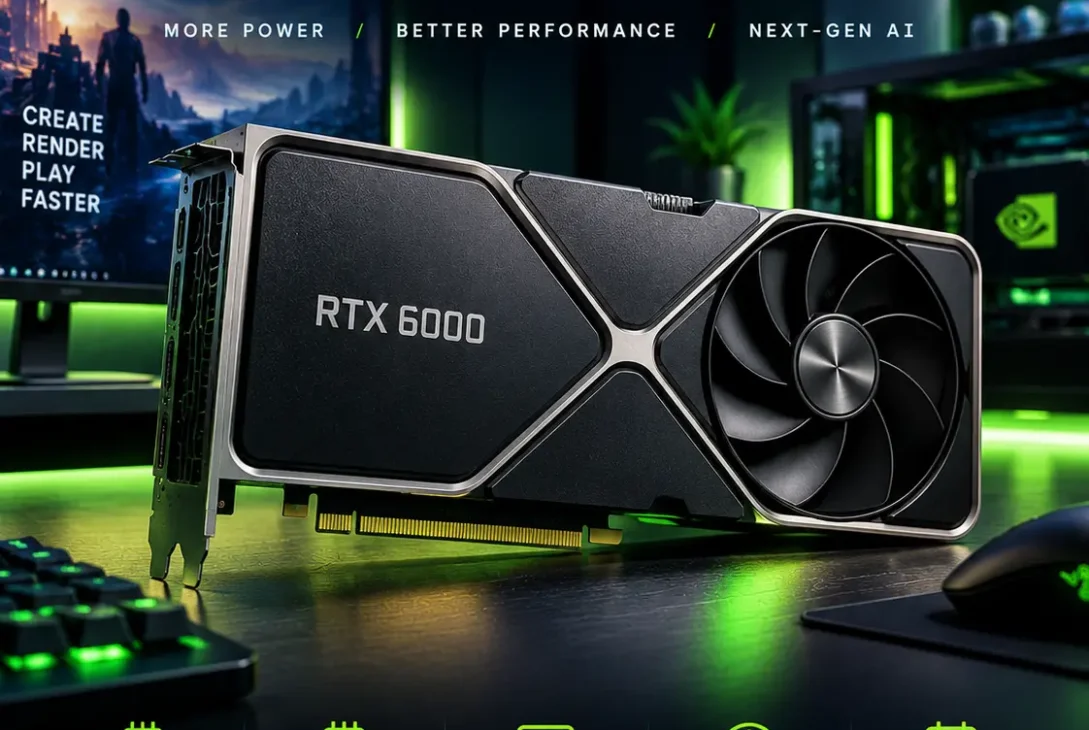
The RTX 6000 series release date has become one of the biggest questions among PC gamers and hardware enthusiasts waiting for NVIDIA’s next-generation GeForce graphics cards. NVIDIA’s current consumer generation is the GeForce RTX 50 series, based on the Blackwell architecture, but attention has already shifted toward what comes next.
As of September 2026, NVIDIA has not officially announced a GeForce RTX 6000 series, its final specifications, or a confirmed launch date. Current reports and hardware-leaker information point toward a possible 2027 or 2028 launch, but the timeline remains uncertain.
Earlier reports suggested that the next-generation cards could arrive in the second half of 2027. More recent reporting, however, indicates that the launch could slip into 2028 because of memory supply constraints, manufacturing capacity, and NVIDIA’s focus on its data-center and AI businesses.
That uncertainty makes the RTX 6000 series release date difficult to pin down right now.
This guide explains what is known about NVIDIA’s next GeForce generation, the current release-date rumors, expected architecture, possible performance improvements, VRAM, pricing, and what buyers should know before waiting for RTX 60-series GPUs.
Table of Contents
- RTX 6000 Series Release Date: Latest Information
- Has NVIDIA Officially Confirmed RTX 6000?
- Why Is the RTX 6000 Launch Timeline Uncertain?
- What Architecture Will RTX 6000 Use?
- RTX 6000 Series Expected Performance
- Ray Tracing and Path Tracing
- Expected VRAM and Memory
- RTX 6000 Series and AI Performance
- RTX 6090 Release Date
- Expected RTX 6000 Models
- RTX 6000 Series Price Expectations
- RTX 6000 vs RTX 5000
- Should You Wait for RTX 6000?
- Frequently Asked Questions
- Conclusion
- External Links
RTX 6000 Series Release Date: Latest Information
The most important thing to understand about the RTX 6000 series release date is that there is currently no official NVIDIA date.
The latest reports have produced conflicting timelines.
Earlier in 2026, hardware leaker Kopite7kimi reportedly indicated a second-half 2027 launch window for NVIDIA’s next-generation GeForce GPUs. Another report also pointed toward 2027, with the next architecture expected to be based on NVIDIA’s Rubin technology.
However, the situation changed in September 2026.
Recent reports from TechSpot and Tom’s Hardware say Kopite7kimi now believes NVIDIA’s next-generation RTX 60 GPUs could be delayed until 2028. Another hardware leaker, Kepler_L2, has reportedly made a similar 2028 claim.
This means the current range of public reporting is roughly:
| Timeline | Status |
|---|---|
| 2026 | No longer expected based on current reporting |
| 2027 | Previously reported possibility |
| Late 2027 | Still claimed by some sources |
| 2028 | Increasingly reported by multiple leakers |
| Official date | Not announced |
So, if you are searching for the RTX 6000 series release date, the most accurate answer right now is that NVIDIA has not confirmed one, and 2028 is currently one of the strongest reported possibilities, not an official launch date.
Has NVIDIA Officially Confirmed RTX 6000?
No.
NVIDIA has not officially announced a consumer GeForce RTX 6000 series launch.
There is therefore no confirmed:
- RTX 6090 release date
- RTX 6080 release date
- RTX 6070 release date
- official RTX 6000 specifications
- official RTX 6000 pricing
- official RTX 6000 VRAM configuration
- official GeForce RTX 60 architecture announcement
This distinction is important because much of the information currently circulating comes from hardware leakers and technology publications rather than NVIDIA itself.
NVIDIA’s current officially announced consumer generation is the RTX 50 series, which the company introduced at CES 2025 using its Blackwell architecture. The RTX 5090 and RTX 5080 were scheduled for January 30, 2025, while the RTX 5070 Ti and RTX 5070 followed in February.
Until NVIDIA makes a formal announcement, every specific RTX 6000 specification or date should be treated as unconfirmed.
Why Is the RTX 6000 Launch Timeline Uncertain?
One of the major reasons behind the changing RTX 6000 series release date rumors is the rapidly growing demand for AI hardware.
NVIDIA currently serves two enormous markets: consumer graphics and data-center AI computing.
Its data-center business has become extremely important, with massive demand for AI accelerators and advanced computing hardware.
Recent reporting suggests NVIDIA may be prioritizing data-center products and manufacturing capacity, potentially affecting the timing of future consumer GPUs. Tom’s Hardware reports that limited memory and wafer supply could also contribute to delays.
Memory availability is particularly important for high-end GPUs.
Modern graphics cards require large amounts of high-speed memory, and the supply chain for advanced memory is also being heavily influenced by AI infrastructure demand.
This could help explain why multiple reports now point toward a longer wait for consumer RTX 60-series GPUs.
What Architecture Will RTX 6000 Use?
Current reports generally associate NVIDIA’s next-generation GeForce GPUs with the Rubin architecture.
However, the exact consumer branding and final architecture details have not been officially confirmed by NVIDIA.
NVIDIA introduced Blackwell with the RTX 50 series. The company says Blackwell-powered GeForce GPUs introduced new AI rendering technologies, fifth-generation Tensor Cores, fourth-generation RT Cores, DLSS 4, and neural rendering capabilities.
The next generation is expected to build on that direction.
Some reports and leaks refer to next-generation gaming GPUs using internal names associated with the Rubin generation. However, leaked architecture information should not be confused with an official NVIDIA specification sheet.
For now, the safest expectation is that RTX 6000 will represent a major architectural step beyond Blackwell, but the final consumer architecture details remain unknown.
RTX 6000 Series Expected Performance
Performance is probably the biggest reason gamers are interested in the RTX 6000 series release date.
Although NVIDIA has not published official benchmarks, several unofficial reports have suggested significant improvements in ray tracing and path tracing.
One leaked report has claimed that next-generation GPUs could potentially deliver around twice the path-tracing performance of the RTX 50 series, while conventional rasterization gains could be considerably smaller. These figures are unverified and should not be treated as confirmed performance targets.
That distinction is important.
A graphics card can become dramatically faster in ray tracing without delivering the same percentage increase in traditional rasterized games.
The actual gaming experience will depend on:
- GPU architecture
- shader performance
- clock speeds
- memory bandwidth
- VRAM capacity
- cache design
- driver optimization
- DLSS and frame-generation technology
- game-engine support
Until NVIDIA releases real hardware and independent benchmarks, performance claims should remain speculative.
Ray Tracing and Path Tracing
Ray tracing has become one of NVIDIA’s major areas of development.
The RTX 50 series already uses dedicated RT cores and AI-powered technologies to improve ray-traced graphics. NVIDIA has also introduced neural rendering features designed to make advanced lighting techniques more practical in games.
The next generation could continue this trend.
Some leaked information suggests that RTX 6000 may focus heavily on improving path tracing performance. If accurate, this could be particularly important for games using fully or heavily path-traced lighting.
However, gamers should not assume that every game will automatically become twice as fast.
Performance improvements depend on the specific rendering workload and whether a game supports technologies such as DLSS.
Expected VRAM and Memory
VRAM will likely be one of the most closely watched RTX 6000 specifications.
The RTX 50 series already introduced high-memory configurations, including the RTX 5090 with 32GB of GDDR7. NVIDIA’s official specifications list the RTX 5090 as a 32GB GDDR7 graphics card.
For RTX 6000, higher VRAM capacities are possible, but there is currently no official confirmation.
Potentially larger memory configurations would benefit:
- 4K gaming
- 8K workloads
- AI applications
- 3D rendering
- video production
- large texture packages
- local AI models
- professional creative applications
However, more VRAM alone does not guarantee better gaming performance.
Memory bandwidth, GPU processing power, architecture, and software optimization all matter.
RTX 6000 Series and AI Performance
AI is expected to remain an important part of NVIDIA’s next-generation consumer GPUs.
The RTX 50 series already includes hardware specifically designed for AI workloads. NVIDIA says its Blackwell consumer GPUs support FP4 precision and can accelerate generative AI workloads locally.
The RTX 6000 generation could push local AI performance even further.
For PC users, that could mean faster:
- AI image generation
- local language models
- video upscaling
- AI-assisted editing
- 3D generation
- neural rendering
- voice processing
- creative applications
This is becoming increasingly important because GPUs are no longer used only for traditional gaming.
The same graphics card can now be used for gaming, content creation, AI development, and local generative AI.
RTX 6090 Release Date
The RTX 6090 is expected to be the flagship consumer GPU if NVIDIA follows its previous naming strategy.
However, there is currently no official RTX 6090 launch date.
Some reports previously suggested that NVIDIA could introduce a next-generation flagship as early as 2027. One current leak even continues to argue for a 2027 launch, while other prominent reporting now points toward 2028.
This disagreement shows why it would be premature to state a specific RTX 6090 release date as fact.
The eventual launch could also happen in stages.
NVIDIA may introduce the flagship model first and release additional GPUs later, similar to previous GeForce generations.
Therefore, the RTX 6090 could potentially arrive before lower-tier RTX 60-series cards, although this has not been confirmed.
Expected RTX 6000 Models
NVIDIA has not announced the official RTX 6000 lineup.
Based on the company’s historical naming strategy, enthusiasts expect cards such as:
- RTX 6090
- RTX 6080
- RTX 6070
- RTX 6060
However, these names are not confirmed.
NVIDIA could change its naming structure, introduce additional models, or launch products in a different order.
It is therefore better to view these names as expected possibilities rather than confirmed products.
The same applies to rumored specifications circulating online.
RTX 6000 Series Price Expectations
There is currently no official RTX 6000 pricing.
The RTX 50 series gives us some historical context.
NVIDIA announced the RTX 5090 at $1,999, the RTX 5080 at $999, the RTX 5070 Ti at $749, and the RTX 5070 at $549.
A future RTX 6000 generation could potentially be more expensive, similarly priced, or cheaper depending on manufacturing costs, competition, memory pricing, and market conditions.
The current memory shortage is particularly relevant because memory costs can directly affect graphics-card pricing.
For this reason, it would be misleading to give a specific RTX 6090 or RTX 6080 price today.
RTX 6000 vs RTX 5000
The RTX 50 series is currently NVIDIA’s official consumer generation.
The RTX 50 family introduced Blackwell, DLSS 4, Multi Frame Generation, neural rendering features, and improved AI performance. NVIDIA says the RTX 5090 includes 92 billion transistors and more than 3,352 trillion AI operations per second.
RTX 6000 is expected to build on this technology.
A future comparison could therefore involve improvements in:
| Feature | RTX 50 Series | RTX 6000 Series |
|---|---|---|
| Architecture | Blackwell | Expected next generation |
| AI hardware | 5th-gen Tensor Cores | Expected newer generation |
| Ray tracing | 4th-gen RT Cores | Expected improvements |
| DLSS | DLSS 4 | Expected next-generation features |
| VRAM | Up to 32GB on RTX 5090 | Unknown |
| Release | 2025 | Unconfirmed, possibly 2027–2028 |
The RTX 6000 column should be treated as an expectation rather than an official specification.
https://nvidianews.nvidia.com/news/nvidia-blackwell-geforce-rtx-50-series-opens-new-world-of-ai-computer-graphics
Should You Wait for RTX 6000?
Whether waiting makes sense depends on your current hardware and how soon you need a new GPU.
If your existing graphics card still handles your games and applications comfortably, there is little reason to upgrade simply because a new generation may eventually arrive.
On the other hand, users who currently have an older GPU and need better performance may not want to wait several years for an unconfirmed release.
The current reporting suggests that the RTX 6000 series release date could be as far away as 2028, although some sources still point toward 2027.
This makes the decision highly dependent on your current GPU, resolution, games, and workload.
For example, someone using a GTX-class GPU for modern 1440p or 4K gaming has very different requirements from someone who already owns an RTX 4080 or RTX 5090.
Frequently Asked Questions
When is the RTX 6000 series release date?
The RTX 6000 series release date has not been officially announced by NVIDIA. Recent reports increasingly point toward 2028, while some sources continue to report a possible 2027 launch.
Will RTX 6000 launch in 2027?
A 2027 launch has been reported by several hardware-leak sources, including earlier reports suggesting a second-half 2027 window. However, newer reports say the launch could slip to 2028.
Will RTX 6000 launch in 2028?
2028 is currently a significant possibility according to recent reports from multiple GPU leakers and technology publications. However, NVIDIA has not confirmed 2028 as the official launch year.
Is NVIDIA RTX 6000 officially announced?
No. NVIDIA has not officially announced a consumer GeForce RTX 6000 series, its final specifications, or a release date.
What architecture will RTX 6000 use?
Current reports associate the next-generation GeForce GPUs with NVIDIA’s Rubin architecture, but NVIDIA has not officially confirmed the final consumer architecture details.
Will there be an RTX 6090?
An RTX 6090 is widely expected to be the name of a future flagship if NVIDIA continues its current naming strategy, but the company has not officially announced the product.
How much will RTX 6000 cost?
There is currently no official pricing. NVIDIA’s current RTX 50 series launched with the RTX 5090 at $1,999, RTX 5080 at $999, RTX 5070 Ti at $749, and RTX 5070 at $549, but those prices do not guarantee what RTX 6000 will cost.
Will RTX 6000 be faster than RTX 5000?
The next generation is expected to improve performance over RTX 50-series GPUs, particularly in areas such as ray tracing and AI acceleration. However, NVIDIA has not published official RTX 6000 benchmarks, so specific performance claims remain unconfirmed.
Why might RTX 6000 be delayed?
Recent reporting points to factors including limited memory supply, manufacturing capacity, and NVIDIA’s prioritization of data-center and AI products.
Conclusion
The RTX 6000 series release date remains unconfirmed as of September 2026.
Earlier reports pointed toward a second-half 2027 launch, but newer information from multiple hardware leakers now suggests that NVIDIA’s next GeForce generation could arrive in 2028. At the same time, other sources continue to argue that some next-generation RTX hardware could appear in 2027.
What is much clearer is the direction of NVIDIA’s technology.
The RTX 50 series brought Blackwell, DLSS 4, neural rendering, improved ray tracing, and major AI capabilities to consumer graphics cards.
The next generation is expected to continue that trend, potentially delivering stronger ray tracing, path tracing, AI acceleration, and higher overall performance.
However, gamers should avoid treating leaked specifications or release windows as confirmed information.
For now, the most accurate answer to RTX 6000 series release date is simple: there is no official date yet, and current reporting ranges from 2027 to 2028, with 2028 increasingly appearing in recent reports.
As NVIDIA provides official information, the release window, specifications, pricing, and performance expectations will become much easier to determine.