
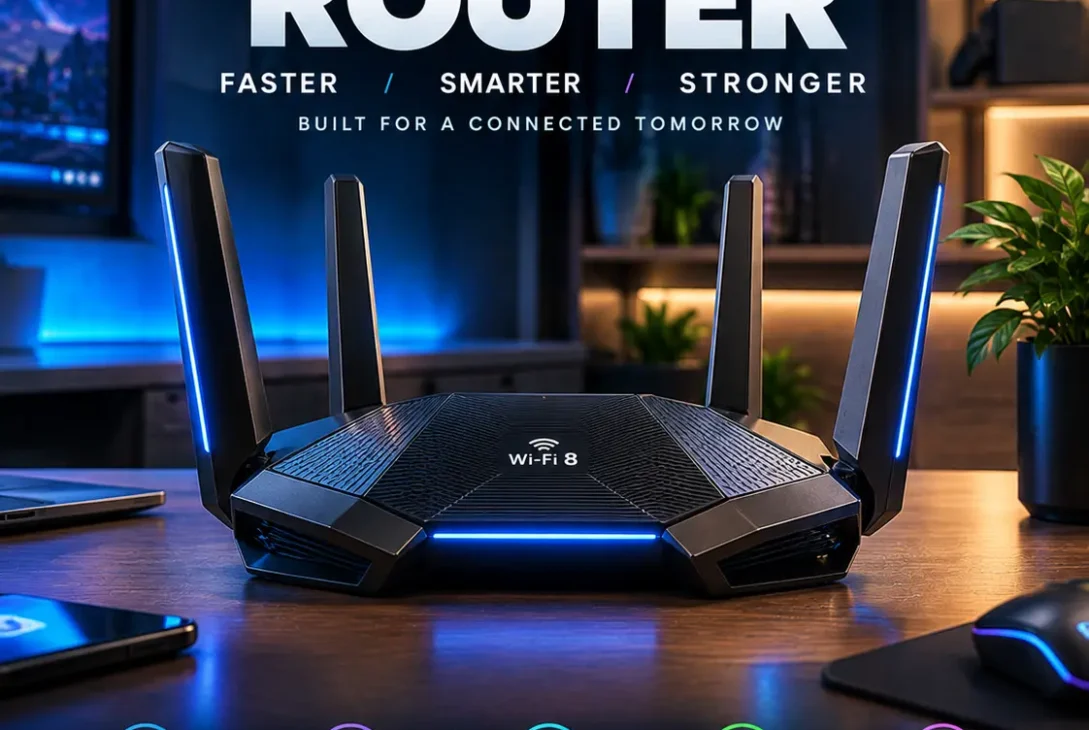
A WiFi 8 router is part of the next generation of wireless networking built around IEEE 802.11bn, a standard focused heavily on reliability, latency, mobility, and consistent performance rather than simply increasing peak speed.
Wi-Fi 7 already introduced technologies such as 320MHz channels, 4K-QAM, and Multi-Link Operation. Wi-Fi 8 takes a different approach by improving how wireless networks behave when signals are weak, networks are crowded, or devices are moving between access points.
The technology is still developing, but 2026 has already brought major Wi-Fi 8 networking platforms from companies such as Qualcomm and Broadcom. Qualcomm says commercial products using its Wi-Fi 8 platforms are expected in late 2026, while Broadcom has announced integrated Wi-Fi 8 SoCs designed specifically for routers and mesh systems.
Table of Contents
- What Is a WiFi 8 Router?
- What Is Wi-Fi 8?
- Wi-Fi 8 vs Wi-Fi 7
- Why Wi-Fi 8 Focuses on Reliability
- Key Wi-Fi 8 Features
- Multi-AP Coordination
- Seamless Roaming
- Improved Long-Range Performance
- Lower Latency
- Multi-Link Operation
- Wi-Fi 8 Speed and Bandwidth
- Wi-Fi 8 Router Availability
- Wi-Fi 8 for Gaming
- Wi-Fi 8 for Smart Homes
- Wi-Fi 8 for Mesh Networks
- Do You Need Wi-Fi 8?
- Frequently Asked Questions
- Final Verdict
- SEO Details
What Is a WiFi 8 Router?
A WiFi 8 router is a networking device designed around the technologies being developed for the Wi-Fi 8 generation, officially associated with IEEE 802.11bn.
Wi-Fi 8 is sometimes described as an “Ultra High Reliability” generation because its main objective is to make wireless connections more consistent under difficult conditions.
That means the technology isn’t simply about achieving a larger maximum number on a speed test.
Instead, Wi-Fi 8 aims to improve:
- Connection reliability
- Latency consistency
- Coverage
- Roaming
- Performance in crowded environments
- Multi-device operation
- Network coordination
- Performance at the edge of coverage
Qualcomm describes Wi-Fi 8 as a generation designed to provide faster, more responsive, and more robust connections, particularly in challenging wireless environments.
What Is Wi-Fi 8?
Wi-Fi 8 is the next major generation of Wi-Fi technology following Wi-Fi 7.
The underlying IEEE project is 802.11bn, and the standard is still progressing through the development process.
Unlike earlier generations that placed substantial emphasis on peak throughput, Wi-Fi 8 places more attention on maintaining dependable performance.
This is important because maximum theoretical speed doesn’t always represent what users experience.
A device can be extremely fast when it is close to the router with little interference. The experience can change dramatically when the user moves to another room, several devices start transmitting simultaneously, or neighboring networks create congestion.
Wi-Fi 8 is designed to address those real-world situations.
Qualcomm’s Wi-Fi 8 documentation highlights technologies including Enhanced Long Range, Distributed Resource Units, coordinated beamforming, coordinated spatial reuse, and improved error correction.
Wi-Fi 8 vs Wi-Fi 7
Wi-Fi 7 is already a mature consumer technology, while Wi-Fi 8 is still emerging.
The biggest difference is the design priority.
Wi-Fi 7 focuses heavily on high throughput and features such as:
- 320MHz channels
- 4K-QAM
- Multi-Link Operation
- Multi-user MIMO
- OFDMA
Wi-Fi 8 retains many advanced wireless capabilities while adding technologies designed to improve reliability and coordination.
| Feature | Wi-Fi 7 | Wi-Fi 8 |
|---|---|---|
| Standard | 802.11be | 802.11bn |
| Main focus | Performance and throughput | Reliability and consistency |
| 6GHz | Supported | Supported |
| 320MHz channels | Yes | Supported |
| 4K-QAM | Yes | Supported |
| Multi-Link Operation | Yes | Supported |
| Multi-AP coordination | Limited compared with Wi-Fi 8 goals | Major focus |
| Seamless roaming | Improved | Further enhanced |
| Long-range reliability | Improved | Major focus |
| Standard status | Established | Still developing |
Wi-Fi 8 therefore shouldn’t be viewed simply as a faster version of Wi-Fi 7.
Why Wi-Fi 8 Focuses on Reliability
Wireless networking has a fundamental problem: conditions constantly change.
Walls, furniture, neighboring networks, Bluetooth devices, distance, reflections, and the number of connected clients can all influence performance.
A network that delivers excellent speeds in one room can behave differently in another.
This is why reliability is becoming increasingly important.
A WiFi 8 router is designed to work with technologies that can coordinate wireless resources more intelligently.
Qualcomm describes Wi-Fi 8 as a move toward predictable latency and consistent performance, especially for demanding applications and networks with many connected devices.
For users, that could mean fewer sudden drops in performance rather than simply a higher peak speed.
Key Wi-Fi 8 Features
Several technologies are central to the Wi-Fi 8 roadmap.
Multi-AP Coordination
One of the biggest ideas behind Wi-Fi 8 is better coordination between multiple access points.
Instead of treating every access point as an isolated wireless system, compatible equipment can coordinate transmissions more intelligently.
This can be especially useful in:
- Large homes
- Offices
- Apartment buildings
- Campuses
- Public venues
- Enterprise networks
Multi-AP coordination can help reduce interference and improve performance when several access points operate close together.
Seamless Roaming
Wi-Fi 8 also aims to improve roaming between access points.
Imagine walking through a large house while using a video call.
With traditional roaming behavior, a device may remain connected to a weaker access point longer than necessary or experience a short interruption while switching.
Wi-Fi 8 introduces technologies intended to make this transition smoother.
Qualcomm describes its Single Mobility Domain approach as a “make-before-break” roaming mechanism designed to avoid the sticky-client problem.
Improved Long-Range Performance
Wi-Fi 8 also introduces technologies intended to improve performance at the edge of wireless coverage.
One example is Enhanced Long Range, or ELR.
Another is Distributed Resource Units, which can help improve connectivity for low-power client devices.
These technologies are designed to make connections more useful when devices aren’t sitting directly beside the access point.
https://www.qualcomm.com/wi-fi/wi-fi-8
Lower Latency
Gaming, video conferencing, cloud applications, augmented reality, and other interactive services benefit from stable latency.
Peak bandwidth is useful, but latency spikes can still cause noticeable problems.
Wi-Fi 8’s reliability-focused approach aims to make latency more predictable.
Qualcomm’s networking platforms include support for technologies such as Coordinated Time Division Multiple Access and Low Latency, Low Loss, Scalable Throughput.
Multi-Link Operation
Multi-Link Operation, or MLO, is already one of Wi-Fi 7’s important technologies, and it remains relevant in Wi-Fi 8.
MLO allows compatible devices to use multiple wireless links instead of relying on a single connection path.
Depending on the implementation, this can improve throughput, reliability, or latency.
Broadcom’s Wi-Fi 8 access-point hardware lists MLO support across wireless bands alongside OFDMA and MU-MIMO.
This is particularly useful in modern homes where many devices compete for wireless capacity.
Wi-Fi 8 Speed and Bandwidth
One common question is whether Wi-Fi 8 will be dramatically faster than Wi-Fi 7.
The answer is more complicated than simply comparing maximum theoretical numbers.
Wi-Fi 8 platforms can still support extremely high PHY rates.
For example, Qualcomm’s N8 platform advertises up to 23Gbps of peak wireless capacity, while its higher-end NPro A8 Elite platform advertises up to 33Gbps. These are platform-level theoretical PHY figures rather than speeds a normal household device should expect from a single connection.
Real-world speeds depend on:
- Client hardware
- Number of antennas
- Channel width
- Distance
- Interference
- Router configuration
- Internet connection
- Ethernet backhaul
- Network congestion
Therefore, buying a router with a large theoretical speed number doesn’t guarantee that an individual smartphone or laptop will reach that number.
Wi-Fi 8 Router Availability
The consumer market is still at an early stage.
In March 2026, Qualcomm announced its Wi-Fi 8 networking portfolio and said its platforms were already sampling to customers, with commercial products expected in late 2026.
Broadcom also announced Wi-Fi 8 SoCs specifically designed for high-performance Ethernet routers and mesh networks in May 2026.
This means the ecosystem is moving from chipset development toward actual consumer networking products.
However, buyers should carefully check whether a product is based on final Wi-Fi 8 specifications or on draft implementations.
The 802.11bn standard is still being developed, so early hardware may not represent the final capabilities of the completed specification.
Wi-Fi 8 for Gaming
Gaming is one area where Wi-Fi 8’s reliability improvements could matter.
Online gaming doesn’t necessarily require enormous bandwidth.
A typical game may use considerably less bandwidth than a 4K video stream, but latency and connection stability are extremely important.
A WiFi 8 router could be useful for gaming households where many devices are active simultaneously.
For example:
- One person is gaming
- Another is streaming 4K video
- Several phones are connected
- Smart-home devices are active
- A computer is uploading files
A network optimized for consistency can potentially handle these situations better than one focused primarily on peak throughput.
For competitive gaming, wired Ethernet will still remain an excellent option whenever practical.
Wi-Fi 8 for Smart Homes
Modern homes can contain dozens of connected devices.
These may include:
- Security cameras
- Smart speakers
- TVs
- Phones
- Tablets
- Laptops
- Smart lighting
- Thermostats
- Appliances
- Game consoles
- Sensors
The number of connected devices makes efficient wireless coordination increasingly important.
Wi-Fi 8’s improvements are therefore relevant not only to computers and smartphones but also to the broader smart-home ecosystem.
Wi-Fi 8 for Mesh Networks
Mesh networking is another area where Wi-Fi 8 could have a major impact.
A mesh system uses multiple access points to provide wireless coverage across a larger area.
The challenge is coordinating those access points without creating unnecessary interference.
Wi-Fi 8’s emphasis on multi-AP coordination and roaming directly addresses this problem.
Qualcomm has already positioned its Wi-Fi 8 platforms for home routers and whole-home mesh systems. Its N8 platform supports tri-band configurations and up to 14 antennas, depending on implementation.
Higher-end platforms can support even more complex configurations.
Do You Need Wi-Fi 8?
For most people, there is no urgent reason to replace a modern Wi-Fi 6 or Wi-Fi 7 router solely because the next generation is arriving.
If your current network provides:
- Stable coverage
- Good speeds
- Low latency
- Reliable roaming
- Enough capacity for your devices
then upgrading may not provide a dramatic improvement immediately.
A Wi-Fi 8 upgrade becomes more interesting when you have a demanding environment with many devices, multiple access points, heavy wireless traffic, or a need for improved reliability.
It is also worth remembering that both the router and client device need compatible technology to take advantage of new features.
A Wi-Fi 8 access point cannot magically turn an older Wi-Fi 5 laptop into a Wi-Fi 8 client.
Frequently Asked Questions
What is a WiFi 8 router?
A WiFi 8 router is a networking device designed around Wi-Fi 8 technologies associated with IEEE 802.11bn. The generation emphasizes reliability, lower latency, roaming, and coordinated wireless performance.
Is Wi-Fi 8 faster than Wi-Fi 7?
Wi-Fi 8 can support very high theoretical throughput, but its main goal is improved reliability and consistency rather than simply maximizing peak speed.
When will Wi-Fi 8 routers be available?
Commercial Wi-Fi 8 products are expected to begin appearing in late 2026. Qualcomm said its Wi-Fi 8 platforms were sampling to customers and that commercial products were expected later in 2026.
What is 802.11bn?
802.11bn is the IEEE project associated with Wi-Fi 8. The technology is commonly described as focusing on Ultra High Reliability.
Does Wi-Fi 8 support 6GHz?
Yes. Wi-Fi 8 platforms can support the 2.4GHz, 5GHz, and 6GHz bands depending on the hardware configuration.
Will Wi-Fi 8 improve gaming?
It can potentially improve gaming consistency by focusing on latency, interference management, and reliability. However, actual performance depends on the router, gaming device, network conditions, and internet connection.
Will Wi-Fi 8 improve range?
Wi-Fi 8 includes technologies such as Enhanced Long Range that are designed to improve performance at the edge of wireless coverage. Actual range still depends heavily on the environment and hardware.
Is Wi-Fi 8 worth waiting for?
If your current router works well, there is usually no need to upgrade immediately. People buying a new premium router in late 2026 may want to consider Wi-Fi 8 products as they become available.
Will Wi-Fi 7 devices work with Wi-Fi 8?
Wi-Fi generations are designed with backward compatibility in mind, but advanced Wi-Fi 8 features require compatible client hardware. A Wi-Fi 7 device won’t automatically gain every Wi-Fi 8 capability.
Will Wi-Fi 8 replace Ethernet?
No. Ethernet will remain valuable for desktops, gaming PCs, servers, and other devices where maximum stability and predictable latency are important.
Final Verdict
A WiFi 8 router represents a shift in wireless networking priorities.
Instead of focusing only on higher theoretical speeds, Wi-Fi 8 is being developed around reliability, latency consistency, multi-access-point coordination, improved roaming, and better performance in challenging environments.
The technology is particularly interesting for large homes, mesh networks, businesses, gaming environments, and households with many connected devices.
The hardware ecosystem is also beginning to take shape. Qualcomm has announced networking platforms designed for premium home routers and mesh systems, while Broadcom has introduced integrated Wi-Fi 8 SoCs for next-generation router hardware.
However, Wi-Fi 8 is still an emerging standard, and commercial products are only beginning to arrive.
If your current Wi-Fi 6 or Wi-Fi 7 network works well, there is little reason to upgrade immediately. But if you’re planning a new premium network in late 2026 or beyond, Wi-Fi 8 could become an important option as compatible routers and client devices become more widely available.