
Introduction
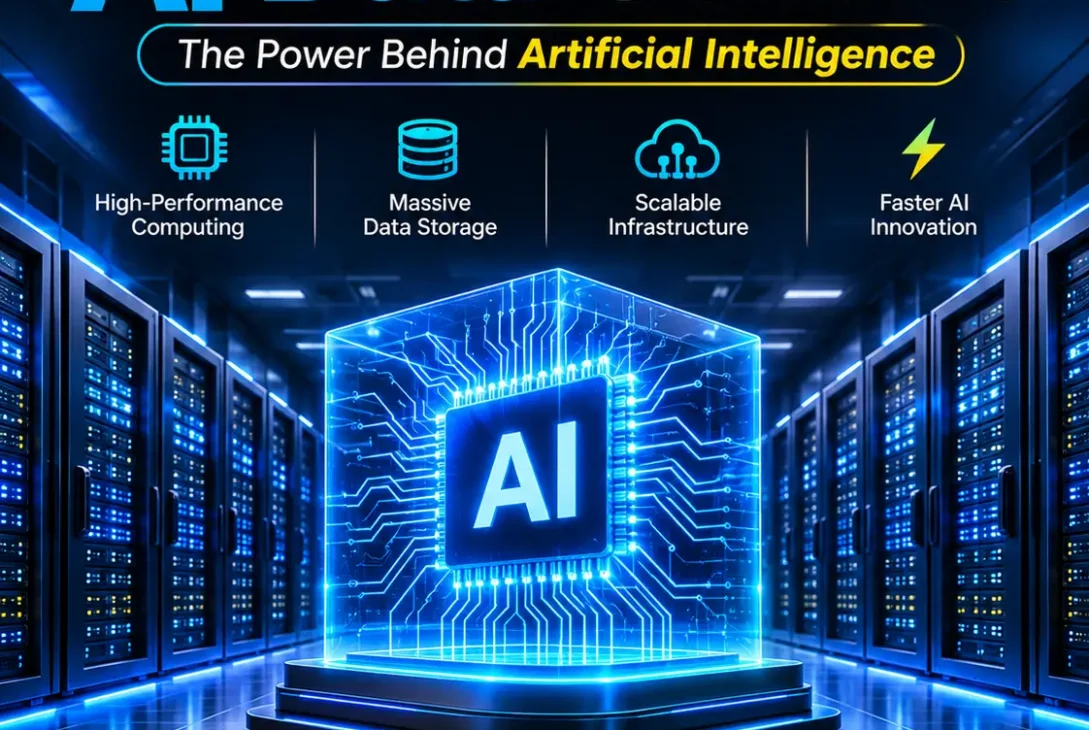
Artificial intelligence is changing how people work, communicate, search for information, create content, and run businesses. Behind every AI chatbot, image generator, recommendation system, and advanced machine learning application is a large amount of computing infrastructure. Much of this work happens inside specialized facilities known as AI data centers.
Unlike a typical office server room, an AI data center is designed to handle demanding workloads that require enormous computing power, fast data movement, high-capacity storage, and advanced cooling. These facilities contain powerful processors, graphics processing units (GPUs), networking equipment, and supporting systems that allow AI models to be trained and operated at scale.
The growth of generative AI has made this infrastructure increasingly important. Companies developing large language models and other AI technologies need access to thousands of interconnected processors to handle complex calculations. As AI services attract more users, the facilities supporting them must also expand.
This growth brings opportunities as well as challenges. AI data centers can support scientific research, healthcare, financial services, automation, and business innovation. However, they also require significant electricity, investment, cooling capacity, and network infrastructure.
So, what is an AI data center, how does it work, and why are technology companies investing so heavily in them?
This guide explains the technology, major components, practical applications, advantages, disadvantages, energy requirements, and future of AI data centers.
Table of Contents
- What Is an AI Data Center?
- How Does an AI Data Center Work?
- AI Data Center vs Traditional Data Center
- 11 Key Components of an AI Data Center
- What Are AI Data Centers Used For?
- Why Are AI Data Centers Growing?
- Electricity Consumption and Cooling Challenges
- Benefits of AI Data Centers
- Challenges and Disadvantages
- Who Builds and Operates AI Data Centers?
- What Is the Future of AI Data Centers?
- Frequently Asked Questions
- Final Verdict
What Is an AI Data Center?
An AI data center is a specialized facility that contains the computing hardware, software, networking equipment, storage systems, power infrastructure, and cooling technology needed to run artificial intelligence workloads.
Its main purpose is to provide the computing resources required to develop, train, fine-tune, and operate AI models.
A conventional data center can host websites, business applications, databases, email systems, and cloud services. An AI data center performs many of these functions too, but it is designed to handle more demanding computational workloads.
For example, training a large language model involves processing enormous datasets and performing complex mathematical calculations across many processors. Answering questions through an AI assistant also requires computing resources, although the workload is different from training.
An AI data center uses specialized hardware and high-speed connections to coordinate these operations.
These facilities may be owned by large technology companies, cloud providers, research institutions, or specialist infrastructure operators. Businesses can also rent computing capacity instead of building their own facilities.
In simple terms, an AI data center is the physical infrastructure that helps artificial intelligence systems learn, process information, and deliver results.
https://www.ibm.com/think/topics/ai-data-center
How Does an AI Data Center Work?
An AI data center works by combining computing resources, data storage, networking, and power systems into one coordinated environment.
When an AI model receives a request, the system processes the input, performs the required calculations, and returns a result. The exact process depends on whether the workload involves training, fine-tuning, or inference.
AI Model Training
Training is the process of teaching an AI model to identify patterns and produce useful outputs from data.
A training workload may involve:
- Collecting and preparing large datasets.
- Storing the data in accessible storage systems.
- Distributing calculations across multiple GPUs or AI accelerators.
- Processing the data through the model.
- Updating model parameters based on training results.
- Repeating the process until the model reaches the desired performance.
Large training workloads can involve thousands of accelerators working together. High-speed networking is essential because processors need to exchange information efficiently.
AI Inference
Inference happens when a trained AI model is used to generate an answer, prediction, image, classification, or other result.
For example, when someone asks an AI chatbot a question, the model processes the input and generates a response. This is an inference workload.
Inference can take place in a large cloud data center, a smaller local facility, or on an edge device, depending on the application and hardware.
Data Processing and Storage
AI systems need access to large amounts of information. Data centers use storage systems to hold training datasets, model files, application data, and generated outputs.
Fast storage and networking help prevent processors from waiting too long for information.
The entire infrastructure must work together. Powerful GPUs alone cannot deliver good performance if the network, storage, power, or cooling systems become bottlenecks.
AI Data Center vs Traditional Data Center
Both types of facilities contain servers, storage systems, networking equipment, power distribution, and cooling. The main difference is the workloads they are designed to support.
Traditional data centers commonly host websites, databases, enterprise applications, and general-purpose cloud services. AI data centers are optimized for the intensive parallel computing and high data throughput required by machine learning.
| Feature | AI Data Center | Traditional Data Center |
|---|---|---|
| Main purpose | AI training and inference | General computing and hosting |
| Processors | GPUs and AI accelerators, alongside CPUs | Often CPU-focused |
| Networking | High-speed, low-latency interconnects | Conventional data center networking |
| Cooling | Often advanced air or liquid cooling | Commonly air-based, depending on design |
| Power density | Often higher | Varies by workload |
| Storage | Optimized for large AI datasets and model access | General application and business storage |
| Workloads | Machine learning and generative AI | Websites, databases, cloud applications |
The distinction is not absolute. Modern facilities can support both traditional computing and AI workloads. Some operators upgrade existing data centers, while others build facilities specifically for high-density AI infrastructure.
11 Key Components of an AI Data Center
An AI data center is made up of several interconnected systems. Each component plays a role in delivering reliable computing performance.
1. Graphics Processing Units (GPUs)
GPUs are among the most important components in modern AI infrastructure.
Originally developed to accelerate graphics processing, GPUs are also well suited to the parallel mathematical operations used in machine learning and deep learning.
Instead of performing one operation at a time like many traditional CPU workloads, GPUs can process large numbers of calculations simultaneously. This makes them useful for training and running complex AI models.
Companies such as NVIDIA and AMD develop GPUs and accelerators used in data center environments. The exact hardware depends on the operator’s workload, performance requirements, and budget.
A large AI data center may contain thousands of GPUs distributed across many servers and racks.
2. AI Accelerators and Specialized Chips
Not every AI workload needs a general-purpose GPU. Some data centers also use specialized processors designed specifically for machine learning operations.
These include:
- Tensor Processing Units (TPUs)
- Neural Processing Units (NPUs)
- Application-specific integrated circuits (ASICs)
- Other machine learning accelerators
Specialized chips can be designed to perform particular AI calculations efficiently.
For example, Google develops TPUs for machine learning workloads. Other technology companies develop their own silicon to optimize performance, cost, and energy use.
The choice of accelerator depends on the model, software environment, availability, and performance requirements.
3. Central Processing Units (CPUs)
CPUs remain important even in facilities built around GPUs.
They handle general-purpose computing tasks, manage operating systems, coordinate applications, and support data processing.
In an AI server, the CPU often works alongside accelerators. It helps prepare data, manage workloads, and coordinate operations between different system components.
A well-designed AI infrastructure needs a balance of CPUs, GPUs, memory, storage, and networking.
4. High-Speed Networking
AI models often require many processors to work together. These processors need to exchange data quickly and reliably.
High-speed networking connects servers, storage systems, and accelerator clusters. Technologies such as InfiniBand and high-performance Ethernet are used in demanding AI environments.
Network performance matters because slow communication can reduce the efficiency of an entire computing cluster.
For large training jobs, the network must support high bandwidth and low latency so that processors can coordinate their calculations without unnecessary delays.
5. High-Capacity Storage Systems
AI data centers need storage for training datasets, model checkpoints, application information, and generated results.
Storage systems must provide enough capacity while delivering data quickly to the computing hardware.
Depending on the workload, operators may use NVMe SSDs, high-performance storage arrays, parallel file systems, and other storage technologies.
For example, a model-training system may repeatedly access large datasets during training. Slow storage can create bottlenecks and leave expensive accelerators waiting for data.
6. High-Bandwidth Memory
Memory is another critical part of AI computing.
Modern AI accelerators use high-bandwidth memory (HBM) to move data between the processor and its memory at very high speeds.
Large AI models may require substantial memory capacity to hold model parameters, intermediate calculations, and other data.
Memory availability can affect the size of models that a system can run efficiently, the number of users it can serve, and the performance of training and inference workloads.
HBM is a specialized component, and its production capacity can influence the availability and cost of advanced AI hardware.
7. Cooling Systems
AI processors generate considerable heat, particularly when operating at high utilization.
Cooling systems remove heat from servers and other equipment to keep temperatures within safe operating limits.
Common approaches include:
- Air cooling: Uses fans and airflow to move heat away from equipment.
- Direct-to-chip liquid cooling: Circulates coolant through cold plates attached to high-heat components.
- Immersion cooling: Places compatible computing hardware in a specially designed dielectric fluid.
The appropriate solution depends on server design, rack power density, facility layout, and operating requirements.
As AI hardware becomes more powerful, cooling is becoming a major design consideration for new data centers.
8. Power Distribution and Backup Systems
An AI data center needs a reliable supply of electricity.
Power infrastructure includes electrical connections, transformers, switchgear, distribution units, and other equipment that delivers electricity to servers and cooling systems.
Facilities also need backup arrangements to handle interruptions. These may include uninterruptible power supplies (UPS), batteries, and backup generators.
Power reliability is essential because unexpected outages can interrupt AI workloads, affect cloud services, and potentially damage operations.
9. Server Racks and Physical Infrastructure
Servers, switches, accelerators, and storage equipment are installed in racks inside the data center.
An AI rack may contain many high-performance components and require more electricity and cooling than a typical general-purpose server rack.
Facility design must account for equipment weight, airflow, cable management, electrical distribution, maintenance access, and physical security.
Rack layout also affects how easily operators can expand the system.
10. Software and Orchestration Platforms
Hardware is only one part of an AI data center. Software is needed to manage computing resources and coordinate workloads.
Common software layers include:
- Operating systems and server management tools
- AI frameworks such as PyTorch and TensorFlow
- Container platforms and orchestration systems
- GPU drivers and accelerator libraries
- Workload scheduling and monitoring software
- Security and access management tools
These technologies help organizations allocate computing resources, monitor performance, deploy models, and manage applications.
Without suitable software, even expensive hardware may not be used efficiently.
11. Security and Monitoring Systems
AI data centers store sensitive information and operate valuable computing infrastructure. Security must cover both digital systems and the physical facility.
Digital protections can include access controls, network segmentation, encryption, authentication, vulnerability management, and continuous monitoring.
Physical security may include controlled entry, surveillance, environmental monitoring, and restricted access to server areas.
Operators also monitor temperature, power consumption, network activity, hardware health, and application performance.
These systems help detect problems before they cause major service interruptions.
What Are AI Data Centers Used For?
AI data centers support a wide range of applications across industries. Their role is not limited to chatbots or generative AI tools.
Generative AI and Chatbots
AI assistants use data center infrastructure to process user prompts and generate responses.
Text generation, image creation, speech processing, and video generation can all require substantial computing resources.
Large-scale AI services rely on data centers to serve many users at the same time.
Healthcare and Medical Research
AI can help researchers analyze medical images, study biological data, and investigate potential treatments.
Data centers provide the computing resources needed to process large datasets and run complex models.
AI systems can support healthcare professionals, but their outputs require appropriate validation and human oversight.
Financial Services
Banks and financial institutions use machine learning for fraud detection, risk analysis, customer support, and transaction monitoring.
AI infrastructure helps process large volumes of information and identify patterns that may be difficult to detect manually.
Autonomous Vehicles
Self-driving technology uses AI to interpret camera feeds, sensor information, road conditions, and surrounding objects.
Data centers support model training, simulation, and analysis. Vehicles also require onboard computing to make decisions while operating.
Scientific Research
Researchers use AI and high-performance computing to analyze complex scientific problems.
Applications include weather forecasting, climate research, drug discovery, materials science, astronomy, and genomics.
Business Automation
Companies use AI systems to automate document processing, customer support, data analysis, software development, and internal workflows.
Data centers provide the infrastructure required to operate these services at scale.
Why Are AI Data Centers Growing?
The growth of AI data centers is closely connected to the increasing use of machine learning and generative AI.
Several factors are contributing to this expansion.
Growing Demand for Generative AI
AI assistants, image generators, coding tools, and business automation platforms are attracting more users.
As usage increases, providers need more computing capacity to serve requests and maintain acceptable response times.
Larger and More Capable Models
Advanced AI models can require more processing power, memory, and data movement than simpler systems.
Training and serving these models can involve large clusters of interconnected accelerators.
AI Agents and More Complex Workloads
AI agents can perform multi-step tasks, use tools, search information, and interact with other applications.
These workflows may require more computing than a simple text question because the system can perform several operations before completing a task.
Cloud Computing Expansion
Cloud providers offer access to AI infrastructure without requiring every business to purchase its own servers.
This allows organizations to rent GPUs and other resources when needed, while infrastructure providers expand their facilities to meet demand.
Competition Between Technology Companies
Major technology companies are investing in computing infrastructure to develop AI models, provide cloud services, and compete in the growing AI market.
The International Energy Agency reported that electricity consumption from data centers increased by 17% in 2025, while AI-focused data centers grew even faster. Its 2026 analysis also projects that total data center electricity consumption could roughly double between 2025 and 2030. <Cite refs={[“turn361444search0″,”turn361444search2”]}/>
Electricity Consumption and Cooling Challenges
Electricity is one of the biggest challenges associated with AI data centers.
Powerful processors, high-speed networking equipment, storage systems, and cooling infrastructure all require electricity. As facilities become larger and server racks become more power-dense, operators need to secure reliable energy supplies.
The International Energy Agency estimated that data centers consumed around 415 terawatt-hours of electricity in 2024, approximately 1.5% of global electricity consumption that year. Its later analysis reported further growth in 2025. <Cite refs={[“turn361444search1″,”turn361444search0”]}/>
Why Do AI Data Centers Use So Much Electricity?
AI workloads can keep large numbers of processors active for extended periods.
Training a model may require repeated calculations across thousands of accelerators. Inference services must also remain available to respond to user requests.
Cooling adds another layer of electricity demand because heat must be removed from servers and other equipment.
Water and Cooling Considerations
Some cooling systems use water directly or indirectly. The amount depends on the facility’s design, climate, cooling technology, and operating conditions.
Water use can become an important local concern, particularly in regions where water resources are limited.
Operators may explore closed-loop liquid cooling, air-based systems, recycled water, and other approaches to improve efficiency.
Renewable Energy and Grid Capacity
Technology companies are exploring renewable electricity agreements, energy storage, nuclear power, and other energy sources to support growing data center demand.
However, connecting a large facility to the electricity grid can take time. Power equipment, transformers, permits, and transmission capacity may all affect construction schedules.
The challenge is not simply generating more electricity. Facilities also need dependable power at the right location and time.
Benefits of AI Data Centers
AI data centers provide several important benefits to technology companies, businesses, researchers, and consumers.
Faster AI Processing
Specialized accelerators and high-speed networking allow large AI workloads to run more efficiently than they would on ordinary computers.
Support for Innovation
Researchers and developers can use large computing clusters to experiment with more advanced models and applications.
Scalable Computing Resources
Cloud-based AI infrastructure allows businesses to access additional computing capacity without building their own data centers.
Improved Business Productivity
AI services can help automate repetitive work, analyze information, support customer service, and assist with software development.
Scientific and Medical Progress
High-performance computing can support research involving complex datasets, simulations, and scientific models.
Centralized Infrastructure Management
Large facilities allow operators to manage computing resources, security, maintenance, and energy systems in a coordinated environment.
Challenges and Disadvantages
Despite their benefits, AI data centers introduce several technical, financial, and environmental challenges.
High Construction Costs
Building an AI data center requires significant investment in land, buildings, processors, networking equipment, power systems, and cooling infrastructure.
Advanced GPUs and memory components can also be expensive and difficult to obtain.
High Electricity Demand
Large AI workloads can consume substantial amounts of electricity. This can place pressure on local power infrastructure and increase operating costs.
Cooling Complexity
High-density computing equipment generates heat that must be removed reliably. Cooling systems add engineering complexity and operating expenses.
Hardware Supply Constraints
Advanced accelerators, high-bandwidth memory, transformers, and networking equipment depend on specialized supply chains.
Limited manufacturing capacity can delay projects and increase costs.
Environmental Impact
The environmental impact of an AI data center depends on its electricity sources, water use, equipment lifecycle, construction, and operating efficiency.
Using renewable electricity and more efficient cooling can reduce some impacts, but they do not automatically eliminate them.
Security and Privacy Risks
Data centers may process sensitive personal, business, or research information. Weak security controls can expose valuable data to unauthorized access or cyberattacks.
Operators need strong security policies, continuous monitoring, and appropriate data governance.
Who Builds and Operates AI Data Centers?
Several types of organizations participate in the AI data center industry.
Hyperscale Cloud Providers
Large cloud companies build and operate extensive data center networks. They provide computing resources, storage, and AI services to businesses and developers.
Examples include:
These platforms allow customers to access AI computing resources without owning the physical infrastructure.
AI Hardware Companies
Companies such as <Entity value=”NVIDIA” category=”company”/> develop processors, networking technologies, and software used in AI infrastructure.
Hardware providers work with cloud companies and data center operators to support increasingly demanding AI workloads.
Specialist Data Center Operators
Some companies specialize in building, leasing, and operating data center facilities. They may provide space, power, cooling, connectivity, and related services to technology businesses.
AI Model Developers
Organizations developing large AI models need access to significant computing capacity. Some rent infrastructure from cloud providers, while others work with specialist operators or invest in dedicated facilities.
What Is the Future of AI Data Centers?
AI data centers are likely to become an increasingly important part of the digital economy.
As AI models become more capable and applications become more widespread, infrastructure providers will need to improve computing performance, energy efficiency, storage, and networking.
More Efficient AI Chips
Hardware companies are developing new processors and accelerators to improve performance while managing power consumption.
Better performance per watt could help operators complete more computing work with less electricity.
Wider Adoption of Liquid Cooling
As rack power density increases, liquid cooling is likely to play a larger role in advanced facilities.
Direct-to-chip cooling and other liquid-based systems can help remove heat from high-performance components.
AI Factories
The term AI factory is increasingly used to describe data center infrastructure designed to produce AI outputs at scale.
These facilities combine accelerators, networking, storage, software, and power systems into an integrated computing environment.
More Distributed Infrastructure
Not every AI task needs to run in a huge centralized facility. Some workloads can be processed closer to users through edge computing.
A distributed approach can reduce latency and support applications that require fast local responses.
Greater Focus on Energy Efficiency
Energy efficiency will become an important part of data center planning. Operators will need to consider power consumption, cooling design, grid capacity, renewable energy, and equipment utilization.
The future of AI data centers will depend not only on how much computing power companies can build, but also on how efficiently and responsibly they operate it.
Frequently Asked Questions
1. What is an AI data center in simple words?
An AI data center is a specialized building filled with powerful computers, GPUs, storage systems, and networking equipment. It provides the computing power needed to train and run artificial intelligence models.
2. How is an AI data center different from a normal data center?
A traditional data center supports general computing tasks such as websites, databases, and business applications. An AI data center is optimized for demanding machine learning workloads using specialized processors, high-speed networking, and advanced cooling.
3. Why do AI data centers need GPUs?
GPUs can perform many mathematical calculations in parallel, making them useful for training and running machine learning models. They help process the large workloads involved in modern AI applications.
4. Do AI data centers use a lot of electricity?
Yes. AI data centers can consume significant electricity because their processors, networking systems, storage equipment, and cooling infrastructure require continuous power.
5. What companies build AI data centers?
Major cloud providers, technology companies, and specialist data center operators build or operate AI infrastructure. Examples include Amazon Web Services, Microsoft Azure, Google Cloud, and other infrastructure providers.
6. What is an AI factory?
An AI factory is a term used for an integrated computing facility designed to process data and produce AI outputs at scale. It combines accelerators, storage, networking, software, power, and cooling systems.
7. Can small businesses use AI data centers?
Yes. Small businesses can access AI data center resources through cloud platforms and specialist computing providers. They generally do not need to build their own facility to use advanced AI services.
8. Are AI data centers bad for the environment?
They can create environmental challenges because of electricity consumption, cooling requirements, water use, and hardware manufacturing. Their impact depends on energy sources, efficiency, location, and facility design.
9. What is AI inference?
AI inference is the process of using a trained AI model to produce an output. When a chatbot answers a question or an image recognition system identifies an object, it is performing inference.
10. Will AI data centers continue growing?
Demand for AI computing is expected to remain an important driver of data center investment. Future growth will depend on AI adoption, hardware efficiency, energy availability, construction costs, and demand for AI services.
Final Verdict
AI data centers are the physical foundation behind many modern artificial intelligence services. They bring together powerful GPUs, specialized accelerators, high-speed networking, large storage systems, advanced cooling, and reliable power infrastructure to train and operate AI models.
Their importance is growing as businesses, researchers, and consumers adopt generative AI, machine learning, and automated applications. Cloud providers and technology companies are investing heavily because access to computing capacity has become a major competitive advantage.
However, building and operating these facilities is not simple. Electricity demand, cooling, hardware availability, construction costs, and environmental considerations all affect how quickly the industry can expand.
Understanding what an AI data center is helps explain why AI development requires much more than software. Behind every advanced AI service is a complex infrastructure system that must process information, move data, manage heat, and deliver reliable computing power.