
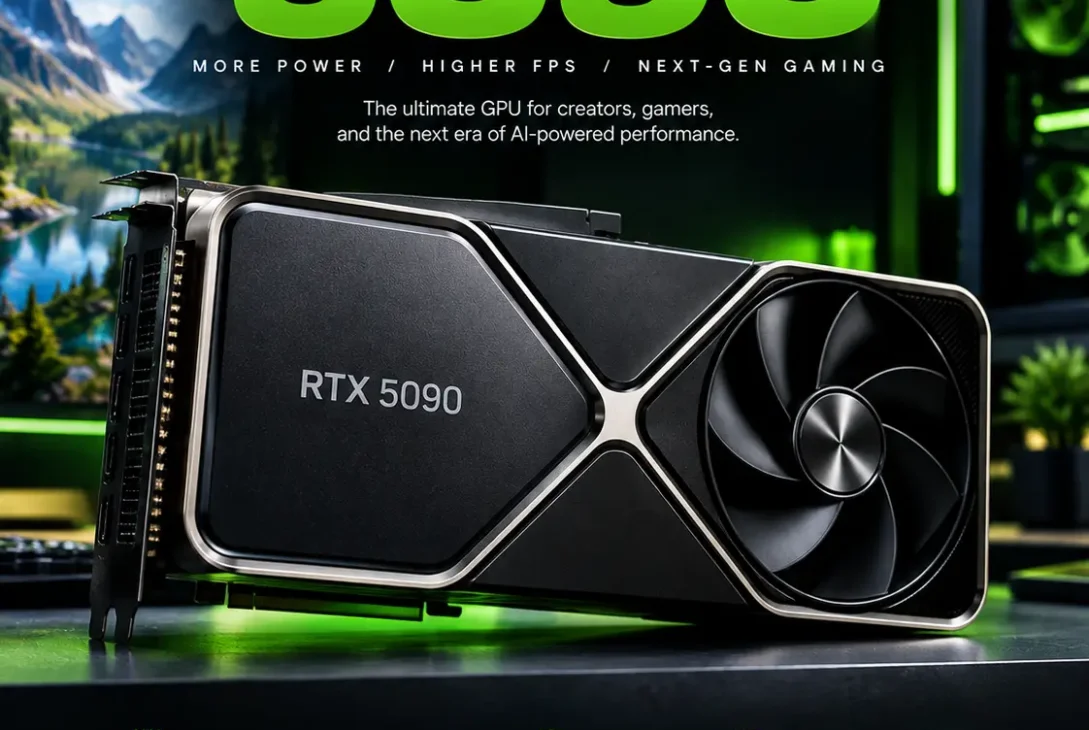
The NVIDIA GeForce RTX 5090 is NVIDIA’s flagship consumer graphics card and one of the most powerful GPUs available for gaming, artificial intelligence, 3D rendering, and demanding creative workloads. Built on the Blackwell architecture, it combines 21,760 CUDA cores, 32GB of GDDR7 memory, a 512-bit memory interface, and fourth-generation ray-tracing hardware.
The flagship was designed for users who want maximum GPU performance rather than the best budget-to-performance ratio. It targets demanding 4K gaming, advanced ray tracing, AI workloads, professional rendering, video production, and other applications that can take advantage of substantial GPU resources.
NVIDIA also introduced major AI-focused improvements with the RTX 50 series, including DLSS 4 and Multi Frame Generation. These technologies make the card particularly interesting for modern games that use neural rendering and AI-assisted performance features.
But raw performance is only part of the story. The card’s power consumption, system requirements, size, and price can make it a difficult purchase for ordinary gamers.
So, is this flagship GPU still worth buying in 2026? Let’s examine its specifications, performance, features, power requirements, competitors, and overall value.
Table of Contents
- NVIDIA GeForce RTX 5090 Overview
- NVIDIA GeForce RTX 5090 Specifications
- Blackwell Architecture
- Gaming Performance
- 4K Gaming
- Ray Tracing and DLSS 4
- AI Performance
- 32GB GDDR7 Memory
- Power Consumption and Cooling
- PC Requirements
- NVIDIA GeForce RTX 5090 vs RTX 4090
- NVIDIA GeForce RTX 5090 vs RTX 5080
- Price and Availability
- Who Should Buy It?
- Who Should Skip It?
- Frequently Asked Questions
- Final Verdict
- SEO Details
NVIDIA GeForce RTX 5090 Overview
The NVIDIA GeForce RTX 5090 sits at the top of NVIDIA’s GeForce RTX 50-series desktop lineup.
It uses the Blackwell architecture and is designed to deliver extremely high performance across both traditional rasterized graphics and ray-traced workloads.
The GPU is aimed at users who want:
- Maximum 4K gaming performance
- High-refresh-rate gaming
- Advanced ray tracing
- Local AI workloads
- Generative AI
- 3D rendering
- Video production
- Professional visualization
- Machine learning experimentation
One of its biggest advantages is the combination of raw processing power and 32GB of GDDR7 memory.
NVIDIA lists 21,760 CUDA cores, fifth-generation Tensor Cores, fourth-generation RT Cores, and up to 3,352 AI TOPS. The card also supports DLSS 4, Multi Frame Generation, Reflex 2, PCIe Gen 5, and other modern technologies.
That makes the flagship more than a conventional gaming GPU. It is also a powerful compute device for workloads that can use CUDA, Tensor Cores, or large amounts of VRAM.
NVIDIA GeForce RTX 5090 Specifications
The core specifications explain why this GPU requires such a powerful supporting system.
| Specification | RTX 5090 |
|---|---|
| Architecture | NVIDIA Blackwell |
| CUDA Cores | 21,760 |
| VRAM | 32GB GDDR7 |
| Memory Interface | 512-bit |
| Boost Clock | Up to 2.41 GHz |
| RT Cores | 4th Generation |
| Tensor Cores | 5th Generation |
| AI Performance | Up to 3,352 AI TOPS |
| Memory Bandwidth | 1,792 GB/s |
| Interface | PCIe 5.0 |
| DLSS | DLSS 4 |
| Launch MSRP | $1,999 |
The memory subsystem is particularly impressive. A 512-bit interface combined with GDDR7 gives the card 1,792 GB/s of memory bandwidth.
For comparison, many mainstream graphics cards have considerably less VRAM and memory bandwidth.
This matters when running high-resolution textures, complex 3D scenes, large AI models, or other workloads that constantly move large amounts of data between the GPU and memory.
Blackwell Architecture
The Blackwell architecture is one of the biggest changes behind the performance of the flagship.
Rather than focusing exclusively on traditional shader performance, NVIDIA designed Blackwell around a combination of graphics processing and AI acceleration.
The architecture includes improvements to:
- CUDA processing
- Ray tracing
- Tensor processing
- Neural shaders
- AI-assisted rendering
- Frame generation
- Memory performance
The fifth-generation Tensor Cores are particularly important for AI workloads.
At the same time, fourth-generation RT Cores improve the hardware’s ability to handle ray-traced lighting, reflections, shadows, and other complex effects.
This combination allows modern games to use more sophisticated rendering techniques without depending entirely on traditional rasterization.
NVIDIA GeForce RTX 5090 Gaming Performance
Gaming performance is where the flagship demonstrates its biggest advantage.
Tom’s Hardware’s 2026 GPU hierarchy ranks the RTX 5090 at the top of its tested lineup. In its native rasterization tests, it recorded an average of 203.8 FPS at 1080p Ultra, 167.3 FPS at 1440p Ultra, and 110.8 FPS at 4K Ultra.
Those figures come from a specific test suite, so they should not be treated as universal FPS numbers for every game.
Performance changes depending on:
- Game engine
- Resolution
- Graphics settings
- CPU
- Drivers
- Ray tracing
- Upscaling
- Frame generation
- Game optimization
Even so, the benchmark results demonstrate the enormous performance ceiling of the flagship.
At lower resolutions, the GPU can sometimes become limited by the CPU rather than its own rendering capability. At 4K, however, the graphics processor has considerably more work to do, allowing its additional resources to become more useful.
4K Gaming
4K gaming is one of the strongest reasons to consider this class of GPU.
At 3840 × 2160 resolution, games require significantly more graphics processing power than they do at 1080p or 1440p.
The flagship is particularly suited to users with:
- 4K 144Hz monitors
- 4K 240Hz displays
- Premium OLED gaming monitors
- Ultrawide high-resolution displays
- HDR gaming setups
Tom’s Hardware’s 2026 testing recorded 110.8 FPS at 4K Ultra in its rasterization suite, placing the card well ahead of the RTX 4090 in the same test environment.
However, not every game will reach triple-digit frame rates at maximum settings.
Extremely demanding titles with advanced ray tracing can still push the hardware hard, which is why NVIDIA’s AI-based rendering technologies remain important.
Ray Tracing and DLSS 4
Ray tracing can dramatically improve lighting and reflections, but it also requires substantial GPU resources.
The fourth-generation RT Cores in the NVIDIA GeForce RTX 5090 are designed specifically to accelerate these calculations.
Tom’s Hardware’s 2026 ray-tracing results also place the flagship at the top of its tested GPUs, with an average of 64.1 FPS at 4K in its RT test suite.
That is where DLSS becomes especially useful.
DLSS uses AI to reconstruct higher-resolution images from lower-resolution rendered frames. DLSS 4 also supports Multi Frame Generation on RTX 50-series GPUs.
Multi Frame Generation can create additional AI-generated frames between traditionally rendered frames, increasing the displayed frame rate in supported games.
NVIDIA’s official specifications list DLSS 4 support, including Super Resolution, DLAA, Ray Reconstruction, Frame Generation, and Multi Frame Generation.
The important point is that generated frames are not equivalent to additional traditionally rendered frames. The underlying rendered frame rate and system responsiveness still matter.
NVIDIA GeForce RTX 5090 for AI
The NVIDIA GeForce RTX 5090 is also designed for AI workloads.
Its fifth-generation Tensor Cores and 32GB of GDDR7 memory give developers and enthusiasts substantial local computing resources.
Potential workloads include:
- Local large language models
- AI image generation
- AI video generation
- Machine learning
- Generative AI applications
- AI-enhanced video editing
- 3D AI tools
- Neural rendering
The 32GB VRAM capacity is particularly important.
Many local AI applications become limited by available video memory rather than pure GPU speed. More VRAM allows users to load larger models or work with larger datasets without immediately moving computation to system memory.
That does not mean every AI model will run efficiently on the card. Software optimization, quantization, model architecture, and framework support still matter.
Nevertheless, 32GB makes the flagship considerably more flexible than GPUs with smaller memory configurations.
32GB GDDR7 Memory
Memory is one of the strongest specifications.
The card includes 32GB of GDDR7 connected through a 512-bit memory interface.
NVIDIA lists memory bandwidth of up to 1,792 GB/s, providing enormous data-transfer capacity for graphics and compute workloads.
For ordinary 1080p gaming, this amount of memory is excessive.
For 4K gaming, professional applications, AI, and large 3D projects, however, it provides useful headroom.
High-resolution textures can consume significant VRAM. The same applies to complex 3D scenes, large video projects, and AI models.
This is one reason the card can remain attractive to creators even when its gaming value is harder to justify.
Power Consumption and Cooling
Power consumption is one of the biggest disadvantages.
The NVIDIA GeForce RTX 5090 is an extremely powerful GPU, and systems built around it need appropriate power delivery and cooling.
Buyers should pay attention to:
- Power supply quality
- PSU capacity
- Power connectors
- Case airflow
- GPU clearance
- CPU cooling
- Motherboard compatibility
The exact PSU recommendation can vary depending on the specific card model and the rest of the PC.
A system with a high-end CPU, multiple storage drives, liquid cooling, and other power-hungry components can require considerably more power than a basic configuration.
This means the real cost of owning the flagship isn’t limited to the graphics card.
PC Requirements
A high-end GPU deserves a balanced high-end PC.
A sensible configuration could include:
CPU: Modern high-performance Ryzen or Intel processor
RAM: 32GB minimum; 64GB for demanding professional workloads
Storage: 1TB or 2TB NVMe SSD
PSU: High-quality 1,000W-class unit or higher depending on the complete system
Motherboard: Modern PCIe platform
Cooling: Strong CPU and case cooling
Monitor: 4K high-refresh display
The exact requirements depend on the rest of the system.
For example, a user who primarily plays competitive games at 1080p does not need the same configuration as someone rendering complex 3D scenes or running local AI models.
A powerful CPU is also important for avoiding CPU bottlenecks, particularly at lower resolutions.
NVIDIA GeForce RTX 5090 vs RTX 4090
The RTX 4090 remains a powerful graphics card, but the newer flagship provides significant hardware improvements.
| Feature | RTX 5090 | RTX 4090 |
|---|---|---|
| Architecture | Blackwell | Ada Lovelace |
| CUDA Cores | 21,760 | 16,384 |
| VRAM | 32GB GDDR7 | 24GB GDDR6X |
| Memory Interface | 512-bit | 384-bit |
| Memory Bandwidth | 1,792 GB/s | 1,008 GB/s |
| RT Core Generation | 4th | 3rd |
| Tensor Core Generation | 5th | 4th |
| PCIe | 5.0 | 4.0 |
The newer card has more CUDA cores, additional VRAM, substantially higher memory bandwidth, and newer AI and ray-tracing hardware.
Tom’s Hardware’s 2026 hierarchy also shows a considerable performance lead for the flagship at 4K.
However, value is a different question.
If an RTX 4090 is available substantially below the price of a new flagship, it can still provide excellent high-end gaming performance.
https://www.nvidia.com/en-au/geforce/graphics-cards/50-series/rtx-5090
NVIDIA GeForce RTX 5090 vs RTX 5080
The RTX 5080 is the more interesting alternative for buyers focused on value.
The flagship offers more CUDA cores and 32GB of VRAM, while the RTX 5080 has a considerably lower launch MSRP.
For gamers who mainly want excellent 4K performance rather than absolute maximum performance, the cheaper model can make much more financial sense.
The flagship becomes easier to justify when the buyer specifically needs:
- Maximum GPU performance
- 32GB VRAM
- Heavy AI workloads
- Professional rendering
- Extremely demanding 4K gaming
For a typical gaming PC, spending the difference on a better monitor, CPU, SSD, or other components may produce a better overall experience.
NVIDIA GeForce RTX 5090 Price and Availability
The original U.S. MSRP was $1,999.
However, the actual market price can vary substantially depending on availability, manufacturer, region, and demand.
Tom’s Hardware’s 2026 GPU hierarchy notes that pricing remains extremely high for the flagship, while its testing shows the card sitting at the top of the performance rankings.
This creates a major problem for value-conscious buyers.
A GPU can be technically the fastest option available while still being a poor purchase at an inflated price.
If a retailer or reseller is asking substantially more than MSRP, buyers should compare the performance difference against less expensive alternatives before purchasing.
Is NVIDIA GeForce RTX 5090 Worth Buying?
The answer depends on the workload.
For a user who wants the fastest consumer graphics card available, the answer is straightforward: it is one of the strongest choices.
For professional users, the 32GB memory configuration can provide a meaningful advantage.
For local AI developers, the combination of Tensor Cores, VRAM, and Blackwell features can make it highly attractive.
But ordinary gamers should be more careful.
If you play primarily at 1080p or 1440p, the GPU may be excessive. A less expensive graphics card can provide an excellent experience without requiring such a large investment.
At extremely high street prices, the value proposition becomes even weaker.
Who Should Buy It?
The NVIDIA GeForce RTX 5090 makes the most sense for a specific group of users.
Extreme 4K Gamers
If you want maximum graphics settings, ray tracing, and very high frame rates on a premium display, this GPU is designed for that purpose.
AI Enthusiasts
The 32GB VRAM configuration can be useful for local AI models and generative workloads.
Content Creators
Video editors, 3D artists, animators, and visual-effects professionals can benefit from its large memory capacity and compute performance.
Professionals
If your income or productivity directly depends on GPU-heavy workloads, spending more on faster hardware can be easier to justify.
Who Should Skip It?
You should probably choose something cheaper if:
- You primarily play at 1080p
- You use a 60Hz display
- You have a limited PC budget
- You don’t use demanding creative applications
- You don’t need large amounts of VRAM
- You would have to sacrifice other components to afford it
A balanced PC can often deliver a better experience than an extremely expensive GPU paired with weaker supporting hardware.
Frequently Asked Questions
What is the NVIDIA GeForce RTX 5090?
The NVIDIA GeForce RTX 5090 is NVIDIA’s flagship consumer desktop GPU in the RTX 50 series. It uses the Blackwell architecture and includes 32GB of GDDR7 memory.
How much VRAM does the NVIDIA GeForce RTX 5090 have?
It has 32GB of GDDR7 VRAM with a 512-bit memory interface.
What architecture does the NVIDIA GeForce RTX 5090 use?
The card uses NVIDIA’s Blackwell architecture, with fifth-generation Tensor Cores and fourth-generation RT Cores.
Is the NVIDIA GeForce RTX 5090 good for 4K gaming?
Yes. It is currently one of the fastest GPUs for 4K gaming, and independent 2026 testing places it at the top of the performance hierarchy.
Is the NVIDIA GeForce RTX 5090 good for AI?
Yes. Its 32GB of VRAM and fifth-generation Tensor Cores make it particularly capable for many local AI and machine-learning workloads.
How much did the NVIDIA GeForce RTX 5090 cost at launch?
Its original U.S. MSRP was $1,999.
Does the NVIDIA GeForce RTX 5090 support DLSS 4?
Yes. NVIDIA lists DLSS 4 support, including Super Resolution, Ray Reconstruction, Frame Generation, and Multi Frame Generation.
Is the NVIDIA GeForce RTX 5090 better than the RTX 4090?
Yes. It has more CUDA cores, more VRAM, higher memory bandwidth, newer RT and Tensor Cores, and newer Blackwell technologies.
How much power does the NVIDIA GeForce RTX 5090 need?
The card is designed for a very high-power desktop system, so buyers should use an appropriate high-quality PSU and ensure sufficient cooling and power-delivery capacity.
Is the NVIDIA GeForce RTX 5090 worth buying in 2026?
It can be worth buying for extreme gamers, AI users, creators, and professionals who genuinely need its performance. For ordinary gaming, cheaper alternatives can offer considerably better value.
Final Verdict
The NVIDIA GeForce RTX 5090 is an exceptional flagship GPU that pushes consumer graphics performance to an extreme level.
Its Blackwell architecture, 21,760 CUDA cores, 32GB of GDDR7 memory, 512-bit interface, fourth-generation RT Cores, fifth-generation Tensor Cores, and DLSS 4 support make it a powerful option for both gaming and professional workloads.
For 4K gaming, advanced ray tracing, local AI, 3D rendering, and demanding creative applications, it offers an enormous amount of performance.
The biggest weakness is not capability but value.
The original $1,999 MSRP already placed the card firmly in the enthusiast category. When market prices rise significantly above that level, the performance advantage becomes harder to justify for ordinary gamers.
If you have a premium 4K display, demanding workloads, and the budget to match, this flagship remains one of the most capable consumer GPUs available.
For everyone else, a lower-tier RTX 50-series GPU or competing graphics card may deliver a much better balance between performance and price.