
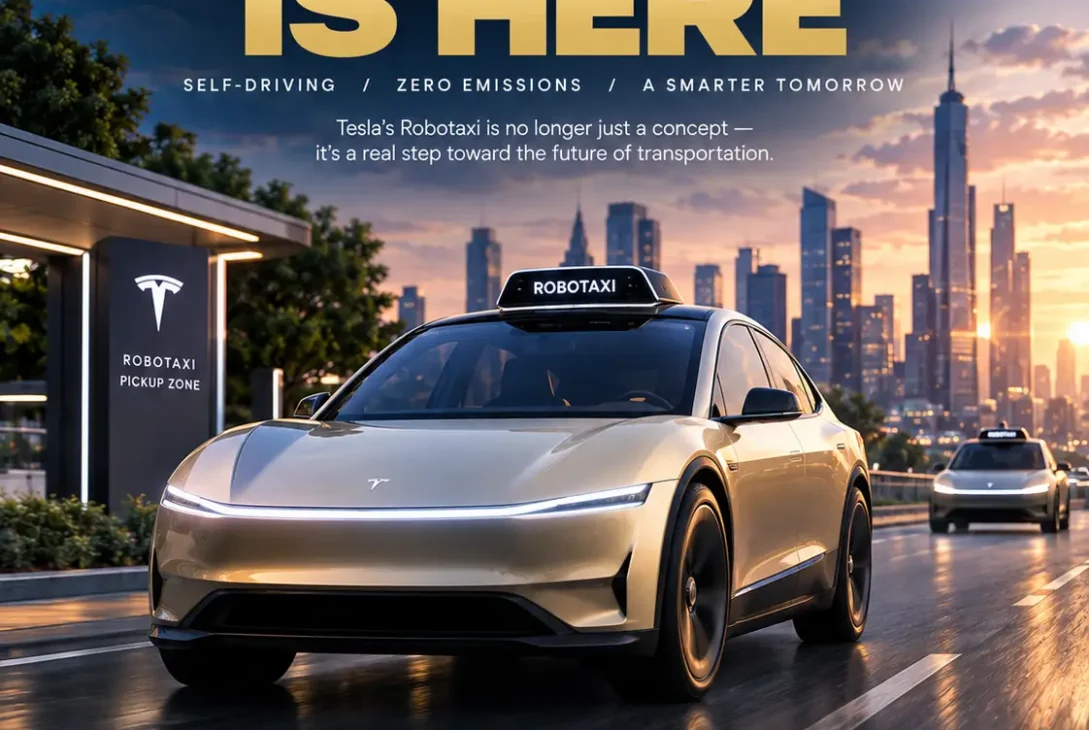
Tesla Robotaxi has moved beyond being a future concept and is now operating as a real autonomous ride-hailing service in parts of the United States. Tesla currently offers autonomous rides in Austin, Dallas, Houston, Miami, Orlando, and Tampa, while its purpose-built Cybercab has also entered limited passenger service in Austin.
The development is one of Tesla’s biggest moves beyond traditional electric vehicles. Instead of simply selling cars, Tesla is attempting to build a transportation network in which customers request a ride through an app and an autonomous vehicle handles the journey.
Tesla’s current fleet includes autonomous Model Y vehicles, while the Cybercab is designed specifically for autonomous operation without a steering wheel or pedals. The company says its long-term goal is to make autonomous transportation more accessible and efficient.
Table of Contents
- What Is Tesla Robotaxi?
- Where Is Tesla Robotaxi Available?
- How Does Tesla Robotaxi Work?
- What Is the Tesla Cybercab?
- Tesla Robotaxi and Full Self-Driving
- Is Tesla Robotaxi Really Driverless?
- Tesla Robotaxi Safety
- Tesla Robotaxi App and Ride Experience
- How Much Does a Tesla Robotaxi Ride Cost?
- Tesla Robotaxi vs Waymo
- Tesla Robotaxi Expansion Plans
- Benefits of Tesla Robotaxi
- Problems and Limitations
- Will Tesla Robotaxi Replace Regular Taxis?
- Frequently Asked Questions
- Final Verdict
- SEO Details
What Is Tesla Robotaxi?
Tesla Robotaxi is Tesla’s autonomous ride-hailing service. Instead of a human driver transporting passengers, compatible Tesla vehicles use autonomous-driving technology to navigate roads and complete passenger trips.
Tesla’s official service currently operates in several U.S. cities, including Austin, Dallas, Houston, Miami, Orlando, and Tampa.
Customers can request rides through Tesla’s dedicated Robotaxi app. The service is designed around autonomous transportation, although the level of human supervision can vary depending on the vehicle, location, and operating conditions.
Tesla’s current fleet includes Model Y vehicles, while the Cybercab represents the company’s longer-term vision for a purpose-built autonomous taxi.
The idea is straightforward: request a ride, enter the vehicle, select or confirm the destination, and allow the autonomous system to handle the journey.
Where Is Tesla Robotaxi Available?
Availability is one of the most important questions for anyone interested in autonomous transportation.
According to Tesla’s official Robotaxi website, the service is currently offered in:
- Austin, Texas
- Dallas, Texas
- Houston, Texas
- Miami, Florida
- Orlando, Florida
- Tampa, Florida
However, availability can depend on the exact service area within each city.
Tesla’s Cybercab service is currently more limited. Tesla says Cybercab rides are available in limited areas of Austin, Texas.
The company also says the service is expected to expand into additional cities in the future.
This means the technology is no longer limited to demonstrations. Customers can already experience autonomous rides in selected locations, although the network remains considerably smaller than a conventional taxi or rideshare service.
How Does Tesla Robotaxi Work?
A typical ride begins through the Robotaxi app.
The passenger requests transportation and provides the required destination. After a vehicle accepts the request, the passenger can meet the vehicle at the designated pickup location.
Tesla’s autonomous driving system then handles tasks such as:
- Steering
- Acceleration
- Braking
- Lane positioning
- Traffic navigation
- Intersections
- Parking
- Route following
- Responding to surrounding traffic
The exact experience can depend on the vehicle and service area.
Tesla says its autonomous vehicles use camera-based perception and artificial intelligence to understand and navigate their surroundings. Unlike some competing autonomous-driving companies, Tesla has historically emphasized cameras and neural-network-based software rather than relying primarily on lidar.
The system continuously interprets road conditions and makes driving decisions while the passenger remains inside the vehicle.
What Is the Tesla Cybercab?
The Cybercab is Tesla’s purpose-built autonomous vehicle.
Unlike a conventional Model Y, the Cybercab is designed without a steering wheel or pedals. Tesla describes it as a fully autonomous vehicle intended specifically for its Robotaxi fleet.
The vehicle has a two-passenger layout and a large center touchscreen.
Tesla says the Cybercab provides enough trunk space for luggage and other everyday items. The interior is designed around passengers rather than a human driver.
One of the most significant differences is the absence of conventional driving controls.
That makes the Cybercab fundamentally different from today’s autonomous Model Y vehicles. A Model Y is still based on a conventional car design, while the Cybercab is being developed specifically around autonomous transportation.
Tesla has also discussed the Cybercab as a vehicle that could eventually operate at large scale across its autonomous transportation network.
Tesla Robotaxi and Full Self-Driving
The technology behind Tesla’s autonomous ride-hailing strategy is closely connected to its Full Self-Driving software.
However, it is important to distinguish between FSD Supervised in privately owned Tesla vehicles and autonomous Robotaxi operation.
Tesla’s consumer FSD system has historically required an attentive driver who remains responsible for the vehicle. Robotaxi operation is different because the vehicle can operate without an active human driver in supported service areas.
Tesla’s autonomous system uses artificial intelligence to process information from the vehicle’s sensors and cameras.
The company is continuing to improve the software through real-world operation and additional training.
This is one reason the Robotaxi fleet is important to Tesla’s broader strategy. Each autonomous trip can provide operational experience while the company works toward larger-scale deployment.
Is Tesla Robotaxi Really Driverless?
In selected service areas, yes.
Tesla has already operated unsupervised Robotaxi rides in Austin and has expanded autonomous service to additional Texas and Florida markets.
However, “driverless” does not mean the technology is equally capable in every road environment.
Autonomous vehicles operate within specific geographic and operational limitations. Weather, road construction, unusual traffic situations, pickup locations, and regulatory requirements can all affect autonomous driving.
Tesla’s current service should therefore not be confused with a universal system that can drive anywhere under every possible condition.
The company is expanding gradually rather than immediately deploying autonomous vehicles everywhere.
Tesla Robotaxi Safety
Safety is one of the most important issues surrounding autonomous transportation.
Tesla says its autonomous technology is designed to improve transportation safety, but independent testing and real-world experience remain important when evaluating the system.
Reuters reported in September 2026 that Tesla’s Cybercab launch attracted attention from U.S. regulators. The National Highway Traffic Safety Administration opened an audit involving Cybercab vehicles to examine compliance with federal vehicle-safety requirements.
The regulatory question is especially important because the Cybercab does not have traditional steering controls.
Tesla’s existing Model Y Robotaxi vehicles are different because they retain conventional vehicle controls.
The company has also taken a cautious approach to expanding the autonomous network. Earlier reporting showed that ride availability and wait times remained challenges in some Texas markets.
For passengers, safety is therefore about more than whether the vehicle can drive itself. It also involves emergency procedures, remote assistance, operating boundaries, vehicle reliability, regulatory compliance, and how the system handles unusual situations.
Tesla Robotaxi App and Ride Experience
The Robotaxi app is designed to make autonomous rides similar to modern rideshare services.
Tesla’s official website says customers can download the app for iOS or Android and use it to access the service where available.
During a ride, passengers can interact with vehicle features such as climate controls and entertainment.
Cybercab also includes a large touchscreen designed for passenger interaction.
The goal is to make the experience feel less like operating a car and more like using an autonomous transportation service.
Tesla says passenger profiles can retain certain preferences, allowing settings such as climate and media choices to carry across rides.
Accessibility is another area Tesla highlights. The company says its Robotaxi vehicles are designed to support various accessibility needs, including space for service animals and wheelchair storage.
How Much Does a Tesla Robotaxi Ride Cost?
Tesla has not established one universal nationwide price for autonomous rides.
The cost can vary based on location, service availability, distance, demand, and Tesla’s pricing strategy.
This is an important distinction because the price of a ride is different from the eventual cost of purchasing or operating a Cybercab.
Tesla’s long-term business model depends partly on making autonomous transportation economical at scale.
If a vehicle can operate for many hours without a human driver, the economics of each ride could potentially change significantly.
However, the current service is still expanding, so it is too early to assume that autonomous rides will automatically be cheaper than every traditional rideshare option.
Tesla Robotaxi vs Waymo
Tesla and Waymo are two of the most closely watched companies in autonomous transportation, but their approaches are different.
Waymo is operated by Alphabet and has focused heavily on dedicated autonomous ride-hailing services.
Tesla, meanwhile, is attempting to combine autonomous driving technology with a much larger existing vehicle fleet and its own consumer ecosystem.
Another major difference is sensor strategy.
Tesla has emphasized camera-based perception and artificial intelligence, while Waymo uses a broader sensor suite that includes lidar.
Both approaches have advantages and challenges.
Tesla’s potential advantage is scale. The company already has millions of vehicles on the road and has extensive experience collecting driving data.
Waymo’s advantage is its long-running focus on autonomous ride-hailing and operational experience in specific cities.
The competition between the two companies could become much more important as autonomous transportation expands.
Tesla Robotaxi Expansion Plans
Tesla’s current service is still relatively small compared with the company’s enormous global vehicle fleet.
However, expansion is clearly a major objective.
Tesla has already moved beyond its original Austin service into other Texas and Florida markets.
The company says Robotaxi is expected to become available in additional cities.
Tesla’s official website currently lists Austin, Dallas, Houston, Miami, Orlando, and Tampa as active markets, while additional expansion is expected.
The larger objective is to create a transportation network rather than operate a small demonstration fleet.
If Tesla can scale autonomous vehicles across many cities, the company could potentially generate revenue from transportation services in addition to vehicle sales and software.
That possibility is one reason investors pay close attention to the progress of the program.
Benefits of Tesla Robotaxi
There are several potential advantages to autonomous ride-hailing.
Lower Driver Dependence
A successful autonomous fleet would not require a traditional human driver for every trip.
Greater Vehicle Utilization
A privately owned vehicle spends much of its life parked. Autonomous ride-hailing could allow compatible vehicles to spend more time transporting passengers.
Potentially Lower Operating Costs
If autonomous vehicles can operate efficiently at scale, removing the cost of a human driver could improve the economics of each ride.
Accessibility
Autonomous transportation could eventually provide another mobility option for people who cannot drive.
Convenient Transportation
Passengers could potentially use autonomous vehicles without worrying about parking or driving themselves.
These benefits remain dependent on safety, reliability, regulation, and the ability to operate the network economically.
Problems and Limitations
Despite its potential, autonomous ride-hailing has significant challenges.
One major issue is reliability.
Reuters testing in Texas found long wait times, limited availability, canceled rides, and problems with some drop-off locations.
That demonstrates an important difference between a technology demonstration and a mature transportation network.
Regulation is another challenge.
Autonomous vehicles must comply with different rules and safety requirements, and purpose-built vehicles without conventional controls create additional regulatory questions.
There is also the technical challenge of unusual road situations.
Construction zones, emergency vehicles, confusing intersections, bad weather, unexpected pedestrian behavior, and temporary road changes can create difficult scenarios for autonomous systems.
Finally, public trust matters.
Even if the technology improves, passengers need to feel comfortable entering a vehicle without a human driver.
https://www.tesla.com/robotaxi
Will Tesla Robotaxi Replace Regular Taxis?
It is unlikely to happen immediately.
Traditional taxis, rideshare vehicles, buses, and privately owned cars will continue to serve transportation needs for many years.
However, autonomous ride-hailing could become a meaningful alternative if companies can demonstrate that it is safe, reliable, affordable, and widely available.
The biggest opportunity may not be replacing every taxi.
Instead, autonomous services could gradually take over certain types of trips, especially predictable urban journeys where the technology works particularly well.
Tesla’s long-term ambition is considerably larger than its current service.
If the company can scale its fleet successfully, autonomous transportation could eventually become an important part of its business model.
Frequently Asked Questions
What is Tesla Robotaxi?
Tesla Robotaxi is Tesla’s autonomous ride-hailing service. Customers can request rides through a dedicated app in supported locations.
Where is Tesla Robotaxi available?
Tesla currently lists Austin, Dallas, Houston, Miami, Orlando, and Tampa as active service locations in the United States.
Is Tesla Robotaxi fully autonomous?
Tesla operates unsupervised autonomous rides in supported locations, but service availability and operating conditions vary by market and vehicle.
What is the Cybercab?
Cybercab is Tesla’s purpose-built autonomous vehicle. It has two passenger seats and is designed without a steering wheel or pedals.
Can I ride in a Tesla Robotaxi?
Yes, if the service is available in your location and you can access the service through Tesla’s Robotaxi app.
How does Tesla Robotaxi navigate?
The vehicles use autonomous-driving software, artificial intelligence, cameras, and other vehicle sensors to understand their environment and control the vehicle.
Is Tesla Robotaxi cheaper than Uber?
There is no universal answer. Pricing can vary by location and service conditions, so customers should compare the actual fare with other transportation options.
Is Tesla Robotaxi safer than a human driver?
Tesla promotes autonomous driving as a safety technology, but safety comparisons require extensive real-world data and independent evaluation. Autonomous systems can still encounter difficult situations.
Does Tesla Robotaxi use lidar?
Tesla has emphasized camera-based perception and AI rather than relying primarily on lidar. This differs from the sensor strategy used by some competitors.
Will Cybercab be sold to consumers?
Tesla has discussed commercial Cybercab use, but availability for ordinary individual consumers is not the same as buying a conventional Tesla today. Tesla currently directs interested commercial fleet customers to contact the company.
Can Tesla Robotaxi operate anywhere?
No. Current service is limited to supported geographic areas and operating conditions.
When will Tesla Robotaxi be available everywhere?
Tesla has not provided a date for worldwide availability. The company is expanding gradually across selected U.S. markets.
Final Verdict
Tesla Robotaxi has reached an important stage because autonomous rides are now available to real customers in multiple U.S. markets.
The program is still far from a fully mature nationwide transportation network, but the progress is significant. Tesla has moved from demonstrations and promises to operating an actual autonomous ride-hailing service.
The Cybercab is arguably the most interesting part of the strategy because it was designed from the beginning around autonomous transportation. Its lack of a steering wheel and pedals represents a major departure from conventional vehicles.
At the same time, Tesla still faces major challenges involving safety, regulation, availability, reliability, and scaling.
For now, the most realistic way to view Tesla’s autonomous transportation strategy is as an expanding technology platform rather than a finished replacement for taxis and rideshare services.
If Tesla succeeds in solving the remaining technical and regulatory challenges, autonomous transportation could become one of the company’s most important businesses over the next several years.