
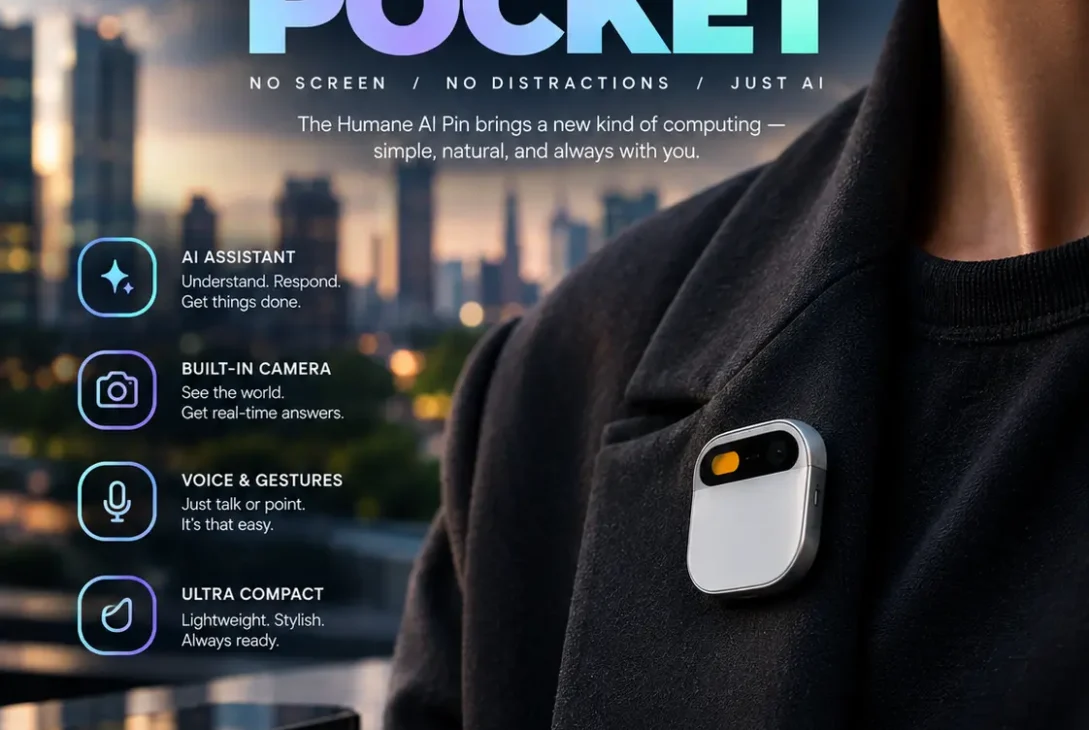
The Humane AI Pin was one of the most ambitious AI gadgets of the past few years. Instead of putting artificial intelligence inside another smartphone app, Humane tried to create a completely new type of personal computer that could be worn on clothing.
The small wearable combined voice controls, cameras, artificial intelligence, a touchpad, a projector, cellular connectivity, and a unique screenless interface. The idea was simple: instead of looking down at a phone, users could talk to an AI assistant and receive information through voice or a small projection onto their hand.
However, the story ended much faster than expected.
Humane launched the device in 2024, but the product struggled with poor reviews, high returns, safety concerns, and questions about its usefulness compared with smartphones. In February 2025, Humane announced that it was winding down the consumer product, and the AI Pin’s cloud-dependent services stopped working on February 28, 2025.
So what exactly was the device, why did it attract so much attention, and what happened to it?
Table of Contents
- What Was the Humane AI Pin?
- Humane AI Pin Features
- How Did the Humane AI Pin Work?
- Laser Ink Display
- Camera and AI Capabilities
- Voice Controls and Touch Interface
- Cellular Connectivity
- Humane AI Pin Price
- Humane AI Pin Subscription
- Why Did the Humane AI Pin Fail?
- Battery and Charging Problems
- Humane AI Pin Safety Concerns
- What Happened to Humane?
- What Happened to the AI Pin?
- Can You Still Use the Humane AI Pin?
- Humane AI Pin vs Smartphone
- What HP Bought From Humane
- Lessons From the AI Pin
- Frequently Asked Questions
- Final Verdict
- SEO Details
What Was the Humane AI Pin?
The Humane AI Pin was a wearable artificial-intelligence device developed by Humane, a company founded by former Apple employees Imran Chaudhri and Bethany Bongiorno.
Rather than functioning like a traditional smartwatch or smartphone, the device was designed to operate as a standalone computer.
It could connect to cellular networks, answer questions, send messages, make calls, take photographs, provide information, and interact with AI services without requiring a smartphone companion.
Humane described the product as a new type of personal computer designed around AI.
The device attached to clothing using a magnetic system. Users could interact with it through voice commands, gestures, a touchpad, and a small projected interface.
The concept attracted significant attention because it appeared to offer a possible alternative to constantly looking at a phone.
Unfortunately, the real-world experience did not match the ambition of the concept.
Humane AI Pin Features
At launch, the Humane AI Pin offered several unusual features for such a small device.
Its main capabilities included:
- AI-powered voice interaction
- Camera-based visual recognition
- Voice calls
- Text messaging
- Music controls
- Cellular connectivity
- Touch controls
- Gesture interaction
- Laser projection
- Translation
- Object recognition
- Photography
- AI-generated responses
- Cloud-based services
The hardware was designed around the idea that users would interact with an AI assistant instead of navigating conventional apps.
This was fundamentally different from using a smartphone.
Instead of opening a weather application, for example, a user could simply ask the device about the weather.
Instead of typing a message, the user could dictate it.
The approach was innovative, but it also introduced limitations because many tasks that are simple on a phone become more complicated when there is no conventional screen.
How Did the Humane AI Pin Work?
The Humane AI Pin combined several technologies into a compact wearable.
The device included a processor, camera, microphone, speaker, sensors, battery, cellular connectivity, and a projection system.
Users could activate the assistant and ask questions using natural language.
The system would then send requests to cloud-based AI services and return an answer through voice or the device’s visual interface.
Humane also designed the device to understand its surroundings.
The camera could be used for tasks such as identifying objects, reading information, and capturing photographs.
The concept was therefore closer to an AI assistant that could see and hear its environment than a traditional wearable display.
However, because many important functions relied on cloud services, the device was highly dependent on Humane’s infrastructure.
That dependency became a major problem when the company shut down the service.
Laser Ink Display
One of the most unusual aspects of the Humane AI Pin was its Laser Ink Display.
Instead of including a conventional screen, the device could project a small monochrome interface onto the user’s palm.
The user could tilt or position a hand in front of the projector and interact with certain information through gestures.
This allowed Humane to create a screenless interface while still providing visual feedback.
The concept was visually impressive and helped distinguish the product from smartphones and smartwatches.
However, the projection system also demonstrated one of the central challenges of screenless computing.
A smartphone gives users a large, bright, high-resolution display that can show maps, photographs, websites, messages, menus, and dozens of other types of information.
A tiny projection onto a hand is far more limited.
The Laser Ink Display was therefore an interesting technological experiment, but it was not a complete replacement for a conventional screen.
Camera and AI Capabilities
The Humane AI Pin included a camera that played an important role in the product’s AI experience.
The camera could capture photographs and provide visual information to the AI system.
For example, users could point the device at objects and ask questions about what they were seeing.
The idea was to make AI more context-aware.
Instead of describing an object manually, the user could allow the wearable to see it.
This type of multimodal interaction has since become increasingly common across AI applications.
The difference was that Humane attempted to place the technology into a dedicated wearable rather than a smartphone.
The concept was ahead of its time in some ways, but the hardware and software experience was not mature enough to replace the convenience of established mobile devices.
Voice Controls and Touch Interface
Voice was one of the primary ways users interacted with the Humane AI Pin.
The device included microphones designed to detect spoken commands and questions.
Users could ask the AI assistant for information, request actions, and communicate with other people.
A touch-sensitive surface provided another method of interaction.
Gestures were also part of the overall interface philosophy.
The goal was to minimize traditional menus and buttons.
This approach made the device feel futuristic, but it also created friction.
Voice assistants are excellent for some tasks but less convenient for others. Typing a complicated message, browsing a long list, editing text, or comparing several products can be much easier on a smartphone.
Cellular Connectivity
Unlike many smart accessories, the Humane AI Pin was designed to operate independently from a smartphone.
Humane partnered with T-Mobile to provide cellular connectivity in the United States.
The company marketed the device as something users could carry without needing to constantly depend on their phone.
The cellular connection allowed functions such as calls, messages, and online AI services.
This was an important part of the device’s identity.
However, standalone cellular hardware also contributed to the product’s cost and subscription requirements.
Humane AI Pin Price
The Humane AI Pin launched at $699 for the complete system.
At launch, the package included the device, battery accessories, charging equipment, cable, and power adapter. Humane also required a monthly subscription for cellular connectivity and its AI services.
The original pricing made the product significantly more expensive than many ordinary wearable accessories.
The cost became even more difficult to justify because buyers were not simply purchasing hardware.
They were also committing to a recurring service.
In October 2024, Humane reduced the starting price to $499, but the lower price did not solve the fundamental problems surrounding the product.
Humane AI Pin Subscription
The subscription was an important part of the business model.
Humane originally charged $24 per month for its wireless service and AI features.
The subscription included cellular connectivity, a dedicated phone number, talk and text functionality, data, cloud storage, and access to Humane’s AI services.
This model made the product different from buying a traditional smartphone outright.
A customer effectively needed to pay for both the hardware and the connected service.
For some consumers, paying hundreds of dollars for a new device followed by another monthly bill was difficult to justify.
Why Did the Humane AI Pin Fail?
There was no single reason for the failure.
The Humane AI Pin faced several problems at the same time.
First, early reviews criticized the product’s speed, battery life, interface, camera experience, heat, and general usefulness.
Second, many reviewers questioned whether the device actually solved a problem that smartphones had already solved extremely well.
Third, the monthly subscription increased the long-term cost.
Fourth, the device was heavily dependent on cloud services.
Finally, safety concerns surrounding the charging system damaged consumer confidence.
The product’s central idea was ambitious, but consumers ultimately had to decide whether that ambition was worth sacrificing many of the conveniences provided by a smartphone.
For many people, the answer was no.
Battery and Charging Problems
Battery life was one of the biggest challenges for the Humane AI Pin.
A small wearable has limited physical space for a large battery.
At the same time, the device needed to power a processor, cellular modem, camera, microphones, speaker, sensors, and AI-related functions.
Continuous wireless connectivity and AI processing could consume significant energy.
This meant users could face limitations during longer periods of use.
The charging system also became a serious issue.
Humane warned customers about a problem involving battery cells in its Charge Case and advised customers to stop using the affected accessory because of a potential fire safety risk. The company later confirmed that replacement Charge Cases would no longer be provided after the service shutdown.
Humane AI Pin Safety Concerns
Safety concerns became particularly damaging to the product’s reputation.
The charging case battery issue forced Humane to warn customers not to use the affected accessory.
That was especially serious for a relatively new product that was already struggling to convince consumers of its value.
The problem also demonstrated a broader challenge with wearable electronics.
When a device is worn on clothing and uses a small rechargeable battery, battery safety becomes particularly important.
A hardware issue that might be inconvenient on another product can become a much bigger concern when the device is designed to be carried or worn throughout the day.
What Happened to Humane?
Humane eventually decided to shut down its consumer AI Pin business.
In February 2025, HP announced an agreement to acquire key AI assets from Humane for $116 million.
The acquisition included Humane’s AI platform, Cosmos, more than 300 patents and patent applications, and a group of technical employees. HP said the technology would help accelerate AI experiences across future HP products and services.
This meant the company behind the original product was effectively moving away from the consumer hardware business.
Rather than continuing to develop the AI Pin, important technology and talent were transferred to HP.
https://support.humane.com/hc/en-us/articles/34243204841997-Ai-Pin-Consumers-FAQ
What Happened to the AI Pin?
The Humane AI Pin officially reached the end of its consumer service in February 2025.
Humane’s official consumer FAQ stated that the devices would stop connecting to its servers on February 28, 2025 at 12:00 p.m. Pacific Time.
After that point, core cloud-dependent features such as AI responses, voice interactions, calls, messaging, and data connectivity were no longer available.
Humane also stated that customer data stored on its servers would be permanently deleted.
This effectively transformed the device from a connected AI computer into a largely unusable piece of hardware.
Can You Still Use the Humane AI Pin?
In 2026, the Humane AI Pin cannot be used as it was originally intended.
Humane’s servers were shut down in February 2025.
The company confirmed that the device would no longer function as a cellular device or connect to its cloud services after the shutdown.
Some limited offline functions remained, such as checking battery information, but the core AI experience was removed.
That means buying a used unit today is generally not a practical way to experience Humane’s original AI concept.
A second-hand device cannot simply be activated with another carrier and used normally because the original service infrastructure is no longer available.
Humane AI Pin vs Smartphone
The biggest question surrounding the product was whether it could replace a smartphone.
In practice, it could not.
A smartphone remains better for:
- Web browsing
- Maps
- Messaging
- Photography
- Video
- Social media
- Gaming
- Document editing
- Multitasking
- App-based services
The wearable had advantages in hands-free interaction and AI-based assistance.
But those advantages were not enough to compensate for the limitations of its screenless design.
The experience demonstrated an important lesson: removing the smartphone screen is not automatically an improvement.
A successful post-smartphone device needs to provide a genuinely better way to accomplish common tasks.
What HP Bought From Humane
HP did not simply purchase the consumer wearable business and continue selling the device.
Instead, HP acquired key technology and intellectual property from Humane.
The deal included:
- Cosmos AI platform
- More than 300 patents and patent applications
- Technical talent
- Engineering expertise
- Product innovation capabilities
HP said the acquisition would support its development of AI-powered experiences across its product ecosystem.
This means that while the original wearable disappeared, some of the technology behind it could continue influencing future AI products.
Lessons From the AI Pin
The Humane AI Pin provides an important lesson for the rapidly growing AI hardware industry.
Artificial intelligence alone does not guarantee a successful hardware product.
A device still needs:
- Reliable battery life
- Useful software
- Competitive pricing
- Strong hardware
- Good user experience
- Reliable connectivity
- Clear everyday benefits
- Long-term service support
The product also demonstrated the risk of cloud dependency.
When the company shut down its servers, much of the hardware’s functionality disappeared.
That is an important consideration for any AI device that depends heavily on remote services.
Frequently Asked Questions
What was the Humane AI Pin?
The Humane AI Pin was a screenless wearable AI computer designed to provide voice-based assistance, calls, messaging, photography, and other AI-powered features without requiring a smartphone.
How much did the Humane AI Pin cost?
The device launched at $699 for the complete system. Humane later reduced the starting price to $499. A $24 monthly subscription was also required for the connected service.
Is the Humane AI Pin still available?
No. Humane discontinued the consumer product and shut down its core cloud services in February 2025.
Does the Humane AI Pin still work?
The Humane AI Pin no longer provides its original connected AI experience because Humane’s servers were shut down on February 28, 2025.
Why did Humane shut down the AI Pin?
The company said it was winding down the consumer product while moving toward new endeavors. The product also faced poor reviews, weak sales, returns, and safety concerns.
Who bought Humane?
HP acquired key AI capabilities, intellectual property, and talent from Humane in a transaction valued at $116 million.
What was the Laser Ink Display?
It was a small projection system that allowed the wearable to display information on a user’s palm instead of using a conventional screen.
Did the Humane AI Pin need a phone?
No. One of its main selling points was that it was designed as a standalone cellular device rather than a smartphone accessory.
Did the Humane AI Pin have a camera?
Yes. The wearable included a camera that could be used for photography and AI-powered visual interactions.
Can I buy a used Humane AI Pin?
Used units may appear on secondary marketplaces, but purchasing one in 2026 is generally not recommended if you expect the original AI functionality. The cloud service has been discontinued.
Was the Humane AI Pin successful?
No. Despite significant attention before and after launch, the product failed to achieve sustainable consumer adoption and its service was discontinued less than a year after launch.
Is HP making a new Humane AI Pin?
HP acquired key Humane technology and talent, but that does not mean the original Humane AI Pin is returning. HP’s stated focus was using the acquired AI capabilities to develop future AI experiences and products.
Final Verdict
The Humane AI Pin was one of the most interesting AI hardware experiments of the 2020s, but it ultimately became an example of how difficult it is to replace the smartphone.
Its screenless interface, AI assistant, camera, cellular connectivity, and Laser Ink Display were genuinely ambitious.
The problem was that ambition did not always translate into a better everyday experience.
The device was expensive, required a monthly subscription, had battery limitations, faced software and usability criticism, and became involved in a battery safety issue. Most importantly, many consumers could already perform the same basic tasks more conveniently on a smartphone.
Humane eventually shut down the consumer service, and the device’s core cloud features stopped working on February 28, 2025. HP subsequently acquired key Humane technology, patents, and talent for $116 million.
For that reason, the Humane AI Pin is no longer a practical AI gadget to buy in 2026.
Its bigger importance is historical.
The product helped demonstrate both the possibilities and the limitations of dedicated AI hardware. As companies continue developing AI glasses, AI earbuds, wearable assistants, and other screenless devices, the lessons from Humane’s experiment are likely to remain relevant.