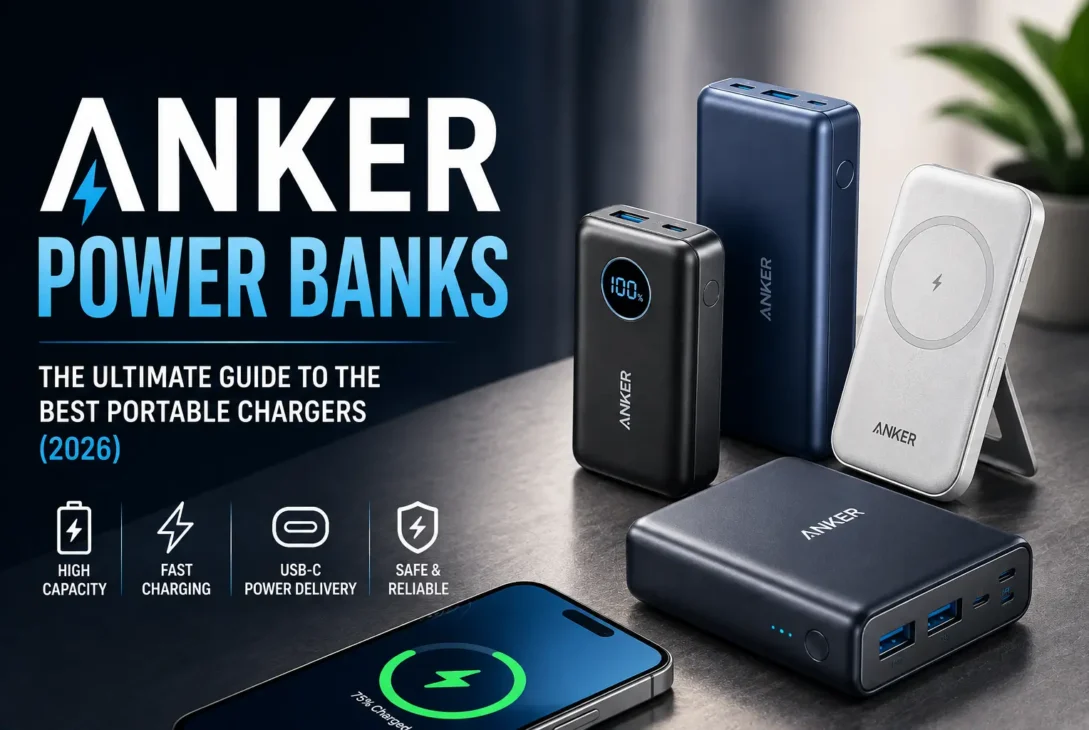
Portable power has become increasingly important as smartphones, tablets, laptops, gaming devices, and wireless accessories become part of everyday life. A reliable power bank can keep these devices running when you’re away from a wall outlet, traveling, working remotely, or spending a long day outdoors.
Among the many brands available today, Anker power banks are known for combining high-capacity batteries, fast charging, multiple ports, and compact designs. The company’s current lineup ranges from small 10,000mAh models designed for phones to high-output Prime models capable of powering laptops and several devices at once.
Choosing the right model isn’t simply about buying the power bank with the largest battery. Capacity, charging speed, USB-C support, portability, device compatibility, and recharge time all matter.
This guide explains the different types of Anker portable chargers, what their specifications mean, which features are worth paying attention to, and how to choose the right option for your devices in 2026.
Table of Contents
- What Are Anker Power Banks?
- Why Choose an Anker Power Bank?
- Different Types of Anker Power Banks
- Understanding Power Bank Capacity
- Charging Speed and Wattage
- USB-C and USB-A Ports
- Best Anker Power Banks for Different Users
- Power Banks for Smartphones
- Power Banks for Laptops
- Power Banks for Travel
- Wireless and Magnetic Power Banks
- Safety Features
- How to Choose the Right Model
- Pros and Cons
- Frequently Asked Questions
What Are Anker Power Banks?
Anker power banks are portable rechargeable battery packs designed to provide additional power to electronic devices when a traditional wall charger isn’t available.
Depending on the model, an Anker power bank can charge smartphones, tablets, wireless earbuds, handheld gaming systems, cameras, and even USB-C laptops.
The lineup includes compact models such as 10,000mAh portable chargers as well as much larger high-output products. Anker’s current high-wattage range includes models designed specifically for demanding devices such as laptops.
The main difference between models is their combination of capacity, output power, physical size, charging ports, and additional features.
Why Choose an Anker Power Bank?
Anker has built its reputation around charging accessories, so its power banks generally focus heavily on charging performance and device compatibility.
One major advantage is the variety of available models. Someone who only needs emergency smartphone power can choose a relatively small battery, while a professional who travels with a MacBook and multiple accessories can choose a much higher-capacity option.
Some newer models also include displays that show battery information, while certain Prime models support app-based monitoring and additional charging controls.
Another important consideration is charging output. Modern Anker models can offer substantially more power than basic portable chargers, making some of them suitable for USB-C laptops rather than just phones.
Different Types of Anker Power Banks
Anker’s lineup can broadly be divided into several categories.
Compact Power Banks
Compact models are designed primarily for smartphones, earbuds, and other small devices.
A 10,000mAh power bank is often a practical choice for everyday carry because it provides a useful amount of backup power without becoming excessively heavy.
For example, Anker’s Nano range includes 10,000mAh models with USB-C connectivity and fast-charging capabilities.
High-Capacity Power Banks
High-capacity models are designed for users who need significantly more battery life.
These products can be useful for long trips, remote work, gaming, photography, and situations where access to a wall outlet is limited.
The Anker Prime 27,650mAh model, for example, has a rated capacity of 27,650mAh and supports up to 250W of total output across its ports.
Laptop Power Banks
Some modern power banks are powerful enough to charge USB-C laptops.
These models generally provide higher wattage and larger battery capacities than standard phone-focused chargers.
Anker’s current lineup includes a 25,000mAh Laptop Power Bank rated at up to 165W, aimed at users who need portable power for demanding devices.
Magnetic Power Banks
Magnetic models are designed primarily for compatible smartphones and can attach directly to the back of supported devices.
They are particularly convenient for people who don’t want to carry a separate cable while charging their phone.
Anker’s MagGo range includes magnetic battery products designed for compatible devices.
Understanding Power Bank Capacity
Capacity is one of the first specifications you should check when comparing Anker power banks.
It is usually expressed in milliamp-hours, or mAh.
A higher mAh rating generally means the battery stores more energy, but it also tends to increase the physical size and weight of the power bank.
10,000mAh
A 10,000mAh model is usually suitable for everyday smartphone users.
It can provide multiple partial charges depending on the phone’s battery size, charging efficiency, and other factors.
For many people, this capacity offers a good balance between portability and backup power.
20,000mAh
A 20,000mAh battery provides considerably more energy and can be useful for frequent travelers or people who use several devices throughout the day.
The trade-off is additional weight and physical size.
25,000mAh and Above
Larger models are better suited to users who need to power laptops, tablets, gaming devices, cameras, or several products during extended periods away from a wall outlet.
Anker’s Prime 27,650mAh model is a good example of this category, offering 99.5Wh of battery capacity while supporting high-power USB-C charging.
Charging Speed and Wattage
Capacity tells you how much energy the power bank stores, while wattage helps explain how quickly it can deliver that energy to a compatible device.
A power bank with a high wattage rating can potentially charge compatible devices much faster than a basic low-output model.
For example, Anker’s Prime 27,650mAh model supports up to 250W of combined output, while individual USB-C connections can deliver up to 140W under supported conditions.
However, buying a high-wattage power bank doesn’t automatically make every device charge faster.
The connected phone, tablet, or laptop must also support the required charging standard and power level.
USB-C and USB-A Ports
The ports on Anker power banks determine which devices you can charge and how quickly they can receive power.
USB-C has become increasingly important because newer smartphones, tablets, laptops, and accessories commonly use USB-C for charging.
Many newer Anker models include one or more USB-C ports capable of both input and output. This means the same port can often be used to recharge the power bank and charge another device.
USB-A is still useful for older cables and accessories, but it generally isn’t as important as USB-C for newer devices.
Best Anker Power Banks for Different Users
There isn’t one perfect power bank for everyone. The right choice depends on how you plan to use it.
https://www.anker.com/collections/portable-power-bank
Best for Everyday Smartphone Use
A compact 10,000mAh model is usually the most practical choice for everyday carrying.
It can fit easily into a backpack or small bag and provides useful backup power without the bulk of larger batteries.
This type of power bank is ideal for students, commuters, and people who mainly need emergency charging during the day.
Best for Frequent Travelers
Travelers may benefit from a 20,000mAh or larger model.
A larger battery can provide more backup power for phones, tablets, earbuds, and other accessories during long journeys.
However, travelers should always check airline battery restrictions before taking a high-capacity power bank on a flight.
Best for Laptop Users
If you want to charge a MacBook or another USB-C laptop, pay close attention to the power output rather than capacity alone.
A high-capacity battery with insufficient wattage may not provide enough power for a laptop while it’s being used.
Anker offers high-output models specifically designed for laptops and other demanding devices. Its 25,000mAh Laptop Power Bank, for example, is rated for up to 165W output.
Best for Multiple Devices
If you regularly carry a phone, tablet, earbuds, smartwatch, and laptop, look for a model with multiple charging ports.
A multi-port power bank allows several devices to be connected at the same time.
Keep in mind that the maximum advertised wattage may represent combined output. When multiple devices are connected, available power can be distributed between the ports.
Power Banks for Smartphones
For smartphone users, portability is often more important than having the biggest possible battery.
A 10,000mAh model can be a good everyday option, while a 20,000mAh model makes more sense if you spend long periods away from an outlet.
Fast charging is another important feature.
If your phone supports USB-C fast charging, choose a power bank capable of delivering the required charging standard and wattage.
There’s little benefit in paying extra for extremely high output if your phone cannot take advantage of it.
Power Banks for Laptops
Laptop charging requires considerably more power than smartphone charging.
Before buying one of the larger Anker power banks, check your laptop’s USB-C charging requirements.
For example, a laptop that normally uses a 65W charger should be paired with a power bank capable of delivering sufficient power through its USB-C output.
For more demanding laptops, a higher-output model may be necessary.
You should also consider capacity because laptops can consume significantly more energy than smartphones.
Power Banks for Travel
A power bank can be particularly useful when traveling because you may spend hours without access to a wall outlet.
However, capacity matters for air travel.
Large lithium-ion batteries are subject to airline and aviation restrictions, and passengers may need to carry approved power banks in carry-on baggage rather than checked luggage.
Before flying, check the rules of your airline and the applicable aviation authority.
The watt-hour rating is often more useful for determining travel eligibility than the mAh number alone.
For example, a 27,650mAh Anker Prime power bank is rated at 99.5Wh, which puts its capacity below the commonly referenced 100Wh threshold, but airline policies can vary.
Wireless and Magnetic Power Banks
Wireless and magnetic charging can make portable charging more convenient.
Instead of connecting a cable, a compatible phone can be placed against the magnetic battery pack.
This is particularly useful when you want to continue using your phone while carrying the power bank.
However, wireless charging can be less efficient than wired charging and may generate more heat.
If charging speed is your main priority, a direct USB-C connection is generally the better choice.
Safety Features
Battery safety is an important consideration when purchasing any portable charger.
Modern Anker power banks include protective technologies designed to help manage charging conditions and reduce risks such as overheating, overcharging, and excessive current.
Still, users should avoid exposing a power bank to extreme temperatures, water, or physical damage.
Don’t continue using a battery that is swollen, cracked, leaking, or showing other signs of physical damage.
How to Choose the Right Anker Power Bank
Choosing between Anker power banks becomes easier when you focus on your actual charging needs instead of simply choosing the biggest battery.
Consider Your Main Device
If you mainly charge a smartphone, a compact 10,000mAh model may be enough.
If you regularly charge tablets, cameras, gaming devices, or laptops, consider a larger capacity with higher USB-C output.
Check the Required Wattage
Look at the charger that came with your device and check its wattage.
For laptops, this is especially important. A power bank should provide enough output to charge the laptop effectively.
Consider Portability
A larger battery provides more power but also takes up more space.
If you carry your power bank every day, a smaller model may be more convenient than a heavy high-capacity option.
Check the Ports
USB-C should be a priority if you’re using modern devices.
Multiple ports are useful if you frequently charge several devices at the same time.
Look at Recharge Time
A large power bank can take considerably longer to recharge if its input power is limited.
If you frequently use your power bank, choosing a model with faster input charging can save significant time.
How Long Do Anker Power Banks Last?
The lifespan of a power bank depends on usage, charging habits, temperature, and battery technology.
Like other rechargeable lithium-ion batteries, capacity gradually decreases over time.
To help maintain battery health, avoid exposing the power bank to extreme heat and don’t continue using a damaged battery.
Storing it in a cool, dry location when you’re not using it can also help.
How Many Times Can a Power Bank Charge a Phone?
The answer depends on both battery capacities and charging efficiency.
For example, a 10,000mAh power bank doesn’t necessarily provide exactly 10,000mAh of usable charging to a phone.
Energy is lost during voltage conversion and charging.
Your phone’s battery capacity, charging efficiency, temperature, and power-bank design can all affect the final number of charges.
As a result, it’s better to think of capacity as an indication of available energy rather than an exact number of phone charges.
Are Anker Power Banks Good for MacBooks?
Some Anker power banks are suitable for MacBooks and other USB-C laptops, but you need to select a model with sufficient output.
A compact phone-focused power bank may not provide enough power for a laptop.
High-wattage models are more appropriate for laptops because they can deliver considerably more power through compatible USB-C ports.
Before buying, check your MacBook’s charging requirements and compare them with the power bank’s USB-C output.
Can You Charge Multiple Devices at Once?
Many Anker models support simultaneous charging.
This can be useful when you need to charge a smartphone and earbuds, or a phone and tablet, at the same time.
However, connecting multiple devices may reduce the amount of power available to each port.
Check the manufacturer’s specifications for the maximum combined output of the specific model you’re considering.
Anker Power Bank Pros and Cons
Pros
- Wide range of capacities
- Compact options available
- High-output models for laptops
- USB-C support
- Multiple-port options
- Fast-charging models
- Magnetic charging options
- Useful for travel and emergencies
Cons
- Higher-end models can be expensive
- Larger capacities increase weight
- Maximum output depends on the connected device
- Wireless charging can be slower than wired charging
- Large batteries may have additional travel restrictions
Final Verdict
Anker power banks offer options for almost every type of user, from people who simply need emergency smartphone power to professionals who need enough capacity to charge laptops and multiple devices.
For everyday use, a compact 10,000mAh model can provide a good balance between portability and battery capacity.
Frequent travelers may prefer 20,000mAh or larger options, while laptop users should prioritize high USB-C wattage alongside capacity.
The best choice ultimately depends on your devices, charging requirements, budget, and how much weight you’re comfortable carrying.
Before purchasing, check the capacity, output wattage, charging ports, dimensions, weight, and travel requirements. Choosing based on these specifications will help you find an Anker portable charger that fits your actual needs instead of paying for features you won’t use.
Frequently Asked Questions
Are Anker power banks worth buying?
They can be a good option for users who want portable charging with different capacity and output choices. The right model depends on your specific devices and budget.
Which Anker power bank is best for phones?
A compact 10,000mAh model is generally a practical choice for everyday smartphone users who prioritize portability.
Which Anker power bank is best for laptops?
Choose a high-output USB-C model that provides enough wattage for your laptop. Anker’s high-wattage range includes models specifically designed for laptop charging.
Is 10,000mAh enough?
For many smartphone users, 10,000mAh provides useful backup power while remaining relatively portable.
Is 20,000mAh better than 10,000mAh?
A 20,000mAh model stores more energy, but it is typically larger and heavier. Choose it if you need more charging capacity rather than maximum portability.
Can Anker power banks charge iPhones?
Yes, compatible Anker models can charge iPhones through supported wired or wireless charging methods.
Can Anker power banks charge MacBooks?
Compatible high-output models can charge USB-C MacBooks. Always check the MacBook’s required charging wattage before purchasing.
Can I take an Anker power bank on an airplane?
Many portable power banks can be carried on flights, but airline and aviation rules apply. Check the current requirements of your airline before traveling.