
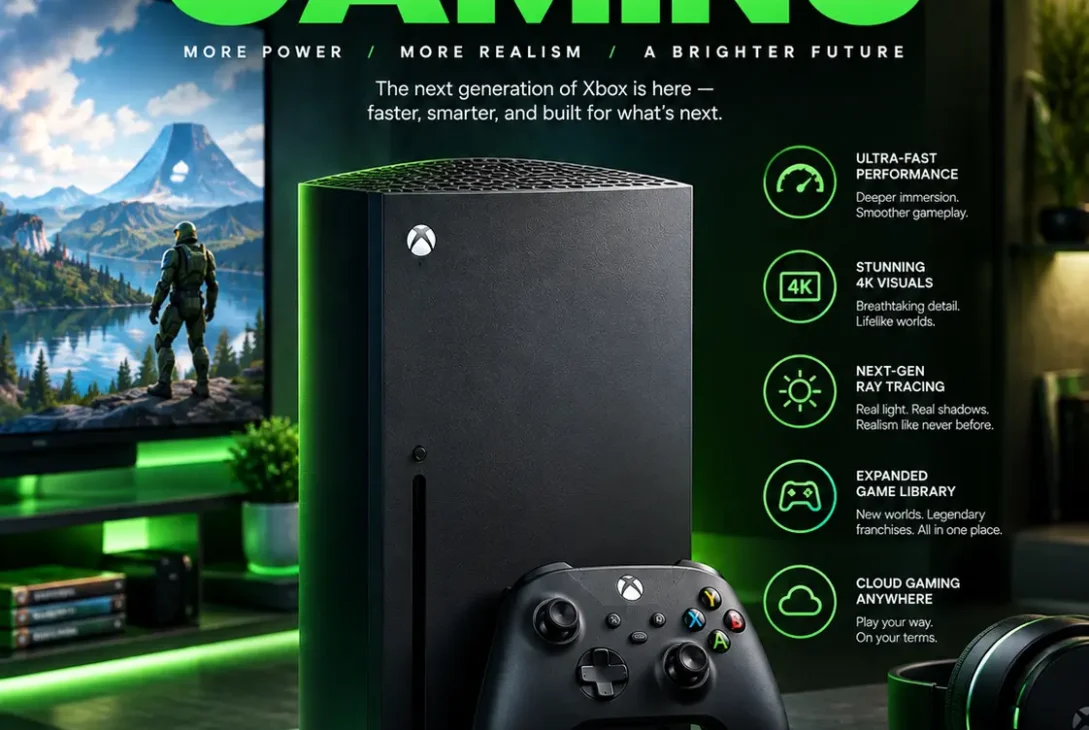
The Xbox next gen console is taking shape as Microsoft prepares for a major change in how Xbox hardware, PC gaming, and the broader Xbox ecosystem work together. Known internally as Project Helix, Microsoft’s next-generation Xbox is being developed in partnership with AMD and is designed to run both Xbox console games and PC games.
Unlike a traditional console upgrade, Microsoft’s vision for the Xbox next gen appears to be broader than simply delivering more powerful hardware. Xbox has described Project Helix as part of a platform that connects console, PC, handhelds, cloud gaming, and other devices.
Microsoft has confirmed several important details, but many questions remain unanswered. There is still no official consumer release date, final retail price, or complete specification sheet. This guide separates what Microsoft has confirmed from reports, leaks, and speculation.
Table of Contents
- What Is the Xbox Next Gen Project Helix?
- Xbox Next Gen Release Date
- Project Helix Hardware and Performance
- AMD Partnership and Graphics Technology
- Xbox Next Gen PC Gaming Support
- Backward Compatibility
- Xbox Next Gen Family of Devices
- Physical Discs and Digital Games
- Xbox Next Gen Price Expectations
- Xbox Next Gen vs Xbox Series X
- What the Next Xbox Means for Gamers
- Rumors and Unconfirmed Specifications
- Frequently Asked Questions
- Final Verdict
- SEO Details
What Is the Xbox Next Gen Project Helix?
Project Helix is Microsoft’s codename for its next-generation Xbox hardware platform. Microsoft officially discussed the project at the 2026 Game Developers Conference, describing it as a next-generation Xbox console designed to play both Xbox console and PC games.
According to Xbox, Project Helix is being developed around a custom AMD system-on-chip and is being co-designed for future versions of DirectX and AMD’s FSR technology. Microsoft also says the hardware is intended to deliver a major improvement in ray-tracing performance and integrate more intelligence into the graphics and compute pipeline.
This is an important change in direction. Instead of treating Xbox and PC as completely separate platforms, Microsoft is increasingly presenting them as connected parts of one gaming ecosystem.
Xbox has also said that Play Anywhere now covers more than 1,500 games, allowing supported titles and progress to move between compatible Xbox and Windows experiences.
The result is that the Xbox next gen is being designed around flexibility as much as raw hardware performance.
Xbox Next Gen Release Date
The release date is one of the biggest unanswered questions.
Microsoft has not announced a consumer launch date for Project Helix. What it has confirmed is that alpha versions of the hardware are planned to begin shipping to developers in 2027.
That does not mean consumers will be able to buy the console in 2027. Developer hardware normally arrives before a commercial product so studios can build and test games on the new platform.
Some reports have suggested that a consumer launch could follow in 2027 or 2028, but these should currently be treated as estimates rather than confirmed information. GamesRadar, for example, has reported that the 2027 developer hardware schedule could point toward a later consumer launch, but Microsoft has not publicly committed to a retail date.
For now, the safest timeline is:
| Milestone | Status |
|---|---|
| Project Helix development | Confirmed |
| AMD hardware partnership | Confirmed |
| Developer alpha hardware | Planned for 2027 |
| Consumer launch | Not officially announced |
| Exact release date | Unknown |
| Pre-orders | Not announced |
| Final price | Not announced |
Anyone claiming to know the exact retail launch date should therefore be treated cautiously unless Microsoft provides confirmation.
https://news.xbox.com/en-us/2026/03/11/project-helix-building-next-generation-of-xbox
Project Helix Hardware and Performance
Microsoft has not published a complete consumer specification sheet for Project Helix.
However, the company has already revealed the direction of the hardware. The Xbox next gen will use a custom AMD SoC and is being designed around future graphics and compute technologies.
Microsoft specifically says Project Helix will provide an “order of magnitude” improvement in ray-tracing performance and capability compared with the company’s existing approach. It also says intelligence will be integrated into the graphics and compute pipeline.
This suggests that the next generation will focus on more than traditional GPU horsepower.
Ray tracing can make lighting, reflections, shadows, and other visual effects more realistic, but it can also be computationally expensive. Improvements in hardware acceleration and reconstruction technologies could therefore allow developers to use more advanced visual effects without sacrificing as much performance.
Rumored Specifications
A number of hardware specifications have circulated online, including reports claiming that Project Helix could use next-generation AMD CPU and GPU architectures and substantially more memory than Xbox Series X.
Those reports are not confirmed by Microsoft.
One recent report based on information attributed to hardware leaker KeplerL2 claimed a Project Helix design with AMD Zen 6 CPU technology, RDNA 5 graphics, GDDR7 memory, and a GPU configuration capable of around 56 TFLOPS. These figures should be treated as leaks rather than specifications.
TFLOPS also should not be treated as a direct measure of real-world gaming performance. Architecture, memory bandwidth, CPU performance, ray tracing, software optimisation, upscaling, and game-engine design all affect how a console actually performs.
Until Microsoft publishes final specifications, leaked numbers should not be presented as confirmed features of the Xbox next gen.
AMD Partnership and Graphics Technology
AMD is central to Microsoft’s next-generation hardware strategy.
Microsoft and AMD announced a multi-year partnership in 2025 covering future Xbox hardware and a broader portfolio of gaming devices. Microsoft said the companies would work together on custom silicon across consoles, handhelds, PCs, and cloud gaming.
Project Helix continues that relationship.
Microsoft says its next-generation Xbox is powered by a custom AMD SoC and is co-designed for future DirectX and FSR technologies. The company also says the system is intended to push rendering and simulation capabilities substantially further.
FSR, or FidelityFX Super Resolution, is AMD’s family of technologies for reconstructing and enhancing rendered images. The next generation of these technologies could become increasingly important as games use more demanding lighting and visual effects.
For players, the practical goal is simple: better image quality and performance without requiring every frame to be rendered entirely at native resolution.
Xbox Next Gen PC Gaming Support
One of the most significant confirmed details is that Project Helix is being designed to play PC games as well as Xbox console games.
Microsoft explicitly describes the system as being designed to play “your Xbox console and PC games.”
That could make the Xbox next gen fundamentally different from previous Xbox generations.
Instead of developers having to think about a console and PC as completely separate destinations, Microsoft’s long-term strategy is moving toward a more unified platform.
Xbox has also been bringing a more PC-like Xbox experience into Windows. In 2026, Microsoft began rolling out Xbox mode for Windows, designed to provide a controller-friendly full-screen experience while retaining the openness of Windows.
This direction is also visible in Xbox handheld hardware.
The broader strategy means future Xbox hardware could behave less like an isolated gaming box and more like a dedicated gaming computer built around Microsoft’s Xbox ecosystem.
Xbox Next Gen Family of Devices
Another major development emerged in 2026: Project Helix is no longer being discussed simply as one traditional console.
The Verge reported in August that Xbox CEO Asha Sharma described Project Helix as a “family of devices” rather than a single device.
This fits Microsoft’s wider strategy.
The company has repeatedly discussed Xbox across console, PC, handhelds, cloud gaming, and accessories. In April 2026, Xbox said its future strategy would focus on hardware, content, experience, and services, with console remaining an important part of a broader ecosystem.
A family approach could potentially mean different hardware configurations for different audiences.
However, Microsoft has not publicly announced the final lineup, names, prices, or specifications of every Project Helix device. Any detailed claims about a cheaper model, handheld version, or exact hardware tiers should therefore be considered unconfirmed unless officially announced.
Physical Discs and Digital Games
Physical media is another major unanswered question for the Xbox next gen.
Microsoft has not confirmed whether every Project Helix device will include a physical disc drive.
In August 2026, Xbox introduced a new program allowing supported physical Xbox games to receive digital entitlements after players insert eligible discs into an Xbox One or Xbox Series X console. Microsoft described this as part of its broader effort to preserve players’ game libraries as hardware and distribution methods evolve.
This development is relevant because game ownership and backward compatibility are becoming increasingly important as Xbox moves toward a multi-device ecosystem.
However, it would be incorrect to conclude from the program that Project Helix will definitely be disc-free.
Xbox CEO Asha Sharma has not confirmed the final physical-media configuration of the next-generation hardware. Reports have highlighted the uncertainty around disc support.
Xbox Next Gen Price Expectations
Microsoft has not announced an official price for Project Helix.
That means current price claims should be treated as speculation.
Pricing could be influenced by several factors, including AMD silicon costs, memory prices, storage capacity, manufacturing volume, regional taxes, and whether Microsoft launches multiple devices.
Xbox itself acknowledged in 2026 that hardware component costs were creating challenges for the industry. Microsoft said storage component prices had increased substantially and that memory costs had followed a similar trend.
This makes it particularly difficult to estimate the eventual retail price.
A high-end model could cost substantially more than the original Xbox Series X launch price, but that is not a confirmed figure. A family-of-devices strategy could also allow Microsoft to offer different price points.
Until official pricing appears, gamers should avoid treating leaked prices as final.
Xbox Next Gen vs Xbox Series X
The easiest way to understand Project Helix is to compare Microsoft’s confirmed direction with the current Xbox Series X.
| Feature | Xbox Series X | Project Helix |
|---|---|---|
| Generation | Current generation | Next generation |
| AMD hardware | Custom AMD architecture | Custom AMD SoC |
| PC game support | Limited ecosystem integration | Designed to play Xbox and PC games |
| Ray tracing | Supported | Microsoft promises a major capability increase |
| FSR | Current-generation technologies | Next-generation FSR integration |
| Developer hardware | Available | Alpha hardware planned for 2027 |
| Consumer release | Available | Not announced |
| Price | Established | Not announced |
| Backward compatibility | Supported | Microsoft promises continued support |
Xbox Series X remains Microsoft’s current flagship console, while Project Helix is being developed as the next generation.
Microsoft has also committed to keeping games from four generations of Xbox playable for years to come.
That commitment could make the transition between generations less disruptive for players with large existing libraries.
What the Next Xbox Means for Gamers
The most interesting part of the Xbox next gen is arguably not the number of GPU compute units or the amount of memory.
It is Microsoft’s attempt to remove boundaries between different types of gaming hardware.
A player could potentially use a console at home, a Windows PC at a desk, a handheld while travelling, and cloud gaming elsewhere while maintaining the same Xbox identity, library, progress, and social connections.
Microsoft’s Play Anywhere program is already moving in this direction. Xbox says the catalogue has surpassed 1,500 games, with progress carrying between supported devices and games generally requiring a single purchase for compatible Play Anywhere titles.
Project Helix appears to be the hardware expression of that philosophy.
For developers, Microsoft also argues that a more unified platform can simplify development and allow games to reach players across more devices.
That could be particularly important as the traditional distinction between console and PC continues to become less clear.
Rumors and Unconfirmed Specifications
There is already significant speculation surrounding Project Helix, but readers should separate three categories of information.
Confirmed: Microsoft is developing Project Helix, AMD is involved, developer alpha hardware is planned for 2027, the system is designed for Xbox console and PC games, and Microsoft is targeting major advances in ray tracing and graphics technology.
Reported: Some outlets and hardware analysts have reported possible CPU, GPU, memory, and performance specifications. These reports may be based on leaks or industry information but have not been confirmed by Microsoft.
Speculation: Exact retail pricing, consumer release date, final storage options, disc-drive configurations, and the complete device lineup remain unknown.
This distinction matters because next-generation console rumors often circulate for months before launch, and early specifications can change during development.
Frequently Asked Questions
What is the Xbox next gen called?
Microsoft’s next-generation Xbox hardware is currently known as Project Helix. Microsoft officially confirmed the codename in its 2026 developer announcements.
When will the Xbox next gen release?
Microsoft has not announced a consumer release date. It has confirmed that alpha versions of Project Helix hardware are planned to reach developers beginning in 2027.
Will Project Helix play PC games?
Yes. Microsoft says Project Helix is designed to play both Xbox console games and PC games.
Will the next Xbox have a disc drive?
Microsoft has not confirmed the final disc-drive configuration. Reports have discussed uncertainty around physical media, so claims that the next Xbox is definitely digital-only should not be treated as confirmed.
How powerful will Project Helix be?
Microsoft has promised a major improvement in ray-tracing performance and capability, but it has not published a complete final specification sheet. Some leaked figures have circulated online, but they remain unconfirmed.
Will Xbox Series X games work on the next Xbox?
Microsoft has committed to keeping games from four generations of Xbox playable for years to come. The exact compatibility list for future Project Helix hardware has not yet been published.
Is Project Helix one console?
Not necessarily. In 2026, Xbox CEO Asha Sharma described Project Helix as a family of devices, suggesting that Microsoft’s next-generation hardware strategy extends beyond one traditional console.
Will Project Helix support Game Pass?
Microsoft has not published a final Project Helix service specification, but Game Pass is already a central part of the Xbox ecosystem. Microsoft’s broader strategy continues to connect games across console, PC, cloud, and other devices.
Will Project Helix use AMD hardware?
Yes. Microsoft has confirmed a multi-year partnership with AMD and says Project Helix uses a custom AMD SoC.
Is 2027 the Xbox next gen launch year?
Not confirmed. 2027 is the year Microsoft has announced for beginning developer alpha hardware shipments. A consumer launch could happen later, but Microsoft has not announced a retail date.
How much will the next Xbox cost?
There is currently no official retail price. Any prices circulating online should be treated as estimates or rumors until Microsoft announces pricing.
Final Verdict
The Xbox next gen is shaping up to be more than a conventional Xbox Series X successor. Project Helix is being developed with AMD around a custom SoC, next-generation graphics technologies, stronger ray tracing, and support for both Xbox console and PC games.
The most important confirmed detail is perhaps the platform strategy. Microsoft is moving toward an Xbox ecosystem that spans console, PC, handhelds, cloud, and other devices rather than relying on a single piece of hardware.
There are still major unanswered questions. Microsoft has not confirmed the consumer release date, final specifications, retail price, exact device lineup, or complete physical-media strategy.
For now, 2027 is confirmed as the beginning of developer alpha hardware shipments, not the confirmed consumer launch year. As more information becomes official, the biggest things to watch will be Project Helix’s final hardware specifications, pricing, backward compatibility, PC-game support, and the shape of Microsoft’s wider family of next-generation devices.
For gamers considering whether to wait for the new generation, the sensible approach is to base that decision on official announcements rather than leaked specifications or unconfirmed release dates.