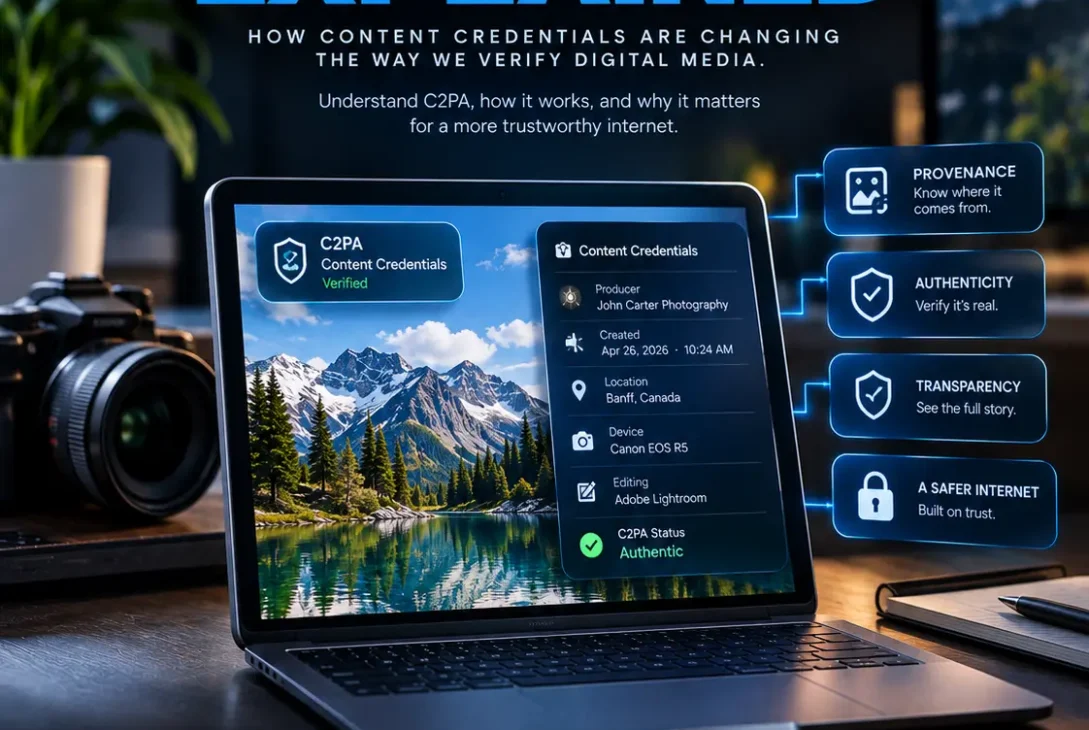
If you have ever seen a Content Credentials icon attached to an image, video, audio file, or other digital asset, you may have wondered what it actually means. This C2PA explained guide breaks down the technology in simple terms and explains why it is becoming increasingly important in the age of generative AI.
C2PA is an open technical standard designed to provide information about the origin and history of digital content. It can help record how an asset was created, what tools were used, whether it was edited, and other provenance information.
The technology has become especially relevant because AI systems can now generate realistic images, video, audio, and other media. At the same time, traditional metadata can be removed or changed, making it difficult to understand where a digital file came from.
This is where Content Credentials become useful. They provide a standardized way to attach provenance information to digital assets and use cryptographic techniques to make that information tamper-evident.
However, C2PA is not a magic authenticity detector. It does not automatically decide whether an image is true, whether a video is fake, or whether a person is trustworthy. Instead, it provides verifiable information about an asset’s provenance.
In this C2PA explained guide, we’ll look at how the standard works, what Content Credentials are, how AI-generated content can be identified, how the technology differs from watermarks and ordinary metadata, its limitations, and why it could become increasingly important for the modern internet.
Table of Contents
- What Is C2PA?
- What Does C2PA Stand For?
- What Are Content Credentials?
- How Does C2PA Work?
- What Is a C2PA Manifest?
- What Information Can C2PA Record?
- C2PA and Generative AI
- Does C2PA Detect AI-Generated Content?
- C2PA vs Digital Watermarks
- C2PA vs Traditional Metadata
- How to View Content Credentials
- Who Uses C2PA?
- C2PA 2.3: What’s New?
- Benefits of C2PA
- Limitations of C2PA
- Is C2PA Secure?
- Does C2PA Protect Privacy?
- Why C2PA Matters for Creators
- Why C2PA Matters for the Internet
- Frequently Asked Questions
- Final Verdict
- SEO Details
What Is C2PA?
C2PA stands for Coalition for Content Provenance and Authenticity.
It is an open technical standard created to help establish the provenance of digital content. Provenance refers to information about where a piece of content came from and what happened to it during its lifecycle.
A photograph, for example, could begin as an original camera capture. It might then be opened in editing software, cropped, have its colors adjusted, receive an AI-assisted edit, and eventually be published online.
Without provenance information, someone viewing the final image may have no idea what happened between the original capture and publication.
The C2PA explained approach is to create a standardized way of recording those actions.
The C2PA standard can allow compatible devices and applications to create structured provenance information associated with a digital asset. That information can be cryptographically signed so that a verifier can determine whether the relevant data and asset relationship have been altered.
The organization behind the standard describes C2PA as a framework for establishing content provenance and authenticity rather than a system for making subjective judgments about content.
That distinction is extremely important.
C2PA can help answer questions about how content was created or changed, but it does not automatically answer whether the claims made by that content are factually correct.
What Does C2PA Stand For?
The name describes the purpose of the organization:
- Coalition — different companies and organizations collaborate on the standard.
- Content — the technology can be applied to digital media and other assets.
- Provenance — the system records information about origin and changes.
- Authenticity — cryptographic techniques can help verify the integrity of provenance information.
The coalition operates as a project of the Joint Development Foundation and focuses on open technical standards for digital provenance.
The project brings together organizations from areas including technology, photography, media, creative software, publishing, and other parts of the digital ecosystem.
For readers searching for C2PA explained, the simplest definition is this:
C2PA is a technical framework for recording and verifying the history of digital content.
That history can include information about creation, editing, software, AI involvement, and other supported actions.
What Are Content Credentials?
Content Credentials are the user-facing part of the C2PA ecosystem.
They can be thought of as a digital history label attached to content.
A Content Credential can contain structured information about the asset’s provenance. According to the C2PA FAQ, credentials can include information about how content was created, what tools or processes were used, when and where it was made, and how it changed over time.
For example, consider a photographer who takes a picture using a compatible camera.
The original capture could receive a Content Credential.
The photographer then edits the picture using compatible software. That software can record the editing action as another part of the asset’s provenance.
If the image is later published, a compatible viewer may be able to inspect the available credentials.
This means the technology can provide more context than a simple filename or social-media caption.
A Content Credential can also help distinguish different stages of a creative workflow.
That is one reason C2PA explained concepts are becoming increasingly relevant to photographers, journalists, designers, publishers, and AI companies.
How Does C2PA Work?
The technical process may look complicated, but the basic workflow is relatively straightforward.
A compatible device or application creates digital content and generates provenance information.
That information is placed into a structured C2PA Manifest and cryptographically signed.
The asset and its provenance information can then travel together.
When compatible software later receives the asset, it can validate the associated credentials.
A simplified workflow looks like this:
Create → Record provenance → Sign → Edit → Add provenance → Publish → Verify
The official C2PA explainer describes an end-to-end workflow involving content creation, manifest generation, cryptographic signing, embedding or linking, distribution, verification, and presentation to users.
The important part is the cryptographic relationship between the asset and its provenance information.
If someone modifies relevant signed information without producing an appropriate new credential, validation can identify that the relationship has been broken.
This is one of the core ideas behind C2PA explained: the system is designed to make provenance information verifiable rather than relying only on ordinary editable metadata.
What Is a C2PA Manifest?
A C2PA Manifest is the structured package containing provenance information associated with an asset.
It can include different types of assertions describing the content and actions performed on it.
For example, a manifest may describe:
- How an asset was created
- Which application performed an edit
- What type of edit occurred
- What other assets were used
- Information about the signing process
- Cryptographic hashes
- Links to related provenance information
The manifest is digitally signed by the relevant implementation.
The C2PA technical specification defines the structures and validation mechanisms used by the ecosystem. The current 2.3 specification includes expanded support for asset types and additional provenance actions.
A manifest does not necessarily contain every detail about a file’s entire history.
Its completeness depends on the tools and workflows involved.
If an asset passes through an unsupported application, that application may not add a provenance record.
Therefore, a valid manifest should not automatically be interpreted as a complete record of every event in an asset’s life.
What Information Can C2PA Record?
One of the most useful aspects of C2PA explained is understanding what the system can actually record.
Depending on the implementation, Content Credentials may include several categories of information.
Creator Information
Some implementations can provide information about the creator or organization associated with an asset.
However, attribution is not automatically required by the core specification. The C2PA FAQ notes that the core Content Credentials specification is designed to remain privacy-preserving, while some communities develop extensions for attribution.
Creation Information
A credential may provide information about how an asset was created.
For a photograph, this could include information associated with the capture process.
Editing Information
Compatible software can record actions such as:
- Cropping
- Resizing
- Color adjustments
- Compositing
- Markup
- Redaction
- Other supported modifications
AI Involvement
Compatible systems can record information about AI-assisted or AI-generated operations.
This is especially important for modern creative workflows.
Software and Device Information
Depending on implementation and privacy settings, provenance information can identify software or hardware involved in the workflow.
The exact information is implementation-dependent, so users should not assume every credential contains identical data.
C2PA and Generative AI
Generative AI is one of the biggest reasons content provenance has become a major technology topic.
AI systems can now create photorealistic images, synthetic voices, video, illustrations, and other digital assets.
A viewer may not always be able to determine how something was produced simply by looking at it.
The C2PA explained model provides another approach.
Instead of trying to identify AI content solely by analyzing the final pixels or audio, compatible creation tools can record information about AI involvement during the content-production process.
For example, an image could begin as a photograph and later receive an AI-assisted modification.
The provenance record could distinguish between the original capture and the subsequent AI-assisted action.
Alternatively, an image could be generated entirely by an AI system and have provenance information indicating that generative technology was involved.
The C2PA published 2026 implementation guidance specifically addressing how Content Credentials can communicate information about synthetic and non-synthetic content.
This can give audiences more precise information than a simple label saying “AI.”
Does C2PA Detect AI-Generated Content?
No.
This is probably the most important misconception to avoid when discussing C2PA explained.
C2PA is not an AI detector.
It does not independently examine an image and announce that it was created by AI.
Instead, compatible tools can create provenance information describing the creation or editing process.
If an AI application generates an image and creates a valid Content Credential indicating that AI was used, a compatible verifier can display that information.
But if an image has no credentials, that does not automatically mean it was created by a human.
Likewise, the presence of a credential does not automatically prove that everything shown in the image is factually true.
The technology answers a narrower but useful question:
What verifiable provenance information is available for this asset?
That is different from asking:
Is this content factually true?
Understanding that difference is essential.
C2PA vs Digital Watermarks
C2PA and digital watermarks can both be used in content-authenticity systems, but they are different technologies.
A watermark can embed information into an image, video, or other media.
Some watermarks are visible, while others are designed to be difficult to see.
C2PA primarily focuses on structured provenance information and cryptographic verification.
The two technologies can also work together.
For example, an implementation may use invisible watermarking or another recovery mechanism to help reconnect content with provenance information after normal metadata has been removed.
The C2PA explainer describes embedding and soft-binding approaches that can help make provenance information accessible even when the primary manifest is no longer directly available.
Therefore, C2PA explained should not be reduced to “C2PA is a watermark.”
It is better understood as a provenance framework that can work alongside other content-identification technologies.
C2PA vs Traditional Metadata
Digital files have supported metadata for many years.
A photograph may contain information about:
- Camera model
- Lens
- Exposure
- Date
- GPS location
- Software
- File properties
Traditional metadata can be useful, but it is not necessarily designed to provide a cryptographically verifiable history.
Metadata can also be removed or changed during editing and file conversion.
C2PA adds cryptographic signing and structured provenance to the workflow.
That means compatible systems can provide stronger evidence that the provenance information has not been altered after signing.
However, this does not mean ordinary metadata becomes useless.
Traditional metadata and Content Credentials can coexist.
The difference is that C2PA is specifically designed around verifiable provenance rather than simply storing descriptive file information.
How to View Content Credentials
The exact method for viewing credentials depends on the application or platform.
Adobe provides tools for viewing Content Credentials, including its Adobe Content Authenticity service.
When supported content is opened, users can inspect available provenance information and see details such as creator information, editing history, and other available data.
A typical workflow is:
- Find an image or other supported asset.
- Look for a Content Credentials indicator.
- Open the available credentials.
- Review the provenance information.
- Check whether AI involvement is disclosed.
- Examine the verification status.
- Review related assets or editing history when available.
Adobe provides documentation explaining how users can view and verify available Content Credentials.
Not every digital file will have credentials.
That is important because the absence of a Content Credential should not automatically be interpreted as evidence that content is fake.
Who Uses C2PA?
The standard is designed for a wide range of organizations and creative workflows.
Potential users include:
- Photographers
- Journalists
- News organizations
- AI companies
- Software developers
- Camera manufacturers
- Video creators
- Designers
- Publishers
- Advertising agencies
- Social-media platforms
- Enterprises
Adobe has integrated Content Credentials into several creative workflows.
Camera and technology companies have also participated in the broader ecosystem.
The goal is interoperability.
If different companies implement the same open technical standard, provenance information can potentially survive across different parts of a content workflow.
The C2PA reported in February 2026 that more than 6,000 members and affiliates had live applications of Content Credentials.
That shows the ecosystem is extending beyond a single software company.
C2PA 2.3: What’s New?
The C2PA specification continues to evolve.
Version 2.3 introduced several updates, including expanded support for live video streaming and additional asset types.
The specification also added support for:
- Plain-text documents
- OGG Vorbis audio
- Large AVI files
- EXIF Original Preservation Images
The update also introduced or refined several provenance actions and improved aspects of validation and cloud-hosted assertion data.
The 2.3 release is significant because digital media is not limited to static photographs.
Modern content includes livestreams, audio, documents, video, AI-generated assets, and mixed-media projects.
The broader the standard becomes, the more useful it can potentially be across different workflows.
For anyone researching C2PA explained, version 2.3 is therefore worth knowing about because it demonstrates that the standard is still actively developing.
Benefits of C2PA
There are several potential advantages to using a standardized provenance system.
Better Transparency
Users can receive additional information about how supported content was created and modified.
AI Transparency
AI involvement can be communicated through structured provenance information.
Creator Attribution
Where supported, creators can associate identity information with their work.
Tamper Evidence
Cryptographic signatures can make unauthorized modifications to provenance information detectable.
Editing History
Compatible tools can record specific actions performed during the content lifecycle.
Interoperability
An open standard allows different companies and organizations to build compatible systems.
Greater Context
Instead of seeing only a final image or video, users can potentially inspect information about its history.
These benefits help explain why C2PA explained is becoming an important topic in AI, photography, journalism, and digital publishing.
Limitations of C2PA
Despite its potential, the technology has important limitations.
Not Every File Has Credentials
Large amounts of existing internet content have no Content Credentials.
The standard only provides useful provenance information when a compatible system creates and preserves it.
Provenance Can Be Incomplete
A file may pass through applications that do not support the standard.
When that happens, the recorded history may not represent every action performed on the asset.
It Does Not Prove Truth
C2PA does not fact-check photographs, videos, statements, or news stories.
A valid credential can help establish provenance without proving that the content’s claims are true.
Metadata Can Be Lost
Credentials can sometimes be separated from assets or removed during unsupported processing.
The ecosystem therefore includes recovery approaches such as soft bindings and cloud-based mechanisms.
Adoption Matters
The usefulness of any standard depends on adoption by devices, software, publishers, platforms, and consumers.
Privacy Requires Attention
Provenance information can potentially expose information that creators do not want to share.
Users should understand what information their tools attach before publishing.
These limitations are an important part of C2PA explained because the technology works best when users understand both its capabilities and its boundaries.
Is C2PA Secure?
Security is a major part of the standard.
Content Credentials can use cryptographic signatures and hashes to create a verifiable relationship between the content and its provenance data.
If relevant signed information is modified without an appropriate update to the credential chain, validation can detect a problem.
The C2PA FAQ explains that credentials contain cryptographic hashes and digital signatures, while the C2PA Conformance Program is designed to evaluate products against technical and security requirements.
The ecosystem also includes a trust list and certification process for conforming implementations.
However, no technology should be described as completely immune to every security problem.
Security depends on correct implementation, certificate management, trusted software, hardware, and operational practices.
Does C2PA Protect Privacy?
Privacy is another important consideration.
Provenance can be valuable, but more information is not always better.
For example, a creator may not want to publicly disclose their location, identity, device information, or other details.
C2PA is designed to allow provenance information to be disclosed in a controlled manner.
The core specification is also designed to remain privacy-preserving, while different implementations may provide additional attribution functionality.
Creators should therefore review their software’s Content Credentials settings.
Before publishing an asset, check what information is included and whether any personal details should be removed or limited.
https://c2pa.org/resources/?utm_source=chatgpt.com
Why C2PA Matters for Creators
Photographers, designers, journalists, and video creators can benefit from having a more reliable way to document the history of their work.
Consider a photographer who captures an original image and then edits it.
A compatible workflow can record the capture and subsequent editing steps.
If the image is later shared online, viewers may be able to inspect that history.
For professional creators, this could help with:
- Attribution
- Editorial workflows
- Licensing
- Portfolio verification
- Brand campaigns
- Commercial media
- Journalism
It can also help distinguish between original work and later modifications.
The creator still controls what information is disclosed, depending on the tools being used.
Why C2PA Matters for AI Content
AI has changed the digital-content landscape.
Before generative AI became widely available, editing a photograph still required software and skills, while synthetic video and audio generally required more specialized workflows.
Today, highly realistic media can be generated quickly.
That makes provenance increasingly valuable.
A Content Credential can potentially tell a viewer that AI was involved in a specific step of the creation process.
The C2PA’s 2026 guidance focuses on making AI-related creation and editing information more precise and machine-readable. It can distinguish different actions rather than simply labeling an entire file as “AI.”
For example, an original photograph could remain identified as a camera capture while a later AI-assisted edit is recorded separately.
That is much more informative than treating the entire asset as either “real” or “AI.”
Why C2PA Matters for the Internet
Digital content is copied and modified constantly.
An image can be downloaded from one website, edited, uploaded to another platform, screenshotted, cropped, and shared again.
A video can be clipped and reposted.
An audio recording can be remixed.
A document can be modified.
Without provenance information, the original history can quickly become difficult to establish.
C2PA offers a framework for maintaining a verifiable record when compatible tools and platforms are involved.
That does not stop people from editing content.
Instead, the objective is to make the history of supported content more transparent.
The C2PA’s official materials describe Content Credentials as a way to help users understand where digital content came from and how it changed.
As synthetic media becomes more common, that type of transparency could become increasingly useful.
Frequently Asked Questions
What is C2PA explained in simple terms?
C2PA is an open technical standard for recording and verifying information about the origin and history of digital content. It is closely associated with Content Credentials.
What does C2PA stand for?
C2PA stands for Coalition for Content Provenance and Authenticity.
Is C2PA the same as Content Credentials?
No. C2PA is the technical standard, while Content Credentials are the provenance records created and validated using that standard.
Does C2PA prove an image is real?
No. It can provide verifiable information about an image’s provenance, but it does not independently prove that everything shown or claimed by the image is true.
Does C2PA detect AI-generated content?
C2PA is not an AI detection system. Compatible tools can record information showing that AI was involved in creating or modifying content.
Can C2PA be removed?
Provenance information can be lost when files pass through unsupported workflows or metadata is removed. Some implementations use recovery mechanisms to help reconnect content with its credentials.
Is C2PA a watermark?
No. C2PA is a provenance standard. Some implementations can use watermarking or other techniques alongside Content Credentials.
Can C2PA track everything done to a file?
No. It can record actions performed by compatible tools, but it cannot automatically know about every change made outside supported workflows.
Who created C2PA?
C2PA was created as an industry collaboration focused on developing open standards for digital content provenance and authenticity.
Why is C2PA important for AI?
Generative AI makes realistic synthetic media easier to produce. Provenance information can give users additional context about how supported content was created or modified.
Is C2PA free?
The C2PA specification is openly available, while individual software products and services can have their own costs and requirements.
Is C2PA secure?
It uses cryptographic signatures, hashes, validation systems, and trust mechanisms to make provenance information verifiable and tamper-evident. Security still depends on correct implementation and trusted infrastructure.
Does C2PA protect privacy?
The standard supports privacy-conscious implementations, but users should review what information their particular tools attach to Content Credentials before publishing.
Final Verdict
C2PA explained in simple terms is a story about digital provenance.
Instead of trying to prevent people from copying or editing digital content, C2PA provides a framework for recording information about where an asset came from and what happened to it during supported workflows.
Content Credentials are the practical part users are most likely to encounter. They can provide information about creation, editing, software, AI involvement, and other aspects of an asset’s history.
The technology is particularly relevant as generative AI makes realistic synthetic media easier to produce.
However, C2PA is not a universal truth detector.
A valid credential does not prove that everything shown in a photograph is real or that every statement associated with a video is accurate. It provides provenance information that can be verified.
That distinction makes the technology more useful, not less.
Rather than promising to solve misinformation completely, the standard focuses on giving creators, publishers, platforms, and audiences better information about the history of supported digital content.
With C2PA 2.3 expanding support for more media types and the ecosystem continuing to grow, provenance is becoming a more important part of modern digital-media infrastructure.
For anyone working with AI, photography, video, journalism, design, or online publishing, understanding C2PA explained concepts can help make sense of the next generation of content authenticity tools.