
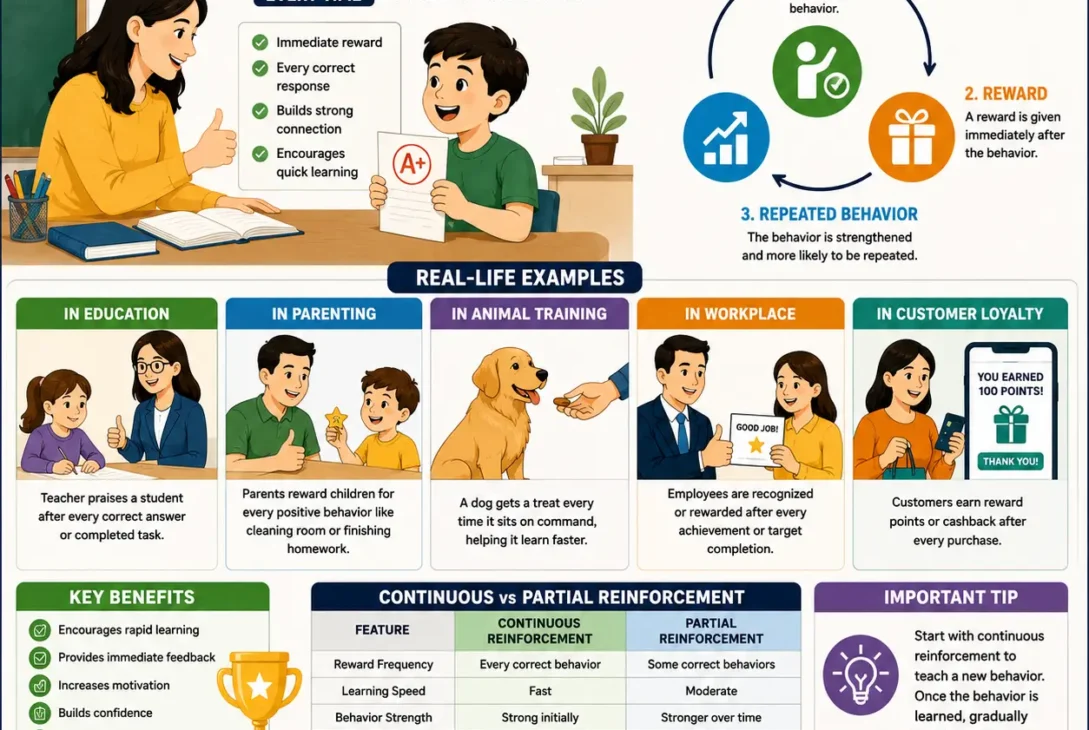
Understanding human and animal behavior has been one of psychology’s most fascinating areas of study. Among the many concepts in behavioral psychology, continuous reinforcement stands out as one of the simplest yet most effective learning strategies. Whether you’re teaching a child new habits, training a pet, educating students, or motivating employees, understanding continuous reinforcement can significantly improve learning outcomes.
The concept was introduced through operant conditioning, a theory developed by psychologist B.F. Skinner. In this learning approach, a reward is provided every time a desired behavior occurs. Because every correct response receives reinforcement, learners quickly understand the connection between their actions and the resulting reward.
Today, continuous reinforcement is used in schools, workplaces, sports coaching, parenting, therapy, customer loyalty programs, and even artificial intelligence training systems. Although it is highly effective during the early stages of learning, psychologists also recognize that it has certain limitations once behaviors become well established.
In this comprehensive guide, you’ll learn what continuous reinforcement is, how it works, why it is important, where it is used, its advantages and disadvantages, and how it compares with other reinforcement schedules in 2026.
Table of Contents
- What Is Continuous Reinforcement?
- The Psychology Behind Continuous Reinforcement
- How Continuous Reinforcement Works
- Key Characteristics
- Types of Reinforcement
- Real-Life Examples
- Benefits of Continuous Reinforcement
- Continuous Reinforcement vs Partial Reinforcement
- Applications in Different Fields
- Common Mistakes
- Pros and Cons
- Conclusion
- FAQs
What Is Continuous Reinforcement?
Continuous reinforcement is a reinforcement schedule in which a reward is given every time a desired behavior occurs. The learner immediately receives positive feedback after performing the correct action, making it easier to associate the behavior with the reward.
For example:
- A teacher praises a student after every correct answer.
- A dog receives a treat every time it follows a command.
- A parent rewards a child each time they complete their homework.
- A manager recognizes an employee whenever a sales target is achieved.
Because reinforcement happens consistently, learners quickly understand which behaviors are expected.
The Psychology Behind Continuous Reinforcement
The idea of continuous reinforcement comes from operant conditioning, a learning theory developed by psychologist B.F. Skinner.
Operant conditioning suggests that behavior is influenced by its consequences.
When positive consequences follow a behavior, that behavior becomes more likely to occur again.
Continuous reinforcement strengthens this connection by rewarding every successful response, allowing learners to build new habits more efficiently.
Psychologists commonly use this reinforcement schedule during the initial stages of learning because it provides immediate feedback and encourages consistent improvement.
How Continuous Reinforcement Works
Understanding continuous reinforcement becomes easier when you look at the learning process step by step.
Step 1: Desired Behavior
A learner performs a specific behavior.
Examples include:
- Completing homework
- Following instructions
- Solving a math problem
- Sitting quietly
- Performing a workplace task
Step 2: Immediate Reward
Immediately after the correct behavior, a reward is provided.
Rewards may include:
- Praise
- Stickers
- Money
- Bonus points
- Extra privileges
- Small gifts
- Recognition
- Certificates
Immediate reinforcement helps learners connect the reward directly with the behavior.
Step 3: Repetition
Since every correct behavior receives reinforcement, learners quickly recognize which actions lead to positive outcomes.
Repeated success strengthens the behavior until it becomes a habit.
Key Characteristics of Continuous Reinforcement
Several features make continuous reinforcement different from other reinforcement schedules.
Its main characteristics include:
- Every correct behavior receives reinforcement.
- Feedback is immediate.
- Learning occurs rapidly.
- Behaviors are acquired quickly.
- The reward is predictable.
- Easy to implement for beginners.
- Frequently used during early learning stages.
- Helps establish new behaviors efficiently.
These characteristics make continuous reinforcement particularly useful when introducing completely new skills or behaviors.
Types of Reinforcement
To fully understand continuous reinforcement, it’s important to distinguish between the two primary forms of reinforcement used in psychology.
Positive Reinforcement
Positive reinforcement involves adding something desirable after the desired behavior occurs.
Examples include:
- Giving praise.
- Offering candy.
- Awarding bonus points.
- Providing extra playtime.
- Giving certificates.
- Offering discounts.
- Employee recognition.
- Loyalty rewards.
Positive reinforcement encourages individuals to repeat the desired behavior.
Negative Reinforcement
Negative reinforcement removes something unpleasant after the correct behavior occurs.
Examples include:
- Turning off an annoying alarm after waking up.
- Removing extra homework when students meet goals.
- Ending a loud warning sound after fastening a seatbelt.
- Reducing workplace monitoring once employees consistently perform well.
Unlike punishment, negative reinforcement increases desired behavior by removing an unpleasant condition.
Real-Life Examples of Continuous Reinforcement
One of the easiest ways to understand continuous reinforcement is by looking at how it is applied in everyday situations. Since this reinforcement schedule rewards every correct behavior, it is especially effective when teaching new skills or encouraging positive habits.
In Schools
Teachers often use continuous reinforcement during the early stages of learning.
Examples include:
- Praising students after every correct answer.
- Giving stickers for each completed assignment.
- Awarding points for every classroom activity.
- Providing certificates for consistent participation.
Immediate rewards motivate students to continue performing the desired behavior.
In Parenting
Parents frequently rely on continuous reinforcement to help children develop positive habits.
Examples include:
- Giving praise after cleaning their room.
- Rewarding children for brushing their teeth.
- Providing extra playtime after completing homework.
- Offering small rewards for good behavior.
Children quickly learn which behaviors receive positive recognition.
In Animal Training
Professional trainers commonly begin with continuous reinforcement when teaching new commands.
Examples include:
- Giving a dog a treat every time it sits.
- Rewarding a horse after following instructions.
- Praising a pet whenever it responds correctly.
- Offering food after every successful training exercise.
Once the behavior becomes consistent, trainers often switch to partial reinforcement.
In the Workplace
Organizations use continuous reinforcement to improve employee motivation and performance.
Examples include:
- Recognizing employees after every achievement.
- Providing bonuses for each sales target reached.
- Offering incentives for completing projects.
- Celebrating consistent attendance.
Frequent recognition helps reinforce productive workplace behaviors.
In Customer Loyalty Programs
Many businesses apply continuous reinforcement to encourage repeat purchases.
Examples include:
- Reward points for every purchase.
- Cashback after every transaction.
- Discount coupons for each order.
- Loyalty stamps for every visit.
Customers become more likely to return because every purchase receives an immediate reward.
Benefits of Continuous Reinforcement
There are many reasons why psychologists and educators recommend continuous reinforcement, especially when introducing new behaviors.
Some of its major benefits include:
- Encourages rapid learning.
- Strengthens desired behaviors quickly.
- Provides immediate feedback.
- Builds learner confidence.
- Easy to understand and apply.
- Creates predictable outcomes.
- Increases motivation.
- Helps establish positive habits.
- Improves engagement.
- Suitable for beginners.
Because rewards are consistent, learners can easily connect their actions with positive outcomes.
Continuous Reinforcement vs Partial Reinforcement
Although both reinforcement schedules aim to strengthen behavior, they work differently.
| Feature | Continuous Reinforcement | Partial Reinforcement |
|---|---|---|
| Reward Frequency | Every correct behavior | Only some correct behaviors |
| Learning Speed | Very Fast | Moderate |
| Motivation | High during learning | High over the long term |
| Best For | Teaching new behaviors | Maintaining learned behaviors |
| Predictability | Predictable | Less predictable |
| Resistance to Extinction | Lower | Higher |
Most psychologists recommend starting with continuous reinforcement before gradually moving to partial reinforcement as the behavior becomes established.
Applications in Different Fields
The usefulness of continuous reinforcement extends far beyond psychology classrooms. Today, it is applied across multiple industries and professions.
Education
Teachers use continuous reinforcement to:
- Teach reading skills.
- Encourage classroom participation.
- Improve attendance.
- Reinforce positive behavior.
- Build study habits.
Healthcare
Healthcare professionals may use reinforcement strategies to encourage patients to:
- Follow treatment plans.
- Take medications consistently.
- Attend therapy sessions.
- Adopt healthier lifestyles.
- Complete rehabilitation exercises.
Business Management
Managers use continuous reinforcement to:
- Improve employee productivity.
- Encourage teamwork.
- Recognize achievements.
- Increase motivation.
- Support professional development.
Sports Coaching
Coaches reinforce positive performance by rewarding athletes for:
- Correct techniques.
- Consistent practice.
- Teamwork.
- Discipline.
- Skill improvement.
Immediate feedback helps athletes refine their performance more effectively.
Behavioral Therapy
Behavioral therapists often use continuous reinforcement to help individuals:
- Develop communication skills.
- Reduce unwanted behaviors.
- Build social confidence.
- Learn daily living skills.
- Strengthen positive routines.
This structured approach is particularly valuable during the initial stages of behavior modification programs.
Common Mistakes When Using Continuous Reinforcement
Although continuous reinforcement is highly effective, improper use can reduce its long-term benefits.
Common mistakes include:
- Rewarding inconsistent behavior.
- Delaying reinforcement after the desired action.
- Using rewards that are not meaningful to the learner.
- Continuing continuous reinforcement for too long without transitioning to partial reinforcement.
- Reinforcing unintended behaviors.
- Failing to explain why the reward was given.
- Depending only on material rewards instead of praise and encouragement.
Avoiding these mistakes helps maintain motivation while supporting lasting behavior change.
https://www.apa.org/
Pros and Cons
Pros
- Helps learners acquire new behaviors quickly.
- Provides immediate feedback after every correct response.
- Strengthens the connection between behavior and reward.
- Increases motivation during the learning process.
- Easy to understand and implement.
- Effective for teaching children, students, and beginners.
- Commonly used in education, parenting, therapy, and animal training.
- Builds confidence through consistent positive reinforcement.
- Encourages active participation.
- Creates clear expectations for learners.
Cons
- Behaviors may disappear quickly if rewards suddenly stop.
- Can create dependence on frequent rewards.
- Less effective for maintaining long-term behaviors.
- Requires consistent monitoring by teachers, parents, or trainers.
- May become costly or time-consuming in some settings.
- Learners may expect rewards for every desired action.
- Not always practical in large groups or busy workplaces.
Final Thoughts
Continuous reinforcement is one of the most effective reinforcement schedules for teaching new behaviors and helping learners understand the connection between actions and rewards. By providing reinforcement after every correct response, it accelerates learning, increases motivation, and builds confidence during the early stages of skill development.
Although continuous reinforcement is highly successful when introducing new behaviors, psychologists generally recommend transitioning to partial reinforcement once the behavior becomes consistent. This approach helps maintain the learned behavior over time and reduces reliance on constant rewards.
Whether used in classrooms, homes, workplaces, healthcare settings, or animal training, continuous reinforcement remains a valuable strategy for encouraging positive behavior and improving learning outcomes. Understanding when and how to use it allows educators, parents, managers, and trainers to create more effective learning environments in 2026 and beyond.
Frequently Asked Questions (FAQs)
1. What is continuous reinforcement?
Continuous reinforcement is a reinforcement schedule in which a reward is provided every time a desired behavior occurs. It is commonly used during the early stages of learning to help individuals quickly associate behavior with positive outcomes.
2. Who introduced continuous reinforcement?
The concept of continuous reinforcement is based on B.F. Skinner’s theory of operant conditioning, which explains how rewards and consequences influence behavior.
3. Where is continuous reinforcement used?
Continuous reinforcement is widely used in education, parenting, behavioral therapy, workplace training, customer loyalty programs, healthcare, and animal training.
4. What is the difference between continuous reinforcement and partial reinforcement?
With continuous reinforcement, every correct behavior receives a reward. In contrast, partial reinforcement rewards only some correct behaviors, making learned behaviors more resistant to extinction over time.
5. What are the advantages of continuous reinforcement?
Some of the biggest advantages of continuous reinforcement include faster learning, immediate feedback, increased motivation, stronger habit formation, improved confidence, and effective teaching of new skills.