
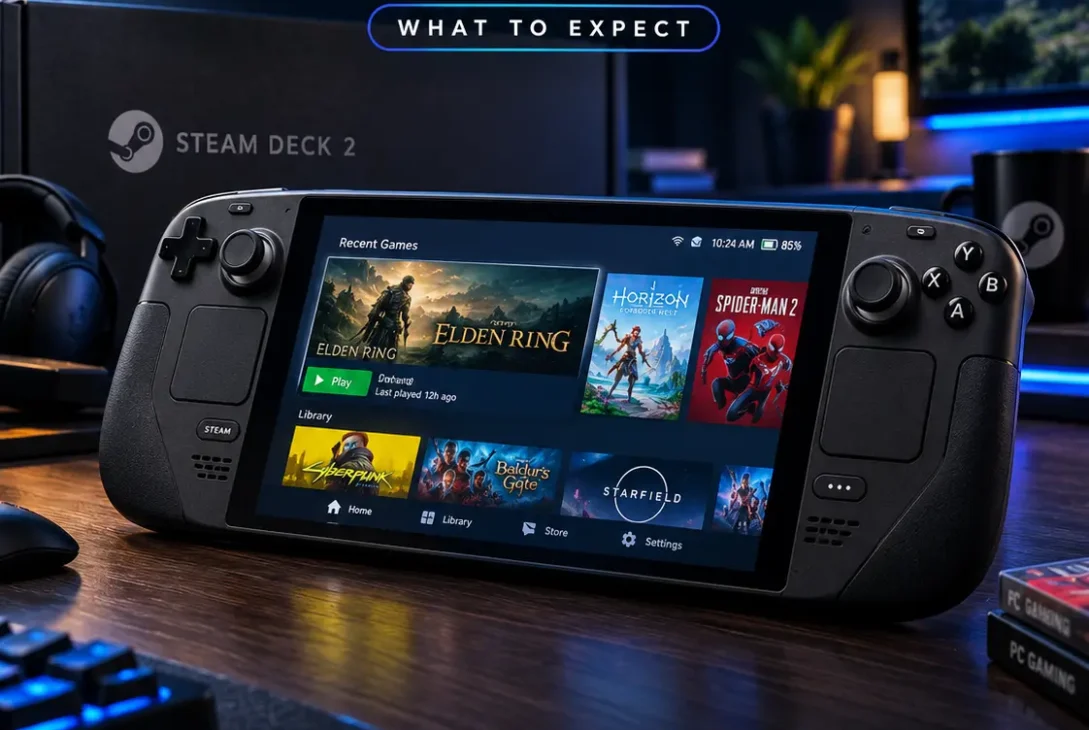
The Steam Deck 2 is one of the most anticipated handheld gaming PCs currently in development. Valve has confirmed that it is working on the next-generation Steam Deck, but the company is taking its time because it wants the next device to deliver a genuinely meaningful improvement in performance and efficiency.
Unlike many gaming hardware companies, Valve does not appear interested in releasing a new handheld simply because newer processors are available. The company has repeatedly indicated that the next Steam Deck needs a significant generational performance improvement without sacrificing the battery life and efficiency that made the original Steam Deck successful.
That means the Steam Deck 2 could still be some time away. Valve has not announced an official release date, final specifications, price, or launch configuration.
However, recent developments have made the next-generation handheld more interesting. Reports about a possible AMD semi-custom chip called Gainsborough have raised speculation that the type of processor Valve has been waiting for may finally be appearing.
Here is everything currently known about the Steam Deck 2, including its expected release date, hardware, performance, display, battery, price, SteamOS, and what Valve has officially confirmed.
Table of Contents
- Steam Deck 2: Latest Update
- Does Steam Deck 2 Have a Release Date?
- Why Is Valve Taking So Long?
- Expected Performance
- Possible AMD Processor
- Display and Design
- Battery Life
- Storage Options
- SteamOS and Software
- Steam Deck 2 Price Expectations
- Steam Deck OLED vs Steam Deck 2
- Steam Deck 2 vs Gaming Handheld PCs
- What Valve Has Confirmed
- Should You Wait for Steam Deck 2?
- Frequently Asked Questions
- Final Verdict
- SEO Details
Steam Deck 2: Latest Update
The biggest recent update came directly from Valve.
Valve programmer and Steam Deck designer Pierre-Loup Griffais confirmed that the company is “hard at work” on the next Steam Deck. He also explained that lessons learned from Valve’s newer hardware projects will contribute to the company’s future handheld.
This confirms that the Steam Deck 2 is actively being developed rather than simply being a product fans are hoping Valve will eventually make.
However, Valve has still not provided a launch date.
That is important because numerous online reports have suggested possible launch windows ranging from 2027 to 2029. Those dates should not be treated as official until Valve announces them.
Recent reporting has also linked a possible AMD chip called Gainsborough to the project, although there is no official confirmation that the processor will actually power the next Steam Deck.
Does Steam Deck 2 Have a Release Date?
No official Steam Deck 2 release date has been announced.
Valve has been clear that it does not want to rush the next-generation handheld.
The original Steam Deck launched in February 2022, while the Steam Deck OLED arrived in November 2023 with an improved display, battery, wireless connectivity, and a more efficient 6nm APU.
The OLED model was not a full performance-generation upgrade. Instead, Valve focused on efficiency, display quality, battery life, and refinements.
For the next major generation, Valve wants something considerably more substantial.
Some reports have suggested that the company could target 2028 or later, but these remain unofficial estimates.
Therefore, anyone claiming to know the exact launch date should be treated cautiously.
Could It Launch Before 2028?
It is possible, but there is currently no official evidence supporting a specific date.
Valve’s comments suggest that the company is waiting for hardware capable of delivering the performance jump it wants.
If the right AMD processor becomes available and passes Valve’s testing requirements, development could progress faster. If the available chips fail to provide enough performance per watt, Valve could continue waiting.
That makes the launch schedule dependent on technology rather than simply a fixed annual hardware cycle.
Why Is Valve Taking So Long?
The biggest reason behind the long development cycle is performance efficiency.
Valve does not want the next handheld to provide only a small performance improvement.
The company has previously explained that it isn’t interested in achieving something like 20%, 30%, or even 50% more performance if the battery life remains essentially unchanged.
Instead, Valve wants a much more meaningful generational improvement.
This approach makes sense for a handheld gaming PC.
A faster processor that consumes significantly more power could produce higher benchmark numbers but result in shorter battery life, more heat, louder cooling, and a less comfortable portable gaming experience.
Valve’s strategy is therefore different from companies that release new handheld hardware every year.
The company appears to be waiting for a processor that can provide significantly more performance while maintaining the efficiency and battery characteristics that define the Steam Deck.
https://www.steamdeck.com/en/hardware
Expected Performance
Performance will probably be the biggest reason people eventually upgrade to the Steam Deck 2.
The original Steam Deck uses a custom AMD APU based on Zen 2 CPU cores and RDNA 2 graphics. The Steam Deck OLED uses a more efficient version of the same general architecture.
A true successor is expected to move to a much newer CPU and GPU architecture.
The goal would not simply be higher benchmark scores. The more important improvement would be the ability to run demanding modern games at better frame rates while maintaining reasonable power consumption.
A future Steam Deck could potentially offer:
- Higher frame rates
- Better graphics quality
- Improved ray-tracing capability
- Faster shader processing
- Better CPU performance
- More efficient AI-related workloads
- Improved compatibility with demanding PC games
- Better performance at 800p and higher resolutions
However, Valve has not published final performance specifications.
Until official hardware details appear, specific teraflop, core-count, or frame-rate claims should be treated as speculation.
Possible AMD Processor
One of the most interesting developments surrounding the Steam Deck 2 is the appearance of an AMD chip reportedly called Gainsborough.
Recent reporting suggests that Gainsborough may be a semi-custom AMD processor built using TSMC’s N3P process.
The chip has attracted attention because its name follows the naming pattern associated with AMD’s previous Steam Deck-related silicon.
There are also reports that AMD has been shipping test equipment associated with the processor.
However, there is an important limitation.
A semi-custom AMD chip appearing in testing does not automatically prove that it is the processor Valve will use.
Valve has used semi-custom AMD hardware before, and chip designs can move between potential products during development.
Therefore, Gainsborough is an interesting possibility rather than confirmed Steam Deck 2 hardware.
If the chip does become the foundation of Valve’s next handheld, however, its newer manufacturing process and potential efficiency improvements could make it an attractive candidate.
Display and Design
Valve has not revealed the final display for the Steam Deck 2.
The current Steam Deck OLED uses a 7.4-inch HDR OLED display with a 1280 × 800 resolution and refresh rate up to 90Hz.
It also offers improved brightness, contrast, colors, and battery efficiency compared with the original LCD model.
Valve is unlikely to abandon the characteristics that make the Steam Deck comfortable for handheld gaming.
The next device could potentially retain a similar screen size while improving:
- Resolution
- Refresh rate
- HDR performance
- Brightness
- Response time
- Variable refresh technology
- Touchscreen responsiveness
A higher-resolution display is possible, but Valve may choose to prioritize battery life and performance instead.
If the GPU is designed around 800p gaming, maintaining a similar resolution could allow more demanding games to run at higher frame rates.
The physical design could also remain familiar.
Valve has spent considerable effort refining the Steam Deck’s controls, ergonomics, trackpads, triggers, and button layout. A completely different design would therefore be unnecessary unless it provided a meaningful advantage.
Battery Life
Battery life could be one of the most important areas for the Steam Deck 2.
The current Steam Deck OLED has a 50Wh battery and can provide approximately 3–12 hours of gameplay depending on the game and settings.
Valve will likely want the next-generation system to maintain or improve that range despite offering substantially higher performance.
That means efficiency will be critical.
A newer manufacturing process can potentially reduce power consumption, while improvements in CPU and GPU architecture can provide more performance from each watt.
The final battery capacity is unknown.
Valve could increase the battery size, improve the efficiency of the hardware, or use a combination of both.
For handheld gaming, efficiency may ultimately matter more than raw performance.
Storage Options
Valve has not announced official Steam Deck 2 storage configurations.
The current Steam Deck OLED is available with 512GB and 1TB storage options, while the original lineup also included smaller capacities.
A next-generation model could potentially begin at 512GB, with 1TB or larger configurations available at higher prices.
Modern PC games can consume well over 100GB each, so larger storage makes sense for a premium gaming handheld.
A microSD card slot would also be useful for expanding storage without paying for a larger internal SSD.
Valve has not confirmed whether the next Steam Deck will retain the same storage architecture.
SteamOS and Software
SteamOS will likely remain one of the biggest advantages of the Steam Deck 2.
Valve’s SteamOS provides a console-like interface while retaining the flexibility of a PC.
Players can access their Steam libraries, configure controls, install applications, switch to desktop mode, and customize the system.
The Proton compatibility layer also allows many Windows games to run on Linux without requiring developers to create native Linux versions.
Valve has continued improving SteamOS even while working on other hardware.
Recent SteamOS updates have introduced fixes, performance improvements, compatibility changes, and support for Valve’s newer hardware ecosystem.
That continued development should benefit the next handheld.
The software experience could therefore be just as important as the hardware itself.
Steam Deck 2 Price Expectations
Valve has not announced an official Steam Deck 2 price.
Pricing will depend heavily on the processor, memory, display, storage, and manufacturing costs at launch.
The current Steam Deck OLED has become more expensive in 2026 because of rising memory and storage costs. Valve announced updated OLED pricing of $789 for the 512GB model and $949 for the 1TB model.
That means future hardware pricing could be affected by component costs.
A next-generation Steam Deck could therefore launch at a significantly higher price than the original LCD model.
At the same time, Valve has historically tried to make the Steam Deck competitive with Windows gaming handhelds.
A reasonable expectation is that Valve will try to offer strong performance at a price below or around premium competitors, but no exact estimate should be considered confirmed.
Steam Deck OLED vs Steam Deck 2
The Steam Deck OLED remains a strong option for gamers who want a handheld today.
The OLED model offers:
- 7.4-inch HDR OLED display
- 90Hz refresh rate
- 50Wh battery
- Wi-Fi 6E
- 6nm AMD APU
- 512GB or 1TB storage
- Excellent controls and ergonomics
- SteamOS
The Steam Deck 2 should eventually focus on performance rather than simply display improvements.
The biggest expected difference will therefore be the processor and graphics architecture.
If you need a handheld immediately, the OLED remains a practical choice.
If your current device already runs the games you play comfortably and you’re interested in a major performance leap, waiting may make more sense.
Steam Deck 2 vs Gaming Handheld PCs
The handheld PC market has become much more competitive since the original Steam Deck launched.
Devices from ASUS, Lenovo, MSI, Ayaneo, and other companies offer newer AMD processors, higher-resolution displays, and Windows-based gaming environments.
Some competing handhelds already provide more raw performance than the current Steam Deck.
However, SteamOS gives Valve an important advantage.
The Steam Deck experience is designed around handheld gaming rather than simply shrinking a Windows desktop onto a small screen.
Valve also controls the hardware and operating system together, allowing it to optimize the experience more closely.
The next generation will need to preserve that advantage while significantly improving performance.
What Valve Has Confirmed
Valve has confirmed several important things about its approach to the next handheld.
The company is actively working on it.
Valve also wants the device to represent a significant generational improvement rather than a minor upgrade.
The company has not confirmed:
- Final processor
- GPU architecture
- RAM capacity
- Storage configurations
- Display resolution
- Battery capacity
- Price
- Release date
This distinction is important because the internet is already filled with supposed specifications and release dates.
Until Valve publishes the information itself, those details should be treated as rumors.
Should You Wait for Steam Deck 2?
Whether you should wait depends on your current gaming setup.
If you don’t own a handheld and want to play PC games right now, waiting indefinitely may not be necessary.
The Steam Deck OLED is still capable of running a large selection of PC games and provides one of the most polished handheld gaming experiences available.
If you already own a Steam Deck OLED, upgrading immediately makes even less sense because there is no confirmed successor release date.
However, if your biggest complaint is performance in demanding modern games, the next generation is worth watching.
The ideal Steam Deck 2 should deliver enough additional GPU and CPU power to make newer games playable at better settings without sacrificing the battery life and portability that define the platform.
Frequently Asked Questions
Is Steam Deck 2 officially confirmed?
Yes. Valve has confirmed that it is actively working on the next-generation Steam Deck, although it has not announced final specifications or a release date.
When will Steam Deck 2 release?
There is currently no official release date. Some reports suggest the device could arrive in 2028 or later, but Valve has not confirmed those estimates.
How powerful will Steam Deck 2 be?
Valve wants a significant performance and efficiency improvement over the current Steam Deck. Exact CPU and GPU specifications have not been announced.
What processor will Steam Deck 2 use?
Valve has not confirmed the processor. A rumored AMD chip called Gainsborough has attracted attention, but there is no official confirmation that it will be used.
Will Steam Deck 2 have an OLED display?
It is possible, but Valve has not confirmed the display technology. The current Steam Deck OLED already uses a 7.4-inch HDR OLED panel.
Will Steam Deck 2 support 120Hz?
There is no official information about the refresh rate. Valve could retain 90Hz or move to a higher refresh rate depending on performance and battery considerations.
How much will Steam Deck 2 cost?
The price has not been announced. Component costs, especially memory and storage, could influence the final price.
Will Steam Deck 2 run SteamOS?
SteamOS is expected to remain central to Valve’s handheld strategy. However, Valve has not published the complete software specifications for the successor.
Should I buy Steam Deck OLED or wait?
If you want a handheld now, the Steam Deck OLED is still a strong choice. If you are specifically waiting for a major performance upgrade, waiting for the successor may be worthwhile.
Will Steam Deck 2 run AAA games?
The goal of the next generation will almost certainly be improved performance in demanding games, but Valve has not published specific AAA performance targets.
Is Steam Deck 2 delayed?
There is no officially announced release date to delay. Unofficial reports have suggested different launch windows, but Valve has not confirmed one.
Final Verdict
The Steam Deck 2 is real, but it is not ready to be fully revealed yet.
Valve is taking a cautious approach because it wants the next handheld to provide a genuinely meaningful improvement rather than a small performance increase with the same battery-life limitations.
That strategy could make the wait frustrating, but it also explains why Valve has not rushed into releasing a yearly upgrade.
The most interesting recent development is the possible AMD Gainsborough processor. If the rumored chip is eventually connected to Valve’s hardware, it could provide the type of efficiency and performance improvement the company has been waiting for. However, that connection remains unconfirmed.
For now, the Steam Deck OLED remains the practical choice for people who want a Valve handheld immediately. For gamers who already own one and want a major generational upgrade, patience may be the better strategy.
The most important thing to watch is not a rumored release date or leaked benchmark. It is whether Valve finally has an AMD platform capable of delivering the Steam Deck 2 performance jump it has been waiting for.