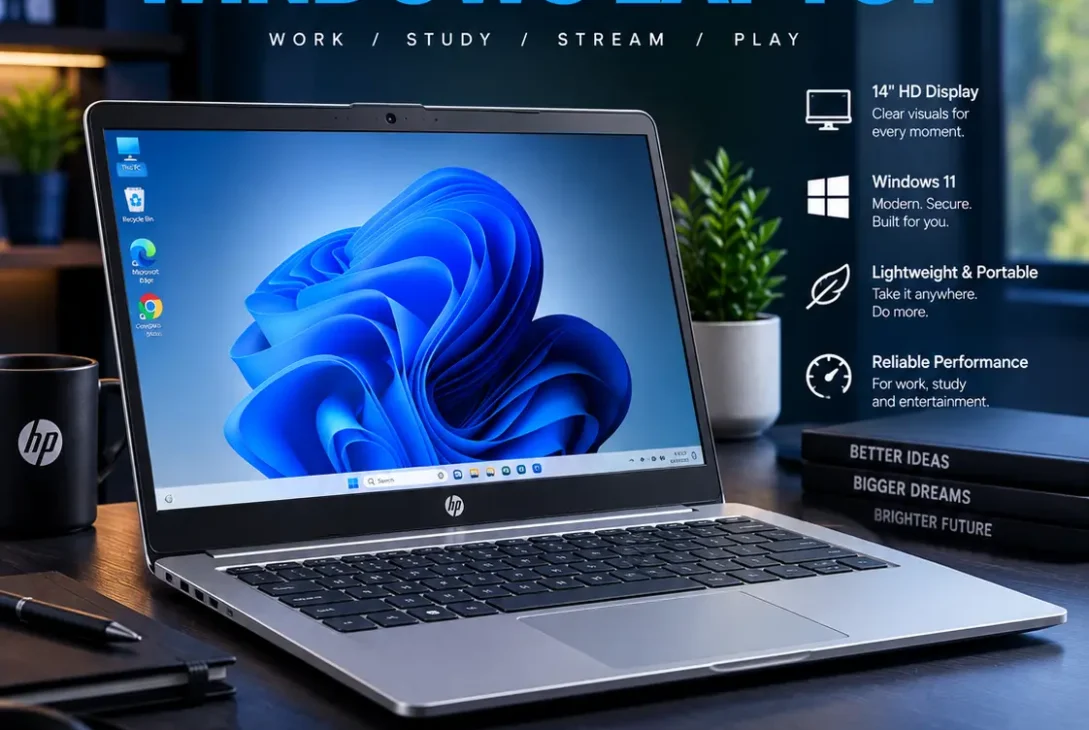
Finding an affordable laptop that is portable, reliable, and capable of handling everyday Windows tasks can be difficult when there are so many configurations available. The HP 14″ HD Windows Laptop category is designed mainly for users who want a compact computer for studying, office work, browsing, streaming, and general productivity without moving into expensive premium-laptop territory.
HP offers many different 14-inch configurations, so the specifications can vary considerably from one model to another. Depending on the exact product, buyers may find Intel or AMD processors, different RAM capacities, SSD storage, Windows 11 editions, and either HD or Full HD displays. HP’s official specifications confirm that its 14-inch range is available with several processor, memory, storage, and display combinations.
That makes it important to look beyond the product name before purchasing. A basic model with limited memory and storage can provide a very different experience from a configuration with 8GB or 16GB RAM and a fast NVMe SSD.
In this guide, we will look at the display, processor, RAM, storage, Windows 11, portability, battery, connectivity, everyday performance, gaming, and the differences between HD and Full HD screens.
Table of Contents
- What Is an HP 14-Inch HD Windows Laptop?
- Display and HD Resolution
- Processor Options
- RAM and Multitasking
- Storage Options
- Windows 11
- Design and Portability
- Battery Life
- Ports and Connectivity
- Everyday Performance
- Office and Student Work
- Entertainment and Streaming
- Gaming Performance
- HD vs Full HD
- Who Should Buy It?
- What to Check Before Buying
- Pros and Cons
- Frequently Asked Questions
- Conclusion
- SEO Details
What Is an HP 14-Inch HD Windows Laptop?
An HP 14″ HD Windows Laptop is a 14-inch HP notebook using Windows and an HD display, with many models using the familiar 1366 × 768 resolution. However, this name does not identify one specific computer.
HP’s 14-inch family includes multiple generations and configurations. For example, HP documentation shows 14-inch models with Intel Core i3, i5, and i7 processors, while AMD versions can include Ryzen 3, Ryzen 5, and Ryzen 7 chips.
The same variation exists with memory and storage. Some models can be configured with 4GB, 8GB, 12GB, or 16GB RAM, while storage options can range from smaller SSDs to 512GB or 1TB NVMe drives.
Therefore, anyone searching for an HP 14″ HD Windows Laptop should always check the complete model number and specification sheet before buying.
Display and HD Resolution
The display is one of the most important parts of an HP 14″ HD Windows Laptop.
HD on many HP 14-inch models means 1366 × 768 pixels. HP currently lists 14-inch configurations with HD panels offering features such as micro-edge designs, anti-glare surfaces, and brightness levels around 250 nits, although specifications differ between models.
A 1366 × 768 display can still be perfectly usable for normal computing.
It is suitable for:
- Web browsing
- Microsoft Word
- Online classes
- Presentations
- YouTube
- Basic spreadsheets
- Video calls
- Everyday Windows applications
The limitation is screen sharpness and workspace.
Full HD uses 1920 × 1080 pixels, which provides more detail and more room for applications. Text can look sharper, and users can fit more information on screen.
For basic tasks, an HD screen is acceptable. For photo editing, detailed spreadsheets, programming, or long hours of reading, Full HD is usually more comfortable.
Processor Options
Processor choice can have a major effect on the performance of an HP 14″ HD Windows Laptop.
HP’s 14-inch range includes both Intel and AMD options. Some HP 14-inch series offer Intel Core processors, while AMD configurations can include Ryzen 3, Ryzen 5, and Ryzen 7 chips.
This means two laptops that look almost identical externally can perform very differently.
Entry-Level Processors
Entry-level processors are intended for basic computing.
They can be suitable for:
- Browsing
- Documents
- Online learning
- Streaming
- Simple productivity applications
They are not ideal for demanding video editing, advanced 3D applications, or high-end gaming.
Mid-Range Processors
A stronger processor is useful if you regularly multitask.
A mid-range configuration can provide better performance when running several browser tabs, office applications, communication tools, and other software at the same time.
For buyers planning to keep an HP 14″ HD Windows Laptop for several years, choosing a stronger processor can be more useful than spending the entire budget on cosmetic features.
RAM and Multitasking
RAM is another specification that should not be ignored.
A modern Windows computer needs enough memory to keep applications running smoothly. HP’s 14-inch specifications show configurations ranging from 4GB to 16GB depending on the series and processor.
4GB RAM
4GB can handle basic tasks, but it is limiting.
Users who keep many browser tabs open may notice slowdowns, particularly when switching between applications.
8GB RAM
8GB is a much more practical starting point.
For an HP 14″ HD Windows Laptop, 8GB can be suitable for:
- Microsoft Office
- Web browsing
- Online classes
- Video calls
- Streaming
- Basic multitasking
16GB RAM
16GB provides additional headroom.
It can be useful for users who work with larger documents, more browser tabs, programming environments, creative applications, or heavier multitasking.
If your budget allows it, 16GB can also make a laptop more comfortable to use over a longer period.
Storage Options
Storage affects both capacity and system responsiveness.
An HP 14″ HD Windows Laptop can come with different storage technologies depending on the model. HP specifications show configurations using PCIe NVMe SSDs, while certain current entry-level models may use other storage arrangements.
64GB or 128GB
Small storage capacities are best suited to lightweight users who rely heavily on cloud storage.
Windows, applications, updates, documents, and media can consume available space quickly.
256GB SSD
256GB is a much more practical option.
It gives enough room for Windows, everyday applications, documents, photos, and other personal files.
512GB SSD
512GB is better for users who store larger amounts of data locally.
It can be useful for creative projects, large software installations, videos, photos, and extensive document libraries.
An NVMe SSD is also preferable to slower storage because it can make booting Windows and opening applications feel significantly quicker.
Windows 11 Experience
Most current HP 14-inch Windows configurations are designed around Windows 11.
HP lists Windows 11 Home among the operating-system options for several 14-inch product families, although exact editions can vary by configuration and market.
Windows 11 provides features such as:
- Snap layouts
- Virtual desktops
- Windows Security
- Microsoft Edge
- Microsoft Store
- OneDrive integration
- Modern multitasking controls
- Accessibility options
The hardware underneath Windows 11 still matters.
An HP 14″ HD Windows Laptop with 8GB RAM and an SSD will generally provide a more comfortable experience than an entry-level configuration with minimal memory and slower storage.
When buying, check whether the machine includes Windows 11 Home, Windows 11 in S mode, or another edition.
Design and Portability
The 14-inch form factor is one of the strongest reasons to consider this category.
An HP 14″ HD Windows Laptop can provide a good balance between screen size and portability.
HP’s specifications for several 14-inch models list starting weights around 1.4kg, although the exact weight changes according to configuration.
That makes a 14-inch notebook convenient for students, office workers, and people who regularly move between locations.
It can fit comfortably into many backpacks without the bulk associated with larger 15.6-inch or 17-inch machines.
Keyboard and Trackpad
Keyboard quality is important if the laptop will be used for writing, studying, or office work.
Many HP 14-inch models use full-size keyboards, while some configurations also offer backlighting. HP specifications show full-size keyboard options on several models in the range.
Before purchasing an HP 14″ HD Windows Laptop, check the exact keyboard layout if you are buying from another country.
Also consider:
- Key spacing
- Keyboard travel
- Trackpad size
- Palm-rest comfort
- Backlighting
- Function-key layout
These details can make a bigger difference during everyday use than many buyers expect.
Battery Life
Battery life varies by processor, display, battery capacity, brightness, applications, and power settings.
Several HP 14-inch models use a 3-cell 41Wh battery, although the exact battery configuration varies by product. HP also notes that actual battery performance depends on system configuration, applications, power management, environment, and other factors.
Some models also support HP Fast Charge.
For example, HP documentation for certain 14-inch configurations states that the battery can reach 50% charge in approximately 45 minutes under specified conditions.
Actual battery life should not be assumed from the battery capacity alone.
For longer battery life, users can lower display brightness, close unnecessary applications, and use Windows power-saving features.
Ports and Connectivity
Connectivity is another practical feature.
Depending on the model, an HP 14″ HD Windows Laptop can include USB Type-A, USB Type-C, HDMI, headphone/microphone connections, Wi-Fi, and Bluetooth.
HP lists several 14-inch models with two USB Type-A ports, one USB Type-C port, HDMI, and a headphone/microphone combination port.
Wireless specifications can also include Wi-Fi 6 and Bluetooth 5.3 on selected configurations.
This allows users to connect common accessories such as:
- External monitors
- USB flash drives
- External SSDs
- Wireless mice
- Keyboards
- Headphones
- Printers
Always check the exact model before purchasing because ports are not identical across every HP 14-inch configuration.
Everyday Performance
For normal productivity, a properly configured HP 14″ HD Windows Laptop can be more than sufficient.
Web Browsing
Chrome, Edge, Firefox, and other browsers should work well on configurations with sufficient RAM and an SSD.
Users who open many tabs should prioritize 8GB or 16GB RAM.
Microsoft Office
Word, Excel, and PowerPoint are natural workloads for this class of laptop.
Students can use it for assignments and presentations, while office workers can use it for documents, spreadsheets, emails, and administrative tasks.
Video Calls
The exact webcam depends on the model.
Some HP 14-inch configurations include an HP True Vision 720p camera, while newer configurations can offer higher-resolution camera hardware.
For frequent Zoom, Teams, or Google Meet use, check the webcam specification before buying.
Study and Office Work
One of the best use cases for an HP 14″ HD Windows Laptop is education and general office productivity.
Students can use it for:
- Research
- Assignments
- PDFs
- Presentations
- Online classes
- Web applications
- Programming basics
- Document creation
Office users can handle email, spreadsheets, presentations, web applications, and video meetings.
The 14-inch format is especially useful for people who need to carry their computer between home, school, college, university, or work.
Entertainment and Streaming
The laptop can also serve as a portable entertainment device.
You can use it for:
- YouTube
- Netflix
- Music
- Podcasts
- Social media
- Web browsing
- Video streaming
However, buyers should remember that an HD panel does not offer the same visual sharpness as an FHD display.
If entertainment and media consumption are major priorities, an FHD IPS configuration may be worth considering.
Gaming Performance
Gaming is not the primary purpose of most HP 14-inch HD models.
Many configurations rely on integrated Intel or AMD graphics rather than dedicated GPUs. HP lists integrated graphics across several 14-inch configurations.
That means an HP 14″ HD Windows Laptop can be suitable for lightweight games, older titles, browser games, and less demanding esports experiences depending on the hardware.
It should not be treated as a dedicated gaming laptop.
Modern AAA games generally require significantly more graphics performance, cooling, and power than a typical thin 14-inch productivity notebook provides.
HD vs Full HD
The display choice is particularly important when comparing an HP 14″ HD Windows Laptop with an FHD alternative.
| Feature | HD | Full HD |
|---|---|---|
| Resolution | 1366 × 768 | 1920 × 1080 |
| Sharpness | Basic | Higher |
| Workspace | Smaller | Larger |
| Text clarity | Acceptable | Better |
| Movies | Good | Better |
| Office work | Good | Better |
| Photo editing | Limited | Better |
| Typical price | Lower | Higher |
HP’s 14-inch range includes both HD and FHD options. Some FHD configurations use IPS panels and anti-glare surfaces, while certain HD configurations can also include touch functionality.
If the price difference is small, FHD is generally the more attractive long-term option.
If the goal is simply to get an affordable computer for basic tasks, HD can still be perfectly reasonable.
Who Should Buy It?
The HP 14″ HD Windows Laptop is primarily aimed at users who want an affordable and portable Windows computer.
Students
It can handle research, assignments, presentations, online classes, and everyday browsing.
Office Users
It is suitable for documents, spreadsheets, emails, presentations, and web-based business tools.
Remote Workers
The compact form factor makes it convenient for working from different locations.
Casual Users
If your main activities are browsing, streaming, email, and social media, a well-configured model can provide enough performance.
Budget Buyers
The HP 14-inch range includes lower-cost configurations, making it easier to choose a model according to your budget.
Who Should Look Elsewhere?
A basic HP 14″ HD Windows Laptop may not be the right choice for demanding workloads.
Consider a more powerful category if your main tasks include:
- Professional video editing
- 3D rendering
- Advanced CAD
- High-end gaming
- Professional animation
- Heavy graphics work
- Large-scale computational workloads
For those jobs, a stronger processor, more RAM, dedicated graphics, and a higher-quality display may be necessary.
What to Check Before Buying
Before buying an HP 14″ HD Windows Laptop, check the complete specification rather than relying on the product title.
Processor
Check the exact Intel or AMD model.
RAM
8GB is a practical baseline for many users, while 16GB is preferable for heavier multitasking.
Storage
An NVMe SSD is generally the better choice.
Display
Confirm whether the screen is HD or FHD and whether it uses IPS technology.
Operating System
Check whether it comes with Windows 11 Home, Windows 11 in S mode, or another edition.
Battery
Look at the battery capacity and manufacturer claims for the exact model.
Ports
Verify USB, USB-C, HDMI, audio, Wi-Fi, and Bluetooth specifications.
Warranty
Check the warranty terms and seller information before purchasing.
Upgradeability
Some HP 14-inch models have accessible SODIMM slots, while others use onboard memory. HP’s documentation shows that upgrade options can vary by processor and series.
https://support.hp.com/us-en/document/ish_8705483-8705685-16
Pros and Cons
Pros
- Compact 14-inch design
- Portable form factor
- Windows 11 availability
- Intel and AMD configurations
- SSD options
- Suitable for office work
- Good for students
- Useful connectivity
- Different configurations for different budgets
Cons
- HD displays are less sharp than FHD
- Entry-level processors can be limited
- 4GB RAM is restrictive
- Small storage options can fill quickly
- Integrated graphics are not ideal for demanding gaming
- Exact specifications vary significantly by model
Frequently Asked Questions
What is an HP 14″ HD Windows Laptop?
An HP 14″ HD Windows Laptop is a 14-inch HP notebook using Windows and an HD display, commonly 1366 × 768 on applicable configurations. The exact processor, RAM, storage, and other features depend on the model.
Is an HP 14-inch laptop good for students?
Yes. An appropriately configured model with 8GB RAM and SSD storage can handle assignments, browsing, presentations, online classes, and everyday applications.
Is 4GB RAM enough?
It can handle basic tasks, but 4GB is restrictive for modern multitasking. An 8GB configuration is a better starting point for most users.
Is 256GB SSD enough?
For many students and office users, 256GB is sufficient. If you store many videos, games, photos, or large projects, 512GB provides more flexibility.
Is HD resolution good enough?
HD can be perfectly usable for browsing, documents, and basic work. However, Full HD provides sharper text and more workspace.
Can an HP 14-inch laptop run games?
It depends on the processor and integrated graphics. Basic models are better suited to lightweight gaming than demanding modern titles.
Does an HP 14-inch laptop support Windows 11?
Yes. HP lists Windows 11 Home among the operating-system options for several 14-inch laptop families.
Is the 14-inch size portable?
Yes. Several HP 14-inch models have starting weights around 1.4kg, although exact weight depends on the configuration.
Should I choose HD or FHD?
If you have a limited budget and mainly perform basic tasks, HD can be suitable. If you can spend slightly more, FHD generally provides a better viewing and productivity experience.
Does every HP 14-inch laptop have the same specifications?
No. This is extremely important. HP sells multiple 14-inch series with different processors, memory, storage, displays, batteries, and ports.
Conclusion
The HP 14″ HD Windows Laptop category remains a practical option for students, office users, remote workers, and casual computer users who want a compact Windows machine without paying for premium hardware.
The biggest advantage is the balance between portability and everyday usability. A 14-inch screen is large enough for documents, browsing, online learning, streaming, and office applications while still being easy to carry.
However, the exact configuration matters more than the name.
A model with 8GB RAM and a 256GB or 512GB NVMe SSD can offer a much better everyday experience than a cheaper configuration with 4GB RAM and limited storage. HP’s official specifications demonstrate that its 14-inch range covers a broad selection of hardware.
The display is another major consideration. A 1366 × 768 HD screen can handle basic computing, but FHD is preferable if you want sharper text, more workspace, or a better multimedia experience.
Ultimately, the best HP 14″ HD Windows Laptop is not necessarily the cheapest one. Look at the processor, RAM, SSD, display, battery, ports, warranty, and upgrade options before making a decision.
If your requirements are everyday productivity, education, browsing, and entertainment, a properly configured 14-inch HP notebook can still be a sensible choice in 2026.