
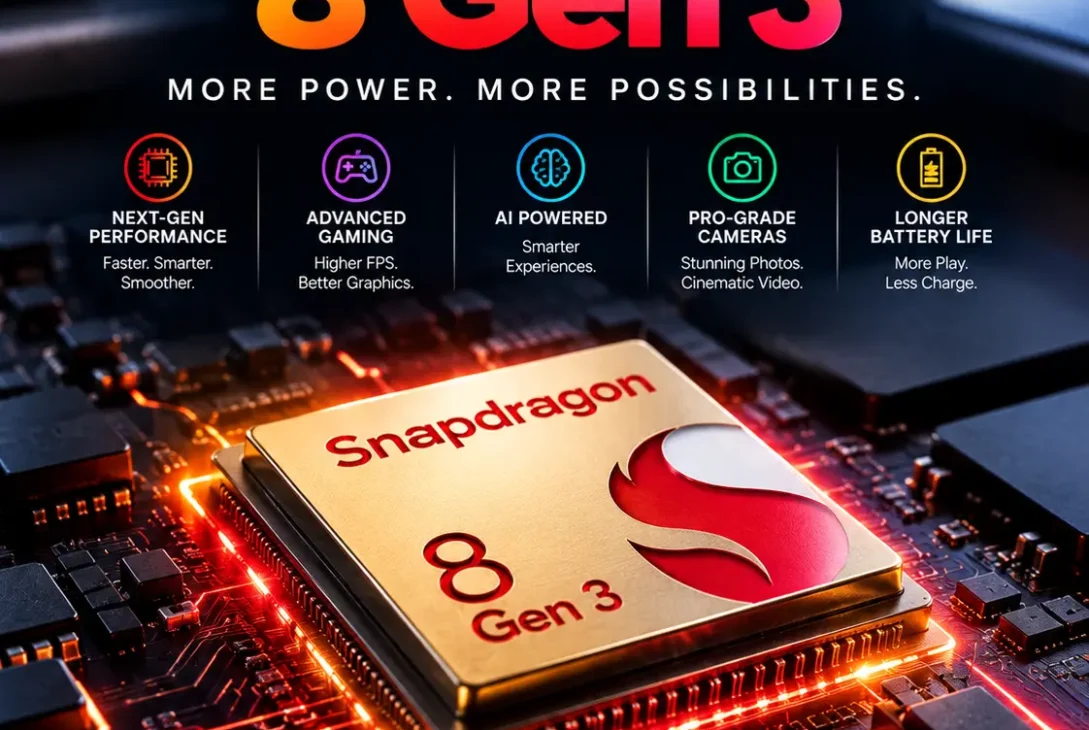
The Snapdragon 8 Gen 3 is one of Qualcomm’s most important flagship smartphone processors of the recent Android generation. Introduced in October 2023, it was designed to deliver higher CPU and GPU performance, stronger on-device AI, improved camera processing, advanced gaming features, and fast connectivity.
Although newer Snapdragon platforms have since arrived, the Snapdragon 8 Gen 3 remains relevant because it powers a large number of premium Android smartphones and continues to offer high-end performance for gaming, photography, multitasking, and everyday use.
Qualcomm built the platform around its Kryo CPU, Adreno GPU, Hexagon NPU, Spectra image signal processor, Snapdragon X75 5G Modem-RF System, and FastConnect 7800 connectivity system.
This guide covers the processor’s specifications, CPU architecture, GPU performance, AI capabilities, camera features, gaming technology, connectivity, power efficiency, supported displays, and the types of smartphones that can benefit from it.
Table of Contents
- What Is Snapdragon 8 Gen 3?
- Snapdragon 8 Gen 3 Specifications
- CPU Architecture
- GPU Performance
- Gaming Features
- AI Performance
- Camera Capabilities
- Display Support
- 5G and Connectivity
- Power Efficiency
- Real-World Performance
- Snapdragon 8 Gen 3 for Gaming
- Snapdragon 8 Gen 3 vs Older Snapdragon Chips
- Smartphones Using the Processor
- Is Snapdragon 8 Gen 3 Still Good?
- Frequently Asked Questions
- Final Verdict
What Is Snapdragon 8 Gen 3?
The Snapdragon 8 Gen 3 is a premium smartphone system-on-chip designed by Qualcomm for flagship Android devices.
Qualcomm announced the platform at Snapdragon Summit in October 2023, describing it as a platform built with on-device generative AI, premium performance, advanced gaming, photography, audio, and connectivity in mind.
Unlike a basic CPU, a modern smartphone SoC combines several important components into one platform.
These include:
- CPU
- GPU
- NPU
- Image signal processor
- 5G modem
- Wi-Fi and Bluetooth connectivity
- Security components
- Display processing
- Video encoding and decoding
This integrated approach allows the processor to handle everything from launching applications to processing photographs and rendering demanding 3D games.
Snapdragon 8 Gen 3 Specifications
The core Snapdragon 8 Gen 3 specifications show why the chip was positioned at the premium end of the Android market.
| Specification | Snapdragon 8 Gen 3 |
|---|---|
| CPU | Qualcomm Kryo |
| CPU Architecture | 64-bit |
| Prime Core | Up to 3.4GHz |
| Performance Cores | 5 cores up to 3.2GHz |
| Efficiency Cores | 2 cores up to 2.3GHz |
| GPU | Qualcomm Adreno |
| NPU | Qualcomm Hexagon |
| 5G Modem | Snapdragon X75 |
| Wi-Fi | Wi-Fi 7 |
| Bluetooth | Bluetooth 5.4 |
| Maximum Display | QHD+ up to 144Hz |
| External Display | Up to 8K at 30Hz |
| Camera Capture | Up to 200MP |
| Ray Tracing | Hardware accelerated |
| Process Technology | 4nm |
Qualcomm’s product brief lists one prime core, five performance cores, and two efficiency cores, with maximum clock speeds of up to 3.4GHz, 3.2GHz, and 2.3GHz respectively.
Actual clock speeds and capabilities can vary between devices and platform versions.
CPU Architecture
CPU performance is one of the major strengths of the Snapdragon 8 Gen 3.
The processor uses a 64-bit Qualcomm Kryo CPU configuration consisting of one prime core, five performance cores, and two efficiency cores.
This arrangement is designed to balance demanding workloads with everyday efficiency.
The prime core can handle heavily demanding tasks, while the performance cores deal with applications that need sustained processing power. The efficiency cores are intended for lighter workloads where maximum performance is unnecessary.
Qualcomm says the CPU provides up to a 30% performance improvement and 20% improved power efficiency compared with the previous generation in its own comparisons.
In practical use, this architecture can help with:
- Faster application launches
- Multitasking
- Photo editing
- Video processing
- Web browsing
- Gaming
- AI workloads
- Background application management
Actual performance depends on the smartphone’s cooling system, software optimization, RAM, storage, and manufacturer settings.
GPU Performance
The Adreno GPU is another important part of the Snapdragon 8 Gen 3 platform.
Qualcomm says its upgraded Adreno GPU provides up to 25% faster graphics rendering and up to 25% improved GPU power efficiency compared with the previous generation.
The GPU supports modern graphics technologies including hardware-accelerated ray tracing and Unreal Engine 5 Lumen global illumination and reflections.
This makes the platform particularly suitable for premium Android gaming.
The GPU can also work with Qualcomm’s Snapdragon Game Super Resolution technology, which can upscale game scenes to improve performance while maintaining image quality.
For users with high-refresh-rate smartphone displays, the graphics hardware provides the processing capability needed for smoother gameplay.
https://www.qualcomm.com/smartphones/products/8-series/snapdragon-8-gen-3-mobile-platform
Gaming Features
Gaming was a major focus of the Snapdragon 8 Gen 3.
Qualcomm introduced several Snapdragon Elite Gaming features with the platform, including hardware-accelerated ray tracing, Game Super Resolution, Adreno Frame Motion Engine 2.0, and other graphics technologies.
The platform supports up to 240Hz displays and Qualcomm promoted 240 FPS gaming capabilities for compatible titles and devices.
Ray tracing is particularly interesting because it allows supported games to simulate more realistic lighting, shadows, and reflections.
The chip also supports Unreal Engine 5.2 features, including Lumen global illumination.
However, having support for a technology does not mean every game will use it. Developers must specifically implement these features, and the smartphone manufacturer must also provide appropriate hardware and software support.
AI Performance
AI is one of the defining characteristics of the Snapdragon 8 Gen 3.
Qualcomm designed its AI Engine to support on-device generative AI applications.
The platform includes a Hexagon NPU alongside the CPU and GPU, allowing supported AI workloads to run directly on the smartphone.
Qualcomm says the Hexagon NPU delivers a 98% performance improvement and 40% better performance-per-watt for sustained AI inference compared with the previous generation, based on its stated comparisons.
The platform was designed to support generative AI models with up to 10 billion parameters on-device.
Possible applications include:
- AI assistants
- Image generation
- Photo editing
- Background replacement
- Object removal
- Voice processing
- Image expansion
- Intelligent camera features
- Text generation
On-device processing can also reduce the need to send every task to a remote server, depending on the application.
Camera Capabilities
The camera system is another area where the Snapdragon 8 Gen 3 can make a significant difference.
Qualcomm’s Spectra Cognitive ISP supports advanced computational photography and real-time image processing.
The platform supports cameras of up to 200MP and can process multiple camera feeds.
According to Qualcomm’s specifications, the platform supports configurations including triple cameras up to 36MP at 30 FPS with zero shutter lag, dual 64MP + 36MP configurations, and single cameras up to 108MP at 30 FPS with zero shutter lag.
The ISP also supports advanced HDR imaging and real-time semantic segmentation.
This can help smartphones identify different elements within a scene and process them independently.
For example, a phone can potentially distinguish between a person, sky, background, and other objects before applying different image-processing techniques.
The final camera quality still depends heavily on the phone manufacturer, camera sensors, lenses, software, and tuning.
Display Support
The Snapdragon 8 Gen 3 supports high-resolution and high-refresh-rate displays.
Qualcomm lists support for QHD+ displays at up to 144Hz and 4K displays at up to 60Hz. External displays can reach up to 8K at 30Hz or 1080p at 240Hz under supported configurations.
This makes the platform suitable for premium smartphones featuring:
- 120Hz displays
- 144Hz displays
- QHD+ resolution
- HDR
- Dolby Vision
- HDR10+
- 10-bit color
A high-refresh-rate display can make scrolling, animations, and supported games feel considerably smoother.
Again, the final display specification is determined by the smartphone manufacturer rather than the processor alone.
5G and Connectivity
Connectivity is another strong part of the Snapdragon 8 Gen 3.
The platform integrates Qualcomm’s Snapdragon X75 5G Modem-RF System.
Qualcomm lists peak download speeds of up to 10Gbps under supported conditions. It also supports 5G Dual-SIM Dual-Active configurations.
For wireless networking, the platform uses Qualcomm FastConnect 7800 and supports Wi-Fi 7.
Qualcomm lists a peak Wi-Fi speed of up to 5.8Gbps, along with 320MHz channels and 4K QAM under supported configurations.
Bluetooth 5.4 is also supported.
These capabilities make the platform suitable for:
- High-speed downloads
- Cloud gaming
- Wireless streaming
- Low-latency gaming
- High-quality Bluetooth audio
- Fast Wi-Fi networking
- Connected accessories
Actual wireless performance depends on the phone’s antennas, modem implementation, carrier network, router, and regional support.
Power Efficiency
Performance is only useful when a smartphone can maintain it without excessive battery drain.
The Snapdragon 8 Gen 3 was designed with power efficiency improvements alongside performance increases.
Qualcomm states that the CPU offers 20% improved power efficiency and the GPU provides 25% improved power efficiency compared with the previous generation. The company also cites up to 10% overall SoC power savings.
However, battery life cannot be determined from the processor alone.
Other factors include:
- Battery capacity
- Screen brightness
- Display refresh rate
- Cellular signal
- Gaming workload
- Software optimization
- Cooling system
- Camera usage
- Background applications
Two phones using the same processor can therefore have noticeably different battery life.
Real-World Performance
In everyday use, a phone powered by the Snapdragon 8 Gen 3 should have enough processing power for demanding applications.
Common tasks such as messaging, social media, browsing, video streaming, and multitasking are relatively easy workloads for a flagship-class SoC.
The bigger difference becomes visible when using demanding applications.
These include:
- High-end gaming
- Video editing
- RAW photo processing
- AI applications
- 3D applications
- Heavy multitasking
- Long gaming sessions
Thermal design is particularly important.
A phone with a large vapor chamber and effective cooling can maintain high performance for longer than a thin device with limited thermal capacity.
Snapdragon 8 Gen 3 for Gaming
For gamers, the Snapdragon 8 Gen 3 remains a capable mobile platform.
Its Adreno GPU supports hardware ray tracing, high-refresh-rate displays, Game Super Resolution, and other Snapdragon Elite Gaming technologies.
Compatible games can take advantage of these features to deliver more detailed lighting and smoother graphics.
The platform can also support demanding titles at high graphics settings when paired with a suitable cooling system and display.
However, gaming performance depends on the game itself.
Some games may prioritize graphical quality, while others target extremely high frame rates. Developers can also limit frame rates based on device temperatures, battery conditions, or software profiles.
Snapdragon 8 Gen 3 vs Older Snapdragon Chips
Compared with earlier flagship Snapdragon platforms, the Snapdragon 8 Gen 3 brought improvements in CPU performance, GPU performance, AI processing, ray tracing, and power efficiency.
Qualcomm’s own comparisons indicate a 30% CPU performance improvement, 25% faster GPU rendering, and substantial improvements in AI processing compared with the preceding generation.
The differences are particularly noticeable when moving from older flagship chips.
For basic applications, however, users may not notice a dramatic difference because modern processors are already extremely fast.
The biggest advantages become apparent in gaming, AI, photography, video processing, and other demanding workloads.
Smartphones Using the Processor
The Snapdragon 8 Gen 3 was adopted by many major Android smartphone manufacturers.
Qualcomm’s launch announcement listed brands including ASUS, Honor, iQOO, MEIZU, Nubia, OnePlus, OPPO, realme, Redmi, RedMagic, Sony, vivo, Xiaomi, and ZTE among companies expected to use the platform.
This broad adoption means the processor can be found in many different types of flagship and performance-focused smartphones.
Some manufacturers also customize thermal management, memory configuration, display settings, camera processing, and software around the platform.
As a result, two smartphones using the same SoC can provide different real-world experiences.
Is Snapdragon 8 Gen 3 Still Good?
Yes, the Snapdragon 8 Gen 3 remains a high-performance smartphone processor.
It is no longer Qualcomm’s newest flagship platform, but its CPU, GPU, AI, camera, gaming, and connectivity capabilities remain strong enough for demanding modern applications.
For someone buying a phone powered by this chip, the more important questions are the overall device quality, price, battery, cameras, display, software support, and cooling system.
A newer processor may provide better efficiency or newer features, but that does not automatically make every phone using it a better overall purchase.
Frequently Asked Questions
What is Snapdragon 8 Gen 3?
The Snapdragon 8 Gen 3 is a premium mobile platform from Qualcomm designed for flagship Android smartphones. It combines a Kryo CPU, Adreno GPU, Hexagon NPU, Spectra ISP, 5G modem, and wireless connectivity technologies.
Is Snapdragon 8 Gen 3 good for gaming?
Yes. The processor includes a powerful Adreno GPU, hardware-accelerated ray tracing, Snapdragon Game Super Resolution, and other gaming technologies designed for demanding mobile games.
Does Snapdragon 8 Gen 3 support ray tracing?
Yes. The platform supports hardware-accelerated real-time ray tracing with global illumination.
Does Snapdragon 8 Gen 3 support Wi-Fi 7?
Yes. The platform uses Qualcomm FastConnect 7800 and supports Wi-Fi 7 with compatible hardware and networks.
How fast is Snapdragon 8 Gen 3?
Its prime CPU core can reach up to 3.4GHz in the standard configuration. Qualcomm also reports up to 30% CPU performance improvement over the previous generation in its own comparisons.
Does Snapdragon 8 Gen 3 support AI?
Yes. Its Hexagon NPU and Qualcomm AI Engine support on-device AI and generative AI workloads.
Does Snapdragon 8 Gen 3 support 200MP cameras?
Yes. Qualcomm lists support for image capture up to 200MP, although the actual camera resolution depends on the smartphone manufacturer.
Can Snapdragon 8 Gen 3 run 4K video?
Yes. The platform supports advanced video capture and playback capabilities, while the exact recording features depend on the smartphone’s camera hardware and software.
Is Snapdragon 8 Gen 3 still good in 2026?
It remains a powerful processor for gaming, multitasking, photography, and everyday use. Newer Snapdragon generations can offer additional performance and efficiency, but this chip is still capable of handling demanding workloads.
Final Verdict
The Snapdragon 8 Gen 3 established itself as a powerful flagship mobile platform by combining high CPU performance, capable Adreno graphics, advanced AI processing, sophisticated camera technology, fast 5G, and Wi-Fi 7 connectivity.
Its CPU configuration reaches up to 3.4GHz, while the GPU supports hardware ray tracing and modern gaming technologies. Qualcomm also designed the platform around on-device AI, allowing compatible smartphones to perform increasingly complex AI tasks locally.
For gamers, the combination of high-refresh-rate display support, Adreno graphics, ray tracing, and Game Super Resolution makes the processor particularly capable.
For photographers and content creators, the Spectra ISP provides advanced image-processing capabilities, while Wi-Fi 7 and the X75 modem provide fast connectivity.
Even though newer Snapdragon platforms now exist, the Snapdragon 8 Gen 3 remains relevant because flagship processors do not suddenly become slow when a new generation arrives.
If a smartphone with this chip offers a strong display, camera system, battery, cooling solution, and software experience at an attractive price, its processor can still provide excellent performance for years.