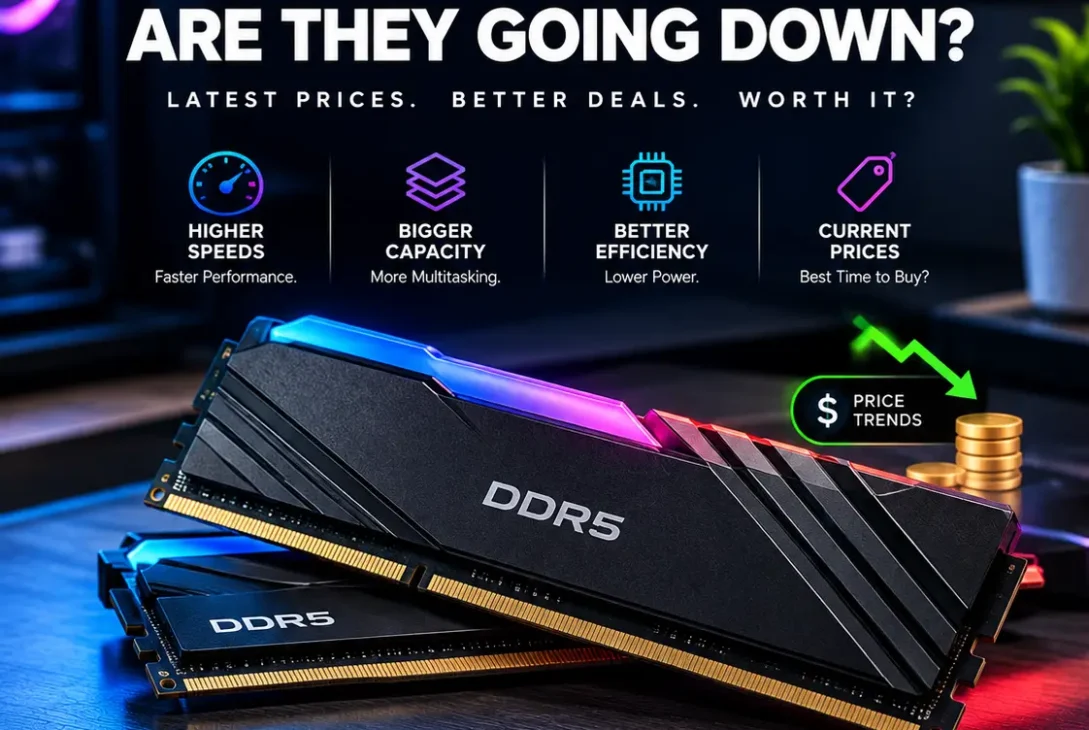
The DDR5 RAM price market has changed dramatically in 2026. Memory that was relatively affordable a year ago can now cost several times more, especially in higher-capacity kits. A standard 32GB DDR5 kit that once commonly sold around the $100–$200 range has become much more expensive in many markets.
For PC builders, gamers, laptop manufacturers, and workstation users, understanding the current memory market is now more important than simply choosing the fastest kit available.
This guide explains why DDR5 memory has become expensive, how much different capacities can cost, what is driving the market, whether prices may fall, and how to decide when to buy.
Table of Contents
- What Is DDR5 RAM?
- Why Is DDR5 RAM So Expensive in 2026?
- Current DDR5 RAM Price Trends
- How Much Does 16GB DDR5 Cost?
- How Much Does 32GB DDR5 Cost?
- How Much Does 64GB DDR5 Cost?
- Why 128GB Kits Are Extremely Expensive
- DDR5 5600 vs 6000 vs 6400
- DDR5 RAM Price Compared With DDR4
- How AI Is Affecting Memory Costs
- Should You Buy DDR5 RAM Now?
- How to Save Money on DDR5 Memory
- What Could Happen to Prices Next?
- Frequently Asked Questions
- Final Verdict
What Is DDR5 RAM?
DDR5 is the fifth generation of Double Data Rate synchronous dynamic random-access memory. It replaced DDR4 as the newer mainstream memory standard for modern desktop and laptop platforms.
Compared with DDR4, DDR5 supports higher memory frequencies, greater bandwidth, improved power management, and larger module capacities. Modern processors from AMD and Intel are designed around DDR5 on many current platforms.
The important point for buyers is that DDR5 is not simply a faster version of older memory. It uses a different memory architecture and requires compatible motherboards or laptops.
That means you cannot install a DDR5 module into a motherboard designed only for DDR4.
Why Is DDR5 RAM So Expensive in 2026?
Several factors are contributing to the unusually high DDR5 RAM price environment.
The biggest factor is the broader DRAM supply situation. Memory manufacturers are balancing traditional DRAM production against demand from data centers and AI infrastructure.
AI accelerators require huge quantities of high-bandwidth memory, while servers also consume large amounts of conventional DRAM. This competition for manufacturing capacity can affect the supply available for consumer memory.
TrendForce reported that DDR5 prices in Germany had reached nearly five times their previous-year level by August 2026, showing how extreme the retail market had become.
Retail availability also matters. When inventory is limited, retailers can increase prices rapidly, particularly for popular 32GB and 64GB kits.
Current DDR5 RAM Price Trends
Current market data shows that consumer memory prices are unusually volatile.
Tom’s Hardware’s 2026 RAM tracker reported that a conventional 32GB DDR5 kit that previously sold for approximately $100–$200 had reached around $350 or more in some U.S. listings. Its tracked prices also showed substantially higher costs for 48GB, 64GB, 96GB, and 128GB kits.
TrendForce’s DRAM data also shows elevated component and module prices. Its September data listed a 16GB DDR5 UDIMM module around $220–$245 in the tracked module spot market.
However, prices are not moving upward every single day. TrendForce reported on September 16 that DDR5 inquiries had slowed and some chip prices had begun to soften.
This suggests that the market may experience short-term corrections even while remaining expensive overall.
https://www.tomshardware.com/pc-components/ram/ram-price-index-2026-lowest-price-on-ddr5-and-ddr4-memory-of-all-capacities
How Much Does 16GB DDR5 Cost?
16GB is still enough for many everyday computers, but the value proposition has changed.
Current retail listings can put 16GB kits well above historical prices, depending on speed, brand, timings, and availability.
For example, TechRadar’s September 2026 RAM deals coverage listed a 16GB DDR5-6000 kit around $239.
For a basic office computer, that can make upgrading memory surprisingly expensive.
For gaming, however, buying 16GB today may not be the most attractive long-term choice if the motherboard supports a 32GB configuration.
How Much Does 32GB DDR5 Cost?
32GB has traditionally been one of the most popular capacities for gaming PCs.
A typical configuration is two 16GB modules running in dual-channel mode. This provides a good balance between capacity and performance for modern gaming and productivity.
Unfortunately, the DDR5 RAM price for 32GB has increased significantly.
Tom’s Hardware currently tracks 32GB DDR5-5600 and DDR5-6000 kits at around $409 in some U.S. listings.
TechRadar’s September 2026 deal listings also showed certain 32GB DDR5-6000 kits around $470–$480, depending on the model and promotion.
These prices vary considerably between countries, retailers, brands, and temporary promotions.
How Much Does 64GB DDR5 Cost?
64GB is increasingly useful for creators, developers, professionals, virtual machines, and demanding multitasking.
A common configuration is 2 × 32GB.
Unfortunately, larger modules are being affected heavily by the supply shortage. Tom’s Hardware reported tracked prices approaching $889 for a 64GB DDR5-6000 kit in its U.S. price index.
This is dramatically higher than historical pricing.
For someone building a gaming PC, 64GB can therefore represent a major portion of the overall system budget.
For professional workloads, however, the additional capacity can still be justified when applications genuinely require it.
Why 128GB Kits Are Extremely Expensive
High-capacity memory has been hit especially hard.
Tom’s Hardware reported a 128GB DDR5-6400 kit reaching approximately $2,339 in its tracked U.S. pricing, while another report highlighted a 128GB kit reaching $3,399.
These numbers show why capacity has become one of the biggest factors affecting memory costs.
A 128GB configuration can make sense for specialized workloads such as:
- 3D rendering
- Large software projects
- Virtual machines
- AI development
- Video production
- Scientific applications
- Professional workstation workloads
For ordinary gaming and web browsing, such capacity is usually unnecessary.
DDR5 5600 vs 6000 vs 6400
Higher frequency does not automatically mean better value.
DDR5-5600 is already fast enough for many general-purpose systems. DDR5-6000 is particularly popular among performance-focused desktop builders because it offers a useful balance between bandwidth, latency, compatibility, and price.
DDR5-6400 and faster kits can provide additional performance in workloads that benefit from increased memory bandwidth, but the improvement depends heavily on the CPU, motherboard, timings, and application.
During a period of inflated memory costs, paying a large premium for a small performance increase may not make financial sense.
For many buyers, a well-priced DDR5-6000 kit can be more practical than chasing the highest frequency available.
DDR5 RAM Price Compared With DDR4
DDR4 used to be the obvious budget alternative.
That advantage has weakened.
Tom’s Hardware reported that 32GB DDR4 kits that commonly sold for around $60–$90 in October 2025 had moved into the $150–$180 range by January 2026.
This means switching to an older memory generation simply to save money is not always effective.
There is another problem: new CPUs and motherboards increasingly focus on DDR5.
If you are building a completely new PC, platform compatibility and future upgrade options should be considered alongside the initial memory cost.
How AI Is Affecting Memory Costs
AI infrastructure is one of the most important factors behind today’s memory market.
Modern AI systems require enormous amounts of memory. High-bandwidth memory is particularly important for accelerators, but broader semiconductor manufacturing capacity also matters to conventional DRAM supply.
When manufacturers prioritize higher-margin memory products for data centers, consumer memory can become tighter.
The result is a market where PC users compete indirectly with rapidly expanding data-center demand.
This is one reason the current DDR5 RAM price situation is very different from an ordinary short-term retail discount cycle.
Should You Buy DDR5 RAM Now?
The answer depends on how urgently you need it.
If your computer is already running out of memory, delaying an upgrade can hurt productivity or gaming performance. In that situation, buying the capacity you actually need may be more important than waiting for a perfect price.
If you are building a new PC, however, it is worth comparing multiple retailers and checking prices regularly.
A buyer who needs 32GB should not automatically jump to a premium RGB kit simply because it has a higher frequency.
Look at:
- Capacity
- Speed
- CAS latency
- XMP or EXPO support
- Motherboard compatibility
- Warranty
- Current price
- Availability
The goal should be balanced performance rather than the highest specification on the box.
How to Save Money on DDR5 Memory
There are several ways to reduce the impact of high memory costs.
Choose 32GB Instead of 64GB When Possible
If your workload does not require 64GB, 32GB can be a much more sensible configuration.
Gaming, office applications, browsing, and many creative workloads can operate comfortably with 32GB.
Avoid Paying Extra for RGB
RGB lighting does not improve memory performance.
If two kits have similar specifications, the non-RGB model may offer better value.
Compare Multiple Speeds
Do not assume DDR5-6400 is automatically worth the premium over DDR5-6000.
Check real-world benchmarks and current prices before choosing.
Check Deals Frequently
The market is extremely volatile. TechRadar’s current deal tracking shows that promotional pricing can make specific kits substantially cheaper than their normal listed prices.
Buy a Matched Kit
Buying two matched modules is generally preferable to combining random sticks later.
A matched kit gives you a better chance of getting the advertised dual-channel performance and memory profile.
What Could Happen to Prices Next?
Predicting exact consumer memory prices is difficult.
Recent data provides mixed signals.
On one side, overall retail prices remain dramatically elevated compared with 2025. On the other, TrendForce recently reported weaker DDR5 inquiries and some softening in chip prices.
That means buyers could see short-term price fluctuations even if the broader market remains expensive.
A major improvement would likely require better supply-demand balance rather than simply a few cheaper retail promotions.
For consumers, the practical approach is to monitor prices instead of assuming that every future month will automatically be cheaper.
Frequently Asked Questions
Why is DDR5 RAM so expensive in 2026?
The major factors include constrained DRAM supply, strong server and AI demand, manufacturing capacity allocation, and limited retail inventory. Prices have risen dramatically compared with 2025.
Is 32GB DDR5 enough for gaming?
For many modern gaming PCs, 32GB is a strong capacity target. Whether you need more depends on the games, background applications, streaming, and other workloads.
Is DDR5-6000 better than DDR5-5600?
DDR5-6000 provides higher memory bandwidth, but the real-world difference depends on the CPU and workload. If the faster kit costs substantially more, DDR5-5600 can sometimes provide better overall value.
Should I buy 64GB instead of 32GB?
Buy 64GB when your applications actually benefit from it. Video editing, development, virtual machines, 3D work, and heavy multitasking are examples where additional memory can be useful.
Will DDR5 prices fall?
Prices can move in either direction. Recent TrendForce data indicates some softening in DDR5 spot activity, but overall consumer pricing remains elevated.
Can I use DDR5 RAM with a DDR4 motherboard?
No. DDR4 and DDR5 use different physical and electrical designs. The motherboard must specifically support the memory generation you purchase.
Final Verdict
The DDR5 RAM price market in 2026 is far more expensive and volatile than PC buyers became accustomed to during the previous memory cycle.
32GB remains a practical target for many users, while 64GB and 128GB configurations are increasingly expensive because higher-capacity memory has been heavily affected by supply constraints.
The best approach is to avoid buying more memory than you need, compare several retailers, consider DDR5-5600 or DDR5-6000 instead of automatically choosing the fastest kit, and watch for temporary discounts.
The market is showing some signs of short-term cooling, but current prices remain far above historical levels.