
Introduction
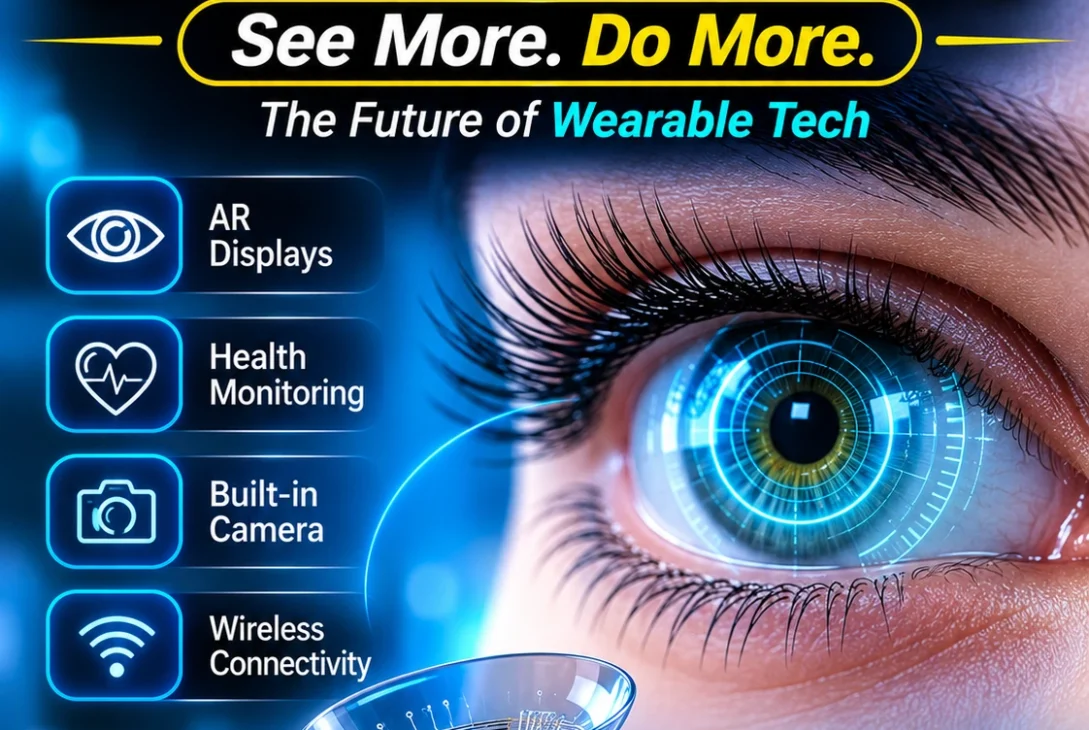
Imagine checking digital information without looking at your smartphone, monitoring changes in eye health while going about your daily routine, or receiving medication through a contact lens. These possibilities are driving the development of smart contact lenses, an emerging technology that combines traditional vision correction with miniature electronics, advanced sensors, and wireless communication.
Unlike ordinary contact lenses, these advanced devices are designed to do more than improve eyesight. Depending on their design, they may monitor intraocular pressure, analyse chemicals in tears, deliver controlled medication, or eventually display digital information directly in front of the eye.
The technology brings together several important areas of innovation, including artificial intelligence, nanotechnology, biomedical engineering, flexible electronics, and augmented reality.
In 2026, research is progressing beyond basic concepts. Scientists have demonstrated experimental lenses capable of wireless eye-pressure monitoring, while other research teams are developing systems for tear-based biomarker detection and responsive drug delivery.
However, there is an important distinction between a successful laboratory experiment and a product that consumers can safely wear every day. Most advanced devices remain in research, prototype, or preclinical development.
This guide explores how smart contact lenses work, seven potential applications, the companies developing them, recent 2026 research, their benefits and limitations, and what consumers should expect in the coming years.
Table of Contents
- What Are Smart Contact Lenses?
- How Do Smart Contact Lenses Work?
- 7 Powerful Applications of Smart Contact Lenses
- Companies Developing Smart Contact Lenses in 2026
- Benefits and Limitations
- Are Smart Contact Lenses Available to Buy?
- Safety, Privacy, and Regulatory Challenges
- What Is the Future of Smart Contact Lenses?
- Frequently Asked Questions
- Final Verdict
What Are Smart Contact Lenses?
Smart contact lenses are advanced wearable devices that combine conventional contact-lens materials with electronic, optical, or chemical components. Their purpose is to provide additional functions beyond correcting eyesight.
Traditional contact lenses use carefully designed optical surfaces to correct vision problems such as nearsightedness and farsightedness. Advanced versions can incorporate miniature sensors, transparent circuits, antennas, and specialised materials while maintaining the basic structure of a wearable lens.
For example, a medical research device might measure changes associated with pressure inside the eye. Another experimental design could analyse selected substances in tears, while an augmented-reality prototype might display simple digital information.
Not every device includes all these capabilities. Most research projects focus on solving one specific problem because integrating several technologies into such a small space is extremely difficult.
The technology also has different categories. Some devices concentrate on medical monitoring, others focus on medication delivery, and a separate group explores miniature displays and digital interaction.
This distinction matters because smart contact lenses designed for healthcare do not necessarily need the same hardware as those intended for augmented reality.
Before considering their potential, it is important to understand that most advanced versions are not yet approved for everyday consumer use.
How Do Smart Contact Lenses Work?
Developing smart contact lenses requires combining several technologies without making the lens uncomfortable or affecting normal vision.
A contact lens must remain flexible, lightweight, transparent, and compatible with the eye’s natural environment. Adding electronic components introduces additional engineering challenges.
1. Miniature Sensors
Sensors are responsible for detecting physical or chemical changes.
Depending on the application, they can measure pressure, temperature, electrical signals, or selected substances present in tear fluid.
For example, pressure-sensitive components can detect mechanical changes associated with variations in intraocular pressure. Chemical sensors may use specialised electrodes or biological recognition materials to identify particular molecules.
These measurements could eventually help researchers understand changes in eye health.
However, the accuracy of a sensor must be established through appropriate testing. A laboratory measurement does not automatically become a reliable medical diagnosis.
2. Wireless Communication
A sensor must transfer its information to an external device if users or healthcare professionals need to review the collected measurements.
Researchers are investigating miniature antennas, near-field communication, and other wireless systems to make this possible.
Some experimental smart contact lenses communicate with an external reader that collects measurements without requiring a conventional battery inside the lens.
Wireless communication also creates opportunities for connecting future devices with smartphones and specialised healthcare applications.
3. Power Management
Power is one of the biggest challenges in wearable lens development.
A traditional battery is generally too large and rigid for a comfortable contact lens. Researchers are exploring miniature energy storage, wireless power transfer, and low-energy electronic components.
An augmented-reality display may require considerably more energy than a simple chemical sensor.
Consequently, developers must balance operating time, charging requirements, heat generation, and overall lens thickness.
4. Flexible and Biocompatible Materials
The materials used in these devices must be suitable for direct contact with the eye.
Researchers are investigating hydrogels, silicone-based materials, conductive polymers, and specialised nanomaterials.
The electronics also need protective layers to prevent potentially harmful substances from reaching the eye.
This is one reason why developing smart contact lenses is more complicated than simply placing a miniature screen inside an ordinary lens.
7 Powerful Applications of Smart Contact Lenses
The technology has several potential applications across healthcare, consumer electronics, and digital communication. Some have already been demonstrated in experimental research, while others remain longer-term possibilities.
1. Monitoring Eye Pressure and Glaucoma
<AsyncImage query=”smart contact lens intraocular pressure monitoring flexible sensor research prototype” aspectRatio=”16:9″ width=”100%”/>
One of the most promising medical applications involves monitoring intraocular pressure, commonly known as IOP.
Changes in eye pressure are important when managing glaucoma. Measurements taken during a short medical appointment may not capture every fluctuation that happens throughout the day.
Researchers are therefore developing smart contact lenses that can monitor signals associated with pressure changes over time.
A study published in npj Flexible Electronics on January 13, 2026, demonstrated an integrated wireless lens using a resistive sensor and a miniature antenna. Researchers tested the system using porcine eyes and rabbit models, reporting strong correlations with conventional pressure measurements.
Another important development came from the Terasaki Institute in April 2026. Researchers published work describing an all-polymer lens that combined real-time pressure monitoring with responsive medication release in preclinical models.
These findings demonstrate the potential of combining monitoring and treatment in one device. However, they do not mean that consumers can currently replace conventional glaucoma examinations with an electronic lens.
2. Monitoring Health Through Tears
<AsyncImage query=”biomedical tear fluid biosensor smart contact lens scientific research” aspectRatio=”16:9″ width=”100%”/>
Tears contain several biological substances, including proteins, salts, hormones, and other molecules.
Scientists are investigating whether specialised sensors can detect selected biomarkers in tear fluid and provide information about physiological changes.
A September 2026 development from the Terasaki Institute introduced a reusable soft-lens platform designed to measure serotonin directly from tears.
Serotonin is involved in several physiological processes, making it an interesting research target. However, detecting serotonin in tears does not automatically provide a complete assessment of someone’s mental health or stress levels.
Future smart contact lenses could potentially support more frequent collection of biological information without requiring repeated blood samples.
Researchers still need to establish how accurately these measurements reflect changes inside the body and how environmental conditions influence the results.
3. Glucose Monitoring for Diabetes
Glucose monitoring is another widely researched application.
Researchers have investigated sensors that detect glucose-related changes in tear fluid, potentially offering an additional method of collecting information about glucose levels.
This approach is attractive because traditional glucose monitoring methods can involve repeated skin punctures or wearable sensors.
However, tear glucose and blood glucose are not identical. Their concentrations can differ, and tear production, environmental conditions, and other biological factors can influence measurements.
This makes accurate calibration particularly important.
Although experimental smart contact lenses may eventually support diabetes research, they are not established replacements for approved glucose monitoring devices.
People with diabetes should continue using their prescribed monitoring systems and following medical advice.
4. Augmented Reality and Miniature Displays
<AsyncImage query=”XPANCEO augmented reality contact lens microdisplay prototype technology” aspectRatio=”16:9″ width=”100%”/>
One of the most futuristic applications involves displaying digital information directly in front of the eye.
An augmented-reality lens could potentially show notifications, navigation indicators, simple instructions, or contextual information without requiring a smartphone screen.
Unlike smart glasses, a contact lens sits directly on the eye. This creates significant optical challenges because the display must produce an image that users can focus on comfortably.
XPANCEO is among the companies exploring this direction. Its research includes miniature displays, specialised optics, wireless power, and other components required for an integrated system.
However, demonstrating a small visual element is not the same as creating a complete smartphone interface.
For now, smart contact lenses with advanced consumer-ready displays remain an experimental technology rather than a mainstream alternative to smart glasses.
5. Controlled Medication Delivery
Traditional eye drops do not always remain on the eye for long periods. Some medication can drain away before reaching the intended tissue.
Therapeutic contact lenses could potentially hold medicine and release controlled quantities over a specific period.
Researchers are also investigating responsive systems that combine sensors with medication delivery.
For example, an experimental lens might detect a particular pressure-related change and respond by releasing a controlled amount of medication.
The Terasaki Institute’s April 2026 research demonstrated a preclinical approach combining intraocular-pressure monitoring and responsive drug release.
This type of research could eventually support more targeted eye treatments.
However, the correct dosage, release rate, material stability, and long-term safety must be established before such systems can become routine medical treatments.
6. Monitoring Dry Eye and Ocular Surface Conditions
Dry eye disease can cause discomfort, irritation, blurred vision, and other problems.
Researchers are exploring wearable sensors that can monitor selected tear-related indicators and changes in the ocular surface.
A particularly interesting 2026 research direction involves electronics-free scleral lenses with passive colour-changing sensors. A study published in August 2026 described monitoring indicators such as pH, chloride ions, and ocular surface temperature using a specialised lens structure.
This approach is different from fully electronic devices because it uses visible colour changes rather than conventional embedded electronics.
Future smart contact lenses could help researchers study how ocular conditions change over time and how treatments affect the tear environment.
However, monitoring technology must be carefully designed so that the lens itself does not disturb the tear film or create additional irritation.
7. Hands-Free Digital Interaction
Another potential application is interacting with digital information without holding a phone or wearing conventional glasses.
Future devices could provide short notifications, navigation instructions, or contextual information directly within the user’s field of vision.
Possible applications include healthcare, industrial environments, logistics, and situations where hands-free access to information is valuable.
For example, a technician might eventually receive a simple visual instruction while working with equipment.
However, the development of practical smart contact lenses for digital interaction requires more than a miniature display. Developers must also solve power management, wireless connectivity, visual comfort, and user-control challenges.
The technology must avoid distracting users or interfering with their normal vision.
Companies Developing Smart Contact Lenses in 2026
Several organisations are working on different parts of this emerging technology. Their projects provide an idea of where the industry is heading.
XPANCEO
<AsyncImage query=”XPANCEO smart contact lens prototype research laboratory” aspectRatio=”16:9″ width=”100%”/>
XPANCEO is a deep-tech company developing contact-lens concepts that combine augmented reality, health monitoring, wireless power, and miniature electronics.
In June 2026, the company presented a portfolio of prototypes at VivaTech, including an on-eye microdisplay demonstration and technologies intended to support a future integrated system.
XPANCEO stated that it was working towards its first public demonstration of an integrated prototype in early 2027.
This is an announced development target, not a confirmed consumer release date.
The company’s work is particularly interesting because it focuses on combining multiple technologies into a single wearable platform.
Official website: https://xpanceo.com/
Terasaki Institute for Biomedical Innovation
<AsyncImage query=”Terasaki Institute biomedical engineering contact lens research laboratory” aspectRatio=”16:9″ width=”100%”/>
The Terasaki Institute is researching medical applications involving biosensors, tear analysis, and therapeutic contact lenses.
Its 2026 research includes intraocular-pressure monitoring, responsive drug delivery, and serotonin measurement through tears.
In September 2026, the institute also announced an approximately $6.9 million NIH research grant for developing a platform intended to investigate real-world PTSD monitoring.
The project illustrates how researchers are exploring physiological measurements beyond traditional eye-care applications.
These developments remain research projects and should not be interpreted as approved diagnostic products.
Official website: https://terasaki.org/
Universities and Research Organisations
Universities are contributing to the development of flexible electronics, transparent sensors, specialised materials, and biomedical systems.
Research published in journals such as Nature, Science Translational Medicine, and Journal of Nanobiotechnology demonstrates the range of technologies being investigated.
These publications are important because they provide experimental evidence and describe the engineering challenges that still need to be solved.
Benefits and Limitations of Smart Contact Lenses
The potential advantages are considerable, but the technology also faces several practical challenges.
Potential Benefits
Continuous monitoring: Certain sensors could collect information over longer periods instead of relying entirely on occasional measurements.
Hands-free access: Future display systems may provide simple digital information without requiring users to look at a smartphone.
Non-invasive research: Tear-based sensors could provide an additional way to study selected biological markers.
Targeted treatment: Therapeutic lenses may eventually deliver medication directly to the eye.
Compact design: A contact-lens form factor could be useful in situations where conventional wearable devices are inconvenient.
Current Limitations
Power requirements: Batteries and wireless systems must fit into a very small space.
Comfort: Electronic components must not make the lens excessively thick or rigid.
Oxygen supply: The cornea needs sufficient oxygen, which restricts material and component choices.
Measurement accuracy: Sensors must provide repeatable and clinically meaningful results.
Manufacturing costs: Specialised materials and precision manufacturing could increase prices.
Long-term safety: Developers must establish that the devices remain safe during extended use.
The biggest challenge is not demonstrating one impressive feature. It is combining multiple technologies into a device that remains comfortable, dependable, affordable, and safe.
Are Smart Contact Lenses Available to Buy?
<badge color=”warning”>Limited commercial availability</badge>
As of November 2026, fully integrated consumer devices combining everyday vision correction, augmented-reality displays, wireless connectivity, and continuous health monitoring are not broadly available for routine purchase.
Some specialised technologies and experimental devices exist, but their commercial and regulatory status differs.
A research publication or company demonstration does not automatically mean a product has been approved for consumers.
In the United States, the Food and Drug Administration maintains an official list of contact lenses reviewed and allowed to be sold. Consumers can use the FDA contact lens database to check relevant product information.
UK consumers should also check the applicable medical-device regulatory information and consult an eye-care professional before considering unfamiliar lens technologies.
If a website advertises advanced smart contact lenses for immediate purchase, verify the manufacturer, intended use, safety information, and regulatory status before spending money.
Do not assume that an ordinary electronic gadget has the same safety requirements as a medical contact lens.
Safety, Privacy, and Regulatory Challenges
Because these devices sit directly on the eye, their safety requirements are particularly demanding.
Eye Safety and Biocompatibility
The lens must have a suitable fit, smooth surfaces, appropriate oxygen permeability, and materials that are safe for ocular use.
Electronic components must be securely protected. The device must also avoid excessive heat and prevent potentially harmful materials from reaching the eye.
Users should never modify an ordinary contact lens or insert electronic components into one.
Data Privacy and Cybersecurity
Connected devices could collect sensitive information about eye health and biological signals.
If this information is transferred to a smartphone or cloud platform, developers must protect it against unauthorised access.
Important safeguards include encryption, secure authentication, user consent, and clear information about data storage.
Consumers should understand what information is collected, who can access it, and whether it is shared with external services.
Medical Regulation
A device designed to diagnose, monitor, or treat a medical condition may face regulatory requirements that differ from those for ordinary consumer electronics.
Manufacturers may need to demonstrate safety, clinical performance, manufacturing quality, and measurement accuracy.
The regulatory requirements in the United States and United Kingdom are not identical, so product approval should be checked in the relevant market.
What Is the Future of Smart Contact Lenses?
The future of smart contact lenses will depend on how successfully developers combine sensors, displays, power systems, and biocompatible materials.
Medical applications may reach practical use before advanced augmented-reality displays because a focused monitoring sensor does not necessarily require a complete visual interface.
For example, an eye-pressure monitoring device could perform its intended function without displaying notifications or graphics.
Researchers will also need to improve wireless charging, low-energy electronics, optical clarity, and manufacturing consistency.
Artificial intelligence could eventually help analyse collected measurements and identify patterns. However, AI-generated interpretations will require appropriate clinical validation before being used for medical decisions.
XPANCEO’s planned integrated prototype demonstration in early 2027 is one milestone worth following, but it should not be confused with a guaranteed commercial launch.
For consumers, the most important developments to watch are independently validated clinical results, long-term safety studies, regulatory decisions, and practical pricing.
The next generation of smart contact lenses could introduce new possibilities in healthcare and wearable computing, but widespread adoption will depend on evidence rather than demonstrations alone.
Frequently Asked Questions
1. What are smart contact lenses used for?
They are being developed for eye-pressure monitoring, tear-based biomarker detection, controlled medication delivery, and augmented-reality applications. Their actual capabilities depend on the specific design.
2. Are smart contact lenses available in 2026?
Research prototypes and specialised experimental systems exist, but fully integrated consumer products are not broadly available for everyday use.
3. Can smart contact lenses monitor blood glucose?
Researchers are investigating glucose-related sensing through tears. However, tear measurements are not established replacements for approved blood-glucose monitoring systems.
4. Can these lenses help people with glaucoma?
Experimental devices can monitor signals associated with intraocular pressure. Some research also explores responsive medication delivery, but these technologies are not replacements for prescribed glaucoma treatment.
5. Do smart contact lenses have built-in displays?
Some augmented-reality prototypes incorporate miniature display technology. However, full smartphone-style displays are not yet available in mainstream contact lenses.
6. Which companies are developing smart contact lenses?
XPANCEO is working on miniature displays, wireless power, and integrated wearable systems. The Terasaki Institute is researching biosensing and therapeutic applications. Universities are also developing sensors and new lens materials.
7. Are smart contact lenses safe for everyday use?
Safety depends on the specific design, materials, fitting, and regulatory status. Experimental devices should only be used within authorised research or clinical settings.
8. Can smart contact lenses deliver medication?
Yes, experimental systems have demonstrated controlled medication delivery in research settings. However, further testing is needed before these approaches can become routine treatments.
9. Will smart contact lenses replace smart glasses?
Not necessarily. Contact lenses could offer a compact interface, while smart glasses have more space for batteries, cameras, displays, and controls. Both technologies may serve different purposes.
10. When will smart contact lenses become mainstream?
There is no confirmed mainstream release date. XPANCEO has announced plans for an integrated prototype demonstration in early 2027, but a prototype is not the same as an approved commercial product.
Final Verdict
Smart contact lenses represent an interesting combination of wearable computing and medical engineering. Research in 2026 has demonstrated progress in wireless eye-pressure monitoring, tear-based biomarker detection, and experimental medication delivery.
Companies are also working on miniature displays, improved optical systems, and flexible electronic components that could eventually make advanced lenses more practical.
However, there is still a considerable difference between a successful laboratory prototype and a safe consumer product. Long-term comfort, oxygen permeability, reliable power, measurement accuracy, manufacturing costs, and regulatory approval remain important challenges.
For now, smart contact lenses should be viewed as an emerging technology with promising healthcare and computing applications rather than a replacement for ordinary contact lenses, smartphones, or established medical devices.
The next major milestones will be stronger clinical evidence, safer materials, practical power systems, and regulatory clearance. These developments will determine how quickly the technology moves from research laboratories into everyday life.