
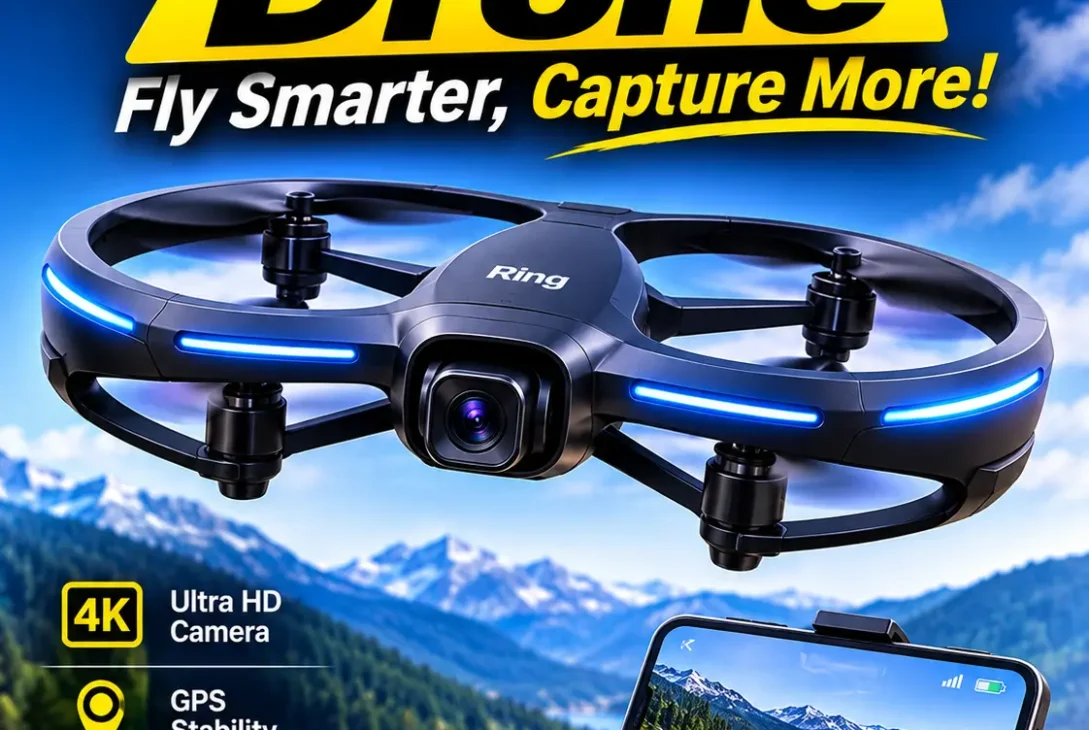
Introduction
Most home security cameras stay in one place. A doorbell camera watches an entrance, while an indoor camera covers one room. These products are useful, but a fixed camera cannot show what is happening outside its viewing angle. Ring is introducing a different approach: a flying indoor camera that can travel to selected areas when a homeowner wants to investigate.
The ring drone, officially called the Ring Drone Cam, is part of Ring Robotics, announced by Amazon in November 2026. It can follow custom routes and respond to supported alerts from compatible Ring devices. The idea is to provide mobile visibility without installing a separate camera in every room.
The announced US price is $249.99, with shipping planned for January 27, 2027. However, the product still needs required FCC equipment authorisation before it can be sold or leased. This guide covers its features, navigation, privacy, price, subscriptions, limitations, and the questions buyers should consider before purchasing.
Table of Contents
- What Is the Ring Drone?
- How the Ring Drone Works
- 11 Important Features to Know
- Camera Quality and Video Coverage
- AI Pilot and Autonomous Navigation
- Privacy and Home Security
- Price and Release Date
- Subscription Requirements
- Benefits and Limitations
- Who Should Consider Buying It?
- Ring Drone vs Traditional Security Cameras
- Frequently Asked Questions
- Final Verdict
What Is the Ring Drone?
The ring drone is a flying security camera designed for indoor home monitoring. It stays in a charging dock until an owner starts a flight, a scheduled route begins, or a supported security event triggers it. It can then travel to a preset location and provide a view of that area.
Its purpose is to inspect places that fixed cameras may not cover. A homeowner might want to check a hallway, look toward a window, or investigate an alert in another room without walking through the property. The Ring Drone is intended to add mobility to a Ring security setup, not replace every camera.
Amazon announced it under Ring Robotics. Unlike a recreational quadcopter, it is designed around mapped indoor routes and automated checks rather than free-flight entertainment. It should also be distinguished from the Ring Rover Cam, a separate wheeled security robot designed for business premises.
How the Ring Drone Works
Setup begins with mapping. The owner carries the aircraft through the home so AI Pilot can understand the layout. Ring says the system uses camera input, specialised vision models, onboard sensors, and cloud processing to create a map and support navigation.
Users can then create patrol points and routes, such as an entrance, hallway, or window. A flight can be started through the Ring app, scheduled where a compatible plan allows, or triggered by supported Ring security activity. The camera follows its preset route to inspect the selected area. It is designed for automated indoor checks, not unrestricted manual piloting.
11 Important Features to Know
1. Custom Flight Routes
Owners can create routes between selected rooms and patrol points, such as entrances, hallways, or windows. This gives the camera a planned way to inspect multiple areas.
2. Scheduled Patrols
The Ring Drone can follow planned routes at selected times. Ring says scheduled flights require a compatible Ring Protect plan, so buyers should check subscription terms first.
3. On-Demand Checks
A user can start a flight through the Ring app when an alert needs a closer look. The camera travels to a preset location and provides a live view.
4. Automatic Incident Response
When a compatible Ring camera, sensor, or alarm detects activity, the aircraft can fly to a previously selected patrol point to investigate.
5. 2K Video
Ring lists 2K video resolution. The final image will still depend on lighting, distance, movement, and wireless conditions.
6. Wide Field of View
A 148-degree field of view helps capture more of a room from one position, although furniture and walls can still block parts of the scene.
7. 360-Degree Camera Rotation
The camera can rotate through 360 degrees, allowing it to look in different directions without requiring the aircraft to change its position.
8. Low-Light LEDs
Two built-in LED lights are designed to help the camera see in darker rooms and hallways. Results will depend on the surrounding conditions.
9. AI-Assisted Navigation
AI Pilot uses camera input, vision models, onboard sensors, and cloud processing to map spaces and help the aircraft navigate around obstacles.
10. Ring Ecosystem Integration
The product is designed to work with compatible Ring cameras, doorbells, sensors, and alarms, allowing it to respond to activity within an existing setup.
11. Dock-Based Privacy
Ring says the camera is off while docked and begins recording when the aircraft takes flight. The dock also provides a home for charging and storage.
Camera Quality and Video Coverage
Video quality is one of the most important considerations for any security camera. Ring lists the Drone Cam with 2K video and a 148-degree field of view, alongside a camera that can rotate 360 degrees.
These specifications suggest that the Ring Drone is intended to capture a broad view when it reaches a patrol point. The wide field of view can help cover more of a room, while camera rotation can provide additional context without requiring a separate flight. The built-in LED lights are intended to support checks in low-light areas.
However, buyers should avoid assuming that 2K automatically guarantees clear identification in every situation. A moving aircraft, a distant subject, poor lighting, reflective surfaces, and wireless performance can all influence the final image. Security footage is most useful when the camera can reach a suitable position and remain stable long enough to capture relevant activity.
The Ring Drone is best understood as a mobile inspection camera for homes. Its strength is the ability to move between selected locations, not necessarily to outperform a dedicated fixed camera in every technical category. A well-positioned indoor camera may still provide more consistent coverage of a specific doorway or valuable object.
AI Pilot and Autonomous Navigation
Autonomous navigation is what separates this product from a camera simply attached to a drone. Ring’s AI Pilot system is designed to map the home, identify patrol locations, plan routes, and respond to obstacles. The company says it combines camera input, vision models, onboard sensors, and cloud processing.
Indoor spaces can change. Furniture moves, doors open, and people or pets may cross a route unexpectedly. The system is intended to navigate around obstacles, but that does not mean it will suit every layout. Buyers should test routes carefully and follow the manufacturer’s safety instructions.
Low ceilings, hanging decorations, narrow spaces, glass, mirrors, and frequently moved furniture deserve attention during setup. The ring drone relies on mapping and connectivity, so an environment that is difficult for its sensors to interpret may affect performance.
This is not unrestricted manual flying like a hobby quadcopter. Users should understand those limits before depending on it for home security.
Privacy and Home Security
A flying camera inside a home raises questions that do not apply in the same way to a fixed outdoor camera. Ring says the camera is off while docked and begins recording when the aircraft leaves its dock. Recording indicators are intended to show when it is active. Amazon also says Ring Robotics footage is protected by its Throw Away the Key encryption system. Buyers should still review the privacy policy, account settings, and subscription terms.
Households should agree on where flight routes are allowed. Bedrooms, bathrooms, guest rooms, and other private spaces may be unsuitable for patrols. Tell household members and visitors how the Ring Drone works and when it may fly.
Account security matters too. Use a strong, unique password, enable available security features, keep the app updated, and review who can access shared devices. Responsible configuration is as important as the camera itself.
Price and Release Date
Amazon announced a US price of $249.99 for the Ring Drone Cam, with shipping expected to begin on January 27, 2027. There is an important qualification: the announcement says the product has not yet received the required Federal Communications Commission authorisation and cannot be sold or leased until that approval is obtained.
For that reason, the announced date should be treated as a planned shipping date rather than an unconditional guarantee. The company has invited interested customers to sign up for updates. At the time of the announcement, Amazon had not confirmed a launch date or local price for markets such as the United Kingdom, Canada, Australia, or Pakistan.
The ring drone may attract international buyers, but availability, shipping, warranty coverage, replacement parts, and subscription support can vary by country. Importing a connected security device also raises questions about regional app support and power requirements. Buyers should wait for official regional information instead of relying on unofficial listings.
Subscription Requirements
The hardware price is not necessarily the complete cost of ownership. Ring has indicated that certain features, including scheduled flights, require a compatible Ring Protect plan. Subscription terms can change, and the exact plan needed for each feature should be checked on the official product page before purchase.
A buyer should compare the cost of the Ring Drone with the ongoing plan fee and decide whether the extra functions are useful. Someone who only wants occasional on-demand checks may value the product differently from a household that wants automatic patrols and saved recordings. Check whether video history, event review, and other services are included in the plan available in your country.
It is also worth checking whether an existing Ring subscription covers the new device or whether a different tier is required. Do not assume that every plan includes every feature. Read the current terms carefully and calculate the annual cost, not just the advertised monthly price.
Benefits and Limitations
Mobility is the main benefit. A fixed camera cannot move to another room, while this product is designed to visit preset locations. It may reduce the need to install a camera in every area and provide extra context after an alert. Ring integration could also make it convenient for existing customers.
There are important limitations. The Ring Drone is designed for indoor use, not outdoor surveillance. It cannot replace a weatherproof camera or provide continuous coverage of every room at once. Flight time, charging, noise, obstacle handling, and route reliability are practical issues that independent reviews should examine.
The Ring Drone also depends on mapping and connectivity. Reflective surfaces, transparent barriers, changing furniture, and difficult layouts may affect navigation. A fixed camera may remain the better choice for continuous monitoring of one doorway or valuable object.
Who Should Consider Buying It?
The product may appeal to Ring customers who want to check multiple indoor areas without installing several fixed cameras. It could be useful for larger homes, properties with separate rooms, or people who frequently travel and want an additional way to investigate alerts. It may also interest technology enthusiasts who want to try a new approach to home monitoring.
It is less compelling for someone who only needs to watch one entrance or a single room. A conventional indoor camera is usually simpler for that job and does not need to fly, map routes, or recharge after movement. Renters should also consider whether the Ring Drone can operate safely in their available space.
Before buying, think about the rooms you want to monitor, whether you already own Ring devices, how often you would use scheduled patrols, and whether a subscription makes financial sense. The Ring Drone is a specialised security product, so its value depends on a real need for mobile coverage.
Ring Drone vs Traditional Security Cameras
Traditional cameras are usually easier to install and provide continuous views of a specific area. They are a strong choice for entrances, driveways, garages, and rooms where a fixed angle is sufficient. Battery-powered and plug-in models also come in a wide range of prices.
A mobile camera offers a different benefit. Instead of buying several cameras for several rooms, a household may use one device to inspect multiple preset locations. However, it cannot watch all those locations at the same time. When it is flying in one room, another room is not being monitored by that aircraft.
For many homes, the most sensible arrangement may be a combination. Fixed cameras can cover critical entrances continuously, while a mobile device can provide additional checks when needed. The Ring Drone should therefore be compared with the role it is meant to fill, rather than judged as a direct replacement for every existing camera.
Frequently Asked Questions
Is the Ring Drone available to buy now?
Amazon announced the Ring Drone Cam in November 2026 and listed a planned US shipping date of January 27, 2027. The product still requires FCC authorisation before it can be sold or leased, so availability depends on regulatory approval.
How much does the Ring Drone cost?
The announced US price is $249.99. This is the hardware price, and some functions require a compatible Ring Protect subscription. Taxes, shipping, and regional pricing may differ.
Can it fly outside?
No. It is designed as an indoor security camera. It should not be treated as an outdoor drone for gardens, streets, or aerial photography.
What video resolution does it support?
Ring lists 2K video, a 148-degree field of view, and a camera that can rotate 360 degrees. Actual footage quality will depend on lighting, distance, movement, and network conditions.
Does it need a subscription?
Some features, including scheduled flights, require a compatible Ring Protect plan. Check the current official terms for the plan available in your region.
Is it the same as the old Always Home Cam?
It follows the same broad idea of a flying indoor camera, but the 2026 Ring Drone Cam is a newly announced product under Ring Robotics. The earlier Always Home Cam was announced years ago but did not reach general retail availability.
Should I replace my indoor cameras with it?
Not automatically. Fixed cameras provide continuous coverage of specific areas, while a mobile camera visits selected locations at different times. Many homes may benefit from using both types for different purposes.
Final Verdict
The Ring Drone Cam is an interesting step in the evolution of home security. By combining a flying camera with automated routes, AI-assisted navigation, and Ring ecosystem integration, it offers a way to inspect indoor areas that fixed cameras cannot easily reach. Its 2K camera, wide field of view, rotating lens, and dock-based privacy approach make it a distinctive product in the consumer security market.
However, it is important to keep expectations realistic. The announced $249.99 price does not include every possible ongoing cost, some features require a compatible subscription, and the planned US launch remains subject to FCC authorisation. International availability has not been confirmed. Buyers should also consider privacy, flight limitations, mapping reliability, and whether mobile coverage solves a genuine problem in their home.
For existing Ring users who want flexible indoor checks, the ring drone could become a useful addition once independent reviews and real-world testing are available. For everyone else, a reliable fixed camera may still be the more practical and affordable option. The best decision is to compare the product’s confirmed capabilities with the specific security needs of your property, rather than buying it simply because the technology is unusual.