
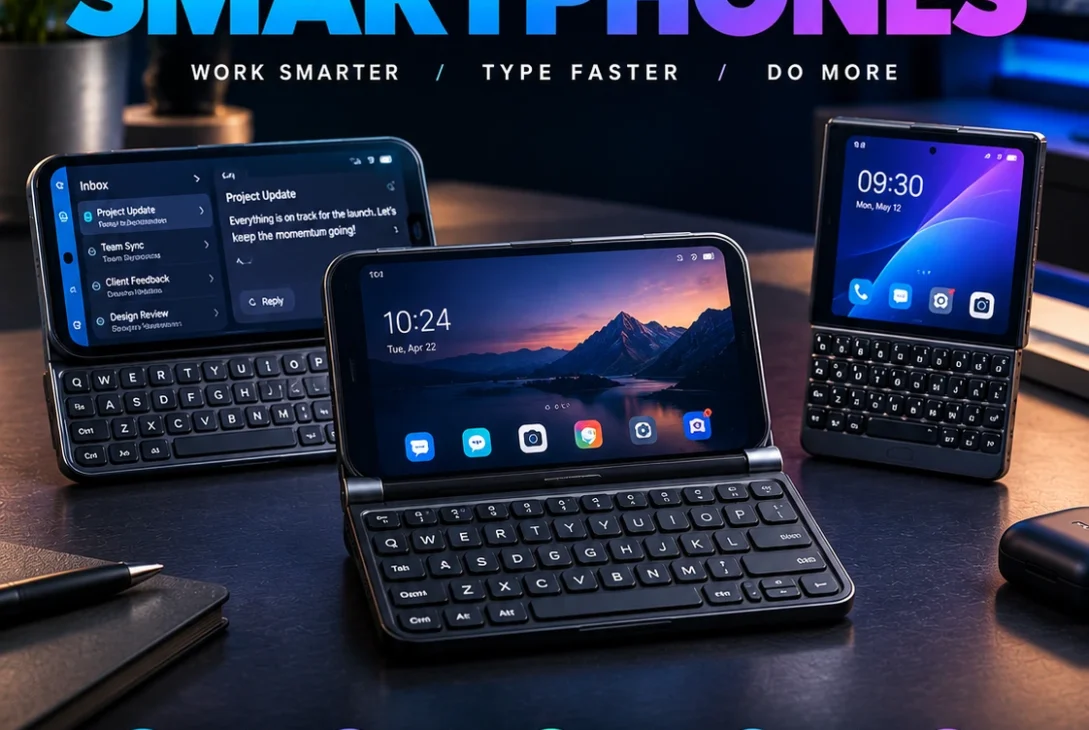
Keyboard smartphones are making a small but noticeable comeback in 2026. While almost every mainstream phone now relies on a touchscreen keyboard, a growing group of users still prefers physical keys for messaging, email, productivity, and everyday typing.
The modern keyboard smartphones market is very different from the old BlackBerry era. Instead of being dominated by major manufacturers, the category is now mainly served by smaller companies developing Android phones with physical QWERTY keyboards.
Recent devices such as the Unihertz Titan 2 show that physical-keyboard phones can still combine a traditional typing experience with modern smartphone features. Unihertz describes the Titan 2 as a 5G Android phone with a redesigned physical QWERTY keyboard and customizable keys.
At the same time, new products are bringing the physical-keyboard concept to a new generation of smartphone users. Clicks, for example, has announced the Communicator, a BlackBerry-inspired Android smartphone with a built-in keyboard that is scheduled to begin shipping later in 2026.
This guide explains how keyboard smartphones work, why people still want them, which models are available, what to consider before buying, and whether a physical keyboard makes sense for your needs.
Table of Contents
- What Are Keyboard Smartphones?
- Why Are Keyboard Smartphones Making a Comeback?
- How Physical Keyboard Phones Work
- Benefits of Keyboard Smartphones
- Drawbacks of Keyboard Smartphones
- QWERTY vs Touchscreen Keyboards
- Unihertz Titan 2
- Unihertz Titan Pocket
- Unihertz Titan Slim
- Clicks Communicator
- Keyboard Smartphones for Productivity
- Keyboard Smartphones for Messaging
- Are Keyboard Smartphones Good for Gaming?
- What to Look for Before Buying
- Are Keyboard Smartphones Worth Buying in 2026?
- Frequently Asked Questions
- Final Thoughts
- External Links
What Are Keyboard Smartphones?
Keyboard smartphones are mobile phones that include a physical keyboard instead of relying exclusively on an on-screen keyboard.
Most modern examples use a QWERTY layout, meaning the letters are arranged similarly to a traditional computer keyboard.
The physical keyboard can be positioned below the display, as seen on several BlackBerry-inspired designs, or integrated into a different form factor.
Unlike traditional feature phones, modern keyboard smartphones generally run a smartphone operating system such as Android. This means users can access applications, web browsers, messaging services, email clients, social networks, cloud services, and other smartphone features.
The main difference is the typing method.
Instead of tapping virtual keys on a touchscreen, users press individual physical buttons. This provides tactile feedback that some people find more comfortable and accurate for longer messages.
Why Are Keyboard Smartphones Making a Comeback?
For years, physical keyboards appeared to be disappearing from smartphones.
The popularity of large touchscreen displays pushed manufacturers toward thinner devices with fewer physical buttons. BlackBerry-style smartphones became increasingly uncommon as Android and iPhone devices dominated the market.
However, interest in keyboard smartphones has never completely disappeared.
In 2026, smaller manufacturers continue developing physical-keyboard devices, while new companies are also experimenting with modern interpretations of the classic QWERTY phone.
The category remains niche rather than mainstream. Current coverage of the market shows that smaller manufacturers, particularly Unihertz, are responsible for many of the available physical-keyboard Android phones.
There is also a practical reason behind the renewed interest.
Many users spend hours writing emails, messages, notes, and documents on their phones. For those users, physical keys can provide tactile confirmation that a button has actually been pressed.
This makes keyboard smartphones particularly interesting for people who prioritize typing over photography, gaming, or having the thinnest possible phone.
How Physical Keyboard Phones Work
A physical keyboard phone works much like a miniature computer with dedicated input keys.
Each key sends a specific input to the operating system. Depending on the phone, the keyboard can also support shortcuts, navigation gestures, programmable keys, or cursor controls.
Modern keyboard smartphones can combine physical typing with touchscreen interaction.
For example, you might use the keyboard to type an email while using the touchscreen to scroll through the message.
Some newer designs go further.
The Unihertz Titan 2 includes customizable A-Z keys, allowing users to assign shortcuts to individual physical keys. It also includes keyboard-based cursor and scrolling functions.
This approach turns the keyboard into more than a typing tool.
It can become part of the phone’s navigation and productivity system.
Benefits of Keyboard Smartphones
Tactile Typing
The biggest advantage of keyboard smartphones is tactile feedback.
With a touchscreen keyboard, you normally rely on visual confirmation and vibration. Physical keys provide a mechanical sensation when pressed.
Some users find this makes typing more deliberate and comfortable.
Better Physical Feedback
Physical buttons are easier to identify without constantly looking at the screen.
Once users become familiar with the layout, they may be able to type while paying less attention to individual keys.
Productivity
A physical keyboard can be useful for people who frequently send emails, write messages, take notes, or manage text-heavy conversations.
A phone with a keyboard can feel more like a miniature productivity device than a traditional touchscreen smartphone.
Dedicated Shortcuts
Some newer keyboard smartphones allow physical buttons to perform shortcuts.
Depending on the device, keys may be configured to open applications, activate functions, or control navigation.
Different User Experience
A physical keyboard also provides something increasingly rare in smartphones: mechanical interaction.
For people who enjoyed classic BlackBerry devices, the experience can feel familiar while still providing access to modern Android applications.
Drawbacks of Keyboard Smartphones
Physical keyboards also create compromises.
Smaller Displays
A built-in keyboard takes up space that could otherwise be used for the display.
This can make the phone physically larger or force manufacturers to use a smaller screen.
Limited Choices
There are far fewer keyboard smartphones than standard Android and iPhone models.
Major manufacturers such as Apple, Samsung, and Google generally focus on touchscreen designs.
As a result, buyers have fewer choices for cameras, processors, displays, and accessories.
Older Hardware on Some Models
Some physical-keyboard phones use hardware that is not competitive with flagship smartphones.
This is especially important if you want advanced gaming performance or high-end cameras.
Higher Niche Pricing
Because production volumes are smaller, a physical-keyboard phone does not necessarily cost less than a mainstream smartphone.
In some cases, you may pay more for the specialized design.
QWERTY vs Touchscreen Keyboards
A touchscreen keyboard is flexible.
It can change its layout, language, size, and appearance depending on the application.
Physical keyboards are less flexible, but they provide consistent button placement and tactile feedback.
For short messages, a touchscreen keyboard is usually convenient.
For people who write long emails or messages throughout the day, physical keys may be more appealing.
Neither option is universally better.
The choice depends on how you use your phone.
If typing is one of the most important things you do on a smartphone, keyboard smartphones become more interesting.
If you mostly watch videos, take photos, browse social media, and play games, a conventional touchscreen phone may make more sense.
Unihertz Titan 2
The Unihertz Titan 2 is one of the more modern examples of keyboard smartphones.
Unihertz describes it as a 5G QWERTY smartphone running Android 15. Its physical keyboard includes features such as customizable A-Z keys, keyboard backlighting, cursor assistance, and scrolling functions.
The phone is designed to combine the classic physical-keyboard experience with more modern smartphone functionality.
Its keyboard can therefore be used for more than basic text input.
Users can configure shortcuts and interact with certain parts of the interface using the physical controls.
For buyers specifically looking for a modern Android phone with a built-in QWERTY keyboard, the Titan 2 is an important model to consider.
You can view the manufacturer’s specifications on the official Unihertz Titan 2 page.
Unihertz Titan Pocket
The Titan Pocket is another example of keyboard smartphones built around a compact physical keyboard.
Unihertz designed the Titan Pocket with a small square display and a physical QWERTY keyboard. The company lists a 3.1-inch display, 6GB of RAM, 128GB of storage, a 4,000mAh battery, and a programmable key.
The compact form factor is one of its defining characteristics.
It is considerably different from today’s large-screen smartphones and is designed around one-handed operation and physical typing.
The Titan Pocket is also an example of how different the physical-keyboard market can be from conventional smartphone design.
Unihertz Titan Slim
The Titan Slim takes a somewhat different approach.
It has a rectangular 4.2-inch display and a physical QWERTY keyboard. Unihertz also highlights keyboard shortcuts and multilingual typing support.
Compared with extremely compact keyboard phones, the larger rectangular display can make general smartphone tasks more practical.
The Titan Slim demonstrates that keyboard smartphones do not have to copy the exact shape of classic BlackBerry devices.
Manufacturers can combine modern touchscreen layouts with traditional physical controls.
Clicks Communicator
The Clicks Communicator is another interesting development in the physical-keyboard category.
Unlike a keyboard accessory attached to an existing smartphone, the Communicator is being developed as a complete Android smartphone with a built-in keyboard.
Current reports say it is expected to begin shipping in December 2026. The device has been described with a 4.03-inch AMOLED display, 12GB of RAM, 256GB storage, expandable microSD storage, and a 4,350mAh battery following announced upgrades.
Its design is clearly inspired by the classic BlackBerry concept while targeting modern smartphone users.
This is significant because it shows that interest in keyboard smartphones is not limited to older devices.
New companies are still experimenting with the form factor.
Keyboard Smartphones for Productivity
Productivity is arguably one of the strongest reasons to consider a physical keyboard.
Writing a long email on a touchscreen can be comfortable for some users, but others prefer physical keys because every button provides tactile feedback.
Keyboard smartphones can be useful for:
- Business messaging
- Notes
- Slack conversations
- Discord
- Document editing
- Quick replies
- Social media posting
- Task management
The physical keyboard can also reduce the need to constantly look at the screen while typing.
For professionals who communicate primarily through text, that can be a useful advantage.
However, buyers should still check the keyboard layout before purchasing because key size, spacing, and arrangement vary considerably between devices.
Keyboard Smartphones for Messaging
Messaging is another natural use case.
People who spend a large portion of their day writing texts may appreciate the consistency of a physical keyboard.
With touchscreen typing, the keyboard disappears when it is not needed and changes depending on the application.
With keyboard smartphones, the keys are always available.
This can make replying to messages feel faster and more deliberate.
The experience is especially attractive to people who used BlackBerry devices in the past and still prefer physical buttons.
However, modern predictive text and swipe typing have made touchscreen keyboards significantly better than they were years ago.
That means the advantage of a physical keyboard is largely about preference and typing style rather than an automatic productivity boost.
Are Keyboard Smartphones Good for Gaming?
Gaming is not usually the main reason to buy keyboard smartphones.
Most mobile games are designed around touchscreen controls, gestures, and large displays.
A physical keyboard can actually reduce the available display area, which may make some games less comfortable.
There are exceptions.
Retro games, emulators, text-heavy games, and applications that benefit from physical buttons can be interesting on a keyboard phone.
Still, if gaming performance is your priority, a mainstream gaming smartphone will generally offer more powerful hardware, larger displays, and better gaming-focused features.
What to Look for Before Buying
If you are considering keyboard smartphones, check more than just the keyboard.
Keyboard Quality
Look for comfortable key spacing, reliable switches, useful shortcuts, and a layout that matches your typing style.
Android Version
Check which Android version the phone runs and whether the manufacturer provides software updates.
Processor
A physical keyboard does not compensate for slow hardware.
Choose a processor appropriate for the applications you use.
Display
Consider screen size, resolution, brightness, and panel quality.
Battery
Physical-keyboard phones can have different battery capacities depending on their size and design.
5G and Network Support
If you need modern cellular connectivity, verify the supported 5G bands and compatibility with your carrier.
Camera
Do not assume a keyboard phone will provide flagship-level camera performance.
If photography is important, research the actual camera hardware and image-processing capabilities.
Software Support
Long-term software updates are particularly important because niche smartphone manufacturers may have different update policies from major Android brands.
Are Keyboard Smartphones Worth Buying in 2026?
For the right user, keyboard smartphones can still make sense in 2026.
They offer something mainstream smartphones generally do not: a built-in physical typing experience.
However, they are not designed to replace every flagship phone.
The category is still relatively small, and most buyers will find more choices among conventional touchscreen smartphones.
A keyboard phone makes the most sense if you specifically value tactile typing, physical shortcuts, compact productivity, or the classic QWERTY experience.
If you prioritize flagship cameras, gaming performance, extremely bright displays, or a large ecosystem of accessories, mainstream phones may provide more options.
The important point is to understand the trade-off before buying.
Frequently Asked Questions
Are keyboard smartphones still available in 2026?
Yes. Physical-keyboard smartphones remain a niche category, with companies such as Unihertz continuing to produce Android phones with QWERTY keyboards. New products are also being developed for 2026.
What are keyboard smartphones?
Keyboard smartphones are mobile phones that include a physical keyboard, usually with a QWERTY layout, alongside smartphone features such as apps, mobile internet, cameras, and touchscreen controls.
Is a physical keyboard better than a touchscreen?
It depends on the user. Physical keyboards provide tactile feedback and consistent buttons, while touchscreen keyboards offer more flexibility and larger displays.
Can keyboard smartphones run Android apps?
Many modern keyboard phones use Android and can run Android applications. However, app compatibility depends on the phone’s Android version, hardware, and software support.
Are keyboard smartphones good for business?
They can be useful for people who frequently write emails, messages, notes, and other text. Physical keys can make typing feel more deliberate and tactile.
Do keyboard smartphones have 5G?
Some newer models do. For example, the Unihertz Titan 2 is marketed as a 5G QWERTY Android smartphone.
Are BlackBerry phones still usable?
Classic BlackBerry devices are no longer a practical choice for modern smartphone use because legacy BlackBerry services were discontinued. Modern keyboard phones instead attempt to provide a similar physical-keyboard experience using current smartphone platforms.
Are keyboard smartphones expensive?
Prices vary considerably. Because physical-keyboard phones are a niche category, their prices depend on the manufacturer, hardware, software, and production volume.
Final Thoughts
Keyboard smartphones occupy a unique place in the smartphone market.
While touchscreen phones have become the standard, physical QWERTY keyboards still offer something that software keyboards cannot completely replicate: real tactile buttons.
Modern devices are also moving beyond simple nostalgia. Phones such as the Unihertz Titan 2 combine physical keyboards with Android, 5G, programmable keys, and modern smartphone functionality. Meanwhile, upcoming devices such as the Clicks Communicator demonstrate continued interest in the concept.
For users who spend much of their day typing emails, messages, notes, or documents, a physical keyboard can provide a distinctive productivity experience.
For everyone else, a conventional touchscreen smartphone may remain more practical because of its larger display, broader hardware selection, and wider availability.
Ultimately, keyboard smartphones are not trying to replace every modern smartphone. They are designed for users who want a different way to interact with their phone—and in 2026, that niche is still alive.