
Introduction
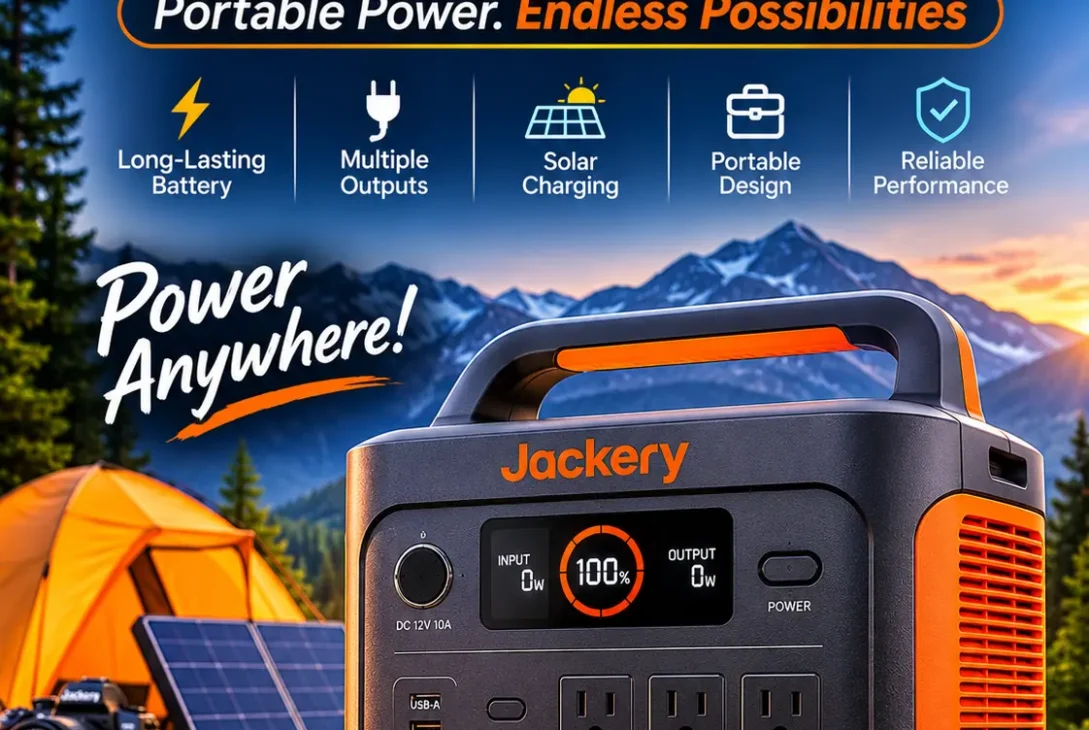
A reliable backup power source can make a major difference during power outages, camping trips, road travel, and outdoor activities. Portable battery systems have become increasingly popular because they provide electricity without requiring a traditional fuel-powered generator. A Jackery power station is one option worth considering for people who need portable energy for electronic devices, small appliances, and emergency backup.
Jackery offers several portable power stations with different battery capacities, output ratings, charging options, and expansion capabilities. Some models are designed for charging phones and laptops, while larger systems can support refrigerators, televisions, and selected household appliances.
However, choosing the right model requires more than looking at its battery capacity. You also need to understand watt-hours, continuous output, battery chemistry, solar charging, charging speed, and the devices you intend to operate.
This guide explains how a Jackery power station works, what its different product categories offer, how to choose the right capacity, and whether it is a practical investment in 2026.
Table of Contents
- What Is a Jackery Power Station?
- How Does a Jackery Power Station Work?
- Understanding Jackery Power Station Models
- Battery Capacity and Power Output Explained
- Solar Charging and Portable Energy
- What Can You Power With a Jackery Power Station?
- How Long Does a Jackery Power Station Last?
- Important Features to Consider Before Buying
- Advantages and Disadvantages
- Jackery vs Traditional Gas Generators
- Is a Jackery Power Station Worth Buying in 2026?
- Frequently Asked Questions
- Final Verdict
What Is a Jackery Power Station?
A Jackery power station is a rechargeable portable battery system designed to provide electricity when a conventional wall outlet is unavailable. It stores electrical energy in an internal battery and delivers that energy through different output connections.
Depending on the model, these connections can include:
- AC outlets for compatible household appliances
- USB-A ports for smaller electronic devices
- USB-C ports for modern phones, tablets, and laptops
- 12V car-style outputs for compatible accessories
- DC connections for selected equipment
Unlike a conventional gasoline generator, a portable battery system does not burn fuel to generate electricity while operating. It stores energy beforehand and releases it when connected devices need power.
This makes a Jackery power station useful for camping, photography, remote working, emergency preparation, and temporary backup electricity.
The company also offers compatible solar panels, allowing users to recharge selected models using sunlight. This can be particularly helpful during extended outdoor trips or situations where access to grid electricity is limited.
How Does a Jackery Power Station Work?
The basic operating process is straightforward. Electricity enters the device through a charging connection, gets stored inside its battery, and becomes available through its output ports.
There are three main stages.
1. Charging the Internal Battery
A Jackery power station can generally be charged through compatible wall outlets, vehicle charging connections, or supported solar panels.
Wall charging is convenient when electricity is available. Vehicle charging can be useful during road trips, while solar charging provides another option when users spend extended periods outdoors.
Charging speed depends on the model, charging method, input limits, and environmental conditions.
2. Storing Electrical Energy
The internal battery stores electricity in watt-hours (Wh). This measurement indicates how much energy the battery can hold.
For example, a 1,000Wh battery theoretically stores enough energy to supply a 100W device for ten hours. Actual operating time will usually be shorter because of conversion losses and the device’s changing power consumption.
3. Supplying Power to Connected Devices
When a compatible device is connected, the power station supplies electricity through the appropriate output.
AC outlets use an internal inverter to convert battery electricity into alternating current. USB and DC outputs provide power through their respective connections.
A Jackery power station also includes protection and battery-management systems. These help monitor operating conditions and protect the equipment within its specified limits.
Understanding Jackery Power Station Models
Jackery has developed several product families for different energy requirements. Understanding the differences is important because a compact travel model cannot provide the same backup capability as a larger expandable system.
Explorer Series
The Explorer family includes portable battery systems with different capacities and output ratings.
Smaller models are suitable for charging phones, cameras, tablets, and other low-power electronics. Larger Explorer products can support more demanding equipment, depending on their rated output.
For example, the Explorer 1000 v2 offers a 1,070Wh LiFePO4 battery and 1,500W rated AC output. Its specifications make it suitable for several everyday electronics and selected household appliances.
Explorer Plus Series
The Explorer Plus family includes models designed for users who need additional capacity and, on selected products, expandable battery storage.
The Explorer 1000 Plus and Explorer 2000 Plus families are examples of higher-capacity options. Their expansion capabilities can make them useful for users planning larger backup systems.
The newer Explorer 1000 Plus v2 and Explorer 2000 Plus v2 introduce a redesigned Cell-to-Body battery architecture. Jackery announced these models at IFA 2026, highlighting reduced size and weight while maintaining substantial battery capacity.
HomePower Series
Jackery also offers products under its HomePower branding. These systems are designed with home backup and higher-capacity energy requirements in mind.
Their suitability depends on the specific model, supported appliances, output ratings, and installation requirements.
Before purchasing a Jackery power station, check the exact product specifications for your country. Model names, electrical standards, accessories, and availability can differ between markets.
Battery Capacity and Power Output Explained
Two specifications matter more than almost anything else when choosing a portable power system: battery capacity and output power.
They measure different things.
What Does Watt-Hour Capacity Mean?
Watt-hours indicate how much energy a battery stores.
A larger capacity generally allows a device to operate for longer, provided the connected equipment remains within the power station’s output limits.
Consider these simplified examples:
| Battery capacity | Example use |
|---|---|
| 250Wh | Phones, cameras and small electronics |
| 500Wh | Electronics, lighting and selected small devices |
| 1,000Wh | Laptops, televisions and selected appliances |
| 2,000Wh | Longer backup periods and higher energy requirements |
| 5,000Wh | Larger backup applications, subject to system limits |
These are general capacity categories rather than guaranteed operating-time recommendations.
What Does Watt Output Mean?
Output power, measured in watts, determines how much power the unit can deliver at a particular moment.
For example, a power station rated for 1,500W continuous output can operate compatible devices whose combined running demand stays within that limit.
Some appliances require considerably more electricity when starting. Refrigerators, pumps, and certain motor-driven equipment can have high startup demands.
This is why surge output is also important.
A Jackery power station with a high battery capacity may still be unsuitable for an appliance if its continuous or surge output is insufficient.
Solar Charging and Portable Energy
Solar charging is one of the most useful features of modern portable battery systems.
Compatible solar panels collect sunlight and convert it into electricity, which is then transferred to the battery through the supported charging connection.
Jackery’s SolarSaga panel range is designed to work with compatible products.
How Solar Charging Works
The process involves three basic steps:
- Place the compatible solar panel where it receives direct sunlight.
- Connect it to the power station using the supported cable.
- Monitor the charging process through the device’s display or app, where supported.
The amount of electricity generated depends on sunlight intensity, panel orientation, temperature, shading, and weather.
A solar panel rated at 200W will not necessarily deliver 200W continuously throughout the day.
How Long Does Solar Charging Take?
Solar charging time depends on battery capacity and the amount of energy the panels can actually produce.
A simple theoretical calculation is:
Charging time = Battery capacity ÷ Solar input
For example, a 1,000Wh battery receiving a consistent 200W input would require approximately five hours under ideal conditions.
Real-world charging usually takes longer because solar production changes throughout the day and energy conversion involves losses.
A Jackery power station paired with compatible solar panels can provide additional flexibility for camping, remote working, and emergency preparation.
What Can You Power With a Jackery Power Station?
The devices you can operate depend on the model’s capacity, continuous output, surge rating, and available connections.
Here are some common examples.
Smartphones and Tablets
Smartphones and tablets generally require relatively little electricity compared with larger household appliances.
USB-A and USB-C connections make it convenient to charge multiple compatible devices.
Laptops and Computers
Many laptops can be powered through compatible USB-C connections or AC adapters.
However, gaming laptops and high-performance workstations may require more power than ordinary office laptops.
Always check the laptop’s adapter rating and the power station’s supported output.
https://faq.jackery.com/hc/en-us/articles/52356402743835-Warranty-Policy
Refrigerators
Selected refrigerators can operate using a sufficiently powerful portable battery system.
However, refrigerator consumption changes throughout the day because compressors switch on and off. Startup power requirements also matter.
A larger battery can provide longer operation, but actual runtime depends on the refrigerator’s energy consumption and operating conditions.
Televisions and Entertainment Devices
Televisions, streaming devices, Wi-Fi equipment, and gaming consoles can be suitable loads when their combined power requirements remain within the unit’s limits.
Users should calculate the total electricity demand before connecting multiple devices.
Lights and Small Appliances
LED lighting, cameras, fans, and selected small appliances are common applications.
A Jackery power station can be particularly useful for temporary lighting during camping trips or unexpected power interruptions.
How Long Does a Jackery Power Station Last?
There are two different meanings of battery life: how long the device powers connected equipment on one charge and how many years the internal battery remains useful.
Runtime on a Single Charge
Runtime depends on battery capacity and the power consumption of connected equipment.
A useful estimate is:
Runtime in hours = Battery capacity in Wh × 0.85 ÷ Device consumption in watts
The 0.85 factor represents an illustrative allowance for conversion losses. Actual efficiency varies by product and operating conditions.
For example, a 1,000Wh battery powering a device that continuously consumes 100W could provide approximately 8.5 hours under this simplified calculation.
The actual result may be lower because of standby consumption, temperature, battery condition, and changing device demand.
Long-Term Battery Lifespan
Battery chemistry plays a major role in long-term performance.
Older lithium-ion battery systems and newer lithium iron phosphate (LiFePO4) systems can have different cycle-life ratings.
Some newer Explorer products use LiFePO4 cells. For example, the Explorer 1000 v2 is rated for 4,000 cycles to at least 70% remaining capacity under the manufacturer’s stated conditions.
This does not mean every Jackery product has the same lifespan. Always check the specific model’s battery chemistry and published cycle rating.
Important Features to Consider Before Buying
Before selecting a Jackery power station, compare more than its advertised capacity.
Battery Chemistry
LiFePO4 batteries are popular in newer portable energy systems because they can offer longer cycle life and good thermal stability.
However, the chemistry alone does not determine overall product quality. Battery management, construction, charging controls, and operating conditions also matter.
Number and Type of Ports
Check whether the device has enough AC, USB-A, USB-C, and DC connections for your equipment.
Modern USB-C output is particularly useful for laptops and newer mobile devices.
Charging Speed
Charging speed can make a significant difference when the battery needs to be replenished quickly.
Compare wall charging, solar input, and vehicle charging specifications before making a decision.
Expandable Battery Capacity
Some larger systems support additional battery packs.
Expansion can be useful when your electricity requirements increase over time. However, not every Explorer model supports this feature.
Display and Monitoring
A clear display can show remaining battery percentage, input power, output power, and estimated operating time.
Selected models also support app-based monitoring and control.
Warranty and Customer Support
Warranty coverage varies by product, purchase region, and sales channel.
For example, Jackery’s official warranty policy lists different coverage periods for different product families. Check the warranty that applies to the exact model you are purchasing rather than assuming every unit has identical coverage.
Advantages and Disadvantages
A portable battery system can be useful, but it is not the ideal solution for every situation.
Advantages
- Portable electricity without operating a fuel-burning generator.
- Multiple output connections for different electronics.
- Rechargeable through compatible wall, vehicle, and solar inputs.
- Useful for camping, travel, and selected emergency backup needs.
- Quiet operation compared with conventional fuel generators.
- No exhaust emissions during battery-powered operation.
- Selected models offer expandable battery capacity.
- Can support essential electronics during temporary outages.
Disadvantages
- Higher upfront cost than some basic backup alternatives.
- Battery capacity limits how long appliances can operate.
- High-power appliances may exceed the output rating.
- Solar charging depends on weather and sunlight.
- Larger models can be heavy and difficult to move.
- Battery performance and lifespan change with use and age.
- Replacement accessories and expansion batteries can increase the total cost.
A Jackery power station is most useful when its capacity and output match the user’s actual electricity requirements.
Jackery vs Traditional Gas Generators
Portable battery systems and gasoline generators both provide electricity away from conventional wall outlets, but they operate differently.
| Feature | Jackery Power Station | Gas Generator |
|---|---|---|
| Energy source | Stored battery electricity | Gasoline or other fuel |
| Operating noise | Generally quiet | Usually louder |
| Exhaust emissions during operation | None | Produces exhaust |
| Indoor operation | Follow manufacturer instructions; no fuel exhaust, but ventilation and electrical safety still matter | Never operate indoors or in enclosed spaces |
| Refueling | Recharge battery | Add fuel |
| Long-duration operation | Limited by stored energy and recharge access | Can continue while fuel is available |
| Maintenance | Battery and electronic system care | Engine and fuel-system maintenance |
| Portability | Depends on battery size | Depends on generator size |
A battery-based system is attractive for people who prioritize quiet operation, portability, and simple charging.
A fuel generator may be more appropriate for extended high-power operation when fuel is readily available.
Neither option is universally better. The right choice depends on the appliances, required runtime, budget, and available charging or fuel supply.
Is a Jackery Power Station Worth Buying in 2026?
A Jackery power station can be a worthwhile purchase for people who need portable electricity for specific applications.
For campers, it can provide power for lighting, cameras, phones, and selected appliances. Remote workers can use compatible models to keep laptops and networking equipment running during temporary interruptions.
Homeowners may also consider larger models for selected backup applications.
However, a portable battery should not automatically be treated as a complete home backup system. Running an entire household requires significantly more energy and may require a professionally designed installation.
Who Should Consider Buying One?
A Jackery power station may be suitable for:
- People who regularly go camping or travel in recreational vehicles.
- Photographers and content creators working outdoors.
- Remote workers who need temporary backup electricity.
- Homeowners who want to power selected essential devices.
- People who want to combine portable electricity with compatible solar panels.
Who May Not Need One?
A smaller power station may be unnecessary if you only need to charge a smartphone occasionally.
Similarly, users who need to run high-power equipment continuously may require a larger battery system, an appropriately rated generator, or a professionally installed backup solution.
Before purchasing, calculate your total watt-hour requirements and check the continuous and surge output of the model.
Frequently Asked Questions
1. What is a Jackery power station used for?
A Jackery power station provides portable electricity for compatible devices and appliances. Common uses include camping, outdoor activities, emergency backup, photography, and remote working.
2. Can a Jackery power station run a refrigerator?
Some larger models can operate compatible refrigerators, provided their startup demand and continuous power consumption remain within the unit’s limits. Runtime depends on battery capacity and refrigerator usage.
3. Can you charge a Jackery power station with solar panels?
Yes. Selected models support compatible Jackery SolarSaga panels and other approved solar charging configurations. Maximum solar input and connection requirements vary by model.
4. How long does a Jackery power station last?
Runtime depends on battery capacity and connected equipment. A 1,000Wh battery powering a 100W load may provide approximately 8.5 hours using an illustrative 85% efficiency assumption. Actual results vary.
5. Is a Jackery power station better than a gas generator?
It depends on the application. Battery systems are quieter and produce no exhaust during operation, while fuel generators can provide continuous electricity as long as fuel is available.
6. Are Jackery power stations safe for indoor use?
Battery-powered units do not produce fuel exhaust during normal operation. However, users must follow the manufacturer’s ventilation, temperature, charging, and electrical safety instructions. Never use a gasoline generator indoors.
7. What is the difference between Explorer and Explorer Plus?
The product families contain different models and configurations. Some Plus products support expandable battery capacity, while many standard Explorer v2 models have fixed internal capacity. Always compare the exact model specifications.
8. How many solar panels do I need?
The answer depends on battery capacity, daily electricity consumption, available sunlight, and the maximum solar input supported by the unit. More panels do not help if their combined input exceeds the product’s supported limit.
Final Verdict
Portable battery technology has made backup electricity more convenient for camping, travel, and everyday emergency preparation. Jackery offers different capacity levels, charging options, and product configurations for people with different energy requirements.
The best choice depends on what you want to power, how long you need it to operate, and whether you can recharge the battery through a wall outlet, vehicle, or solar panels.
A smaller unit may be sufficient for mobile devices and laptops, while a larger expandable system can support more demanding backup requirements.
Before purchasing a Jackery power station, compare battery capacity, continuous output, surge rating, charging speed, battery chemistry, expansion support, and regional warranty coverage. These details will help you choose a system that matches your actual needs instead of paying for capacity you may never use.