
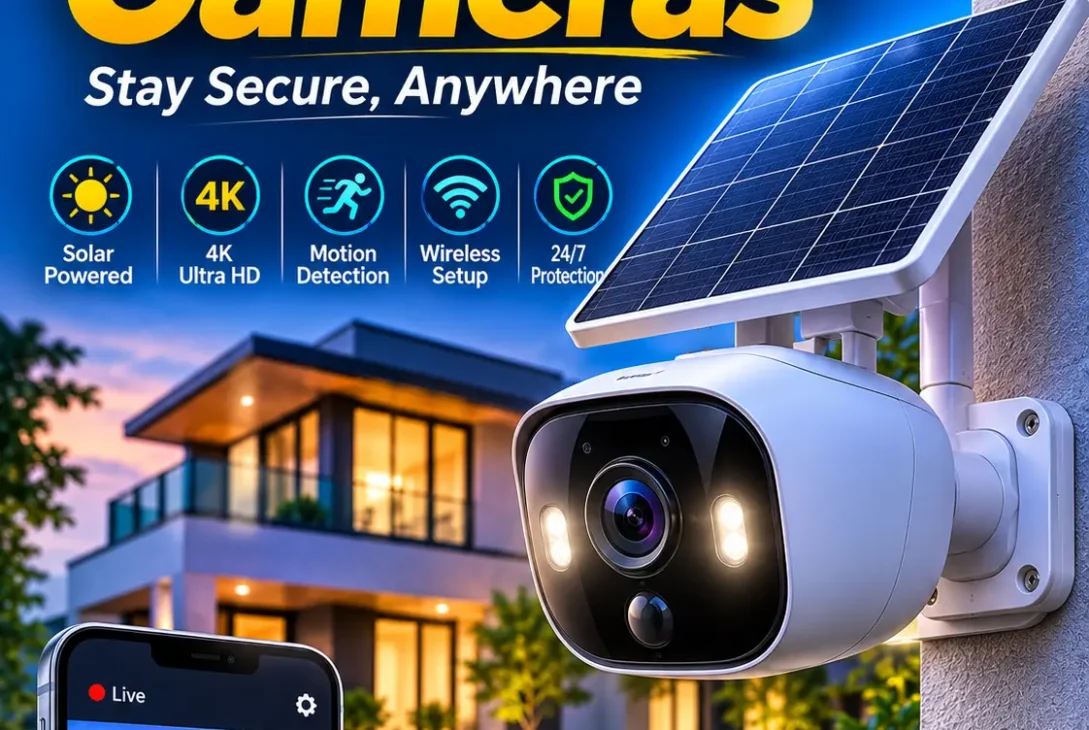
Choosing the best solar security cameras can make protecting your home, driveway, garden, or business much easier. These cameras use rechargeable batteries and solar panels to reduce the need for power cables and frequent manual charging. They are especially useful for outdoor locations where installing electrical wiring would be expensive or inconvenient.
However, not every solar camera offers the same performance. Some provide sharp 4K footage, while others focus on affordable installation, motion detection, local storage, or smart-home compatibility. Solar charging also depends on sunlight, camera activity, and panel placement.
In this guide, we explore the best solar security cameras available in 2026, compare their important features, explain their advantages and limitations, and help you choose the right option for your property.
Table of Contents
- What Are Solar Security Cameras?
- How Do Solar Security Cameras Work?
- Best Solar Security Cameras in 2026
- Comparison of the Top Solar Cameras
- What to Look for Before Buying
- Are Solar Security Cameras Worth It?
- Solar Security Cameras With No Monthly Fees
- Can Solar Cameras Work Without Wi-Fi?
- Installation Tips for Better Performance
- Common Problems and How to Avoid Them
- Frequently Asked Questions
- Final Verdict
- SEO Details
What Are Solar Security Cameras?
Solar security cameras are outdoor surveillance devices that use a rechargeable battery and a solar panel to maintain their power supply. Instead of connecting directly to a traditional electrical outlet, they collect energy from sunlight and store it in an internal battery.
This design makes them useful for locations where running power cables is difficult. You can install a camera near a driveway, garden, garage, fence, shed, or remote entrance without needing a nearby electrical socket.
The best solar security cameras combine dependable charging with useful security features, including motion detection, night vision, smartphone notifications, and video recording.
Some models have a solar panel built directly into the camera. Others use a separate panel connected through a cable. A separate panel can be more flexible because you can position it in a sunny location while keeping the camera somewhere else.
It is important to understand that solar cameras are not completely independent of sunlight. Their batteries still need enough energy to support recording, live viewing, and motion detection.
How Do Solar Security Cameras Work?
A solar-powered security camera uses a simple charging system.
During daylight, the solar panel converts sunlight into electrical energy. The camera stores that energy in its rechargeable battery, which powers the device when sunlight is unavailable.
At night, the camera continues operating using the stored battery power.
Most models remain in a low-power standby mode and activate recording when their motion sensors detect activity. This approach helps reduce energy consumption compared with continuously recording cameras.
The charging performance depends on several factors:
- Daily sunlight exposure
- Solar panel size and output
- Battery capacity
- Number of motion events
- Video recording settings
- Night vision usage
- Local weather conditions
The best solar security cameras balance these factors instead of relying on a large battery or powerful panel alone.
For example, a camera installed in an open garden with several hours of direct sunlight may maintain its battery more easily than an identical model mounted beneath a roof.
Best Solar Security Cameras in 2026
Here are several models worth considering for different security requirements. Features and bundle availability can vary by region, so check the manufacturer’s current specifications before purchasing.
1. eufy SoloCam S340 – Best Overall
The eufy SoloCam S340 is a strong option for homeowners who want flexible outdoor monitoring without complicated wiring.
It combines dual-camera hardware with pan-and-tilt movement, allowing users to monitor a wider area than many fixed-position cameras. Its integrated solar panel also reduces the need to install a separate charging accessory.
Important features include:
- Dual-camera design
- 3K telephoto and wide-angle viewing capabilities
- Pan-and-tilt coverage
- Integrated solar charging
- Motion tracking
- Local video storage
- Smartphone notifications
One of its biggest advantages is the ability to monitor different parts of an outdoor area without installing several fixed cameras.
The built-in solar panel also makes installation simpler because there is no separate panel cable to position.
However, the camera’s integrated panel may not receive ideal sunlight at every mounting location. If the camera is installed beneath a roof or in a shaded area, charging performance can be limited.
For people comparing the best solar security cameras, the SoloCam S340 is worth considering because it combines flexible viewing, solar charging, and local storage.
2. Reolink Argus PT Ultra – Best for 4K Resolution
The Reolink Argus PT Ultra is designed for users who want detailed outdoor footage and flexible camera positioning.
Its 4K resolution can capture more image detail than standard Full HD cameras, making it useful for monitoring larger outdoor areas.
Key features include:
- 4K video recording
- Pan-and-tilt functionality
- Battery-powered operation
- Compatible solar panel options
- Motion detection
- Local storage support
- Remote viewing through the Reolink app
The ability to move the camera remotely is particularly useful when monitoring a driveway, backyard, or large entrance.
Local storage can also reduce dependence on a monthly cloud subscription, although available features depend on the selected configuration.
Before purchasing, confirm whether the solar panel is included in the bundle. Some camera packages and accessories are sold separately.
Among the best solar security cameras, this model is worth considering if video detail and flexible viewing are more important than having an integrated solar panel.
3. EufyCam S3 Pro – Best Premium Option
The EufyCam S3 Pro is a premium outdoor security camera system for homeowners who want advanced monitoring features.
It offers 4K recording, solar charging, and colour night vision technology. Its solar-powered design helps reduce manual charging, while its system-based approach supports multiple-camera installations.
Notable features include:
- 4K video resolution
- Solar charging
- Colour night vision
- Smart detection features
- HomeBase integration
- Local storage options
- Multi-camera support
One advantage of a camera system with a central HomeBase is the ability to manage multiple cameras from a single setup.
The system can also be suitable for people who want to expand their home security coverage over time.
However, premium camera kits can cost considerably more than individual outdoor cameras. You should compare the full kit price, storage options, and included accessories before buying.
If image quality and a more advanced home security setup are your priorities, the EufyCam S3 Pro deserves a place among the best solar security cameras to compare.
4. TP-Link Tapo C660 KIT – Best 4K Solar Kit to Consider
The TP-Link Tapo C660 KIT is an option for shoppers looking for a high-resolution outdoor camera with solar charging.
Its 4K video capability makes it suitable for monitoring entrances, gardens, and other areas where image detail matters.
Features to examine include:
- 4K video recording
- Solar panel bundle
- Rechargeable battery
- Motion detection
- Smartphone app access
- Outdoor installation
- Smart detection capabilities, depending on configuration
A solar bundle can make installation more convenient because the charging accessory is designed to work with the camera.
However, solar charging performance depends on the panel’s output and the amount of sunlight available at the installation location.
Check the exact kit specifications before purchasing, especially the included panel, storage support, and available detection features.
For shoppers researching the best solar security cameras, the Tapo range is worth comparing with Reolink and eufy alternatives.
5. Reolink Argus 3 Pro – Best Value Option
The Reolink Argus 3 Pro is an older but useful option for buyers who want an affordable battery-powered camera with solar charging support.
It offers 2K video and can be paired with a compatible solar panel.
Its main strengths include:
- 2K video resolution
- Battery-powered operation
- Solar panel compatibility
- Motion detection
- Local microSD storage
- Smartphone access
- Customisable recording settings
One reason to consider this model is its combination of local storage and flexible charging.
However, its built-in battery is not removable, and its camera design does not offer the same viewing flexibility as pan-and-tilt models.
It is also important to compare its current price with newer alternatives. An older model only makes sense when the price reflects its age and feature set.
For buyers who do not need 4K recording, it remains one of the best solar security cameras worth checking in the value category.
6. eufyCam 3 – Best for Integrated Solar Panels
The eufyCam 3, also known as the S330, is designed for users who prefer a camera with an integrated solar charging system.
Instead of positioning a separate panel, the camera includes solar hardware as part of its design.
Its main features include:
- 4K recording
- Integrated solar charging
- AI-powered detection features
- HomeBase 3 support
- Local storage
- Outdoor wireless installation
The integrated panel helps simplify installation, especially when the camera can be mounted in a location with good sunlight.
Another advantage is its local storage approach through the HomeBase system.
However, an integrated panel offers less flexibility than a separate solar panel. If the camera is mounted in a shaded location, you may not be able to position the charging surface independently.
It is a useful option for people who want a cleaner installation and a camera system that can be expanded.
7. Ring Outdoor Cam Plus Solar – Best for Ring Users
The Ring Outdoor Cam Plus Solar is worth considering if you already use Ring security products.
It combines outdoor monitoring with a solar charging accessory, depending on the selected package.
Features include:
- 2K video
- Outdoor camera design
- Motion alerts
- Smartphone access
- Two-way communication
- Solar charging accessory
- Ring ecosystem integration
One advantage is the familiar Ring app experience for users who already own compatible devices.
However, subscription costs are an important consideration. Some recording history and advanced features require an eligible Ring subscription.
Check the exact plan requirements before buying because live viewing, motion alerts, cloud recording, and other services may have different availability.
For existing Ring customers, this can be one of the best solar security cameras to consider when ecosystem compatibility matters.
8. Wyze Battery Cam Pro – Best Budget-Friendly Alternative
The Wyze Battery Cam Pro is another option for buyers who want an affordable wireless security camera.
It offers 2K video and battery-powered operation, with compatible solar charging accessories available depending on the package.
Features worth checking include:
- 2K video
- Battery-powered design
- Motion detection
- Smartphone notifications
- Outdoor installation
- Compatible solar charging accessories
The biggest advantage is affordability.
However, make sure you compare the camera price with the cost of its solar accessory. A low camera price does not always mean the complete solar setup is inexpensive.
You should also review storage and subscription requirements before making a decision.
It may be a sensible option for buyers who want basic outdoor monitoring without paying for a premium multi-camera system.
9. Reolink Go PT Ultra – Best for Locations Without Wi-Fi
Not every property has a reliable Wi-Fi connection.
For remote areas, construction sites, farms, and locations far from a home router, a cellular camera can be more useful.
The Reolink Go PT Ultra is designed for this type of installation. It combines battery-powered operation, pan-and-tilt monitoring, and cellular connectivity with compatible solar charging options.
Its features can include:
- 4K video
- 4G LTE connectivity
- Pan-and-tilt viewing
- Battery operation
- Solar panel compatibility
- Motion detection
- Local storage support
The main advantage is that it does not depend on your home’s Wi-Fi network.
However, cellular connectivity usually requires a compatible SIM card and a mobile data plan. Network coverage and carrier compatibility should be checked before installation.
If you need monitoring in a remote location, this model is worth comparing with traditional Wi-Fi cameras.
Comparison of the Top Solar Cameras
The following table summarises the main differences between the models discussed above.
| Camera | Best For | Video Resolution | Solar Setup |
|---|---|---|---|
| eufy SoloCam S340 | Overall flexibility | 3K dual-camera system | Integrated |
| Reolink Argus PT Ultra | High-resolution monitoring | 4K | Compatible panel |
| EufyCam S3 Pro | Premium security | 4K | Solar-powered system |
| TP-Link Tapo C660 KIT | 4K solar kit | 4K | Kit-dependent |
| Reolink Argus 3 Pro | Value | 2K | Compatible panel |
| eufyCam 3 | Integrated solar | 4K | Integrated |
| Ring Outdoor Cam Plus Solar | Ring ecosystem | 2K | Solar accessory |
| Wyze Battery Cam Pro | Budget | 2K | Compatible accessory |
| Reolink Go PT Ultra | Remote locations | 4K | Compatible panel |
Specifications and included accessories can vary by region and package. Always check the manufacturer’s product page for the exact version you intend to buy.
What to Look for Before Buying
Choosing between the best solar security cameras requires more than comparing video resolution.
A camera with excellent image quality may still be unsuitable if its solar panel cannot receive enough sunlight or its recording features require an expensive subscription.
Here are the most important factors to consider.
Video Resolution
Resolution affects how much detail a camera can capture.
Common options include:
- 1080p Full HD
- 2K
- 3K
- 4K Ultra HD
A 2K camera can be sufficient for a front door or small garden. A 4K model may be more useful when monitoring a wider driveway or larger outdoor area.
However, resolution alone does not determine image quality. Lens quality, lighting, compression, and sensor performance also matter.
Solar Panel Performance
The solar panel is one of the most important parts of a solar camera system.
A larger or more powerful panel may provide better charging performance, but the result depends on sunlight exposure and the camera’s energy consumption.
Look for information about:
- Panel wattage
- Cable length
- Mounting flexibility
- Weather resistance
- Compatibility with the camera
- Manufacturer charging recommendations
A separate panel is often useful when the camera itself must be installed in a shaded position.
Battery Capacity
The internal battery stores energy for nighttime operation and periods when sunlight is limited.
A larger battery can provide a longer backup period, but actual runtime depends on recording activity, temperature, and camera settings.
Do not rely only on advertised standby battery life. Real-world usage can be very different.
Night Vision
Outdoor security cameras need to capture useful footage after dark.
Many models offer infrared night vision, while some premium options provide colour night vision using built-in lighting or advanced sensors.
Consider the area you want to monitor.
For a dark driveway, a camera with a spotlight or strong night vision may be more useful than a basic model.
Motion Detection
Motion detection helps cameras record important events without continuously using battery power.
Some models can identify people, vehicles, or animals.
These detection features can reduce unnecessary notifications, but their accuracy varies.
Look for adjustable detection zones and sensitivity settings so you can avoid alerts caused by trees, passing traffic, or moving shadows.
Local and Cloud Storage
Storage is another important buying consideration.
Some cameras support microSD cards or a dedicated home hub, while others rely more heavily on cloud subscriptions.
Local storage can reduce ongoing costs, but you should check whether recordings remain accessible if the camera or internet connection goes offline.
Cloud storage may offer convenient remote access and backup, but it can involve recurring fees.
Weather Resistance
Outdoor cameras must withstand rain, dust, heat, and changing weather.
Check the manufacturer’s IP rating and operating temperature range.
A suitable weather-resistance rating is particularly important for cameras installed in exposed locations.
https://www.safewise.com/home-security-systems/cameras/best-solar-powered/
Are Solar Security Cameras Worth It?
For many homeowners, solar-powered cameras are worth considering because they reduce the need for electrical wiring and repeated manual charging.
They can be especially useful for:
- Driveways
- Gardens
- Backyards
- Garages
- Gates
- Sheds
- Farms
- Construction sites
The biggest benefit is installation flexibility.
You can install a battery-powered camera in locations where a traditional wired model would require additional electrical work.
However, solar cameras are not ideal for every situation.
If your installation area receives very little sunlight, the battery may eventually need manual charging. A wired camera may be more reliable for locations requiring continuous recording.
The best solar security cameras are most effective when their solar panels receive sufficient sunlight and their recording settings are configured appropriately.
Solar Security Cameras With No Monthly Fees
Many buyers prefer security cameras that do not require a monthly subscription.
Some models support local storage through microSD cards or a dedicated home hub. This can allow users to record and review footage without paying for a cloud plan.
However, free local recording does not always mean every smart feature is free.
Before buying, check:
- Whether local recording is supported
- Whether a memory card is included
- Whether remote playback is available
- Whether AI detection requires a subscription
- Whether cloud backups are optional
- Whether a home hub is required
Reolink and eufy offer models with local-storage options, but the exact features differ by product.
The best solar security cameras for subscription-free use are those that provide the recording and playback features you actually need without requiring a recurring payment.
Can Solar Cameras Work Without Wi-Fi?
Some solar security cameras require Wi-Fi for remote viewing, notifications, and cloud services.
Others use cellular connectivity instead.
A Wi-Fi camera is usually suitable for homes with a reliable wireless network. However, a remote property may need a cellular model with a compatible SIM card and data plan.
It is also important to understand that solar charging and internet connectivity are separate things.
A solar panel provides energy to the camera. It does not provide an internet connection.
If you need a camera for a farm, cabin, or construction site, consider a cellular model rather than assuming every solar camera can work independently.
Frequently Asked Questions
What are the best solar security cameras in 2026?
Popular options to compare include the eufy SoloCam S340, Reolink Argus PT Ultra, EufyCam S3 Pro, and TP-Link Tapo solar camera kits. The right choice depends on resolution, charging performance, storage, and budget.
Do solar security cameras work at night?
Yes. Solar cameras store energy in rechargeable batteries during daylight. They use that stored energy to operate at night, although runtime depends on battery capacity and usage.
Do solar security cameras need Wi-Fi?
Many models use Wi-Fi for remote viewing and notifications. Cellular models can use a mobile network instead, which is useful for remote locations without reliable Wi-Fi.
Can solar security cameras work on cloudy days?
Yes, but charging performance can decrease when sunlight is limited. A camera with a larger battery may provide more backup during extended periods of cloudy weather.
Do solar security cameras work without electricity?
They do not need a direct electrical connection when operating from their rechargeable batteries. However, the battery still needs to receive enough energy from its solar panel or another charging source.
Are solar security cameras completely wireless?
Battery-powered solar cameras generally do not need a power cable. However, they may still require Wi-Fi or cellular connectivity for remote access and notifications.
Do solar security cameras require a monthly subscription?
Not always. Some models support local recording through microSD cards or a home hub without a monthly cloud subscription. Certain advanced features may still require a paid plan.
How much sunlight does a solar security camera need?
The amount varies by camera and solar panel. Follow the manufacturer’s charging recommendations and install the panel where it receives strong, direct sunlight whenever possible.
Are 4K solar security cameras better than 2K models?
4K cameras can capture more detail, which can help when monitoring larger areas. However, 2K models may offer better value for smaller spaces and basic home monitoring.
Can I install a solar security camera myself?
Most battery-powered solar cameras are designed for DIY installation. You generally need to mount the camera, position the solar panel if separate, connect the device to its app, and configure recording settings.
Which solar security camera is best for a remote property?
A cellular model such as the Reolink Go PT Ultra may be more suitable when Wi-Fi is unavailable. Check mobile network coverage and data-plan requirements before purchasing.
Final Verdict
The best solar security cameras offer a convenient way to monitor outdoor spaces without installing traditional power cables.
The eufy SoloCam S340 is a strong option for flexible home monitoring, while the Reolink Argus PT Ultra is worth considering if you want 4K footage and pan-and-tilt functionality. The EufyCam S3 Pro is a premium choice, and TP-Link Tapo models offer another option for shoppers comparing high-resolution solar camera kits.
Before buying, compare the solar panel, battery capacity, video quality, night vision, storage options, and subscription requirements. Most importantly, make sure the installation location receives enough sunlight to maintain the battery.
A carefully selected camera can provide convenient outdoor monitoring with less maintenance. Choose a model that matches your property, internet connection, and security needs rather than simply buying the camera with the highest resolution.