
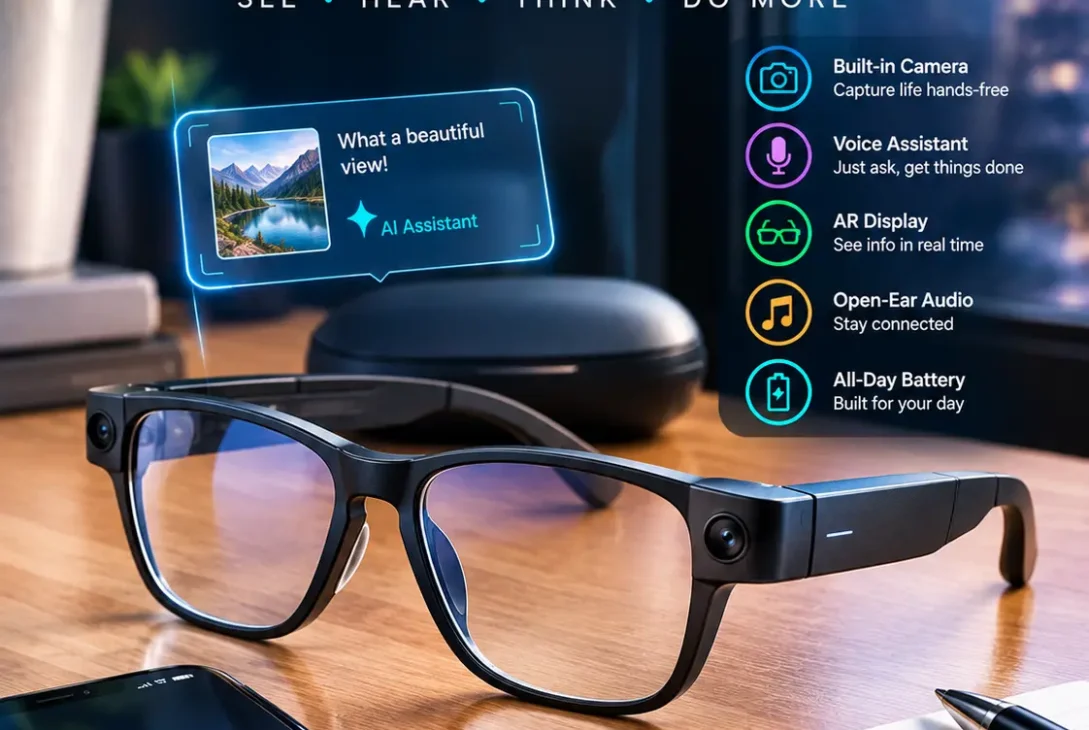
AI glasses are quickly becoming one of the most interesting categories in consumer technology. Instead of opening a phone every time you need information, directions, a translation, a photo, or an AI assistant, these glasses can bring useful features directly into your field of view or through open-ear audio.
In 2026, the technology is moving beyond simple smart eyewear. Meta has expanded its AI glasses lineup with Ray-Ban Meta, Oakley Meta, Meta Glasses, and display-equipped models, while Google is preparing Android XR eyewear powered by Gemini.
The biggest attraction is convenience. You can ask questions, take photos, make calls, listen to music, translate conversations, and interact with AI while keeping your hands free.
This guide explains how AI glasses work, what they can do, their benefits and limitations, privacy concerns, major products, and whether they are worth considering in 2026.
Table of Contents
- What Are AI Glasses?
- How Do AI Glasses Work?
- What Can AI Glasses Do?
- AI Glasses With Cameras
- AI Glasses With Displays
- AI Glasses and AI Assistants
- AI Glasses for Translation
- AI Glasses for Productivity
- AI Glasses for Creators
- Privacy and Security
- Best AI Glasses Options in 2026
- Are AI Glasses Worth It?
- Frequently Asked Questions
- Final Verdict
What Are AI Glasses?
AI glasses are wearable glasses that combine traditional eyewear with cameras, microphones, speakers, wireless connectivity, and artificial intelligence.
Unlike ordinary sunglasses or prescription glasses, these devices can interact with digital services while you wear them.
Depending on the model, they may allow you to:
- Ask an AI assistant questions
- Take photos and videos
- Make phone calls
- Send messages
- Listen to music and podcasts
- Translate conversations
- Identify objects and surroundings
- Get navigation assistance
- Receive reminders
- Interact with smartphone apps
Some models are completely display-free and communicate through audio. Others add a small visual display that can show information directly in front of your eyes.
Google describes its Android XR eyewear strategy as two categories: audio glasses that provide spoken assistance and display glasses that show information visually.
That distinction is important because not every pair of AI glasses works in the same way.
How Do AI Glasses Work?
Most modern AI glasses combine several pieces of hardware.
Cameras
A built-in camera allows the glasses to capture photos and videos or understand what is in front of the wearer.
Microphones
Multiple microphones capture voice commands and help reduce background and wind noise.
Speakers
Open-ear speakers allow users to hear music, calls, notifications, translations, and AI responses without covering their ears.
Wireless Connectivity
The glasses usually connect to a smartphone using Bluetooth and Wi-Fi. The phone can provide internet access, processing, storage, and access to applications.
Artificial Intelligence
The AI system interprets voice requests, images, surroundings, or other information and generates an appropriate response.
This combination makes AI glasses more useful than traditional smart glasses because they can understand both what you say and, on supported devices, what you are looking at.
What Can AI Glasses Do?
The capabilities depend heavily on the model, but current products are becoming surprisingly versatile.
Meta says its glasses can capture photos and videos, send messages, make calls, play music, translate speech, and interact with Meta AI.
Some common functions include:
Hands-Free Photography
You can capture a moment without reaching for your smartphone.
This can be particularly useful while walking, traveling, cycling, attending events, or creating first-person content.
Voice Assistance
Instead of typing a question into a phone, you can simply speak to the assistant.
For example:
“What am I looking at?”
or:
“Translate this sentence.”
The response can then be delivered through the built-in speakers.
Calls and Messages
Compatible models can make calls and send messages using voice commands.
This can be useful when your hands are occupied or when taking out your phone would be inconvenient.
Music and Podcasts
Open-ear speakers allow you to listen while remaining aware of your surroundings.
Meta says its newer glasses use improved directional audio and open-ear speakers for calls, music, podcasts, and audiobooks.
AI Glasses With Cameras
Camera-equipped AI glasses are particularly popular because they make first-person photography much easier.
Instead of holding a phone at arm’s length, you can simply look at something and capture it.
Meta’s current glasses lineup includes models capable of 12MP photography and 3K video capture.
This can be useful for:
- Travel photography
- Family moments
- Social media content
- Walking tours
- Sports
- Product demonstrations
- First-person videos
The biggest advantage is speed.
You do not need to unlock a phone, open the camera application, frame the shot, and press a button. A voice command or physical control can be enough.
For creators, that can make spontaneous content considerably easier.
https://about.fb.com/news/2026/07/metas-ai-glasses-your-questions-answered
AI Glasses With Displays
Display-equipped AI glasses take the concept further.
Instead of only hearing information, users can potentially see notifications, directions, translations, messages, and other digital content directly through the eyewear.
Meta’s Meta Ray-Ban Display uses an in-lens visual overlay and works with the Meta Neural Band, which interprets signals from subtle hand movements to provide another way to interact with the glasses.
Google is also developing Android XR display glasses that can show information when needed.
The company says its upcoming intelligent eyewear will support experiences such as directions, texting, photography, and other phone functions without requiring users to take their smartphone out.
Display technology could therefore become one of the biggest differences between today’s smart eyewear and the next generation.
AI Glasses and AI Assistants
The AI assistant is arguably the most important part of modern AI glasses.
Meta integrates Meta AI into its glasses, while Google’s Android XR platform is built around Gemini.
Meta’s newer AI experience is powered by Muse Spark, which Meta says provides improved multimodal capabilities and better understanding of what the wearer sees.
This means the glasses can potentially understand more than a simple spoken command.
For example, you could point your camera toward a menu and ask for help understanding it.
You might also ask about an object, a landmark, a product, or something happening around you.
Google’s approach is similar in principle. Gemini is being integrated into Android XR so that the assistant can understand the user’s environment and provide hands-free help.
This combination of visual understanding and voice interaction is what makes AI glasses different from conventional Bluetooth eyewear.
AI Glasses for Translation
Real-time translation is another major use case.
Instead of constantly looking down at a translation application, compatible glasses can provide translated information through audio or visual interfaces.
Meta has expanded live translation support across its AI glasses ecosystem, with additional languages including Mandarin, Japanese, Korean, Hindi, and others being added.
This could make travel much easier.
Imagine speaking with someone who uses another language and hearing a translation through your glasses without constantly checking your phone.
The experience is not perfect, and translation quality can depend on internet connectivity, language support, accents, and the AI model being used.
Nevertheless, this is one of the areas where wearable AI can provide a genuinely useful advantage.
AI Glasses for Productivity
The productivity potential is also growing.
Future-focused AI glasses can act as a lightweight personal assistant that stays available throughout the day.
Potential productivity tasks include:
- Checking reminders
- Reading notifications
- Managing messages
- Getting directions
- Asking quick questions
- Scheduling activities
- Taking notes
- Searching for information
- Receiving contextual assistance
Google’s upcoming Android XR glasses are designed around this hands-free approach, with Google showing experiences involving directions, messaging, phone applications, and other everyday tasks.
The major benefit is reduced friction.
Instead of stopping what you are doing to interact with a smartphone, you can potentially handle simple tasks through voice or glance-based controls.
AI Glasses for Creators
Content creators are another group that can benefit significantly.
Traditional cameras and smartphones are excellent for high-quality production, but they are not always convenient for capturing spontaneous moments.
Camera-equipped AI glasses provide a first-person perspective without requiring a camera to be held.
Meta specifically positions its Ray-Ban Meta products toward creators, with hands-free photo and video capture and social sharing capabilities.
This can be useful for:
- YouTube Shorts
- Instagram Reels
- Travel videos
- Behind-the-scenes footage
- Tutorials
- Walking tours
- Sports content
- Daily-life videos
The result is a more natural point-of-view recording style.
Privacy and Security
Privacy is one of the biggest concerns surrounding AI glasses.
A camera mounted on someone’s face can potentially record people who may not realize they are being filmed.
Manufacturers are therefore adding visible indicators and privacy controls.
Meta says its glasses use a white capture LED that flashes when content is being captured. The company also says that covering or disabling the LED automatically disables the camera.
Users should still behave responsibly.
Do not assume that because a device allows recording, recording is appropriate everywhere.
People should also understand what information their glasses collect, where that information is processed, which apps receive it, and how long data is retained.
Before buying AI glasses, it is worth reviewing the manufacturer’s privacy documentation and account settings.
Best AI Glasses Options in 2026
There are now several major directions in the market.
Ray-Ban Meta
Ray-Ban Meta remains one of the best-known examples of consumer AI eyewear.
The glasses combine familiar Ray-Ban styling with cameras, microphones, open-ear audio, smartphone connectivity, and Meta AI.
Meta says its second-generation Ray-Ban Meta models offer up to eight hours of battery life, a 12MP ultra-wide camera, and 3K photo and video capture.
They are particularly attractive for people who want AI assistance and hands-free cameras without wearing a bulky headset.
Meta Glasses
Meta introduced a broader Meta Glasses line in 2026 with multiple frame styles and prescription compatibility.
The company says the new models start at $299, offer more than eight hours of battery life, open-ear audio, cameras, Meta AI, and a charging case capable of providing additional battery capacity.
This makes the category more accessible than premium display-based eyewear.
Meta Ray-Ban Display
For users who want visual information rather than audio alone, Meta Ray-Ban Display is a more advanced option.
It combines an in-lens display with Meta AI and the Meta Neural Band.
Meta lists the product starting at $799.
The display makes this type of eyewear fundamentally different from display-free models.
Google Android XR Glasses
Google is taking a major role in the next stage of the market.
At Google I/O 2026, the company announced intelligent eyewear built around Android XR and Gemini.
Google says its first audio glasses, developed with partners including Gentle Monster, Warby Parker, and Samsung, are expected to arrive in fall 2026 and work with Android and iOS devices.
This could significantly increase competition in the category.
Are AI Glasses Worth It?
For the right person, AI glasses can be genuinely useful.
They make the most sense if you:
- Frequently use voice assistants
- Create first-person content
- Travel often
- Want hands-free photography
- Need quick translations
- Prefer open-ear audio
- Want contextual AI assistance
- Like experimenting with new technology
They may be less useful if you rarely use voice commands, do not need a camera, or already find smartphone interaction perfectly convenient.
Price is another factor.
A basic pair of smart glasses can be much cheaper than a display-equipped model, while premium products can approach or exceed the price of a good smartphone.
Battery life also remains important.
Even if the glasses can technically last most of a day, intensive camera use, AI processing, calls, and streaming can increase power consumption.
Advantages and Disadvantages
Advantages
- Hands-free AI assistance
- Convenient photography
- Voice-controlled functions
- Open-ear audio
- Real-time translation
- Navigation support
- Useful for creators
- Increasingly natural form factor
Disadvantages
- Privacy concerns
- Battery limitations
- Dependence on smartphones or internet services
- Higher cost for advanced models
- AI accuracy is not perfect
- Camera restrictions in some locations
- Display models can be significantly more expensive
Frequently Asked Questions
What are AI glasses?
They are wearable glasses that combine traditional eyewear with cameras, microphones, speakers, wireless connectivity, and artificial intelligence.
Can AI glasses take pictures?
Yes. Many current models include built-in cameras that can capture photos and videos using physical controls or voice commands.
Can AI glasses answer questions?
Yes. Supported products can connect to AI assistants such as Meta AI or Gemini and provide spoken or visual responses.
Do AI glasses need a phone?
Many models rely on a smartphone for connectivity, internet access, applications, or additional processing. The exact requirements vary by product.
Can AI glasses translate languages?
Supported models can provide real-time translation for certain languages. Meta, for example, has expanded live translation across its glasses ecosystem.
Are AI glasses safe for privacy?
They can include privacy safeguards, but users should still respect people around them and understand the camera and data policies of the specific product.
Do AI glasses have displays?
Some do and some do not. Traditional Ray-Ban Meta-style products can operate without an in-lens display, while products such as Meta Ray-Ban Display add visual information.
Will Google make AI glasses?
Google is developing Android XR intelligent eyewear with Gemini and has announced partner devices expected to arrive in fall 2026.
Final Verdict
AI glasses are moving from an experimental idea toward a practical consumer technology category.
The biggest breakthrough is not simply putting a camera or speaker into a pair of glasses. The real opportunity is combining wearable hardware with multimodal AI that can understand voice commands, images, surroundings, and context.
Meta is currently pushing the category forward with Ray-Ban Meta, Oakley Meta, Meta Glasses, and display-equipped products. Google is preparing its own Android XR ecosystem with Gemini-powered eyewear.
For creators, travelers, people who rely heavily on voice assistance, and technology enthusiasts, these devices can already provide useful everyday features.
However, they are not replacements for smartphones yet.
Battery life, privacy, pricing, connectivity, and AI limitations still matter.
The next few years could be even more important as displays become smaller, AI becomes more capable, and more companies enter the market.
For 2026, AI glasses are no longer just a futuristic concept. They are becoming a genuine new category of personal computing.