
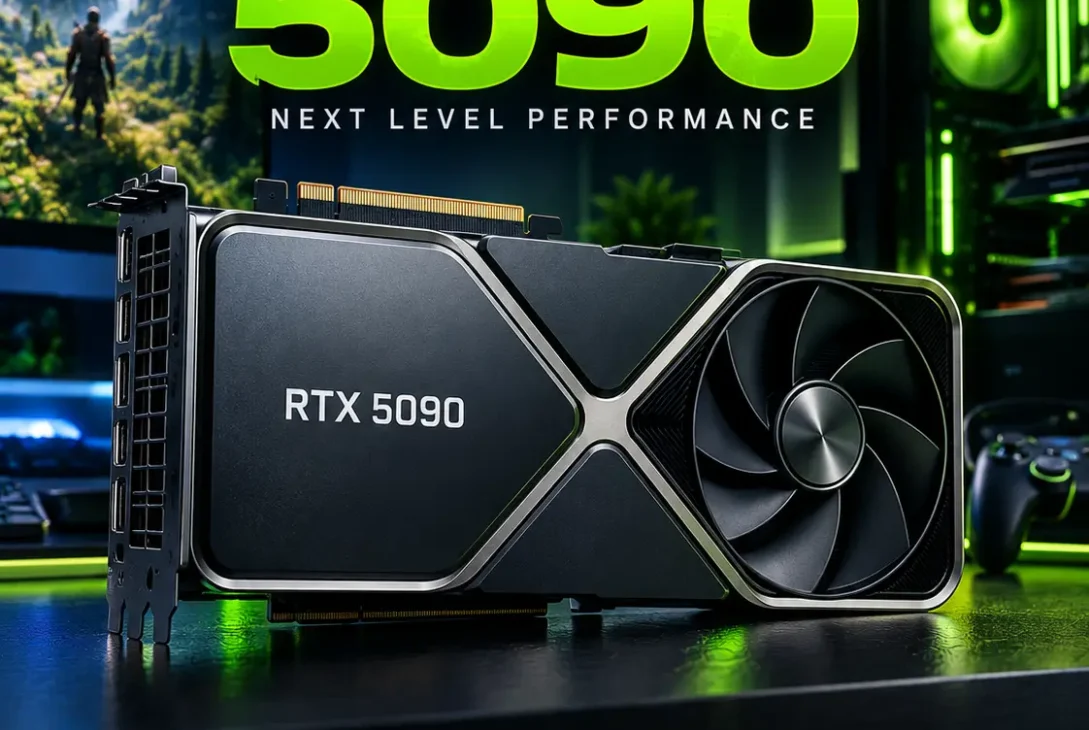
The NVIDIA RTX 5090 remains one of the most powerful graphics cards available to PC gamers and creators in 2026. Built on NVIDIA’s Blackwell architecture, it combines 21,760 CUDA cores, 32GB of GDDR7 memory and a 512-bit memory interface with advanced AI and ray-tracing hardware.
For gamers, the NVIDIA RTX 5090 is aimed at high-end 4K gaming, ray tracing and demanding workloads rather than budget PC builds. For creators and AI users, its large 32GB VRAM capacity can also be useful for demanding local workloads.
However, there is an important catch: the NVIDIA RTX 5090 launched with a $1,999 Founders Edition MSRP, but real-world prices have moved substantially above that level in some markets. In September 2026, Tom’s Hardware reported North American prices reaching at least $5,000 for some RTX 5090 cards.
So, is the RTX 5090 still worth buying in 2026, and what makes it different from other high-end GPUs?
Table of Contents
- What Is the NVIDIA RTX 5090?
- NVIDIA RTX 5090 Specifications
- Blackwell Architecture Explained
- RTX 5090 Gaming Performance
- 4K Gaming and Ray Tracing
- DLSS and AI Features
- 32GB GDDR7 VRAM
- Power Requirements
- Size and PC Case Compatibility
- RTX 5090 for AI and Content Creation
- RTX 5090 Price in 2026
- NVIDIA RTX 5090 vs RTX 4090
- Who Should Buy the RTX 5090?
- Frequently Asked Questions
- Final Verdict
- SEO Details
What Is the NVIDIA RTX 5090?
The NVIDIA RTX 5090 is NVIDIA’s flagship GeForce RTX 50 Series desktop graphics card.
It uses the Blackwell architecture and is designed for demanding gaming, professional creative applications and AI workloads. NVIDIA describes it as its most powerful GeForce GPU, with hardware dedicated to rasterization, ray tracing and AI processing.
The card is positioned above the RTX 5080 and other RTX 50 Series models.
Its headline specifications include:
| Specification | RTX 5090 |
|---|---|
| Architecture | NVIDIA Blackwell |
| CUDA Cores | 21,760 |
| VRAM | 32GB GDDR7 |
| Memory Interface | 512-bit |
| Memory Bandwidth | 1,792 GB/s |
| Boost Clock | 2.41 GHz |
| Total Graphics Power | 575W |
| Recommended System Power | 1,000W |
| PCIe Interface | PCIe Gen 5 |
| Launch MSRP | $1,999 |
| Launch Date | January 30, 2025 |
These are NVIDIA’s reference specifications; partner cards can have different clock speeds, dimensions, cooling systems and power requirements.
NVIDIA RTX 5090 Specifications
The NVIDIA RTX 5090 is built around extremely high-end hardware.
It has 21,760 CUDA cores, fifth-generation Tensor Cores for AI workloads and fourth-generation RT Cores for ray tracing. NVIDIA rates it at 3,352 AI TOPS and 318 RT TFLOPS.
The memory subsystem is equally important.
The card includes 32GB of GDDR7 VRAM connected through a 512-bit interface, delivering up to 1,792 GB/s of memory bandwidth.
That large memory capacity gives the GPU considerable headroom for high-resolution textures, demanding creative applications and AI workloads that can exceed the practical memory limits of smaller graphics cards.
Blackwell Architecture Explained
The NVIDIA RTX 5090 is based on NVIDIA’s Blackwell architecture, which introduced several changes over the previous GeForce generation.
One major focus is AI-powered graphics.
The GPU includes fifth-generation Tensor Cores and fourth-generation RT Cores. NVIDIA also introduced neural-rendering technologies designed to combine traditional rendering with AI processing.
This matters because modern PC graphics increasingly rely on more than raw GPU rendering.
Features such as DLSS can use AI models to reconstruct images and generate additional frames, allowing supported games to deliver higher apparent frame rates without rendering every displayed frame traditionally.
RTX 5090 Gaming Performance
The NVIDIA RTX 5090 is primarily designed for enthusiasts who want extremely high graphics performance.
At 4K resolution, the GPU has enough performance to handle demanding modern games with high or maximum settings, including workloads using ray tracing.
NVIDIA specifically positions the card around 4K gaming with DLSS technologies, while its hardware also supports up to 4K at 480Hz or 8K at 165Hz with Display Stream Compression under supported display configurations.
Actual FPS varies considerably by game.
CPU performance, game engine optimization, graphics settings, ray-tracing features and DLSS settings can all change the results.
That’s why a single benchmark number shouldn’t be treated as representative of every game.
4K Gaming and Ray Tracing
If you’re building a premium 4K gaming PC, the NVIDIA RTX 5090 is particularly attractive because it combines traditional GPU performance with dedicated ray-tracing hardware.
Ray tracing can create more realistic lighting, reflections and shadows, but it can also be extremely demanding.
The RTX 5090’s fourth-generation RT Cores are designed to accelerate these calculations. NVIDIA’s Blackwell architecture also adds neural-rendering technologies that can work alongside ray tracing.
For gamers using a high-refresh-rate 4K monitor, the combination of raw GPU performance, DLSS and frame-generation technology can be much more useful than simply looking at conventional rasterization performance.
DLSS and AI Features
One of the biggest reasons to consider the NVIDIA RTX 5090 is its AI hardware.
The RTX 50 Series supports NVIDIA’s latest DLSS technologies, including Super Resolution, Ray Reconstruction, Frame Generation and Multi Frame Generation. NVIDIA’s current RTX 5090 page also highlights DLSS 5 and its 3D-Guided Neural Rendering technology.
The important point is that these features depend on software and game support.
A game doesn’t automatically receive every DLSS feature simply because it runs on an RTX 5090.
For supported games, however, AI-assisted rendering can significantly change the performance and visual-quality balance.
32GB GDDR7 VRAM
The NVIDIA RTX 5090 comes with 32GB of GDDR7 memory.
That’s a major advantage for demanding workloads.
Games with large texture packs and high-resolution assets can consume significant VRAM, while professional applications and local AI workloads can require even more memory.
The 512-bit memory interface also contributes to the card’s very high memory bandwidth of 1,792 GB/s.
For a typical 1080p gaming PC, 32GB of VRAM is far beyond what most users need.
For 4K gaming, AI experimentation, 3D rendering and professional workloads, the additional capacity is much easier to justify.
Power Requirements
Power consumption is one of the biggest things you need to consider before buying the NVIDIA RTX 5090.
NVIDIA lists a 575W Total Graphics Power and recommends a 1,000W system power supply for its Founders Edition under its reference configuration.
This isn’t a component you should pair casually with an old or low-quality PSU.
Tom’s Hardware has also documented substantial transient power behavior and recommends giving the system appropriate power headroom, particularly with high-end CPUs and factory-overclocked partner cards.
What PSU Should You Use?
For a new NVIDIA RTX 5090 build, look for a high-quality modern PSU with the appropriate native high-power GPU connector.
NVIDIA lists either four PCIe 8-pin cables used with its included adapter or a suitable PCIe Gen 5 power cable for the Founders Edition.
A quality 1,000W PSU is NVIDIA’s stated minimum recommendation, but the ideal capacity can be higher depending on your CPU, overclocking and the specific RTX 5090 model.
Size and PC Case Compatibility
Before buying an NVIDIA RTX 5090, check your PC case carefully.
The Founders Edition measures approximately 304mm long and 137mm high, with a two-slot design according to NVIDIA’s specifications.
However, partner cards can be considerably larger.
Some factory-overclocked RTX 5090 models use substantially more space and power than the Founders Edition. Tom’s Hardware’s testing of MSI’s RTX 5090 Lightning Z, for example, shows how dramatically partner-card specifications can differ from the reference design.
Check these measurements before purchasing:
- GPU length
- GPU thickness
- Case clearance
- Power-cable clearance
- PSU capacity
- Airflow
- Motherboard slot layout
Don’t assume every RTX 5090 will fit into a case simply because the Founders Edition does.
RTX 5090 for AI and Content Creation
The NVIDIA RTX 5090 isn’t only a gaming GPU.
Its 32GB of GDDR7 and Blackwell Tensor Cores make it attractive for AI experimentation, video production, 3D rendering and other GPU-accelerated workloads.
NVIDIA also highlights support for FP4 precision on RTX 50 Series GPUs, allowing supported generative-AI workloads to use less memory and run more efficiently.
For creators, NVIDIA’s ninth-generation NVENC encoders can accelerate video workflows, while NVIDIA Studio drivers and applications are designed for creative workloads.
You can also use NVIDIA’s official Studio and Game Ready driver downloads when setting up the card.
RTX 5090 Price in 2026
The NVIDIA RTX 5090 launched at $1,999 in the United States, while NVIDIA announced a starting price of £1,939 for the UK market.
However, those launch prices don’t necessarily reflect what buyers pay in 2026.
Current market conditions have pushed some RTX 5090 cards dramatically above their original MSRP. Tom’s Hardware reported in September 2026 that North American prices had reached at least $5,000 for the GPU in some cases, while European premium models had reached even higher prices.
That makes the NVIDIA RTX 5090 much harder to recommend purely on value.
If you’re in the USA or UK, compare the actual price against the performance of other current GPUs before purchasing.
Is RTX 5090 Worth Its Price?
At its original MSRP, the RTX 5090 was clearly positioned as an enthusiast flagship.
At several times MSRP, the value proposition changes completely.
If you’re paying thousands of dollars above the launch price, you should ask whether you genuinely need the additional performance and 32GB VRAM.
For many gamers, a lower-tier GPU paired with a strong CPU and high-quality display can provide a better overall gaming experience per dollar.
NVIDIA RTX 5090 vs RTX 4090
The NVIDIA RTX 5090 replaced the RTX 4090 as NVIDIA’s flagship GeForce GPU.
On paper, the newer card brings significant hardware changes:
| Feature | RTX 5090 | RTX 4090 |
|---|---|---|
| Architecture | Blackwell | Ada Lovelace |
| CUDA Cores | 21,760 | 16,384 |
| VRAM | 32GB GDDR7 | 24GB GDDR6X |
| Memory Bus | 512-bit | 384-bit |
| Memory Bandwidth | 1,792 GB/s | 1,008 GB/s |
| Total Board Power | 575W | 450W |
| Launch MSRP | $1,999 | $1,599 |
The RTX 5090 therefore offers more VRAM and substantially greater memory bandwidth, alongside newer-generation AI and ray-tracing hardware.
Whether the upgrade makes financial sense depends on the price difference between the two cards in your market.
If you’re replacing an RTX 4090 purely for ordinary 1440p gaming, the upgrade may be difficult to justify.
If you’re targeting 4K, heavy ray tracing, professional workloads or AI applications that benefit from additional VRAM, the newer flagship is much easier to justify.
Who Should Buy the NVIDIA RTX 5090?
The NVIDIA RTX 5090 makes the most sense for a relatively small group of users.
4K Enthusiasts
If you’re building a no-compromise 4K gaming PC, the RTX 5090 is an obvious candidate.
Professional Creators
Video editors, 3D artists and other professionals who regularly use GPU-accelerated software can benefit from its large memory pool and compute capability.
AI Developers
The 32GB VRAM capacity and Blackwell Tensor Cores make it interesting for people running supported AI workloads locally.
Enthusiast PC Builders
If price is secondary to maximum performance, the RTX 5090 remains the obvious flagship choice within NVIDIA’s GeForce lineup.
Who Should Not Buy It?
The NVIDIA RTX 5090 is probably unnecessary for casual gaming.
You don’t need a 575W flagship GPU to play esports games at 1080p.
It can also be a poor value if your monitor is limited to a relatively low resolution or refresh rate and you aren’t using demanding creative or AI workloads.
The rest of the system matters too.
Pairing an RTX 5090 with an underpowered CPU, inadequate cooling or a poor PSU can prevent you from getting the experience you’re paying for.
Frequently Asked Questions
1. How much does the NVIDIA RTX 5090 cost?
The original U.S. MSRP was $1,999, while NVIDIA announced a UK starting price of £1,939. Actual 2026 retail prices can be substantially higher depending on the model and market.
2. Is the RTX 5090 the fastest GeForce GPU?
Yes. NVIDIA describes the NVIDIA RTX 5090 as its most powerful GeForce GPU.
3. How much VRAM does the RTX 5090 have?
It has 32GB of GDDR7 VRAM with a 512-bit memory interface.
4. Is the RTX 5090 good for 4K gaming?
Yes. It is designed for high-end gaming and is particularly suited to demanding 4K workloads, ray tracing and supported DLSS technologies.
5. What PSU do I need for an RTX 5090?
NVIDIA recommends a 1,000W system power supply for the Founders Edition configuration. Higher capacity may be appropriate for some systems or factory-overclocked cards.
6. Is the RTX 5090 good for AI?
Yes. Its 32GB VRAM and fifth-generation Tensor Cores make it a powerful consumer GPU for supported local AI workloads.
7. Is RTX 5090 better than RTX 4090?
The RTX 5090 is the newer flagship and offers more CUDA cores, 32GB of GDDR7 and much higher memory bandwidth. Whether upgrading is worthwhile depends on your workload and the current price difference.
8. Does RTX 5090 support DLSS?
Yes. The NVIDIA RTX 5090 supports NVIDIA DLSS technologies, including Super Resolution, Ray Reconstruction, Frame Generation and Multi Frame Generation.
9. Is RTX 5090 good for video editing?
It can be excellent for GPU-accelerated video workflows, particularly when applications can take advantage of its compute resources and ninth-generation NVENC encoders.
10. Is RTX 5090 worth buying in 2026?
It can be worth buying for enthusiasts and professionals who need maximum GPU performance, but paying several times its original MSRP makes it much harder to recommend for ordinary gaming.
Final Verdict
The NVIDIA RTX 5090 is an extreme graphics card built for extreme workloads.
Its combination of Blackwell architecture, 21,760 CUDA cores, 32GB GDDR7, a 512-bit memory interface, advanced ray tracing and powerful AI hardware makes it exceptionally capable for 4K gaming, content creation and supported AI workloads.
The biggest problem in 2026 isn’t its performance—it’s price and power consumption.
At its original $1,999 MSRP, the flagship made sense for enthusiasts who wanted the fastest GeForce GPU available. At today’s inflated prices in some markets, the calculation is very different.
For a high-end gaming or workstation build, the RTX 5090 can still be an outstanding choice if you can buy it at a sensible price.
For everyone else, a cheaper GPU is likely to deliver much better value.