
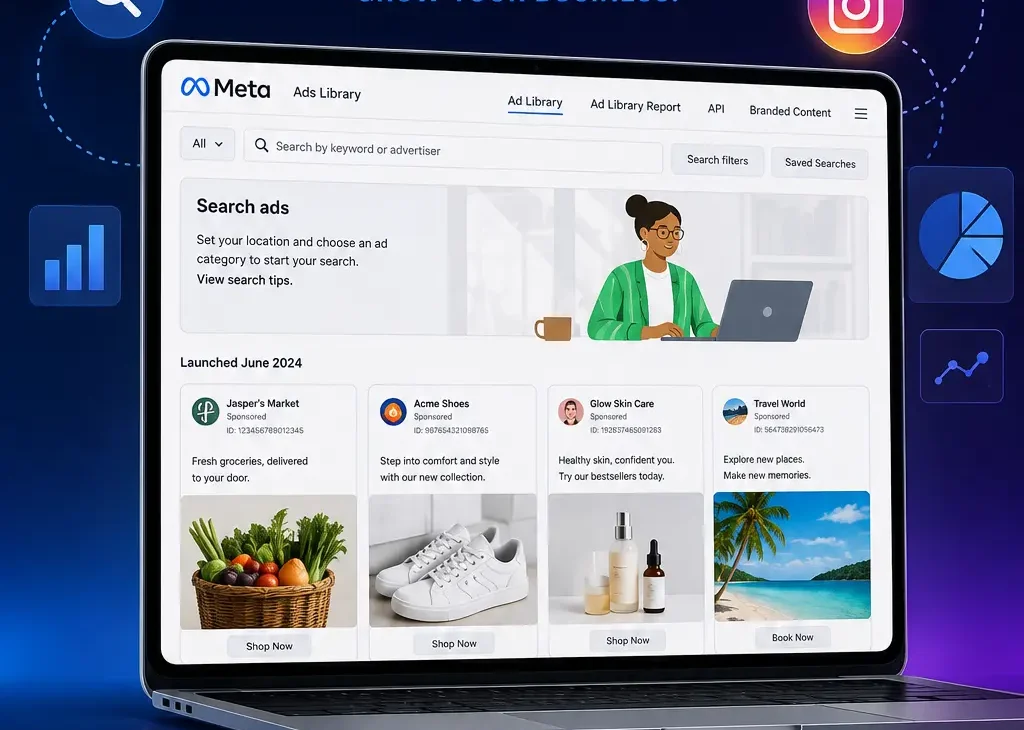
If you’re running Facebook or Instagram advertising, researching competitors, or simply looking for new advertising ideas, the Meta Ads Library can be an extremely useful research tool.
Instead of guessing what other businesses are doing, marketers can use the library to discover advertisements that brands are currently running across Meta’s platforms.
The tool can be useful for businesses of almost any size. A small business can study larger competitors, an agency can research campaigns for clients, and an experienced advertiser can use it to identify patterns in creative styles, offers, messaging, and positioning.
The important thing is to understand that the Meta Ads Library isn’t a tool that simply gives you a list of “best ads.”
You have to learn how to search, compare, and interpret what you find.
What Is Meta Ads Library?
The Meta Ads Library is a searchable database of advertisements running across Meta’s platforms.
It allows users to search for ads and view information about advertisements without needing to be the advertiser who created them.
This makes the tool particularly useful for advertising research.
For example, imagine you sell fitness clothing online and want to understand what competing brands are promoting.
Instead of searching randomly through Facebook or Instagram, you can search for those brands and examine the advertisements associated with their pages.
You might discover that several competitors are promoting:
- Free shipping
- Limited-time discounts
- New product launches
- Customer testimonials
- Short-form videos
- Product demonstrations
- Seasonal promotions
- Bundle offers
These observations can help you understand what’s happening in your market.
Why Is Meta Ads Library Useful?
The biggest advantage of the Meta Ads Library is transparency.
You can see what advertisers are publicly running instead of relying entirely on assumptions.
This can provide valuable information about:
- Advertising messages
- Creative styles
- Promotional offers
- Product positioning
- Video formats
- Image styles
- Calls to action
- Campaign themes
- Seasonal promotions
For marketers, this information can be extremely useful when planning new campaigns.
However, it’s important to remember that seeing an advertisement doesn’t tell you everything about its performance.
You generally can’t assume that an ad is profitable simply because you can find it in the library.
An advertiser may be testing it, running it for awareness, targeting a very specific audience, or using it for another strategic reason.
Therefore, the goal isn’t to copy an ad blindly.
The goal is to understand the strategy behind it.
How Does Meta Ads Library Work?
Using the tool is relatively straightforward.
You can search for an advertiser, brand, or other relevant information and then review the ads associated with the search.
Depending on the type of advertisement and information available, you may be able to see details about the ad’s creative and how it is being presented.
The exact information available can vary depending on the advertisement and its category.
This means marketers should focus on identifying patterns rather than expecting every ad to provide identical information.
Searching for a Brand
One of the easiest ways to use the Meta Ads Library is by searching for competitors.
Suppose you’re selling skincare products.
You could make a list of several competing brands and research each one.
Instead of studying only one advertisement, look at the entire collection.
Ask questions such as:
- How many different ads are they running?
- Are they using mostly images or videos?
- Are they promoting discounts?
- Are they highlighting specific products?
- Are they using testimonials?
- Are their ads educational or promotional?
- Do several ads use similar messaging?
- Are they repeatedly promoting the same offer?
These patterns can tell you much more than a single advertisement.
How to Analyze Competitor Ads
Finding competitor advertisements is only the first step.
The real value comes from analyzing them.
A useful approach is to break each advertisement into several elements.
The Hook
The hook is the part designed to grab attention.
It may be the first sentence of a video, the headline on an image, or the opening visual.
Look for patterns.
Are competitors asking questions?
Are they making bold claims?
Are they focusing on a problem?
Are they showing a product immediately?
Understanding the hook can help you identify what type of message the market is using to attract attention.
The Problem
Many effective advertisements begin by highlighting a problem.
For example:
“Struggling to keep your skin hydrated?”
or
“Tired of slow-loading websites?”
The advertiser is identifying something the target audience already cares about.
When researching ads, look for the problems that repeatedly appear across different brands.
Those recurring problems may indicate strong customer pain points.
The Solution
After presenting a problem, many advertisements introduce a product or service as the solution.
Look at how competitors position their solutions.
Do they focus on convenience?
Price?
Quality?
Speed?
Results?
Features?
Customer service?
The answer can reveal how the brand wants its product to be perceived.
The Offer
The offer is another important element.
Competitors may use:
- Discounts
- Free shipping
- Buy-one-get-one deals
- Free trials
- Bundles
- Limited-time promotions
- Bonuses
- Special packages
If you notice several competitors promoting similar offers, that can provide insight into the competitive environment.
However, copying the exact offer isn’t always the best approach.
Your business needs to consider its own margins and customer expectations.
The Call to Action
The call to action tells the audience what to do next.
Examples include:
- Shop Now
- Learn More
- Sign Up
- Get Started
- Book Now
- Download
- Contact Us
Pay attention to how competitors structure their calls to action.
A direct purchase campaign may use a different CTA from a campaign designed to generate leads.
Studying Ad Creative
Creative is one of the most valuable things to analyze inside the Meta Ads Library.
Creative includes the visual and presentation style of an advertisement.
For image ads, examine:
- Color combinations
- Typography
- Product placement
- Backgrounds
- Text overlays
- Product photography
- Lifestyle photography
For video ads, examine:
- Opening seconds
- Video length
- Camera style
- Captions
- Product demonstrations
- Voiceovers
- Music
- Customer appearances
- Editing speed
You don’t need to copy these elements.
Instead, identify which creative formats appear repeatedly within your industry.
Finding Advertising Trends
Another powerful use of the Meta Ads Library is identifying trends.
Suppose you research ten competitors and discover that eight of them are using short videos.
That doesn’t automatically mean short videos are profitable.
But it does tell you that video is an important creative format in the market.
Similarly, you may notice that many brands are using customer testimonials.
Or perhaps competitors are increasingly focusing on educational content instead of direct product promotion.
These patterns can help you understand where the market is moving.
How to Find Potentially Strong Ads
The library doesn’t provide a simple button that tells you which advertisement is guaranteed to be a winner.
Instead, you need to look for signals.
One useful signal is creative variety.
If a company has many different versions of advertisements around the same product, it may indicate that the company is actively testing different messages and creatives.
Another useful signal is repeated themes.
If a brand consistently promotes the same product or offer across multiple creatives, that messaging may be an important part of its advertising strategy.
However, don’t automatically assume that an older advertisement is successful.
An ad may remain visible for many reasons.
The best approach is to combine ad-library research with other information such as customer reviews, website messaging, social media content, and your own campaign data.
Meta Ads Library for Small Businesses
Small businesses can benefit significantly from this type of research.
A small company usually doesn’t have the same advertising budget as a large brand.
That makes research particularly important.
Before spending money on a new campaign, a small business can study competitors and learn:
- What products they advertise
- What offers they use
- How they position their products
- What types of creatives they use
- Which customer problems they emphasize
- What type of content appears repeatedly
This can reduce the amount of guesswork involved in developing a campaign.
Using the Library Without Copying Competitors
There’s a major difference between researching competitors and copying competitors.
Copying another company’s advertisement word-for-word can create several problems.
It can make your brand look unoriginal and may also create intellectual-property concerns depending on what you copy.
Instead, look for the underlying idea.
For example, if a competitor uses a testimonial-based advertisement, you could create your own testimonial campaign using your own customers and your own brand style.
If a competitor uses a problem-solution format, you can use the same general marketing structure while addressing your own audience’s needs.
The goal should be inspiration and market research, not duplication.
Building an Ad Research Spreadsheet
If you regularly research competitors, creating a spreadsheet can make the process much more useful.
You could create columns for:
| Brand | Product | Format | Hook | Offer | CTA | Main Message |
|---|---|---|---|---|---|---|
| Brand A | Product | Video | Problem | 20% Off | Shop Now | Convenience |
| Brand B | Product | Image | Benefit | Free Shipping | Learn More | Quality |
| Brand C | Product | Video | Question | Bundle | Shop Now | Value |
You can then compare several competitors at once.
Over time, this can help you identify patterns that aren’t obvious when looking at individual advertisements.
What Makes a Good Ad Research Process?
A good research process should be systematic.
Don’t open the library, look at three advertisements, and immediately create your own campaign.
Instead:
- Identify competitors.
- Search each competitor.
- Collect multiple advertisements.
- Categorize the creative formats.
- Analyze hooks.
- Compare offers.
- Identify repeated customer problems.
- Study calls to action.
- Look for common themes.
- Develop your own concepts based on the research.
This approach gives you much more useful information.
Meta Ads Library for Agencies
Marketing agencies can also use the Meta Ads Library during client research.
Before creating a campaign for a new client, an agency can study the client’s competitors and build a competitive overview.
This can help answer questions such as:
- What is the market currently advertising?
- Which products receive the most promotional attention?
- What offers are common?
- Which creative formats dominate?
- How do competitors position themselves?
- What messaging opportunities appear to be missing?
The research can then be used to develop a campaign strategy that feels different rather than simply following the existing market.
Important Limitations
The Meta Ads Library is powerful, but it isn’t perfect.
The biggest limitation is that seeing an advertisement doesn’t automatically reveal its financial performance.
You may not know:
- How much the advertiser spent
- How many sales it generated
- Its exact conversion rate
- Its profit margin
- Its customer acquisition cost
- Its targeting strategy
- Its complete campaign structure
This is why the tool should be treated as a research resource, not a complete advertising analytics platform.
The best marketers combine ad-library research with their own campaign data.
Final Takeaway
The Meta Ads Library is one of the most useful free resources for marketers who want to understand what competitors are doing on Meta’s advertising platforms.
Its real value isn’t simply finding advertisements.
The real value is learning how to analyze them.
Look at the hooks, offers, creative formats, customer problems, positioning, calls to action, and repeated themes.
Then use those insights to develop original advertising concepts for your own business.
Don’t copy competitors.
Study them.
Don’t assume an advertisement is successful simply because it exists.
Look for patterns.
And most importantly, use competitor research as a starting point rather than a replacement for your own testing.
How to Use Meta Ads Library for Competitor Research
One of the most practical uses of the Meta Ads Library is competitor research. Instead of looking at competitors only from a customer’s perspective, you can examine how they present their products and services through paid advertising.
This can help you understand what messages are being used in your industry and where there may be opportunities to create something different.
Start With Your Main Competitors
Begin by creating a list of competitors.
Don’t limit yourself to one or two companies. Try to identify at least five to ten brands operating in the same market.
For each competitor, look at:
- Their main products
- Their advertising messages
- Their visual style
- Their offers
- Their calls to action
- Their video and image formats
- Their recurring themes
You may notice that some companies focus heavily on price while others focus on quality, convenience, trust, or results.
Those differences can reveal how businesses position themselves.
Separate Direct and Indirect Competitors
Not every competitor sells exactly the same product.
A direct competitor might sell a nearly identical product to the same audience.
An indirect competitor may solve the same customer problem in a different way.
Both can be useful to research.
For example, if you sell website development services, another web-development company is a direct competitor.
However, a no-code website builder could be an indirect competitor because it offers customers another way to create a website.
Studying both can give you a broader understanding of the market.
How to Identify Repeated Advertising Messages
When researching multiple competitors, don’t focus only on individual ads.
Look for repetition.
Suppose you discover that several companies repeatedly talk about:
- Saving time
- Lower prices
- Free delivery
- Easy setup
- Professional results
- Customer satisfaction
These repeated messages may represent important customer concerns within the market.
This doesn’t mean you should use exactly the same message.
Instead, ask why competitors are emphasizing those benefits.
If several brands repeatedly highlight the same problem, there may be strong demand around that problem.
Analyze the First Few Seconds of Video Ads
Video advertising is often designed to capture attention quickly.
When reviewing video ads, pay special attention to the opening moments.
Ask yourself:
What happens immediately?
Does the advertiser show the product?
Does someone speak directly to the camera?
Does the video start with a question?
Does it introduce a problem?
Does it show a surprising result?
Does it use text on screen?
These opening elements can reveal how advertisers try to stop users from scrolling.
You can then use the underlying principles to develop your own original concepts.
Look at the Visual Style
The visual presentation of an advertisement can tell you a lot about a brand.
For example, premium brands may use clean photography, minimal text, and carefully controlled colors.
Discount-focused brands may use large prices, bold promotional graphics, and attention-grabbing messages.
A younger audience may be targeted with short videos, casual creators, memes, or user-generated-style content.
When studying the Meta Ads Library, look for these patterns across multiple advertisements.
One advertisement might not tell you much.
Ten advertisements from the same brand can reveal a clear creative strategy.
Analyze the Offer
The offer is one of the most important parts of many advertisements.
A business may offer a discount, bundle, free trial, free shipping, bonus, consultation, or another incentive.
Don’t just record the offer.
Think about why the company might be using it.
A discount can reduce price resistance.
Free shipping can remove an additional purchasing concern.
A free trial can reduce the perceived risk of trying a product.
A bundle can increase the value of an order.
Understanding the reason behind an offer is more valuable than simply copying the offer itself.
Study Landing Page Messages
An advertisement is only one part of a marketing campaign.
After clicking an advertisement, the customer usually reaches another page.
That page might be a product page, landing page, signup form, booking page, or homepage.
When researching competitors, compare their advertising message with their website message.
If the advertisement promises convenience but the landing page focuses on something completely different, the experience may feel disconnected.
If the same message continues from the advertisement to the landing page, the campaign may have stronger consistency.
This gives you another useful lesson for your own advertising.
How to Find New Ad Ideas
The Meta Ads Library can also be used as an idea-generation tool.
Instead of searching for one perfect advertisement, collect different approaches.
For example, you might find:
- A product demonstration
- A customer testimonial
- A founder video
- A comparison advertisement
- A before-and-after concept
- A problem-solution video
- An educational advertisement
- A product showcase
- A limited-time offer
You can then combine different ideas with your own brand and audience.
This is much more useful than copying one competitor’s advertisement.
Create Multiple Creative Concepts
One common advertising mistake is creating a single advertisement and expecting it to work immediately.
Modern advertising often requires testing.
Instead of creating one concept, create several variations.
For example, a campaign could have:
Concept 1: Problem-focused
Concept 2: Product demonstration
Concept 3: Customer testimonial
Concept 4: Educational
Concept 5: Offer-focused
Each concept can then be tested to see how your actual audience responds.
The Meta Ads Library can help you discover which creative approaches competitors are already using, but your own campaign data should determine which concepts actually work for your business.
How to Build a Competitive Ad Database
If you regularly run advertisements, maintaining a database can save a lot of time.
Create a document or spreadsheet containing competitor information.
Useful categories include:
| Category | What to Record |
|---|---|
| Brand | Competitor name |
| Product | Product being advertised |
| Creative | Image, video, carousel, etc. |
| Hook | Opening message |
| Problem | Customer pain point |
| Benefit | Main promised benefit |
| Offer | Discount or incentive |
| CTA | Call to action |
| Style | Visual and communication style |
| Audience | Likely target customer |
You don’t need to record every advertisement you see.
Focus on advertisements that provide useful strategic information.
What Are the Signs of a Strong Advertising Strategy?
There isn’t one universal sign that proves an advertisement is successful.
However, you can look for patterns.
A brand that consistently uses several creative variations around the same product may be testing different approaches.
A company that repeatedly emphasizes one product may consider that product strategically important.
A brand that frequently changes hooks while keeping the same core offer may be experimenting with messaging.
These observations can help you form hypotheses.
But remember that hypotheses aren’t proof.
Only actual campaign performance data can tell you whether an advertisement generates profitable results for your business.
Don’t Assume Older Ads Are Winners
A common mistake when using the Meta Ads Library is assuming that an advertisement must be successful because it appears to have been running for a long time.
There could be many reasons an advertiser keeps an advertisement active.
It may be profitable.
It may be used for awareness.
It may be targeting a small audience.
It may be part of a larger campaign.
It may simply still be active while the advertiser tests alternatives.
Therefore, don’t treat an advertisement’s presence as proof of success.
Use it as a clue.
How Agencies Can Use Meta Ads Library
Marketing agencies can use the library during the research stage of a client project.
Before creating a campaign, an agency can study the client’s market and create a competitive overview.
This can help answer questions such as:
- What are competitors promoting?
- Which products appear frequently?
- What offers are common?
- Which creative formats dominate?
- What customer problems are emphasized?
- What messages appear over and over?
- Where are competitors failing to differentiate?
The agency can then use this information to develop a campaign strategy.
This can also make client presentations more useful because the agency can explain how its recommendations relate to the current competitive landscape.
How E-Commerce Businesses Can Use It
E-commerce businesses have particularly strong opportunities to use the Meta Ads Library.
A store can research competing brands and compare:
- Product photography
- Pricing messages
- Discounts
- Bundles
- Testimonials
- User-generated content
- Product demonstrations
- Seasonal campaigns
- New product launches
For example, if several competitors are promoting the same category of product with discount-based advertisements, a new business might consider differentiating itself through quality, convenience, customer service, or another meaningful benefit rather than simply offering an even larger discount.
How Service Businesses Can Use It
The library isn’t only useful for online stores.
Service businesses can also benefit from competitor research.
A marketing agency might study other agencies.
A gym might research fitness businesses.
A software company might research competing platforms.
A web-development company might examine advertisements from other agencies and website builders.
Service businesses should pay particular attention to:
- Problems being discussed
- Results being promised
- Testimonials
- Case studies
- Guarantees
- Pricing messages
- Calls to action
- Lead-generation offers
This can reveal how competitors attempt to turn attention into leads.
Using Meta Ads Library for Seasonal Research
Advertising strategies often change during important seasons.
Businesses may launch special campaigns around:
- Black Friday
- Christmas
- New Year
- Valentine’s Day
- Back-to-school
- Summer
- Ramadan
- Eid
- Industry-specific events
By researching competitors during these periods, marketers can identify seasonal offers and messaging patterns.
This can help businesses prepare campaigns earlier instead of waiting until competitors have already started advertising.
Use Research to Find Gaps
Perhaps the most valuable use of competitor research is discovering what competitors aren’t doing.
Imagine that every competitor focuses on discounts.
That could create an opportunity to focus on quality.
If everyone uses polished studio photography, user-generated content might provide a different approach.
If everyone talks about product features, educational content might help your business stand out.
If everyone uses aggressive sales messages, a more informative approach could create differentiation.
The goal isn’t always to find something completely new.
Sometimes the best opportunity is simply to communicate an existing benefit in a way competitors aren’t emphasizing.
Meta Ads Library vs Your Own Advertising Data
The library provides competitive intelligence.
Your advertising account provides actual performance data.
These two sources should be used together.
The library can help you answer:
“What are competitors doing?”
Your campaign data can help answer:
“What works for our audience?”
These are very different questions.
A competitor may use a certain creative format successfully because it has a completely different audience, budget, product, brand reputation, or customer journey.
Therefore, competitor research should influence your ideas, not replace your testing.
Common Mistakes When Using Meta Ads Library
Copying Ads Directly
Don’t copy another company’s creative, wording, images, or videos.
Use research to understand strategies and develop original concepts.
Studying Only One Competitor
One company may have a completely different strategy from the rest of the industry.
Research multiple competitors.
Looking Only at Visuals
An advertisement isn’t just a picture or video.
Analyze the hook, problem, offer, positioning, message, and CTA.
Assuming Every Ad Is Successful
The library doesn’t give you complete financial performance information.
Treat advertisements as research evidence, not guaranteed winners.
Ignoring Your Own Audience
Your audience may respond differently from your competitors’ audiences.
Always validate ideas through your own campaigns and customer feedback.
Best Practices for Meta Ads Library Research
A strong research process should be organized and repeatable.
Start with a clear goal.
If you’re researching a competitor, don’t simply browse randomly.
Decide what you want to learn.
You might want to understand their offers, creative formats, positioning, or product strategy.
Then collect examples.
Compare them.
Identify patterns.
Finally, turn those patterns into original ideas that fit your own business.
This makes the Meta Ads Library much more valuable than simply scrolling through advertisements.
Final Verdict
The Meta Ads Library is a powerful research resource for marketers, businesses, agencies, and advertisers.
Its biggest value is the ability to observe advertising activity and study how brands communicate with their audiences.
You can use it to research competitors, discover creative formats, understand offers, identify customer pain points, find market trends, and generate new campaign ideas.
However, it should never replace actual advertising testing.
The best strategy is to use competitor research to generate hypotheses, create original advertisements, test them with your own audience, and then use your performance data to determine what works.
When used this way, the Meta Ads Library becomes more than a collection of advertisements.
It becomes a valuable source of competitive intelligence.
How to Get Better Results From Meta Ads Library
The Meta Ads Library becomes much more useful when you have a clear research process. Simply searching for competitors and scrolling through advertisements can provide some ideas, but a structured approach can reveal much more about how businesses approach their advertising.
Search Multiple Competitors
Start by identifying several competitors instead of relying on one brand.
Ideally, research between five and ten businesses in your niche. Include both established companies and smaller brands that appear to be active advertisers.
For each competitor, look for patterns in:
- Products being promoted
- Advertising frequency
- Creative formats
- Offers
- Headlines
- Hooks
- Calls to action
- Customer problems
- Visual presentation
- Testimonials
- Promotional campaigns
When the same pattern appears across several competitors, it may indicate an important trend in the market.
Compare Different Products
If a company sells several products, don’t only examine its most popular product.
Look at the entire advertising portfolio.
You may discover that one product receives significantly more creative attention than another.
That could indicate that the company is focusing its advertising budget on a particular product category, launching something new, or experimenting with a different offer.
For e-commerce businesses, this type of research can be particularly useful.
Look for Creative Patterns
One of the easiest ways to improve your advertising research is to categorize creatives.
For example, you could classify advertisements into:
Product Demonstration
Shows the product being used or explains how it works.
Customer Testimonial
Uses a customer experience to build trust.
Problem and Solution
Introduces a problem and presents the product as the solution.
Educational
Teaches the audience something useful before presenting the product.
Lifestyle
Shows the product being used within a particular lifestyle.
Offer-Based
Focuses heavily on discounts, promotions, bundles, or special deals.
After categorizing advertisements, you can compare which formats competitors appear to use most frequently.
Analyze the Hook
The hook is especially important for video advertisements.
The first few seconds need to give viewers a reason to continue watching.
When using the Meta Ads Library, write down the opening line or concept of interesting video ads.
You may notice patterns such as:
- Questions
- Bold statements
- Unexpected facts
- Problems
- Demonstrations
- Customer results
- Before-and-after situations
- Direct statements to the viewer
For example, a fitness company might begin with a question about a common training problem.
A software company might begin by demonstrating a feature.
A skincare company might begin by showing a common skin concern.
These approaches can help you understand what types of hooks are common within an industry.
Analyze the Ad Copy
Don’t ignore the written portion of an advertisement.
Ad copy can reveal how a company communicates its value proposition.
Look for:
- Short or long descriptions
- Emotional language
- Technical language
- Benefits
- Features
- Guarantees
- Social proof
- Urgency
- Discounts
- Questions
- Calls to action
Compare how different competitors describe similar products.
You may discover that one brand focuses on price while another focuses on quality.
This can help you understand positioning within the market.
Identify the Customer Pain Points
Strong advertising usually addresses something the customer cares about.
When researching advertisements, create a list of the problems that appear repeatedly.
For example, a website-management company might focus on:
- Security
- Website downtime
- Slow performance
- Technical problems
- Lack of maintenance
A fitness business might focus on:
- Lack of progress
- Difficulty staying consistent
- Poor nutrition
- Lack of time
A software company might focus on:
- Manual work
- High costs
- Complicated processes
- Lack of automation
Repeated pain points can reveal what customers in that market consider important.
Study the Positioning
Positioning refers to how a business wants customers to perceive its product compared with alternatives.
A company might position itself as:
- Affordable
- Premium
- Fast
- Reliable
- Convenient
- Innovative
- Professional
- Beginner-friendly
- Specialized
When you research the Meta Ads Library, look at the words and ideas that repeatedly appear in a brand’s advertisements.
You may notice that a premium brand rarely discusses low prices.
Instead, it may focus on craftsmanship, quality, exclusivity, or customer experience.
Understanding this distinction can help you develop a stronger identity for your own brand.
Look at Customer Testimonials
Testimonials are commonly used to build trust.
When researching competitor advertisements, pay attention to how testimonials are presented.
Some brands use customers speaking directly into a camera.
Others use screenshots, written reviews, before-and-after stories, or structured case studies.
The important thing isn’t to reproduce the exact format.
Instead, understand why the format works.
A testimonial can reduce uncertainty because potential customers see another person describing their experience.
Study User-Generated Content
User-generated-style advertising has become increasingly popular.
These advertisements often look less polished than traditional brand advertisements.
They may feature:
- Customers
- Creators
- Employees
- Founders
- Influencers
- Everyday product demonstrations
The style can make advertisements feel more natural and less like traditional commercials.
When researching competitors, compare polished brand creatives with creator-style content.
This can help you determine whether your market is moving toward more authentic and informal advertising.
Analyze Calls to Action
The CTA tells people what action to take.
Common examples include:
- Shop Now
- Learn More
- Sign Up
- Get Started
- Contact Us
- Book Now
- Download
- Try It Free
The appropriate CTA depends on the objective.
A product advertisement may encourage an immediate purchase.
A lead-generation campaign may encourage users to request information.
An educational advertisement may use a softer CTA such as learning more.
Look at how competitors match their CTAs to their campaigns.
Meta Ads Library for Lead Generation
Service businesses can use the Meta Ads Library to study how competitors generate leads.
Instead of directly selling a service, businesses may offer something valuable in exchange for contact information.
Examples include:
- Free consultations
- Free estimates
- Guides
- Checklists
- Demonstrations
- Free trials
- Assessments
- Strategy calls
If several competitors use lead magnets, that may indicate customers aren’t ready to make an immediate purchase and need additional information before converting.
This can help service businesses design more appropriate funnels.
Meta Ads Library for Product Launches
The library can also be useful when researching product launches.
If a competitor introduces a new product, you can observe how they communicate it.
Look at:
- Announcement messages
- Product benefits
- Launch offers
- Creative formats
- Testimonials
- Demonstrations
- Urgency
- Calls to action
This can help you understand how brands introduce products to the market.
However, don’t assume that every launch strategy will work for your audience.
Your own product, price, brand, and customer expectations may be completely different.
Use Competitor Research to Create Your Own Strategy
After collecting research, don’t immediately start designing advertisements.
First, summarize what you’ve learned.
You might discover that:
- Competitors heavily use discounts.
- Video is more common than static images.
- Most brands focus on one major customer problem.
- Testimonials are used frequently.
- Competitors have very similar messaging.
These observations can then become strategic opportunities.
For example, if every competitor focuses on discounts, your business might differentiate through quality or service.
If everyone uses polished advertisements, a creator-led approach could feel different.
If everyone focuses on features, you could focus more heavily on outcomes.
Don’t Try to Be Different Just for the Sake of Being Different
Differentiation is valuable, but being different isn’t enough.
Your alternative approach still needs to matter to customers.
If competitors are offering free shipping because customers genuinely care about shipping costs, removing the offer just to look different may hurt your business.
The goal is to identify opportunities where you can be different and provide meaningful value.
How Often Should You Research Ads?
There isn’t a single correct schedule.
Businesses that advertise regularly can perform competitor research periodically.
For example, you might conduct a detailed review once a month and perform shorter checks when launching a major campaign.
Seasonal businesses may want to research competitors before important promotional periods.
The important thing is consistency.
Regular research can help you notice changes in creative trends, offers, messaging, and positioning.
Meta Ads Library Research Checklist
Before launching a campaign, you can use this checklist:
Competitor Research
- Identify five to ten competitors.
- Search each brand.
- Review multiple advertisements.
- Identify promoted products.
- Record common offers.
- Analyze creative formats.
- Study hooks.
- Analyze customer pain points.
- Review calls to action.
- Identify positioning.
- Look for repeated messages.
Your Campaign
- Choose your target audience.
- Define the problem.
- Create a clear value proposition.
- Develop original creative concepts.
- Create multiple variations.
- Test different hooks.
- Test different formats.
- Measure actual performance.
- Improve based on data.
This process turns the Meta Ads Library from a browsing tool into part of a real advertising workflow.
Final Thoughts
The biggest mistake marketers can make with the Meta Ads Library is treating it as a place to find advertisements to copy.
Its real purpose is research.
The most valuable information isn’t always the advertisement itself.
It’s the pattern behind the advertisements.
If five competitors repeatedly promote the same problem, that tells you something.
If several brands use the same type of offer, that tells you something.
If certain creative formats dominate your industry, that tells you something.
But none of these observations guarantee that a campaign will work for your business.
Use competitor research to generate ideas, then use your own advertising data to determine what actually performs.
The strongest marketers don’t simply imitate what competitors are doing.
They understand why competitors are doing it and then create a better approach for their own audience.
Meta Ads Library for Different Types of Businesses
The Meta Ads Library can be useful for almost any business that wants to understand how competitors promote their products or services. The exact research process changes depending on the business model, but the basic principle remains the same: study the market, identify patterns, and use those insights to develop original campaigns.
E-Commerce Businesses
E-commerce brands can use the library to study product advertisements in detail.
Pay attention to which products competitors promote most frequently. Look at whether they use product photography, lifestyle images, customer-generated content, demonstrations, comparisons, or promotional graphics.
Also examine the offers.
Some brands may focus on discounts, while others emphasize free shipping, bundles, limited editions, or product benefits.
If a competitor repeatedly promotes the same product with different creative concepts, it may be worth researching that product more closely.
However, don’t assume that repeated advertising automatically means the product is the company’s best seller. Treat the information as a research signal rather than confirmed sales data.
SaaS and Software Companies
Software companies can use the Meta Ads Library to understand how competitors explain complicated products in simple advertising messages.
Software advertisements often focus on a specific problem rather than listing every feature.
For example, a productivity tool might focus on saving time.
An accounting platform might focus on reducing manual work.
A project-management platform might focus on helping teams stay organized.
When researching software companies, look for the problem being emphasized first.
Then examine how the product is presented as the solution.
This can help you understand how competitors simplify their value proposition for people who may not have technical knowledge.
Marketing Agencies
Agencies can use competitor research to understand how other agencies generate leads.
Look for offers such as:
- Free consultations
- Free audits
- Strategy calls
- Case studies
- Free reports
- Marketing guides
- Limited-time packages
Then examine how those offers are presented.
Some agencies may focus on results, while others focus on experience, industry specialization, pricing, or specific services.
This can help an agency identify opportunities to position itself differently.
Local Businesses
Restaurants, gyms, salons, dental clinics, real estate businesses, and other local companies can also benefit.
Local businesses should pay attention to location-specific messaging.
Examples include:
- Serving a particular city
- Special local offers
- New-location announcements
- Seasonal promotions
- Appointment offers
- Local customer testimonials
A local business doesn’t necessarily need a complicated advertising strategy.
A clear offer combined with relevant creative and location-specific messaging can sometimes be more useful than a highly complicated campaign.
Meta Ads Library for Content Ideas
The Meta Ads Library isn’t limited to direct-response advertising research.
It can also help businesses discover content ideas.
Suppose you run a technology website and notice competitors repeatedly creating advertisements around certain topics.
Those topics could reveal customer interests.
You can then develop educational content around the same general problems while adding your own perspective.
For example, if several companies advertise around website security, you could create an educational guide explaining common website security problems and how businesses can prevent them.
This creates a connection between advertising research and content marketing.
Finding Gaps in Competitor Messaging
One of the most valuable things you can discover is what competitors aren’t saying.
Imagine that ten competitors all focus on price.
That may create an opportunity to emphasize quality.
If everyone focuses on features, you could focus on customer outcomes.
If everyone uses highly polished advertisements, authentic customer stories might help your brand stand out.
If everyone uses short promotional messages, educational content could create a different experience.
The goal isn’t simply to be different.
The goal is to identify something important to customers that competitors aren’t communicating effectively.
Meta Ads Library and Brand Positioning
Brand positioning can be difficult to understand from a homepage alone.
Advertising often reveals how a company actually wants to compete.
For example, a company may position itself as affordable through aggressive discount messaging.
Another may position itself as premium through high-quality visuals and exclusivity.
A third company may position itself around convenience.
When you compare multiple advertisements from the same company, these positioning choices become easier to identify.
This can help you understand the competitive landscape before creating your own campaign.
How to Organize Your Research
If you want your research to remain useful, organize it.
Create a spreadsheet with columns such as:
- Competitor
- Product
- Ad format
- Hook
- Main problem
- Main benefit
- Offer
- CTA
- Visual style
- Audience
- Notes
You don’t need to write a long analysis for every advertisement.
Short observations are enough.
For example:
Hook: “Still wasting hours on manual reporting?”
Problem: Time-consuming reporting
Solution: Automated software
Offer: Free trial
Format: Short video
CTA: Start Free Trial
After collecting several examples, patterns become easier to recognize.
Don’t Confuse Visibility With Performance
This is one of the most important limitations of the Meta Ads Library.
Seeing an advertisement doesn’t tell you exactly how successful it is.
You generally don’t know its complete:
- Spend
- Revenue
- Profit
- Conversion rate
- Customer acquisition cost
- Audience targeting
- Return on ad spend
Therefore, don’t create a strategy based entirely on what appears in the library.
Use the information as competitive intelligence.
Then test your own ideas.
How to Turn Research Into Original Ads
After completing research, use a simple process.
First, identify the common customer problem.
Second, identify how competitors are currently addressing it.
Third, look for weaknesses or gaps.
Fourth, create your own value proposition.
Fifth, develop several creative concepts.
Sixth, test those concepts.
For example, imagine competitors all advertise a website-management service by saying:
“Keep your website secure.”
You could approach the same general problem differently:
“Your website doesn’t need another emergency fix. It needs ongoing maintenance.”
The underlying customer problem is similar, but the positioning and message are different.
This is how research should influence advertising.
How to Avoid Copying Competitors
Never treat the library as a source of advertisements to reproduce.
Avoid copying:
- Exact headlines
- Images
- Videos
- Brand graphics
- Testimonials
- Logos
- Unique creative concepts
- Promotional wording
Instead, study the principles.
If a competitor uses testimonials effectively, create your own testimonial campaign.
If competitors use demonstrations, demonstrate your own product.
If a competitor focuses on a customer problem, create your own solution around that problem.
Research should inspire strategy rather than duplication.
Meta Ads Library for New Advertisers
For someone new to Facebook or Instagram advertising, the library can be an excellent learning resource.
New advertisers often don’t know what a good advertisement should look like.
By studying many brands, they can learn how businesses structure:
- Hooks
- Offers
- Visuals
- Copy
- CTAs
- Product demonstrations
- Testimonials
However, beginners should remember that advertising is not about making an advertisement look attractive.
The advertisement needs to communicate a relevant message to the right audience.
A beautiful advertisement can still fail if the offer doesn’t solve a meaningful problem.
Meta Ads Library for Experienced Marketers
Experienced marketers can use the library differently.
Instead of simply looking for ideas, they can use it to monitor competitive changes.
For example, they can track:
- New products
- New offers
- New creative formats
- Messaging changes
- Seasonal promotions
- Positioning changes
- New competitors
This can provide a broader understanding of market movement.
Regular research can help marketers avoid becoming disconnected from what competitors are doing.
A Simple Weekly Research Routine
You don’t need to spend hours every day researching ads.
A simple routine can be enough.
Once a week, select several important competitors.
Review their active advertisements.
Record anything new.
Pay attention to new products, offers, creative styles, and messaging.
After several weeks, you’ll have a much clearer picture of the market.
This is more valuable than doing one large research session and never looking at competitors again.
Meta Ads Library Research for Seasonal Campaigns
Seasonal campaigns are another area where research can be useful.
Before major shopping periods, look at how competitors changed their advertising.
You may notice:
- Bigger discounts
- Limited-time offers
- Gift bundles
- Special landing pages
- Seasonal visuals
- Countdown messaging
- Free shipping
- Promotional codes
This can help you plan campaigns before the season begins.
However, don’t simply copy the same promotion.
Consider what makes sense for your customers and profit margins.
What Makes Meta Ads Library Valuable?
The real strength of the Meta Ads Library is accessibility.
You don’t need to be a major advertising agency to conduct competitor research.
A small business owner can study large brands.
A freelancer can research competitors before working with a client.
A startup can understand how established companies communicate.
A content creator can discover advertising trends.
An e-commerce store can analyze product promotion.
This makes the library a useful research resource for businesses at different stages.
https://www.facebook.com/ads
Frequently Asked Questions
What is Meta Ads Library used for?
The Meta Ads Library is primarily used to search and research advertisements running across Meta’s platforms. Marketers can use it for competitor research, creative inspiration, market analysis, and advertising strategy development.
Is Meta Ads Library free?
Yes, the Meta Ads Library is available as a free public research resource.
Can I see my competitors’ ads?
You can search for advertisers and view available advertisements associated with them.
Can Meta Ads Library show how much competitors spend?
The library does not provide complete financial performance information for ordinary commercial advertisements, so you shouldn’t assume you can determine a competitor’s exact advertising budget or profit from the ads you see.
Can I copy an advertisement from Meta Ads Library?
You should not copy another company’s creative, images, videos, branding, or advertising copy. Use the library for research and develop original advertisements.
Can small businesses use Meta Ads Library?
Yes. Small businesses can use it to study competitors, identify customer problems, compare offers, and generate original advertising ideas.
Is Meta Ads Library useful for Facebook ads only?
The library is part of Meta’s advertising ecosystem and can provide information about advertisements running across Meta platforms, depending on the type of advertisement and available information.
How often should I research competitors?
There is no universal schedule, but businesses that advertise regularly can perform periodic research and pay particular attention before major campaigns or seasonal promotions.
Final Verdict
The Meta Ads Library is a valuable tool because it gives marketers an opportunity to observe the advertising environment around them.
Its greatest benefit isn’t finding one advertisement that looks impressive.
It’s discovering patterns.
You can identify common customer problems, understand competitor positioning, compare offers, analyze creative formats, and discover gaps in the market.
But research should always lead to testing.
Don’t assume another company’s advertisement will work for your audience.
Don’t copy what competitors are doing.
Study the strategy, create something original, and then use your own campaign data to determine what works.
When used properly, the Meta Ads Library can become an important part of your marketing research process rather than simply another website for browsing advertisements.