
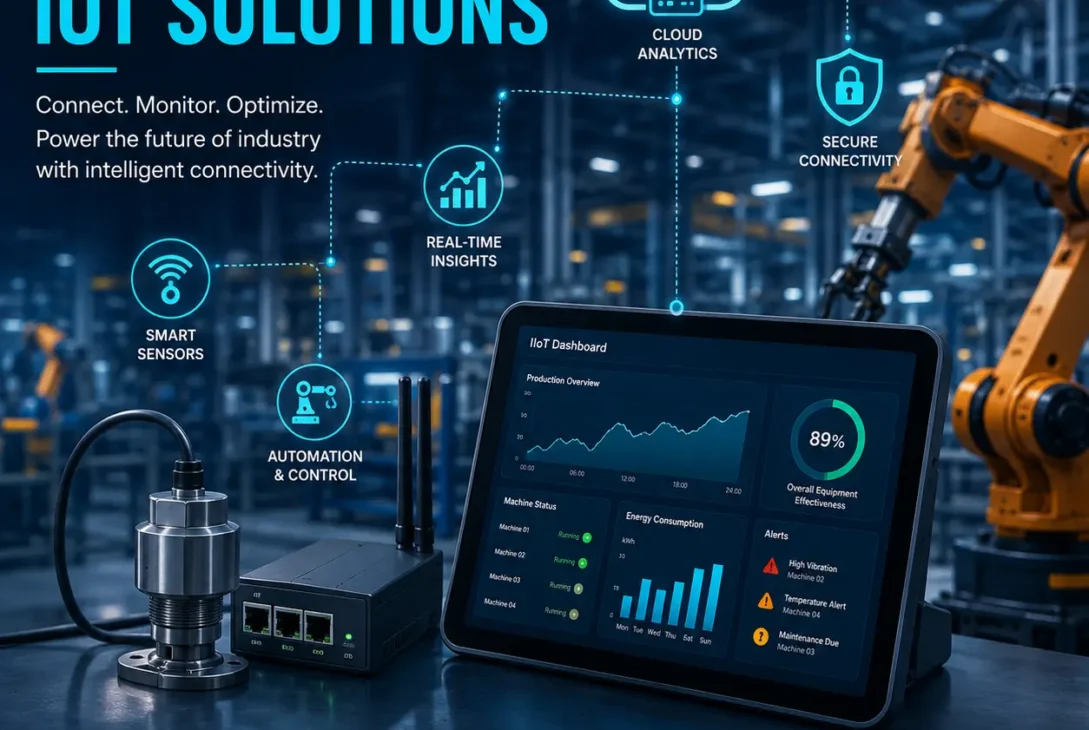
Industrial companies are increasingly using connected devices, sensors, automation systems, and real-time analytics to improve productivity and reduce operational costs. This transformation is driven by the Industrial Internet of Things (IIoT), which connects machines, equipment, software, and industrial processes through intelligent digital networks. Industrial IoT solutions help organizations monitor operations, identify problems, improve efficiency, and make faster decisions using real-time data.
Unlike traditional IoT applications designed mainly for consumers, industrial IoT focuses on factories, warehouses, energy facilities, transportation systems, manufacturing plants, and other large-scale operations. Modern industrial IoT solutions combine sensors, edge computing, cloud platforms, artificial intelligence, machine learning, and analytics to create smarter industrial environments.
Businesses can use industrial IoT solutions to monitor equipment performance, predict maintenance requirements, improve production quality, reduce energy consumption, and strengthen workplace safety. These technologies are becoming increasingly important as organizations look for ways to modernize their infrastructure and remain competitive.
In this guide, you’ll learn what industrial IoT solutions are, how they work, their main components, benefits, applications, implementation challenges, costs, and the major IIoT trends shaping industrial businesses in 2026.
Table of Contents
- What Are Industrial IoT Solutions?
- How Industrial IoT Works
- Key Components of Industrial IoT
- Benefits of Industrial IoT
- Common Industrial Applications
- Industries Using IIoT
- Industrial IoT vs Traditional IoT
- Implementation Process
- Pricing and Costs
- Common Challenges
- Future Trends
- Pros & Cons
- Final Verdict
- Frequently Asked Questions
What Are Industrial IoT Solutions?
Industrial IoT solutions are technology systems that connect industrial machines, sensors, equipment, software platforms, and operational processes to collect and analyze data. The information generated by connected devices can then be used to monitor operations, automate tasks, identify inefficiencies, and improve decision-making.
A typical solution may include:
- Industrial sensors
- Connected machinery
- IoT gateways
- Edge computing devices
- Cloud platforms
- Data analytics software
- Industrial automation systems
- Monitoring dashboards
- Artificial intelligence
- Machine learning
The main objective of industrial IoT solutions is to create a connected industrial environment where machines and systems can communicate while providing useful information to operators and managers.
For example, a manufacturing facility can install sensors on production equipment to monitor temperature, vibration, pressure, and operating conditions. If unusual vibration is detected, the system can alert maintenance teams before the machine experiences a major failure.
How Industrial IoT Works
Understanding how industrial IoT solutions work requires looking at the complete flow of industrial data. Connected sensors first collect information from machines, equipment, and physical processes. That information is then transferred through industrial networks to edge devices or cloud platforms for processing and analysis.
A typical IIoT workflow includes five steps:
- Data collection
- Data transmission
- Data processing
- Data analysis
- Automated action
Sensors continuously collect information while gateways transfer it between industrial equipment and software platforms. Edge computing can process critical information close to the machines, reducing latency and allowing faster responses.
Cloud platforms can then store larger datasets and provide advanced analytics, reporting, and machine learning capabilities. The resulting insights allow operators to make informed decisions and automate specific industrial processes.
Key Components of Industrial IoT
Modern industrial IoT solutions rely on several technologies working together to create a reliable connected environment.
Industrial Sensors
Sensors are responsible for collecting information from physical equipment and industrial environments. They can measure:
- Temperature
- Pressure
- Vibration
- Humidity
- Motion
- Speed
- Energy consumption
- Machine performance
Accurate sensors provide the foundation for reliable industrial analytics.
IoT Gateways
IoT gateways connect industrial devices and sensors with networks, edge systems, or cloud platforms. They can translate different communication protocols and filter data before sending it to centralized systems.
Gateways are especially useful in facilities containing older machinery that may not directly support modern connectivity standards.
Edge Computing
Edge computing processes information close to where it is generated instead of sending every piece of data to a remote cloud server.
This provides several advantages:
- Lower latency
- Faster responses
- Reduced bandwidth requirements
- Improved reliability
- Better local processing
Edge computing is particularly valuable for safety-critical industrial operations where immediate decisions are required.
Cloud Platforms
Cloud platforms provide centralized infrastructure for storing, processing, and analyzing industrial data. They allow organizations to access information from multiple facilities and create centralized monitoring systems.
Analytics and AI
Analytics platforms turn raw industrial information into actionable insights. Artificial intelligence and machine learning can identify patterns, detect anomalies, predict equipment failures, and optimize production processes.
Benefits of Industrial IoT Solutions
Businesses are adopting industrial IoT solutions because connected technology can improve productivity, reduce downtime, and provide better visibility into industrial operations. Instead of relying on manual inspections and delayed reports, companies can monitor equipment and processes continuously.
Predictive Maintenance
One of the most valuable applications is predictive maintenance. Sensors monitor equipment conditions and identify unusual changes before they become serious failures.
Businesses can track:
- Machine vibration
- Temperature changes
- Pressure levels
- Motor performance
- Operating hours
Predictive maintenance helps companies schedule repairs before unexpected breakdowns occur.
Reduced Downtime
Unplanned equipment failures can stop entire production lines. Industrial IoT solutions provide real-time monitoring that allows maintenance teams to identify potential problems earlier.
Early warnings can help organizations:
- Reduce production interruptions
- Respond to equipment problems faster
- Improve maintenance scheduling
- Increase machine availability
- Protect production targets
Improved Productivity
Connected machines provide managers with detailed information about production performance. This information can reveal bottlenecks, inefficient processes, and underperforming equipment.
Companies can use these insights to optimize workflows and improve overall production efficiency.
Better Product Quality
Quality problems can become expensive when they are discovered after products leave a production line. Industrial IoT solutions can continuously monitor production conditions and identify variations that may affect product quality.
Manufacturers can use connected systems to monitor:
- Production parameters
- Equipment conditions
- Material usage
- Defect rates
- Environmental conditions
This makes it easier to identify quality problems and take corrective action quickly.
Energy Optimization
Industrial facilities consume significant amounts of electricity, fuel, water, and other resources. Connected sensors can monitor consumption across machines and production areas.
Energy analytics can help organizations identify:
- Equipment using excessive power
- Unnecessary energy consumption
- Peak usage periods
- Inefficient production processes
Reducing energy waste can lower operating costs while supporting sustainability goals.
Common Industrial IoT Applications
Modern industrial IoT solutions can be applied to almost every part of an industrial operation.
Smart Manufacturing
Smart factories use connected machines, sensors, robotics, and analytics platforms to create more automated production environments.
Manufacturers can monitor production lines in real time and automatically collect information about machine performance, output, quality, and downtime.
Asset Tracking
Large industrial facilities often manage thousands of tools, vehicles, machines, and other assets. IoT tracking technologies can monitor asset locations and movements.
This can help companies:
- Reduce asset loss
- Improve inventory visibility
- Track equipment utilization
- Optimize resource allocation
- Improve logistics
Remote Equipment Monitoring
Remote monitoring allows technicians to monitor industrial equipment without being physically present at the facility.
This is especially useful for geographically distributed operations such as:
- Oil and gas facilities
- Solar farms
- Wind farms
- Utility infrastructure
- Remote manufacturing sites
Supply Chain Monitoring
Connected sensors can monitor shipments, storage conditions, vehicle locations, and inventory levels throughout the supply chain.
Companies can track temperature, humidity, location, and other environmental conditions to protect sensitive products.
Worker Safety
Safety is another important application of industrial IoT solutions. Connected devices can monitor environmental conditions and identify potential hazards.
Examples include monitoring:
- Gas levels
- Temperature
- Air quality
- Worker locations
- Restricted areas
Wearable devices can also provide alerts when workers enter dangerous zones or encounter hazardous conditions.
Industries Using Industrial IoT
The flexibility of industrial IoT solutions makes them useful across many industries.
Manufacturing
Manufacturing remains one of the largest IIoT markets. Factories use connected systems for predictive maintenance, quality control, production monitoring, robotics, and energy management.
Oil and Gas
Oil and gas companies use connected sensors to monitor pipelines, drilling equipment, storage facilities, and production systems.
Real-time monitoring can improve safety while helping companies identify equipment problems before they cause major operational disruptions.
Energy and Utilities
Power plants and utility companies use IIoT technologies to monitor generation equipment, electrical infrastructure, distribution systems, and energy consumption.
Transportation and Logistics
Logistics companies use connected devices for fleet tracking, vehicle monitoring, route optimization, and shipment visibility.
Agriculture
Smart agriculture combines sensors, connected equipment, weather information, and analytics to improve irrigation, crop monitoring, equipment management, and resource usage.
Mining
Mining companies operate in challenging environments where equipment reliability and worker safety are critical. IIoT systems can monitor heavy machinery, environmental conditions, and production activities.
https://www.nist.gov/
Industrial IoT vs Traditional IoT
Although both technologies use connected devices, their objectives and environments are different.
| Feature | Industrial IoT | Traditional IoT |
|---|---|---|
| Primary Focus | Industrial operations | Consumer and everyday applications |
| Environment | Factories, plants, utilities | Homes, offices, personal environments |
| Reliability | Extremely high | Varies by application |
| Data Volume | Often very large | Usually moderate |
| Main Goal | Efficiency, safety, automation | Convenience and personalization |
| Examples | Smart machines, sensors, production systems | Smart watches, cameras, home devices |
| Industrial systems generally require stronger reliability, security, scalability, and real-time performance than consumer IoT applications. |
How to Implement Industrial IoT Solutions
Implementing industrial IoT solutions requires careful planning because industrial environments often contain complex machinery, legacy systems, multiple communication protocols, and strict security requirements. A successful implementation should begin with clear business objectives rather than simply installing connected devices.
Define Business Objectives
Start by identifying the specific problems the technology needs to solve. Common objectives include reducing downtime, improving production efficiency, lowering energy costs, increasing safety, or improving product quality.
Clear objectives make it easier to select the right sensors, platforms, analytics tools, and connectivity technologies.
Assess Existing Infrastructure
Before deployment, companies should evaluate their current equipment and technology infrastructure. This assessment should identify:
- Existing machines and sensors
- Network infrastructure
- Legacy equipment
- Industrial protocols
- Data sources
- Security controls
- Existing software platforms
Understanding the current environment helps prevent compatibility problems during implementation.
Select the Right Connectivity
Industrial environments can use several connectivity technologies, including Ethernet, Wi-Fi, cellular networks, Bluetooth, LoRaWAN, and specialized industrial communication protocols.
The right option depends on factors such as distance, bandwidth, reliability, security, and environmental conditions.
Start With a Pilot Project
Instead of connecting an entire facility immediately, organizations should begin with a smaller pilot project. A pilot allows teams to test hardware, connectivity, analytics, security, and workflows before expanding the system.
Once the pilot demonstrates measurable results, the deployment can gradually expand to additional machines, production lines, or facilities.
Integrate With Existing Systems
Modern IIoT platforms should work with existing business and industrial systems rather than operating as isolated technologies. Integration may involve:
- Enterprise Resource Planning (ERP)
- Manufacturing Execution Systems (MES)
- Customer Relationship Management (CRM)
- Supervisory Control and Data Acquisition (SCADA)
- Computerized Maintenance Management Systems (CMMS)
Successful integration allows information to move between operational and business teams.
Security Challenges
Cybersecurity is one of the most important considerations when deploying industrial IoT solutions. Connecting machines and operational systems to networks can create additional entry points for attackers.
Industrial organizations should implement:
- Network segmentation
- Strong authentication
- Access controls
- Device monitoring
- Encryption
- Regular security updates
- Vulnerability assessments
- Incident response plans
Security should be considered from the beginning rather than added after deployment.
Data Management
Connected industrial environments can generate enormous amounts of information. Without proper data management, organizations may struggle to identify useful insights.
Companies should establish policies for:
- Data collection
- Data storage
- Data retention
- Data processing
- Data access
- Data quality
Edge computing can reduce the amount of information sent to centralized systems by processing time-sensitive data locally.
Cost of Industrial IoT Solutions
The cost of industrial IoT solutions varies considerably depending on the size of the deployment, number of connected devices, infrastructure requirements, software platforms, security needs, and integration complexity.
Major expenses may include:
- Sensors and connected devices
- IoT gateways
- Network infrastructure
- Cloud platforms
- Analytics software
- Installation
- System integration
- Cybersecurity
- Maintenance
Small pilot deployments may require a relatively limited investment, while large industrial implementations involving multiple facilities can require significant capital.
Businesses should calculate expected return on investment by comparing implementation costs with potential savings from reduced downtime, lower maintenance expenses, improved productivity, and energy optimization.
Common Implementation Challenges
Organizations may face several challenges when adopting industrial IoT solutions.
Legacy Equipment
Older machinery may not support modern connectivity technologies. Specialized gateways, adapters, or additional sensors may be required to connect legacy systems.
Data Overload
Collecting too much information without a clear purpose can make analytics difficult. Companies should focus on data that directly supports measurable business objectives.
Integration Complexity
Connecting new IIoT platforms with existing industrial and business applications can require significant technical expertise.
Employee Training
Employees need appropriate training to understand dashboards, alerts, analytics, and new automated workflows. Technical adoption becomes much easier when workers understand how the technology benefits their daily responsibilities.
Future Trends in Industrial IoT
The next generation of industrial IoT solutions will be shaped by artificial intelligence, edge computing, advanced robotics, digital twins, and increasingly autonomous industrial systems.
AI-Powered Predictive Analytics
Artificial intelligence will increasingly analyze machine data to detect anomalies and predict failures automatically. This can help maintenance teams prioritize the equipment requiring attention.
Digital Twins
Digital twins create virtual representations of physical machines, facilities, or production processes. Organizations can use these models to simulate changes, identify potential problems, and optimize operations without disrupting real equipment.
Edge AI
Combining artificial intelligence with edge computing allows industrial systems to analyze information locally. This can provide faster responses and reduce dependence on centralized cloud processing.
Autonomous Operations
As robotics, AI, and connected systems become more advanced, some industrial processes will require less manual intervention. Automated systems can adjust production parameters, respond to equipment conditions, and optimize workflows in real time.
Pros and Cons
Pros
- Real-time operational visibility
- Reduced equipment downtime
- Better predictive maintenance
- Improved production efficiency
- Lower energy consumption
- Better product quality
- Enhanced worker safety
- More informed decision-making
- Improved asset utilization
- Greater automation
Cons
- Initial implementation costs can be significant.
- Legacy equipment may require additional integration work.
- Cybersecurity risks increase as more devices become connected.
- Large deployments can generate complex data-management requirements.
- Employees may require technical training.
Final Verdict
Industrial IoT solutions are transforming traditional industrial environments by connecting machines, sensors, software, and people through intelligent digital networks. Organizations can use these technologies to monitor equipment, predict failures, optimize production, reduce energy waste, and improve workplace safety.
The most successful IIoT projects begin with specific business objectives and expand gradually through carefully tested deployments. Companies should also prioritize cybersecurity, data quality, system integration, and employee training throughout the implementation process.
As AI, edge computing, digital twins, and automation continue advancing, connected industrial systems will become even more intelligent and capable. Businesses that adopt IIoT strategically can improve operational efficiency while building a stronger foundation for long-term digital transformation.
Frequently Asked Questions
1. What are industrial IoT solutions?
Industrial IoT solutions connect industrial equipment, sensors, networks, and software platforms so organizations can collect data, monitor operations, automate processes, and improve decision-making.
2. What is the main purpose of IIoT?
The main purpose is to improve industrial efficiency, reliability, safety, and productivity by connecting physical equipment with digital technologies.
3. How does IIoT reduce downtime?
Sensors continuously monitor equipment conditions and can identify abnormal temperature, vibration, pressure, or performance patterns. Maintenance teams can then address problems before major failures occur.
4. Is industrial IoT secure?
IIoT can be secure when organizations implement network segmentation, strong authentication, encryption, access controls, monitoring, and regular security updates.
5. How much do IIoT projects cost?
Costs depend on the number of connected devices, facility size, connectivity requirements, software, analytics, security, integration, and ongoing maintenance.
6. What industries benefit from IIoT?
Manufacturing, energy, oil and gas, logistics, transportation, agriculture, utilities, and mining can all benefit from connected industrial technologies.