
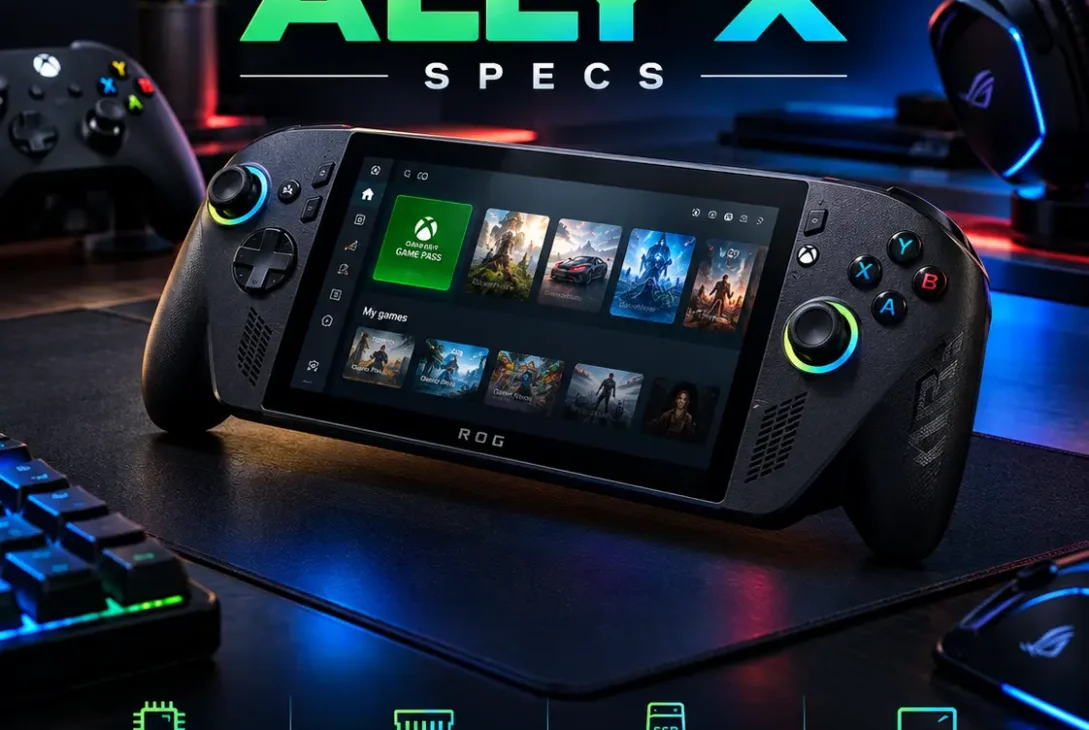
The ROG Xbox Ally X is one of the most powerful Windows handheld gaming PCs in the current ROG Xbox lineup. It combines AMD’s Ryzen AI Z2 Extreme processor with 24GB of LPDDR5X memory, a 1TB PCIe 4.0 SSD, an 80Wh battery, and a 7-inch 120Hz display.
For gamers looking for a portable PC capable of running demanding Windows games, the hardware is designed to offer considerably more performance than traditional handheld consoles. The device also combines ASUS ROG hardware with Xbox-focused software features, giving users access to PC game libraries while providing a more console-like interface.
This guide breaks down the ROG Xbox Ally X specs, including its processor, graphics, display, memory, storage, battery, connectivity, controls, dimensions, and gaming features.
Table of Contents
- What Is the ROG Xbox Ally X?
- ROG Xbox Ally X Specs at a Glance
- Processor and Performance
- Radeon Graphics
- Display
- Memory
- Storage
- Battery and Charging
- Cooling System
- Controls and Ergonomics
- Ports and Connectivity
- Audio Features
- Windows 11 and Xbox Experience
- Gaming Performance
- ROG Xbox Ally X vs ROG Ally X
- Is the ROG Xbox Ally X Good for Gaming?
- Frequently Asked Questions
- Final Verdict
- SEO Details
What Is the ROG Xbox Ally X?
The ROG Xbox Ally X is a Windows 11 handheld gaming PC developed by ASUS in collaboration with Xbox.
Unlike a traditional console, it runs Windows 11 Home and can access PC games and applications. At the same time, Xbox has added software features designed to make navigating a handheld PC more convenient.
The hardware is aimed at gamers who want desktop-style PC gaming in a portable form factor.
The device features contoured grips inspired by Xbox Wireless Controllers, Hall Effect-style controls, programmable rear buttons, a touchscreen, and a high-performance AMD processor.
The combination makes it more like a portable gaming PC than a conventional console.
ROG Xbox Ally X Specs at a Glance
Here is a quick overview of the main hardware:
| Specification | ROG Xbox Ally X |
|---|---|
| Operating System | Windows 11 Home |
| Processor | AMD Ryzen AI Z2 Extreme |
| CPU | 8 cores / 16 threads |
| CPU Boost | Up to 5.0GHz |
| NPU | Up to 50 TOPS |
| Graphics | AMD Radeon Graphics |
| Display | 7-inch FHD IPS-level |
| Resolution | 1920 × 1080 |
| Refresh Rate | 120Hz |
| Brightness | 500 nits |
| Variable Refresh | AMD FreeSync Premium |
| RAM | 24GB LPDDR5X |
| Storage | 1TB PCIe 4.0 NVMe SSD |
| Battery | 80Wh |
| Wireless | Wi-Fi 6E |
| Bluetooth | Bluetooth 5.4 |
| USB | USB4 + USB 3.2 Gen 2 Type-C |
| microSD | UHS-II |
| Audio | 3.5mm headphone jack |
| Weight | About 715g |
These ROG Xbox Ally X specs put the handheld firmly in the high-performance category.
Processor and Performance
At the center of the device is AMD’s Ryzen AI Z2 Extreme processor.
The chip features 8 CPU cores and 16 threads, with boost speeds reaching up to 5.0GHz. ASUS also lists an AMD XDNA NPU capable of up to 50 TOPS for supported AI workloads.
The processor is designed specifically for modern handheld PCs, balancing CPU performance with integrated graphics capabilities.
This is important because handheld gaming PCs cannot rely on a separate desktop graphics card. The processor and integrated GPU share the available power and memory resources.
The Ryzen AI Z2 Extreme therefore plays a major role in determining gaming performance.
For demanding games, CPU performance helps with game logic, physics, background tasks, and frame-rate consistency.
Radeon Graphics
The graphics processor is based on AMD Radeon technology integrated into the platform.
Because there is no dedicated laptop-style GPU, system memory is shared between the CPU and graphics hardware.
The 24GB memory configuration gives the system a relatively large pool of fast LPDDR5X memory to work with.
The platform also supports technologies such as AMD’s upscaling and frame-generation features, depending on the game and software configuration.
These technologies can help increase frame rates or improve the perceived smoothness of supported games.
For demanding AAA titles, users will still need to adjust graphics settings and resolution according to the game’s requirements.
Display
The display is a 7-inch Full HD IPS-level panel with a 1920 × 1080 resolution.
It supports a 120Hz refresh rate and AMD FreeSync Premium variable refresh technology.
Brightness is rated at up to 500 nits.
The display also supports 10-point multitouch and uses Corning Gorilla Glass Victus with an anti-reflective DXC treatment.
For a handheld gaming PC, 120Hz is useful because it allows supported games to display smoother motion than a standard 60Hz panel.
The 1080p resolution also provides a practical balance between image quality and GPU workload.
Running every modern AAA game at native 1080p with maximum settings would be demanding for an integrated GPU, so players can benefit from resolution scaling and upscaling technologies.
Memory
The device comes with 24GB of LPDDR5X memory.
ASUS specifies dual-channel memory, while the original launch specifications list LPDDR5X-8000 memory.
The memory is particularly important because the integrated Radeon graphics uses system memory rather than having its own dedicated VRAM pool.
A larger memory capacity can also help when running Windows applications alongside games.
The 24GB configuration provides more headroom than many older handheld gaming PCs that shipped with 16GB.
For gamers who want to keep a browser, launcher, communication application, or other software available while gaming, additional memory can be useful.
Storage
The device includes a 1TB PCIe 4.0 NVMe M.2 SSD.
One of the advantages of this configuration is the use of the standard M.2 2280 format, which can make future storage upgrades more convenient.
Modern PC games can be extremely large.
A single AAA title can consume well over 100GB, so 1TB provides useful space for a collection of games while still leaving room for Windows and applications.
The handheld also includes a UHS-II microSD card reader.
This gives users another option for storing compatible games and files, although demanding games generally benefit from the faster internal SSD.
Battery and Charging
Battery capacity is one of the biggest improvements in the high-end Ally X design.
The device includes an 80Wh four-cell lithium-ion battery.
ASUS supplies a 65W USB-C power adapter, although charger availability can vary by region.
Battery life will depend heavily on the game, display brightness, refresh rate, power mode, frame rate, and performance settings.
A demanding AAA game can consume considerably more power than a lightweight indie title.
For longer sessions away from a wall outlet, users can reduce power consumption by lowering brightness, limiting frame rate, or selecting a lower-performance mode.
Cooling System
Handheld gaming PCs have to manage considerable heat inside a relatively small chassis.
The ROG Xbox Ally X uses ASUS’s cooling system to help maintain performance during extended gaming sessions.
Thermal management is particularly important because sustained CPU and GPU workloads can cause temperatures to rise.
If a device becomes too hot, performance can be reduced automatically to control temperatures.
A good cooling system therefore affects more than comfort. It can also influence sustained gaming performance.
The exact results will vary according to ambient temperature, power mode, game workload, and software updates.
Controls and Ergonomics
The physical controls are one of the most important parts of the handheld.
The device features two full-size analog sticks, an Xbox-style button layout, a D-pad, bumpers, triggers, menu and view buttons, and additional assignable rear buttons.
The triggers use Hall Effect technology, while the device also includes HD haptics and a six-axis IMU.
The contoured grips are designed around the shape of a traditional Xbox controller.
This can make longer gaming sessions more comfortable than using a flat handheld device.
The touchscreen also allows users to interact with Windows and supported games without connecting an external mouse or keyboard.
Ports and Connectivity
The handheld provides several connectivity options.
It includes one USB4 Type-C port with DisplayPort support and Power Delivery, as well as another USB 3.2 Gen 2 Type-C port.
The USB4 connection is compatible with Thunderbolt 4 accessories and can support external displays through DisplayPort.
A UHS-II microSD card reader is also included.
For wired audio, there is a 3.5mm combo headphone and microphone jack.
Wireless connectivity includes Wi-Fi 6E and Bluetooth 5.4.
This gives users flexibility when connecting wireless headphones, controllers, keyboards, mice, or other compatible accessories.
Audio Features
The handheld includes stereo speakers with Smart Amp technology.
ASUS also lists Hi-Res audio certification for headphones, Dolby Atmos support, and AI noise-canceling technology.
The built-in microphone array is designed for communication during multiplayer gaming and other Windows applications.
For competitive gaming, many players may still prefer a wired or wireless gaming headset, but the built-in audio system is useful when portability matters.
Windows 11 and Xbox Experience
One of the biggest differences between this device and a traditional gaming console is Windows 11.
Windows provides access to a broad PC software ecosystem, including multiple game stores and applications.
Xbox has also worked with ASUS to improve the handheld experience by providing a more controller-friendly interface.
The Xbox full-screen experience is intended to make navigating games and libraries easier when the device is being used without a mouse and keyboard.
Users can still access the normal Windows desktop when they need traditional PC functionality.
This combination gives the handheld both console-style convenience and PC flexibility.
https://rog.asus.com/us/gaming-handhelds/rog-ally/rog-xbox-ally-x-2025/spec
Gaming Performance
The hardware is designed for modern PC gaming, but performance depends heavily on the game and selected settings.
Less demanding games can take advantage of the 120Hz display more easily, while graphically intensive AAA games may require lower settings, resolution scaling, or upscaling.
Games such as competitive shooters can benefit from the high-refresh display and responsive controls.
Single-player games can take advantage of the larger 80Wh battery and performance-focused hardware.
The device can also run games from different PC storefronts because it is based on Windows.
This gives it a wider software library than platforms restricted to one game store.
ROG Xbox Ally X vs ROG Ally X
The ROG Ally X from 2024 and the newer ROG Xbox Ally X share some important characteristics, including a 7-inch 1080p 120Hz display and 24GB memory.
However, the newer model moves to AMD’s Ryzen AI Z2 Extreme platform and adds the Xbox-oriented software experience.
The older ROG Ally X uses the Ryzen Z1 Extreme processor and has an 80Wh battery.
The newer model keeps the large battery while adding a newer processor platform, updated controls, and deeper Xbox integration.
For buyers comparing the two, processor generation, software experience, storage, price, and availability should all be considered.
Is the ROG Xbox Ally X Good for Gaming?
The hardware is clearly designed around gaming.
The Ryzen AI Z2 Extreme processor, 24GB LPDDR5X memory, 1TB SSD, 120Hz display, 80Wh battery, and integrated Radeon graphics give it the specifications expected from a premium Windows handheld.
The biggest limitation is the same one faced by every integrated-GPU handheld: power and thermal limits.
A desktop gaming PC with a dedicated graphics card will remain substantially more powerful.
However, the advantage of this device is portability.
It can run PC games while fitting into a handheld form factor that can be used on a sofa, during travel, or away from a traditional desk setup.
Frequently Asked Questions
What are the main ROG Xbox Ally X specs?
The main specifications include an AMD Ryzen AI Z2 Extreme processor, 24GB LPDDR5X memory, 1TB PCIe 4.0 SSD, 7-inch 1080p 120Hz display, integrated Radeon graphics, and an 80Wh battery.
How much RAM does the ROG Xbox Ally X have?
It comes with 24GB of onboard LPDDR5X memory.
How much storage does it have?
The handheld includes a 1TB PCIe 4.0 NVMe M.2 2280 SSD and also has a UHS-II microSD card slot.
What processor does it use?
It uses AMD’s Ryzen AI Z2 Extreme processor with 8 CPU cores, 16 threads, and boost speeds of up to 5.0GHz.
Does the ROG Xbox Ally X have a 120Hz display?
Yes. Its 7-inch Full HD display supports a 120Hz refresh rate and AMD FreeSync Premium.
How large is the battery?
The device has an 80Wh four-cell lithium-ion battery.
Does it support external monitors?
Yes. Its USB-C ports support DisplayPort, allowing compatible external displays to be connected.
Does it run Windows?
Yes. The device ships with Windows 11 Home.
Can you upgrade the SSD?
The system uses an M.2 2280 PCIe 4.0 SSD, making storage replacement or upgrading more accessible than on some compact handhelds.
Final Verdict
The ROG Xbox Ally X specs show a handheld designed for users who want high-end portable PC gaming.
Its Ryzen AI Z2 Extreme processor, 24GB LPDDR5X memory, 1TB PCIe 4.0 SSD, 120Hz 1080p display, 80Wh battery, and broad connectivity give it a strong hardware foundation.
The combination of Windows 11 and Xbox’s handheld-focused interface is also important. Instead of being limited to a traditional console ecosystem, users can access a much wider range of PC games and applications.
The main consideration is that performance will always depend on the game’s graphics requirements and the handheld’s power limits.
For gamers who prioritize portability while still wanting access to modern PC games, the device provides a powerful handheld format with specifications built specifically around gaming.