
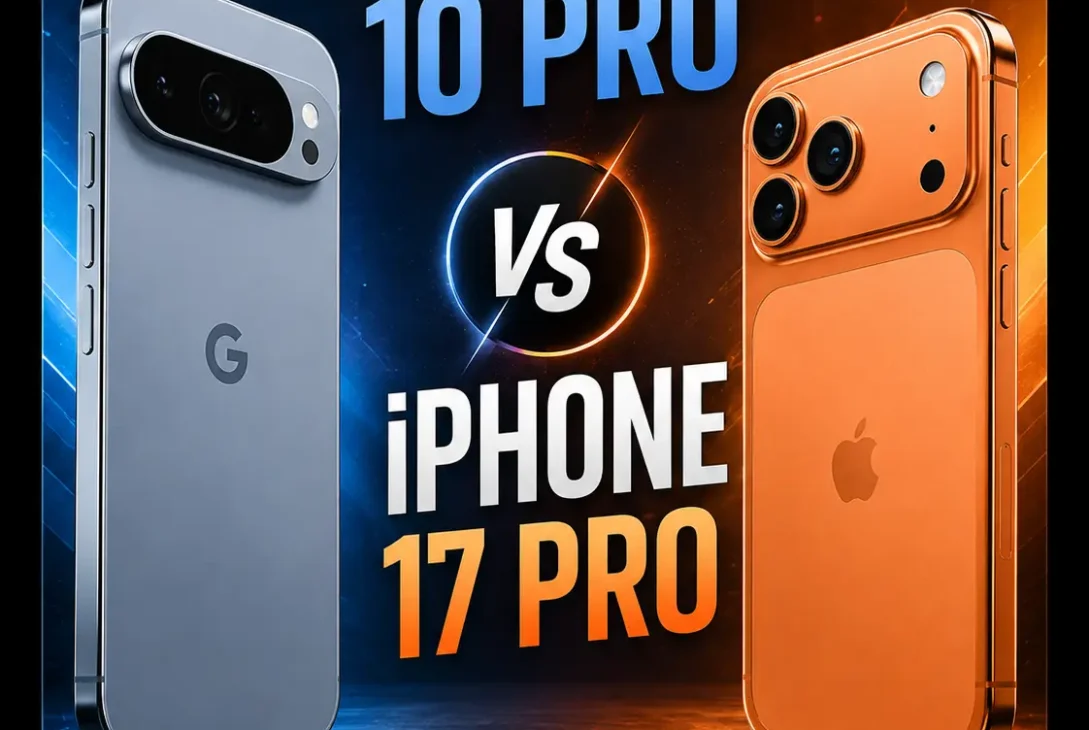
The Pixel 10 Pro vs iPhone 17 Pro comparison comes down to two very different approaches to a premium smartphone. Google’s Pixel 10 Pro focuses heavily on computational photography, AI features, Android integration and Google’s Tensor G5 platform, while Apple’s iPhone 17 Pro combines the A19 Pro chip, a powerful Pro camera system, iOS and Apple’s wider ecosystem. Both are serious flagship phones, but they suit different types of users.
Google lists the Pixel 10 Pro with a 6.3-inch LTPO OLED display, 16GB RAM, Tensor G5, a triple rear-camera system and 24+ hour battery life. Apple lists the iPhone 17 Pro with a 6.3-inch OLED display, A19 Pro, a 48MP triple-camera system and up to 33 hours of video playback.
If you’re deciding between these two phones in the USA or UK, this guide breaks down the important differences instead of simply comparing numbers on a specification sheet.
Table of Contents
- Pixel 10 Pro vs iPhone 17 Pro: Quick Comparison
- Design and Display
- Performance and Gaming
- Camera Comparison
- Zoom and Photography
- Video Recording
- Battery and Charging
- Software and AI Features
- Storage and Connectivity
- Which Phone Is Better for Everyday Use?
- Pixel 10 Pro vs iPhone 17 Pro: Pros and Cons
- Frequently Asked Questions
- Final Verdict
- SEO Details
Pixel 10 Pro vs iPhone 17 Pro: Quick Comparison
| Feature | Google Pixel 10 Pro | iPhone 17 Pro |
|---|---|---|
| Display | 6.3-inch LTPO OLED | 6.3-inch OLED |
| Refresh rate | 1–120Hz | Up to 120Hz ProMotion |
| Processor | Tensor G5 | A19 Pro |
| RAM | 16GB | Apple does not list RAM in its official specifications |
| Base storage | 128GB in some markets | 256GB |
| Rear cameras | 50MP + 48MP + 48MP | 48MP + 48MP + 48MP |
| Telephoto | 48MP, 5x optical | 48MP, 4x optical; 8x optical-quality |
| Maximum stated zoom | Up to 100x Pro Zoom | Up to 40x digital |
| Front camera | 42MP autofocus | Center Stage camera |
| Battery claim | 24+ hours | Up to 33 hours video playback |
| Wireless charging | Qi2 Pixelsnap up to 15W | MagSafe/Qi2 up to 25W |
| Water resistance | IP68 | IP68 |
| OS | Android | iOS |
Specifications vary by region and configuration, so buyers should check the exact local model before purchasing. Google’s official UK specification page, for example, lists different storage configurations from some other markets.
Design and Display
Both phones use a 6.3-inch display, so neither is an especially large flagship.
The Pixel 10 Pro uses Google’s Super Actua LTPO OLED panel with a 1280 × 2856 resolution, 1–120Hz adaptive refresh rate and up to 3300 nits peak brightness according to Google’s specifications.
The iPhone 17 Pro has a 6.3-inch Super Retina XDR OLED display with a 2622 × 1206 resolution and ProMotion adaptive refresh rates up to 120Hz. Apple specifies up to 3000 nits peak outdoor brightness.
Which Has the Better Display?
On paper, the Pixel 10 Pro has the more aggressively specified display, particularly when looking at its resolution and quoted peak brightness.
The iPhone 17 Pro counters with Apple’s display calibration, ProMotion and strong HDR support.
For everyday use, both should provide an excellent experience. The difference is more about personal preference than a simple winner.
Display winner: Pixel 10 Pro, by specifications.
Performance and Gaming
The Pixel 10 Pro is powered by Google’s Tensor G5 processor and includes 16GB of RAM. Google also pairs the platform with its Titan M2 security coprocessor.
The iPhone 17 Pro uses Apple’s A19 Pro chip with a six-core CPU, six-core GPU, 16-core Neural Engine and hardware-accelerated ray tracing.
For demanding games and applications, both phones have flagship-level hardware. However, the platforms are designed differently.
Apple controls both the iPhone hardware and iOS software, giving developers a tightly integrated platform. Google’s Tensor approach puts considerable emphasis on AI, photography and Google’s own software features.
If gaming is your priority, don’t choose based only on CPU names. Look at the games you actually play and the platform your friends or existing devices use.
Performance winner: iPhone 17 Pro for traditional high-end performance; Pixel 10 Pro for Google’s AI-focused experience.
Camera Comparison
The camera is one of the biggest reasons someone might search for a Pixel 10 Pro vs iPhone 17 Pro comparison.
Google’s Pixel 10 Pro has a 50MP wide camera, 48MP ultrawide camera with autofocus and a 48MP 5x telephoto camera with optical image stabilisation. Google also lists Pro Zoom up to 100x.
Apple’s iPhone 17 Pro uses three 48MP Fusion cameras: a main camera, an ultrawide camera and a 48MP telephoto camera. Apple lists a 4x telephoto lens and an 8x optical-quality option, along with digital zoom up to 40x.
Pixel 10 Pro Camera
Google puts a major emphasis on computational photography.
The Pixel 10 Pro supports features such as Night Sight, Camera Coach, High-Res Portrait Mode, Macro Focus, Best Take, Face Unblur, Magic Eraser and Zoom Enhance.
The 42MP autofocus front camera also gives the Pixel a strong specification for selfies and video calls.
iPhone 17 Pro Camera
Apple takes a more comprehensive pro-camera approach.
The iPhone 17 Pro supports ProRAW, macro photography, spatial photos, Photographic Styles and Apple’s computational photography technologies. Its telephoto camera uses a tetraprism design and supports optical-quality zoom options up to 8x.
Camera winner: Pixel 10 Pro for computational photography and zoom flexibility; iPhone 17 Pro for Apple’s pro-oriented photo and video workflow.
Zoom and Photography
This is one of the clearest hardware differences.
The Pixel 10 Pro includes a dedicated 48MP 5x optical telephoto camera and Google’s Pro Zoom system can reach up to 100x. Google also describes 10x optical-quality zoom as part of the system.
The iPhone 17 Pro has a 48MP 4x telephoto camera and supports an 8x optical-quality telephoto option. Apple also lists up to 40x digital zoom.
If you frequently photograph distant subjects, the Pixel’s approach is particularly attractive.
Zoom winner: Pixel 10 Pro.
Video Recording
Video is an area where the iPhone has historically been particularly strong, and the iPhone 17 Pro continues Apple’s pro-video approach.
Apple includes features such as ProRes, ProRes RAW support, Dolby Vision recording and advanced stabilisation features in its camera system.
Google also gives the Pixel 10 Pro a strong video feature set, including Video Boost and improved stabilisation. Google says Video Boost can help produce more stable, cinematic footage.
For someone creating YouTube videos, social content or professional-looking clips, the iPhone’s broader pro-video ecosystem remains a major reason to choose it.
Video winner: iPhone 17 Pro.
Battery and Charging
Google rates the Pixel 10 Pro for 24+ hours of battery life and lists a typical 4870mAh battery. It supports fast charging of up to 55% in around 30 minutes using a compatible 30W USB-C PPS charger or higher. Pixelsnap wireless charging is rated up to 15W.
Apple does not provide a battery-capacity figure on its official iPhone 17 Pro specification page. Instead, Apple rates the phone for up to 33 hours of video playback and says it can reach up to 50% charge in around 20 minutes with a 40W adapter or higher. MagSafe and Qi2 wireless charging are supported up to 25W.
Because Google and Apple use different testing methods, their battery numbers should not be treated as a direct apples-to-apples benchmark.
Battery winner: iPhone 17 Pro on Apple’s stated video-playback rating, while Pixel offers a clearly specified large-capacity battery.
Software and AI Features
This is where the two phones feel most different.
The Pixel 10 Pro runs Google’s Android experience and is deeply integrated with Google services and AI features. Google highlights tools including Camera Coach, Magic Eraser, Best Take, Reimagine, Zoom Enhance and other intelligent editing features.
The iPhone 17 Pro runs iOS and includes Apple Intelligence. Apple’s ecosystem also connects the phone closely with Macs, iPads, Apple Watches and AirPods.
Choose Pixel If You Want:
- Google’s Android experience
- Google Assistant/Gemini-style AI integration
- Extensive AI photo editing
- Google Photos and Google services
- More freedom to customise the phone
Choose iPhone If You Want:
- iOS
- Apple Intelligence
- Seamless Apple-device integration
- AirDrop and Continuity features
- A mature ecosystem around Mac, iPad and Apple Watch
Software winner: It depends heavily on your existing ecosystem.
Storage and Connectivity
Google lists the Pixel 10 Pro with 16GB RAM and storage options that include 128GB, 256GB, 512GB and 1TB depending on market.
Apple offers the iPhone 17 Pro in 256GB, 512GB and 1TB capacities.
Neither phone supports microSD expansion, so storage choice matters when purchasing.
The iPhone 17 Pro supports Wi-Fi 7, Bluetooth 6 and USB 3 through its USB-C connector.
For people who regularly transfer large video files, Apple’s USB 3 support can be particularly useful.
Which Phone Is Better for Everyday Use?
For everyday social media, browsing, messaging, streaming and photography, both are excellent.
The Pixel 10 Pro makes more sense if you want Google’s Android ecosystem and enjoy experimenting with AI-powered photography tools.
The iPhone 17 Pro makes more sense if you already use Apple devices or want a phone that fits naturally into a Mac, Apple Watch or AirPods setup.
For someone switching from Android to iPhone, Apple’s ecosystem is a major consideration. For someone moving from iPhone to Android, Pixel provides a similarly polished experience while offering more Android flexibility.
https://store.google.com/product/pixel_10_pro_specs?hl=en-US
Pixel 10 Pro vs iPhone 17 Pro: Pros and Cons
Pixel 10 Pro Pros
- 16GB RAM
- Tensor G5 processor
- Excellent camera hardware
- 5x optical telephoto
- Up to 100x Pro Zoom
- Strong AI photography features
- 1–120Hz LTPO OLED display
- Google ecosystem
Pixel 10 Pro Cons
- Tensor is designed differently from Apple’s performance-focused chip
- Wireless charging is listed at 15W
- Some AI features may depend on region or software availability
- Storage and specifications vary by market
iPhone 17 Pro Pros
- A19 Pro processor
- Strong pro-video capabilities
- 48MP triple-camera system
- 8x optical-quality telephoto option
- Up to 33 hours of stated video playback
- Up to 25W MagSafe/Qi2 wireless charging
- Excellent Apple ecosystem integration
- USB 3 connectivity
iPhone 17 Pro Cons
- Less Android-style customisation
- Apple ecosystem is less flexible if you use Windows or Android devices
- Some features work best when paired with other Apple products
- Apple’s official specifications do not state RAM capacity
Frequently Asked Questions
Is Pixel 10 Pro better than iPhone 17 Pro?
Neither is universally better. The Pixel 10 Pro is particularly attractive for Google’s AI features, photography tools and zoom system, while the iPhone 17 Pro is a strong choice for performance, video and Apple ecosystem integration.
Which has the better camera, Pixel 10 Pro or iPhone 17 Pro?
The Pixel 10 Pro has a 50MP main camera, 48MP ultrawide and 48MP 5x telephoto, while the iPhone 17 Pro uses three 48MP cameras. The Pixel has a particularly strong specification for zoom, while Apple’s camera system offers extensive pro photo and video capabilities.
Which phone has better zoom?
The Pixel 10 Pro has the stronger stated zoom range, with Google’s Pro Zoom reaching up to 100x and a dedicated 48MP 5x telephoto camera.
Which is better for video, Pixel 10 Pro or iPhone 17 Pro?
The iPhone 17 Pro is the better choice for users who prioritise professional video features and Apple’s video workflow. The Pixel 10 Pro remains highly capable and includes Video Boost and advanced stabilisation.
Does Pixel 10 Pro have more RAM than iPhone 17 Pro?
Google officially lists 16GB RAM for the Pixel 10 Pro. Apple does not list RAM capacity in the iPhone 17 Pro’s official technical specifications, so comparing the two purely by RAM is not meaningful.
Which has the better display?
Both use 6.3-inch high-end OLED displays with adaptive refresh rates up to 120Hz. Google specifies up to 3300 nits peak brightness for the Pixel 10 Pro, while Apple specifies up to 3000 nits outdoor peak brightness for the iPhone 17 Pro.
Is Pixel 10 Pro good for gaming?
Yes. Its Tensor G5 processor and 16GB RAM provide flagship-level hardware for demanding Android games. Actual performance depends on individual games, graphics settings and thermal conditions.
Which phone has better battery life?
Apple rates the iPhone 17 Pro for up to 33 hours of video playback, while Google describes the Pixel 10 Pro as offering 24+ hours of battery life. Because the companies use different testing methods, these figures should not be treated as a direct laboratory comparison.
Should I buy Pixel 10 Pro or iPhone 17 Pro?
Choose the Pixel 10 Pro if you prefer Android, Google’s AI tools and powerful zoom photography. Choose the iPhone 17 Pro if you prefer iOS, Apple’s ecosystem, strong video features and the A19 Pro platform.
Is Pixel 10 Pro worth buying in 2026?
Yes, if its camera system, Android software and AI features match what you need. It remains a current flagship model with Google’s Tensor G5 platform and Pro camera system.
Final Verdict
The Pixel 10 Pro vs iPhone 17 Pro battle does not have one winner for everyone.
Choose the Pixel 10 Pro if photography, AI editing, Android flexibility and long-range zoom are your priorities. Its 48MP 5x telephoto and up-to-100x Pro Zoom make it especially interesting for people who take a lot of zoomed-in photos.
Choose the iPhone 17 Pro if you care more about Apple’s ecosystem, pro-level video, high-end performance and seamless integration with other Apple devices. Its A19 Pro chip and extensive video capabilities make it a particularly strong choice for creators.
For most buyers, the final decision should be based less on megapixel counts and more on Android vs iOS, camera style, video needs and the devices you already own.