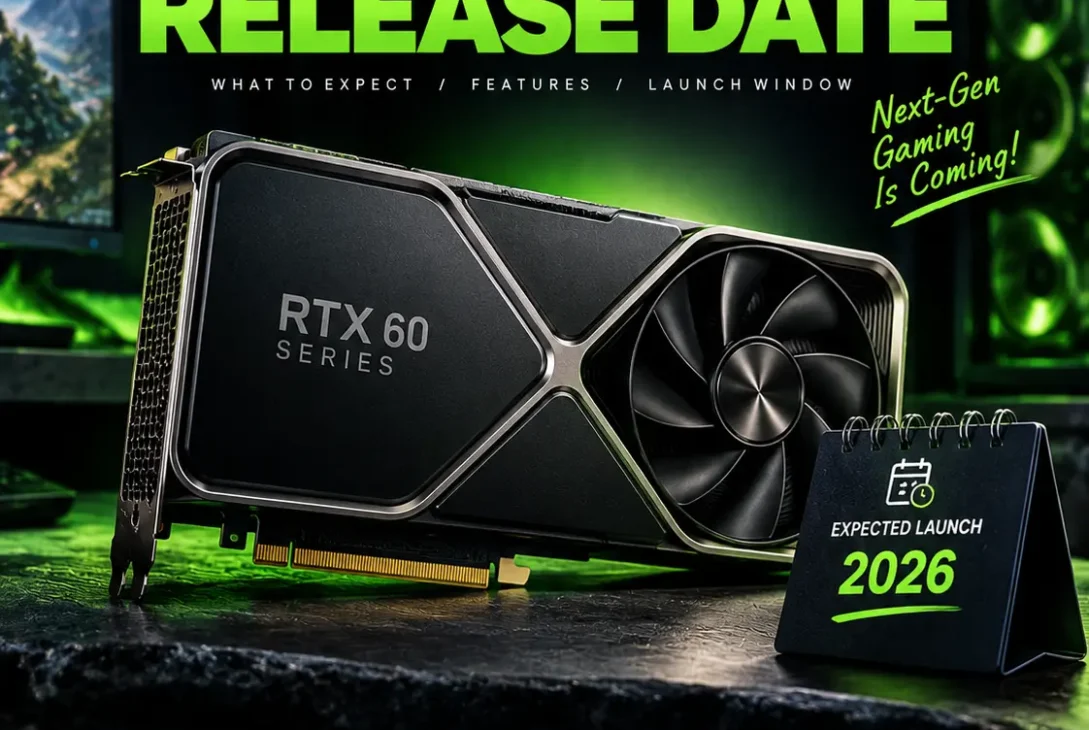
The NVIDIA RTX 60 series release date is becoming one of the biggest questions for PC gamers looking for their next graphics card. NVIDIA has not officially announced the GeForce RTX 60 lineup or provided a consumer launch date, but recent reports suggest the next-generation gaming GPUs could be pushed into 2028. Earlier rumors had pointed toward late 2027, making the latest reports particularly important for anyone considering an RTX 50-series upgrade.
The situation is complicated by NVIDIA’s rapidly expanding AI business. The company is currently focusing heavily on its Rubin platform and data-center products, while memory and semiconductor supply remain important factors for consumer GPU availability. This could explain why the next GeForce generation is taking longer than many gamers originally expected.
For now, gamers should separate confirmed NVIDIA information from leaks and industry reports. Rubin is a real NVIDIA architecture, but a consumer RTX 60 product lineup and its final specifications have not been officially announced.
Table of Contents
- NVIDIA RTX 60 Series Release Date: Latest Update
- Has NVIDIA Confirmed RTX 60?
- Why RTX 60 Could Be Delayed
- Will RTX 60 Use Rubin?
- Expected RTX 60 Specifications
- RTX 6090 and Other Possible Models
- RTX 60 Performance Expectations
- RTX 60 vs RTX 50 Series
- Should You Buy an RTX 50 GPU?
- What the 2028 Rumor Means for Gamers
- When Could RTX 60 Actually Launch?
- NVIDIA RTX 60 Series Release Date FAQs
- Final Verdict
NVIDIA RTX 60 Series Release Date: Latest Update
The latest reports have changed expectations for the NVIDIA RTX 60 series release date.
Earlier leaks suggested NVIDIA’s next-generation gaming GPUs could launch during the second half of 2027. More recent reporting now points toward 2028, with hardware leaker Kopite7kimi reportedly saying that NVIDIA’s next gaming GPU family, referred to in reports as GR20x, has moved into the 2028 timeframe. NVIDIA has not confirmed the information and has declined to comment on rumors.
That means 2028 is currently the most cautious expected timeframe, rather than an official release date.
The distinction is important because there is a lot of RTX 60 information circulating online. Some websites publish specific launch months, specifications and model names as though they are confirmed, but NVIDIA has not officially provided those details.
The current situation can be summarized simply:
- 2026: RTX 60 is not expected.
- 2027: Earlier rumors suggested a possible launch.
- 2028: Newer reports increasingly point toward this timeframe.
- Official launch date: Not announced by NVIDIA.
The latest reporting therefore makes waiting for the next GeForce generation a potentially longer process than gamers originally expected.
Has NVIDIA Confirmed RTX 60?
No.
NVIDIA has not officially announced consumer GeForce RTX 60 graphics cards.
There is currently no official confirmation for:
- RTX 6090
- RTX 6080
- RTX 6070
- RTX 6060
- RTX 60 specifications
- RTX 60 pricing
- RTX 60 desktop launch date
- RTX 60 laptop launch date
NVIDIA’s official consumer graphics-card lineup is still centered on the RTX 50 family. The RTX 50 generation introduced Blackwell-based GeForce products and technologies including DLSS and advanced ray tracing. NVIDIA Investor Relations
This is why the NVIDIA RTX 60 series release date should currently be described as rumored, not confirmed.
That does not mean the next generation is not being developed. NVIDIA obviously has a future gaming GPU roadmap, but the company has not yet publicly revealed the complete consumer product strategy.
Why RTX 60 Could Be Delayed
One of the biggest factors behind the changing NVIDIA RTX 60 series release date could be NVIDIA’s increasing focus on artificial intelligence.
NVIDIA’s Rubin platform is designed primarily for large-scale AI infrastructure and data-center workloads. The company officially launched Rubin in January 2026 and said Rubin-based products would become available through partners during the second half of 2026.
NVIDIA later announced that Vera Rubin was entering full production, with production shipments scheduled to begin in fall 2026.
That is significant because NVIDIA now operates in two enormous markets:
Consumer graphics: GeForce gaming GPUs.
AI infrastructure: Extremely expensive data-center systems and accelerators.
AI products have become strategically important to NVIDIA, meaning the company has strong reasons to prioritize advanced manufacturing capacity toward products serving the rapidly expanding AI market.
Recent reporting also points to limitations involving memory and semiconductor supply. These constraints can affect consumer GPU launches even when the underlying GPU architecture is already being developed.
Will RTX 60 Use Rubin?
One of the biggest rumors surrounding the NVIDIA RTX 60 series release date is that the next GeForce generation will be based on a gaming version of NVIDIA’s Rubin architecture.
Rubin itself is officially confirmed.
NVIDIA’s Rubin GPU for AI infrastructure uses a very different configuration from a typical GeForce graphics card. NVIDIA says the Rubin GPU features 224 streaming multiprocessors, 896 Tensor Cores, 336 billion transistors and HBM4 memory with up to 288GB of capacity in its data-center implementation.
However, gamers should not assume that a future RTX 60 graphics card will simply be a smaller version of the data-center Rubin GPU.
Consumer GPUs have different priorities.
A GeForce graphics card needs to balance:
- Gaming performance
- Power consumption
- Manufacturing cost
- Memory cost
- Ray tracing
- AI acceleration
- Cooling
- Retail pricing
- Board design
A future gaming architecture could therefore share technology with Rubin while still being significantly different from NVIDIA’s data-center products.
Expected RTX 60 Specifications
Exact RTX 60 specifications are not confirmed.
That means current claims about CUDA cores, clock speeds, memory capacity and power consumption should be treated as rumors.
Still, several areas are worth watching.
More Powerful Ray Tracing
NVIDIA has made ray tracing one of the major features of its recent GeForce generations.
The RTX 50 family continued this trend with newer RT hardware and AI-powered rendering technologies.
A future generation would logically be expected to improve ray-tracing performance, but NVIDIA has not published official RTX 60 benchmarks.
Faster Memory
Memory bandwidth will likely remain extremely important.
The current generation already uses advanced GDDR7 memory on its GeForce products. Future GPUs could use improved versions of GDDR7 or another memory technology.
However, there is no confirmed consumer memory specification for RTX 60.
The HBM4 technology used by NVIDIA’s Rubin data-center platform should not automatically be assumed to appear in consumer GeForce cards. NVIDIA’s data-center and gaming products have very different cost and performance requirements. NVIDIA Developer
Improved AI Features
AI-assisted rendering is becoming increasingly important to NVIDIA’s gaming strategy.
DLSS has evolved considerably across recent GeForce generations, and future graphics cards are likely to continue combining traditional rendering with AI-based technologies.
If the next generation arrives around 2028, NVIDIA could introduce another major step in neural rendering, upscaling and frame-generation technology.
The exact features, however, remain unknown.
RTX 6090 and Other Possible Models
The rumored flagship is commonly referred to as the RTX 6090.
However, NVIDIA has not officially confirmed the name.
The same applies to possible RTX 6080 and RTX 6070 models.
NVIDIA has historically used a tiered naming system, so similar names would make sense, but the company could change its product structure before launch.
Possible future products could include:
| Possible Model | Expected Position | Status |
|---|---|---|
| RTX 6090 | Enthusiast flagship | Rumored |
| RTX 6080 | High-end | Rumored |
| RTX 6070 | Upper mid-range | Rumored |
| RTX 6060 | Mainstream gaming | Rumored |
| RTX 6050 | Entry-level | Speculative |
These names should not be treated as confirmed products.
For anyone following the NVIDIA RTX 60 series release date, this is an important distinction. Product names appearing in leaks do not mean NVIDIA has finalized those products for retail.
RTX 60 Performance Expectations
Performance is probably the biggest reason gamers are watching the next generation.
The RTX 50 generation already offers substantial performance at the high end, so NVIDIA would need to provide meaningful improvements to make a new generation attractive.
Potential improvements could include:
- Higher rasterization performance
- Faster ray tracing
- Better AI acceleration
- Improved power efficiency
- Higher memory bandwidth
- More advanced frame generation
- Better 4K performance
- Improved neural rendering
But there are currently no official RTX 60 benchmarks.
Any website claiming an exact percentage improvement should therefore be treated carefully.
A new architecture could provide substantial performance improvements, but actual gaming results depend on the final silicon, memory configuration, drivers and software support.
RTX 60 vs RTX 50 Series
The RTX 50 series remains the official current consumer generation.
That gives buyers an important choice.
Do you purchase an RTX 50 card now, or wait for the next generation?
| Feature | RTX 50 Series | RTX 60 Series |
|---|---|---|
| Architecture | Blackwell | Expected Rubin-derived gaming architecture |
| Availability | Current generation | Unannounced |
| Memory | GDDR7 on current models | Unknown |
| Ray tracing | Advanced RT hardware | Expected improvement |
| AI features | DLSS and neural rendering | Unknown |
| Flagship | RTX 5090 | Possible RTX 6090 |
| Release | Current generation | Rumored 2028 |
| Official specs | Available | Not announced |
The RTX 50 generation has one major advantage: it actually exists and is available to consumers.
RTX 60 has the potential to be faster, but gamers cannot currently buy it or evaluate independent benchmarks.
Should You Buy an RTX 50 GPU?
If your existing graphics card is struggling with modern games, waiting several years may not make sense.
A current-generation GPU can provide immediate benefits.
You should consider buying an RTX 50 card if:
- You need a GPU now.
- Your current graphics card cannot handle your games.
- You want better 1440p or 4K performance.
- You need a GPU for creative applications.
- You are building a new gaming PC.
- You don’t want to wait for an uncertain launch.
On the other hand, waiting can make sense if your current GPU is already powerful.
If you own a high-end RTX 40 or RTX 50 card, upgrading immediately may not provide enough value to justify the cost.
In that situation, waiting for more information about the NVIDIA RTX 60 series release date could be the smarter decision.
What the 2028 Rumor Means for Gamers
If the latest reports are correct, NVIDIA could maintain the RTX 50 generation for considerably longer than many consumers expected.
That could have several effects.
RTX 50 GPUs Could Remain Relevant Longer
A longer generation cycle means RTX 50 cards could remain NVIDIA’s primary consumer products for an extended period.
This could be good news for owners who recently purchased an RTX 50 GPU.
GPU Prices Could Remain High
If supply remains constrained, high-end NVIDIA graphics cards could remain expensive.
Recent reporting has already highlighted supply issues surrounding high-end GeForce products, including the RTX 5090.
This could make the eventual RTX 60 launch particularly important for consumers looking for a major upgrade.
AMD Could Gain More Opportunity
A longer NVIDIA generation gap could provide AMD with more room to compete.
If AMD can deliver competitive performance and pricing before RTX 60 arrives, consumers could benefit from greater choice.
The eventual competition between NVIDIA and AMD will therefore be an important part of the next GPU cycle.For gamers, the upcoming RTX 60 generation could bring exciting performance improvements, making the latest release-date rumors especially worth watching.
When Could RTX 60 Actually Launch?
Based on current reporting, 2028 is now the safer expectation.
However, that does not mean January, March or any other specific month has been confirmed.
Earlier reporting suggested late 2027, while newer reporting has pushed the expected timeline toward 2028.
A reasonable timeline is therefore:
2026: RTX 50 remains the current consumer generation.
2027: More information about the future gaming architecture could emerge.
Late 2027: Earlier rumored launch window.
2028: Current reported expectation for the next-generation GeForce gaming GPUs.
Official launch: Still unconfirmed.
This is why the NVIDIA RTX 60 series release date should not currently be presented as a fixed date.
What to Watch Before Buying
If you’re planning a GPU upgrade, there are several things worth monitoring before making a decision.
Official NVIDIA Announcements
This is the most important source.
A formal NVIDIA announcement will provide much more reliable information than leaks.
Independent Benchmarks
Once engineering samples and retail cards exist, independent reviews will reveal actual gaming performance.
VRAM
Future games are becoming more demanding, so memory capacity will be an important consideration.
Power Consumption
Performance-per-watt could become increasingly important as GPU performance increases.
Pricing
Even if RTX 60 delivers excellent performance, high pricing could reduce its value compared with RTX 50 or AMD alternatives.
Availability
A graphics card is not useful if gamers cannot actually purchase it at a reasonable price.
NVIDIA RTX 60 Series Release Date FAQs
What is the NVIDIA RTX 60 series release date?
There is currently no official NVIDIA RTX 60 series release date. Recent reports suggest the next-generation GeForce GPUs could arrive in 2028, while earlier leaks pointed toward late 2027.
Is RTX 60 coming in 2027?
It is possible, but newer reports suggest 2028 is more likely. NVIDIA has not confirmed either timeline.
Is RTX 60 delayed until 2028?
Recent reporting indicates that NVIDIA’s next-generation gaming GPUs could be delayed into 2028. However, NVIDIA has not officially confirmed the delay.
Will RTX 60 use Rubin?
Reports connect the future GeForce generation with Rubin, but NVIDIA has not officially confirmed the consumer RTX 60 architecture. Rubin itself is an official NVIDIA AI platform.
Will there be an RTX 6090?
An RTX 6090 is a widely discussed rumored flagship, but NVIDIA has not officially announced the product or confirmed its specifications.
How much will RTX 60 cost?
There is no official RTX 60 pricing. Any leaked RTX 6090 or RTX 6080 prices should be treated as estimates.
Should I buy an RTX 50 or wait for RTX 60?
If you need a graphics card now, an RTX 50-series GPU may make sense. If your current GPU is already powerful, waiting for more information could be better.
Will RTX 60 be faster than RTX 50?
A new generation is expected to improve performance, but there are no official RTX 60 benchmarks yet.
What is NVIDIA’s current GeForce generation?
The RTX 50 series is NVIDIA’s current GeForce generation, while the RTX 60 series remains unannounced.
Is 2028 the confirmed RTX 60 launch year?
No. 2028 is the latest reported expectation, not an official NVIDIA confirmation.
Final Verdict
The NVIDIA RTX 60 series release date remains officially unknown, but the latest reports have made 2028 the most important timeframe to watch.
Earlier leaks suggested that the next GeForce generation could arrive in late 2027. More recent reporting now says the next-generation gaming GPUs may not arrive before 2028, with NVIDIA’s AI and data-center priorities, memory availability and semiconductor supply among the factors being discussed.
What is confirmed is that NVIDIA’s Rubin architecture is real. NVIDIA has already announced Rubin for next-generation AI infrastructure and says Rubin-based systems are moving into production.
What remains unconfirmed is how and when Rubin-related technology will reach consumer GeForce graphics cards.
For gamers, the best approach is simple: don’t make a purchase decision based entirely on an unconfirmed RTX 60 rumor.
If your current GPU is struggling, an available RTX 50-series card can make sense. If your current hardware is still performing well, waiting is reasonable.
The next major milestones will be NVIDIA’s official announcement, confirmed GPU models, specifications, pricing and independent performance benchmarks.
Until then, 2028 is the latest serious RTX 60 expectation, but it is not an official launch date.