
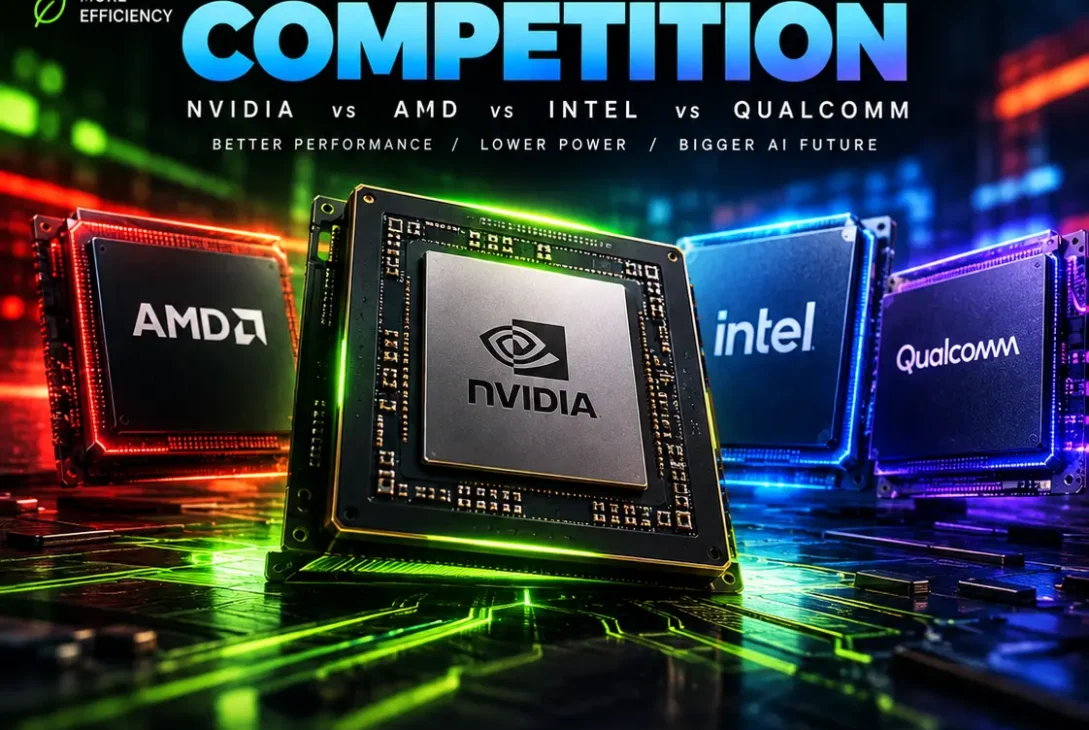
The NVIDIA AI chip competition is intensifying as AMD, Google, Amazon, Microsoft, and other technology companies invest in processors designed to train and run artificial intelligence models. NVIDIA remains a major force in AI computing, but customers increasingly want alternatives that can lower costs, improve energy efficiency, and reduce dependence on a single supplier.
The NVIDIA AI chip competition is not just about building the fastest processor. Software support, memory, networking, electricity use, availability, and cost per AI task all influence which chips companies choose. Some rivals sell general-purpose accelerators, while others design chips specifically for their own cloud services.
This guide explains the biggest competitors, what makes their chips different, and how the changing market could affect AI services and prices.
Table of Contents
- Why Is NVIDIA Facing More Competition?
- NVIDIA’s Competitive Advantages
- 7 Companies Competing With NVIDIA
- AMD vs. NVIDIA
- Google TPUs vs. NVIDIA GPUs
- Amazon Trainium and Inferentia
- Microsoft Maia AI Chips
- Broadcom and Custom AI Accelerators
- Huawei and China’s AI Chip Industry
- Why Companies Are Building Their Own Chips
- Training vs. Inference
- How Competition Could Affect AI Prices
- Frequently Asked Questions
- Final Verdict
- SEO Details
Why Is NVIDIA Facing More Competition?
The NVIDIA AI chip competition is growing because demand for AI computing now extends beyond training large language models. Companies need computing power for chatbots, AI agents, image generators, coding assistants, recommendation systems, and enterprise software.
NVIDIA’s hardware can be expensive when a deployment requires thousands of accelerators, high-speed networking, memory, cooling, and data-center power. Large cloud providers therefore have a strong reason to develop custom chips that suit their own workloads.
Another reason for the NVIDIA AI chip competition is supply diversification. AI companies do not want their growth to depend entirely on the availability, pricing, or delivery schedules of one supplier. Alternative chips give buyers more negotiating power and may help them reserve GPUs for workloads that benefit most from them.
The competitors do not all offer direct replacements. AMD sells general-purpose data-center GPUs, Google develops TPUs for machine learning, and cloud providers such as Amazon and Microsoft build custom accelerators for selected workloads. This means the NVIDIA AI chip competition is taking place across several parts of the AI infrastructure market at once.
NVIDIA’s Competitive Advantages
To understand the NVIDIA AI chip competition, it is important to know why NVIDIA became so influential.
CUDA and Software Support
NVIDIA’s CUDA platform provides tools for programming GPUs and accelerating AI workloads. Many machine-learning frameworks, libraries, research projects, and production systems already support NVIDIA hardware. That familiarity saves developers time and makes it easier to deploy models.
Switching platforms can require code changes, performance tuning, testing, and staff training. Even if another chip has attractive specifications, migration costs may make it difficult for a company to move its existing systems.
This software advantage remains one of the strongest barriers competitors face. Winning the NVIDIA AI chip competition requires not only good hardware but also dependable software, documentation, and developer support.
Complete AI Systems
NVIDIA sells more than individual processors. Its portfolio includes GPUs, CPUs, networking equipment, interconnects, and software for building large AI systems. Buyers can deploy integrated infrastructure rather than assembling every component independently.
This full-system approach is a central advantage in the NVIDIA AI chip competition. Rivals must compete not only on chip speed but also on system performance, reliability, software, and the ability to scale across data centers.
Developer Ecosystem and Availability
NVIDIA-based computing is available through numerous cloud and hardware providers. This broad access, combined with established developer support, makes NVIDIA a convenient choice for teams that need to move quickly.
Competitors are making progress, but replacing an entire ecosystem is harder than designing a chip with strong benchmark results.
7 Companies Competing With NVIDIA
The NVIDIA AI chip competition includes several companies with different business models and strengths. Some sell accelerators to cloud providers and enterprises, while others focus on chips for their own services.
1. AMD
AMD is one of NVIDIA’s most direct competitors in data-center AI accelerators. Its Instinct family targets AI training and inference, while its ROCm software ecosystem provides tools for running supported machine-learning workloads.
AMD can appeal to organizations looking for an alternative supplier, competitive memory configurations, or a different balance of performance and price. Its existing server CPU business and relationships with enterprise customers can also help it expand.
The main challenge is software adoption. Customers need reliable libraries, developer tools, drivers, and performance on their specific models. AMD may be a strong option for some workloads, but buyers should benchmark their own applications rather than relying on peak specifications alone.
For organizations comparing platforms, the NVIDIA AI chip competition makes it increasingly important to evaluate total system cost rather than comparing only processor prices.
2. Google
Google develops Tensor Processing Units, or TPUs, for machine-learning workloads. The company can optimize these accelerators around its own models, software, and cloud infrastructure.
Google’s strategy is important to the NVIDIA AI chip competition because it controls both the hardware and much of the environment in which the chips run. Customers whose workloads fit Google’s platform may find TPUs attractive for training or serving models.
However, TPUs are not a universal substitute for GPUs. Compatibility, framework support, availability, and migration effort all matter. Organizations should evaluate the complete cloud service rather than comparing processor names alone.
3. Amazon
Amazon develops custom AI chips for Amazon Web Services. Trainium is designed primarily for AI training, while Inferentia targets inference, the stage where a trained model produces answers or other outputs.
Custom accelerators can help AWS offer alternatives to GPU instances and optimize computing costs for supported workloads. This matters for AI services that process enormous numbers of requests, where small efficiency gains can add up.
Amazon still offers NVIDIA-based infrastructure. Its strategy is to give customers options and improve the economics of its cloud platform, rather than remove GPUs from every workload.
4. Microsoft
Microsoft is developing its Maia accelerator family for AI workloads in its cloud infrastructure. Custom silicon gives Microsoft more control over how hardware, networking, and software operate together.
The company can design chips around workloads that matter to its own services, potentially improving efficiency and reducing dependence on a single external supplier. But custom chips require substantial investment in design, manufacturing, software, and ongoing development.
Microsoft is likely to use a mixture of custom accelerators and third-party hardware. The NVIDIA AI chip competition is therefore about how workloads are divided among platforms, not simply which company wins every contract.
5. Broadcom
Broadcom plays an important role in custom AI silicon and networking. Rather than selling only a general-purpose accelerator, companies can work with design partners to develop application-specific integrated circuits, commonly called ASICs.
A custom chip can be efficient when a company runs a large, predictable workload at scale. The design can focus on the operations that matter most instead of supporting every possible AI application.
The trade-off is flexibility. A specialized accelerator may be less useful when workloads change or when a company wants to run a wide variety of models. Custom silicon is most attractive when expected demand is large enough to justify the development cost.
6. Huawei
Huawei is a major participant in China’s domestic AI chip market. Export restrictions have encouraged Chinese technology companies to develop local alternatives and reduce reliance on advanced chips from overseas suppliers.
Huawei’s progress is relevant to the NVIDIA AI chip competition, but regional figures should be interpreted carefully. A company gaining share in China does not automatically mean it has gained the same position globally. Manufacturing access, software compatibility, memory, and large-system performance all influence adoption.
Domestic demand may support local suppliers, particularly where customers prioritize supply security and local infrastructure. Their long-term competitiveness will depend on both chip design and the broader software ecosystem.
7. Other Chinese Chip Developers
Alibaba’s T-Head, Baidu’s Kunlunxin, Cambricon, and other Chinese developers are also building AI processors. Their products target different needs, including cloud computing, inference, and specialized enterprise workloads.
These companies may benefit from customers seeking local suppliers, but they still need to demonstrate reliable performance, production capacity, developer support, and efficient software tools. A promising chip specification does not guarantee broad adoption.
AMD vs. NVIDIA
AMD is a direct alternative for buyers seeking data-center accelerators that can run a wide range of AI workloads. NVIDIA benefits from CUDA and a mature ecosystem, while AMD offers another hardware and software platform.
| Factor | NVIDIA | AMD |
|---|---|---|
| Main hardware | Data-center GPUs and integrated systems | Instinct data-center accelerators |
| Software | CUDA ecosystem | ROCm ecosystem |
| Key advantage | Broad software adoption and deployment options | Alternative supplier and competitive hardware choices |
| Main challenge | Cost and supplier concentration | Expanding software adoption and deployment |
| Best evaluation | Test real models and total system cost | Test the same models and configuration |
The NVIDIA AI chip competition does not have one universal winner. A workload that performs well on one platform may need extra tuning on another. Buyers should compare throughput, latency, memory capacity, cost, and engineering time using the applications they actually run.
https://developer.nvidia.com/blog/inside-the-nvidia-rubin-platform-six-new-chips-one-ai-supercomputer/
Google TPUs vs. NVIDIA GPUs
Google TPUs are specialized for machine learning and closely integrated with Google’s cloud environment. NVIDIA GPUs support a broad range of computing tasks and benefit from extensive CUDA support.
TPUs can be attractive when a workload fits Google’s tools and deployment model. NVIDIA may be more convenient for developers who rely on CUDA libraries or want to move between supported cloud providers.
Availability also matters. A TPU configuration may be suitable for one training job, while another workload may depend on libraries or tools that work more easily on NVIDIA GPUs. This is why the NVIDIA AI chip competition is likely to produce different winners across different workloads.
Amazon Trainium and Inferentia
Amazon’s chips target the economics of AI inside AWS. Trainium focuses on training workloads, while Inferentia is intended for inference.
Inference can be especially important because a popular AI service may process millions of requests. If a custom accelerator reduces the cost of each request and maintains acceptable response times, the savings can become meaningful at scale.
However, chip price alone does not determine total cost. Software migration, engineering effort, model compatibility, and availability all matter. Businesses should test representative workloads before moving production services.
Microsoft Maia AI Chips
Microsoft’s custom silicon gives it greater control over the hardware used in its cloud and AI services. The company can optimize chip design around its own software and data-center architecture.
But developing an accelerator is only one part of the job. Microsoft must also build software support, manufacture enough chips, and ensure that the system performs well as AI models evolve. Custom silicon complements third-party GPUs rather than automatically replacing them.
Broadcom and Custom AI Accelerators
Custom AI accelerators can be more efficient than general-purpose chips for specific, repeated tasks. They may suit cloud providers that know which models they will run and can optimize hardware around those workloads.
Broadcom’s work in custom silicon and networking helps companies develop specialized processors and connect large systems. This part of the NVIDIA AI chip competition is less visible to consumers, but it can have a significant impact on cloud infrastructure economics.
The limitation is flexibility: a specialized chip may not be suitable for every new model or application. Organizations need a clear workload and enough scale to justify custom development.
Why Companies Are Building Their Own AI Chips
Several factors are driving investment in custom accelerators:
- Cost control: Specialized chips may reduce the cost of particular AI workloads.
- Energy efficiency: Better performance per watt can reduce electricity and cooling costs.
- Supply diversification: Multiple suppliers reduce reliance on one hardware provider.
- Workload optimization: Custom designs can focus on the operations a company uses most.
- Infrastructure control: Hardware and software can be designed to work together.
- Negotiating power: Alternative platforms give large buyers more choices.
These benefits are strongest for companies operating AI services at enormous scale. Smaller businesses may still prefer NVIDIA-based cloud services because they are widely available and supported by established tools.
AI Chip Competition: Training vs. Inference
Training and inference place different demands on hardware. Training adjusts a model using large datasets and can require high memory bandwidth and fast communication between accelerators. Inference runs the trained model to generate outputs and may prioritize latency, throughput, or cost per request.
NVIDIA GPUs, AMD accelerators, Google TPUs, and custom chips can all serve parts of this market, but results depend on the workload. The NVIDIA AI chip competition will therefore develop differently across large-scale training, real-time inference, and specialized AI services.
Inference efficiency is becoming increasingly important as AI applications reach more users. A chip that lowers operating costs for a particular model can be valuable even if it does not replace GPUs for training every model.
How Competition Could Affect AI Prices
More competition can improve price-performance and give cloud customers additional choices, but lower prices are not guaranteed. AI infrastructure costs also include memory, networking, electricity, cooling, data-center construction, and hardware utilization.
Businesses should compare cost per million tokens, time to train a model, response latency, throughput, and energy use. Advertised chip prices alone do not show the full economics of running an AI service.
As alternatives become more capable, customers may gain negotiating power and be able to match workloads to the most efficient hardware. The NVIDIA AI chip competition could therefore improve choices for businesses, although the scale of any savings will depend on software support, production capacity, and real-world performance.
Frequently Asked Questions
What is the NVIDIA AI chip competition?
The NVIDIA AI chip competition refers to the rivalry between NVIDIA and companies developing alternative AI processors, including AMD, Google, Amazon, Microsoft, Broadcom’s custom-silicon partners, and Chinese chipmakers.
Who is NVIDIA’s biggest AI chip competitor?
AMD is a direct competitor in general-purpose data-center accelerators. Google, Amazon, and Microsoft are also important because they develop custom chips for their own cloud and AI workloads.
Is AMD better than NVIDIA for AI?
It depends on the model, software, and budget. NVIDIA benefits from CUDA and broad ecosystem support, while AMD provides an alternative accelerator platform. Compare performance using your own workload.
Why is Google making its own AI chips?
Google’s TPUs let it optimize hardware for machine-learning workloads and its cloud environment. They can be attractive when applications fit Google’s software stack.
Can Amazon Trainium replace NVIDIA GPUs?
Trainium can serve supported training workloads in AWS, but it is not a universal replacement. Software, performance, and deployment needs determine which option is best.
Is Microsoft developing AI chips?
Yes. Microsoft’s Maia accelerator family is designed for AI workloads in its infrastructure. Custom chips complement its use of processors from external suppliers.
Why are AI companies building custom chips?
Custom chips can reduce costs for specific workloads, improve energy efficiency, diversify supply, and give companies greater control over their infrastructure.
Is NVIDIA losing its market dominance?
Competition is increasing, and some companies are moving selected workloads to custom accelerators. NVIDIA still has major advantages in software, hardware systems, and broad availability. Regional market changes should not be mistaken for a complete global shift.
Will AI chips become cheaper?
Competition may improve price-performance, but total costs also depend on power, networking, memory, and data-center operations. Lower costs are possible, but not guaranteed.
Which AI chip should a business choose?
Compare software compatibility, real-world performance, availability, energy use, and total cost. Test a representative workload before committing to a large deployment.
Final Verdict
The NVIDIA AI chip competition is intensifying as AMD, Google, Amazon, Microsoft, Broadcom, and Chinese chip developers pursue different ways to make AI computing faster and more efficient.
NVIDIA retains important advantages in CUDA, integrated hardware systems, and developer support. However, custom accelerators are becoming more relevant, especially for cloud providers that can optimize chips around their own AI services.
For customers, the result is more choice. The best chip depends on the model, software, performance target, power budget, and total cost—not simply the brand or headline specification. Expect AI infrastructure to become more diverse, with NVIDIA GPUs remaining important while specialized accelerators take on a larger role in selected workloads.