
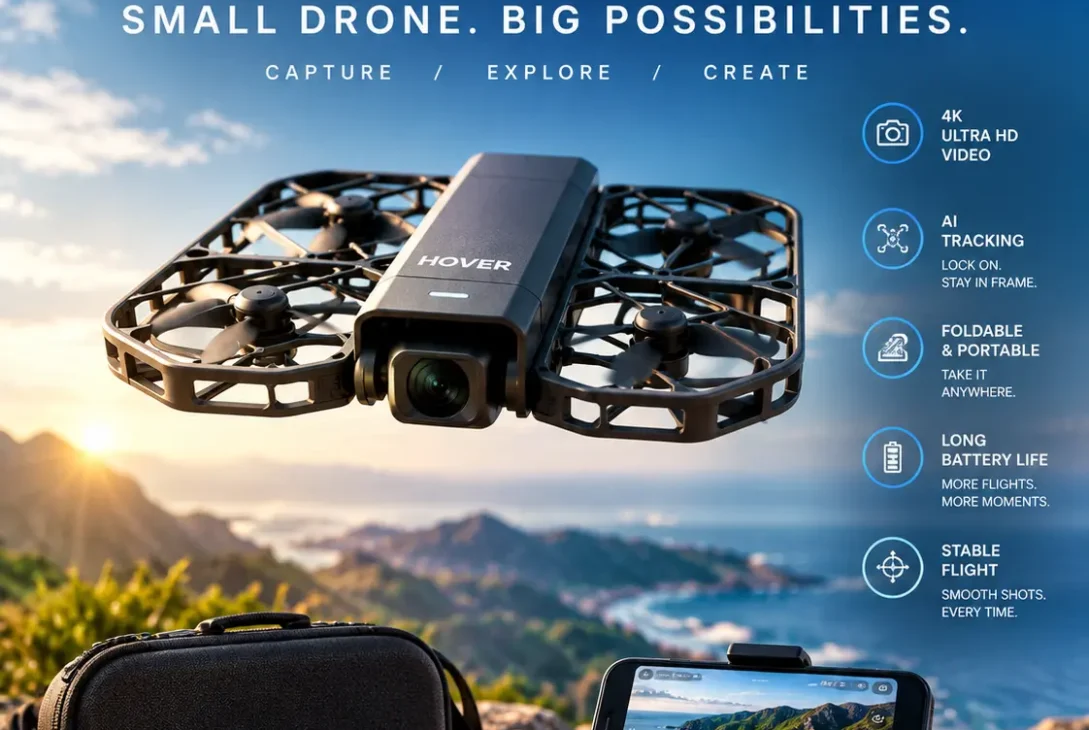
The HOVERAir Versa is one of the most unusual camera products to arrive in 2026. Instead of being only a drone or only a handheld camera, it combines both ideas into one compact device.
In handheld mode, it works as a stabilized pocket camera with a three-axis mechanical gimbal. Attach the Flight Kit, and the same camera becomes an autonomous flying camera capable of tracking its subject and capturing aerial perspectives.
HOVERAir officially launched the product in August 2026, positioning it for travelers, vloggers, solo creators, families, outdoor enthusiasts, and people who want cinematic footage without carrying multiple cameras. The company says it can record up to 4K video, offers AI-powered tracking, includes more than 10 intelligent flight modes, and weighs under 230 grams in flying configuration.
The concept is simple: instead of carrying a pocket camera, gimbal, and small drone separately, one modular system can handle all three types of shooting.
Table of Contents
- What Is HOVERAir Versa?
- Design and Build
- HOVERAir Versa Specifications
- Camera and Image Quality
- Three-Axis Gimbal
- Autonomous Flight
- AI Tracking and Flight Modes
- 3D Worlds
- Battery Life and Storage
- Video Features
- HOVERAir Versa Price and Availability
- Safety and Limitations
- Who Should Buy It?
- Pros and Cons
- Frequently Asked Questions
- Final Verdict
What Is HOVERAir Versa?
The HOVERAir Versa is a hybrid creator camera designed to operate both on the ground and in the air.
In handheld mode, the camera functions like a compact gimbal camera. It can be used for walking videos, travel footage, family moments, vlogging, and everyday photography.
When the Flight Kit is attached, the system becomes a self-flying camera. Users can launch it, select an intelligent flight mode, and allow the aircraft to capture footage without manually controlling a conventional drone.
This approach makes the product fundamentally different from traditional camera drones.
A conventional drone is primarily an aircraft carrying a camera. This product is designed first around the camera and then adds autonomous flight capability.
That distinction is important because the main attraction is not maximum flight performance. The appeal is convenience.
Design and Build
The handheld camera weighs approximately 163 grams, while the Flight Kit adds about 67 grams. With the flight hardware attached, the complete flying configuration weighs approximately 230 grams.
The compact body is designed to be carried easily in a pocket or small camera bag.
The Flight Kit uses HOVERAir’s MagLatch system, allowing the flying components to attach directly to the camera. HOVERAir says the attachment system has undergone more than 5,000 durability tests.
The camera itself measures approximately 148 × 38 × 38mm in handheld configuration.
When folded with the Flight Kit attached, the flying configuration measures approximately 148 × 79.5 × 45mm. When unfolded, the wings extend the overall width considerably.
This modular design is what makes the device interesting for travel creators.
Instead of bringing a dedicated gimbal and a separate autonomous camera, the creator can carry one camera and add the flight components when needed.
HOVERAir Versa Specifications
| Feature | HOVERAir Versa |
|---|---|
| Product Type | Handheld and autonomous flying camera |
| Handheld Weight | 163g |
| Flight Kit Weight | 67g |
| Flying Weight | 230g |
| Image Sensor | 1/1.3-inch |
| Stabilization | 3-axis mechanical gimbal |
| Maximum Video | 4K at 60fps |
| HDR | 10-bit HDR |
| Log | H-Log |
| Dynamic Range | Up to 17.5 stops claimed |
| Maximum Flight Time | Up to 14 minutes |
| Handheld Recording | Up to 180 minutes |
| Maximum Horizontal Speed | 36 km/h |
| Wind Resistance | Level 5 |
| Internal Storage | 64GB |
| Expandable Storage | microSD up to 1TB |
| Slow Motion | Up to 1080p at 120fps |
| Vertical Video | Up to 4K/60fps |
| Zoom | Up to 2x lossless zoom |
| Battery | 2,070mAh |
| Intelligent Flight Modes | 10+ |
Specifications can vary depending on firmware, market, and final retail configuration.
Camera and Image Quality
The camera uses a 1/1.3-inch image sensor and is designed to provide better image quality than a basic pocket camera.
HOVERAir claims up to 17.5 stops of dynamic range, which is particularly useful for difficult lighting conditions such as sunsets, bright city lights, and scenes containing both strong highlights and dark shadows.
The camera supports 4K recording at up to 60 frames per second.
It also supports 10-bit HDR and H-Log, giving more flexibility to creators who want to perform color correction and grading during post-production.
This makes the camera more suitable for serious content creation than a simple automatic selfie camera.
The 1/1.3-inch sensor is also a useful size for a compact product, although buyers should not expect it to replace a large interchangeable-lens camera in demanding low-light situations.
Three-Axis Gimbal
One of the most important features of the HOVERAir Versa is its three-axis mechanical gimbal.
A mechanical gimbal physically stabilizes the camera to reduce unwanted movement while recording.
This is particularly useful when walking or moving with the camera.
For travel creators, the benefit is that the same camera remains useful even when it is not flying.
You can record a walking vlog, capture a family moment, film a product demonstration, or shoot travel footage. When an aerial perspective is needed, the Flight Kit can then be attached.
That makes the system more versatile than an autonomous camera that can only operate in the air.
Autonomous Flight
The flying configuration is designed primarily around autonomous filming rather than traditional manual drone piloting.
HOVERAir lists a maximum horizontal speed of approximately 36 km/h and Level 5 wind resistance.
The maximum advertised flight time is around 14 minutes.
Fourteen minutes is not particularly long compared with some larger camera drones, but the product is not designed for long-distance aerial photography.
Its intended use is closer-range filming of the owner.
Examples include:
- Walking through a city
- Hiking
- Running
- Cycling at moderate speeds
- Travel videos
- Family activities
- Outdoor adventures
- Social media content
- Cinematic third-person shots
The relatively short flight time becomes less problematic when the device is viewed as a camera that happens to fly rather than a conventional drone intended for extended aerial missions.
AI Tracking and Flight Modes
AI automation is central to the product.
The system can track its subject and capture footage without requiring the creator to operate a conventional controller.
HOVERAir lists more than 10 intelligent flight modes, including options such as Auto Follow, Orbit, Zoom Out, and overhead-style perspectives.
This makes it possible for a single person to create footage that would normally require a second camera operator.
For example, a solo traveler can start recording, move through a scene, and allow the camera to follow from behind.
A cyclist can also use automated tracking for suitable low-speed footage.
The important limitation is that autonomous tracking should not be confused with full obstacle avoidance.
Creators still need to choose an appropriate environment and maintain awareness of trees, buildings, cables, people, and other hazards.
AI Auto Framing
Another interesting feature is AI Auto Framing.
Instead of simply following a subject through space, automatic framing attempts to keep the composition visually useful.
This can be helpful when recording solo content.
Traditional filming often requires the creator to position a tripod, check the frame, start recording, and then remain within a specific area.
Automated composition can reduce some of that setup.
For social-media creators, this can be particularly useful because vertical video can be captured without requiring a separate camera arrangement.
3D Worlds
The HOVERAir Versa also introduces a feature called 3D Worlds.
The technology is designed to capture spatial information and create a three-dimensional representation of the environment.
This goes beyond ordinary video because the resulting scene can be explored from different viewpoints.
The feature could eventually have applications in travel documentation, creative storytelling, memories, virtual experiences, and spatial content.
However, 3D capture is still a relatively new area for consumer cameras, so its long-term usefulness will depend heavily on software support and how creators actually use the generated content.
Video Features
The camera is designed for both standard and more advanced video workflows.
Key capabilities include:
- 4K at 60fps
- 10-bit HDR
- H-Log
- 1080p slow motion at up to 120fps
- Native vertical recording
- 2x lossless zoom
- H.264/H.265 support
- High dynamic range capture
The combination of 4K/60, HDR, and H-Log makes the device more attractive to creators who edit their footage rather than simply uploading directly from the camera.
Vertical video is also important because platforms such as TikTok, Instagram Reels, and YouTube Shorts have made portrait-oriented content a major part of modern video creation.
Battery Life and Storage
The battery is rated at 2,070mAh.
HOVERAir states that the camera can provide up to 180 minutes of handheld recording under its specified conditions.
Flight operation is limited to approximately 14 minutes.
These two figures demonstrate the difference between the two operating modes.
Handheld recording is relatively efficient because the camera does not need to power motors continuously.
Flying requires considerably more energy because the aircraft must constantly operate its propulsion system.
The camera includes 64GB of internal storage and supports microSD cards up to 1TB.
For 4K recording, expandable storage is especially useful because high-resolution video can consume storage quickly.
Creators planning longer trips should carry a sufficiently large microSD card and backup storage.
HOVERAir Versa Price and Availability
The product launched on Indiegogo in August 2026.
Because it initially launched through crowdfunding, pricing can vary depending on the package, campaign stage, accessories, taxes, and shipping destination.
The important distinction is between the camera itself and the Flight Kit.
If you only purchase the camera portion, you are primarily getting a compact handheld creator camera.
The Flight Kit is required for autonomous aerial operation.
Therefore, anyone purchasing specifically for drone-style footage should carefully check which package includes the flight hardware.
Availability also varies by country.
This is particularly important for U.S. customers because the product has encountered a significant regulatory issue there.
U.S. Regulatory Situation
The HOVERAir Versa has faced a major U.S. regulatory setback in 2026.
Reports from The Verge and TechRadar state that the FCC rescinded an authorization connected to the product and directed HOVERAir to stop importing, marketing, or selling the device in the United States.
The FCC reportedly determined that the previous authorization had been granted erroneously under its Covered List rules.
As a result, U.S. buyers should not assume that campaign availability automatically means the flying configuration can legally be shipped or sold there.
This situation is specific to the U.S. market and does not necessarily describe availability in other countries.
Potential buyers should check the latest local regulations and HOVERAir’s current shipping information before ordering.
Safety and Flight Limitations
One of the most important limitations is that the product should not be treated as an obstacle-avoidance drone.
Its autonomous flight features are designed to track and film the user, but creators still need to choose a clear environment.
Potential hazards include:
- Trees
- Power lines
- Buildings
- Poles
- Crowded areas
- Narrow spaces
- Other aircraft
- Strong or unpredictable wind
The fact that a camera can fly autonomously does not remove the responsibility of the operator.
Local drone regulations also vary by country.
Even lightweight drones can be subject to restrictions concerning registration, airspace, privacy, airports, people, and operating locations.
Always check the rules applicable to your location before flying.
https://hoverair.com/pages/versa
Who Should Buy HOVERAir Versa?
The product makes the most sense for creators who value portability and versatility.
Travel Creators
Travelers can use it as a handheld camera and then switch to aerial filming when an interesting location appears.
Solo Vloggers
Solo creators can record themselves without needing another person to operate the camera.
Social Media Creators
4K/60 video, vertical capture, AI tracking, and automatic framing make it suitable for short-form content.
Families and Casual Users
The automated flight approach can make creative third-person shots easier for people who do not want to learn traditional drone controls.
Outdoor Creators
Hikers, walkers, and recreational cyclists can use automated tracking for suitable environments.
Who Should Avoid It?
The product may not be suitable for every buyer.
It is less appropriate for someone who wants:
- Long flight times
- Long-distance aerial photography
- Advanced obstacle avoidance
- Extensive manual flight control
- Professional large-sensor camera performance
- High-end 8K aerial recording
- Heavy cinematic drone workflows
For those users, a dedicated camera drone may be a better fit.
The biggest advantage here is not maximum technical performance. It is the ability to combine two different camera roles in one compact system.
Pros and Cons
Pros
- Unique 2-in-1 camera concept
- Handheld and flying modes
- Three-axis mechanical gimbal
- 4K/60 recording
- 10-bit HDR and H-Log
- 1/1.3-inch sensor
- AI tracking
- 10+ intelligent flight modes
- AI Auto Framing
- 3D Worlds
- Native vertical recording
- 64GB internal storage
- microSD support up to 1TB
- Lightweight 230g flying configuration
Cons
- Only around 14 minutes of maximum flight time
- No conventional long-range drone workflow
- Autonomous flying still requires careful environment selection
- Larger cameras can deliver better low-light results
- Flight Kit is essential for aerial functionality
- U.S. availability is currently affected by FCC action
- Crowdfunding availability can differ from normal retail purchasing
Frequently Asked Questions
What is HOVERAir Versa?
It is a hybrid pocket camera that combines a three-axis handheld gimbal camera with an autonomous flying camera through a detachable Flight Kit.
How long can it fly?
The advertised maximum flight time is up to 14 minutes.
How heavy is the flying version?
The complete flying configuration weighs approximately 230 grams, consisting of the 163-gram camera and 67-gram Flight Kit.
Can HOVERAir Versa record 4K video?
Yes. The camera supports up to 4K at 60fps and also supports 10-bit HDR and H-Log.
Does it have a gimbal?
Yes. It uses a three-axis mechanical gimbal for handheld stabilization.
Does it have AI tracking?
Yes. AI-powered tracking is one of its main features, allowing the camera to follow the creator during autonomous flight.
Does it have obstacle avoidance?
The product should not be considered an active obstacle-avoidance drone. Users need to maintain a suitable and clear flying environment.
How much storage does it have?
There is 64GB of internal storage, with support for microSD cards up to 1TB.
Is HOVERAir Versa good for vlogging?
Its design is specifically suited to vlogging because it can function as a handheld stabilized camera and then create third-person aerial footage when the Flight Kit is attached.
Can it record vertical video?
Yes. It supports native vertical recording at up to 4K/60fps.
Final Verdict
The HOVERAir Versa represents a different approach to consumer camera technology.
Instead of making another traditional drone, HOVERAir has combined a stabilized handheld camera with autonomous flight.
That makes the product particularly interesting for people who travel, vlog, create social-media content, or regularly film themselves.
Its 1/1.3-inch sensor, 4K/60 recording, 10-bit HDR, H-Log, three-axis gimbal, AI tracking, automatic framing, and 3D Worlds give it a surprisingly broad feature set for such a small device.
The 14-minute maximum flight time is its biggest practical limitation. The lack of active obstacle avoidance also means users need to be more careful about where they fly.
Nevertheless, the hybrid concept solves a genuine problem: carrying fewer pieces of camera equipment.
For someone who wants a compact device capable of handheld footage, tracking shots, and aerial perspectives, the HOVERAir Versa is one of the most distinctive creator-camera products of 2026.