
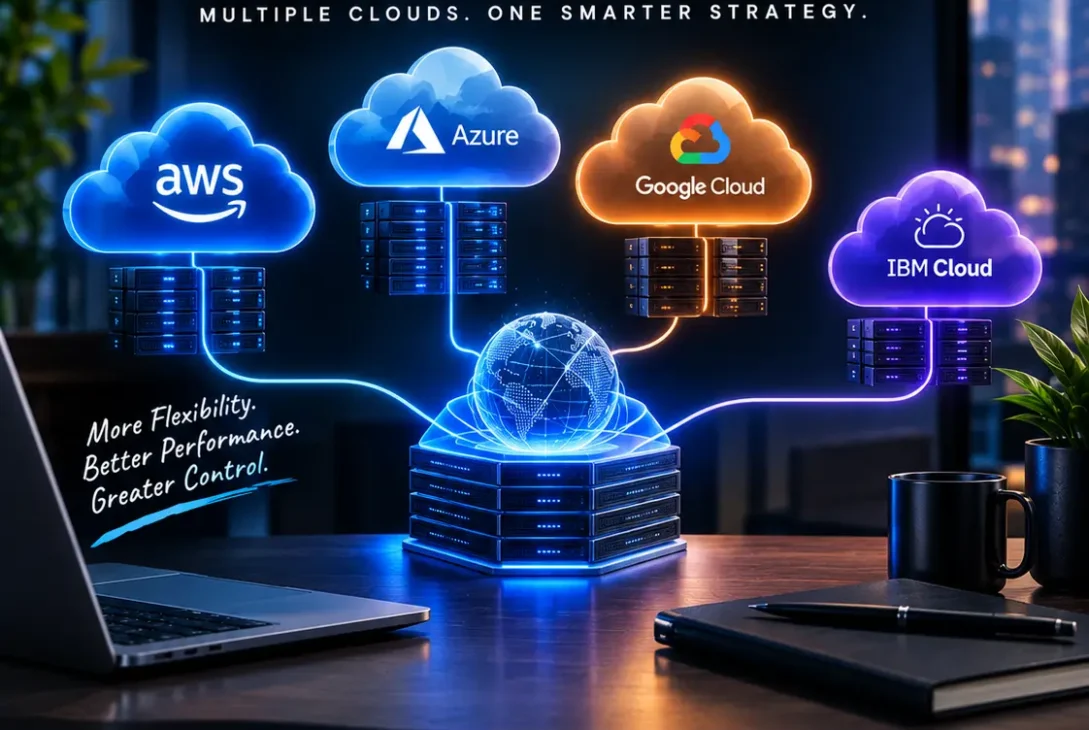
Multicloud is a cloud computing strategy in which an organization uses services from two or more cloud providers instead of depending on a single company. For example, a business might host its website on Amazon Web Services (AWS), use Microsoft Azure for business applications, and rely on Google Cloud for data analytics. Each platform can perform a different role depending on its features, pricing, performance, and availability.
As businesses move more applications and data online, choosing the right cloud infrastructure has become an important decision. A single provider may offer everything a company needs, but different platforms have different strengths. Multicloud gives organizations the option to select suitable services from multiple vendors while maintaining control over their technology.
This approach can offer greater flexibility, reduce dependence on one provider, and support business continuity. However, managing multiple platforms also introduces challenges involving security, networking, costs, and technical complexity.
In this guide, you will learn what multicloud means, how it works, how it compares with hybrid cloud, and why organizations use it. We will also explore real-world examples, common tools, advantages, disadvantages, and practical steps for developing a successful strategy.
Table of Contents
- What Is Multicloud?
- How Does Multicloud Work?
- Common Multicloud Architecture Models
- Multicloud vs. Hybrid Cloud
- Benefits of a Multicloud Strategy
- Challenges and Risks
- Real-World Use Cases
- Popular Multicloud Tools and Technologies
- How to Build a Multicloud Strategy
- Is Multicloud Right for Every Business?
- Frequently Asked Questions
- Final Verdict
What Is Multicloud?
Multicloud refers to using cloud computing services from at least two different cloud service providers. These providers can supply computing power, databases, storage, networking, artificial intelligence, analytics, and application hosting.
For example, an online retailer could host its shopping website on AWS, use Azure for internal business applications, and process customer data through Google Cloud analytics services. Each platform would support a particular part of the business.
The important distinction is that the organization uses services from different cloud vendors. Using several data centers or geographic regions from the same provider does not automatically make an environment multicloud.
Companies can adopt this approach intentionally by selecting providers for specific workloads. It can also happen gradually when different departments choose their own software and cloud services.
The main objective is not to use as many platforms as possible. It is to select the right technology for each workload while maintaining reliable operations, security, and cost control.
What Does Multicloud Mean in Simple Terms?
Imagine a company that uses different suppliers for different business needs. It purchases computers from one manufacturer, internet services from another, and accounting software from a third.
A cloud strategy works in a similar way. Instead of purchasing every technology service from one company, an organization chooses suitable cloud services from multiple vendors.
This gives the business more options, but it also means it must manage relationships, accounts, security settings, and costs across different platforms.
How Does Multicloud Work?
A multicloud environment distributes applications, data, and computing resources across multiple cloud platforms. Each provider operates its own infrastructure, while the organization decides how those environments should communicate and work together.
Consider a company that runs an international online store. Its website might operate on one provider, its customer database on another, and its analytics platform on a third. When a customer visits the store, the different services communicate through application programming interfaces (APIs), network connections, and integration systems.
Some environments operate independently, while others are closely connected. The level of integration depends on the application’s requirements.
A typical architecture includes several important components:
- Cloud providers: Companies that supply computing, storage, databases, networking, and other services.
- Applications: Websites, business software, databases, and other workloads running in the cloud.
- Networking: Secure connections that allow applications and services to exchange information.
- Identity management: Systems that control who can access resources and applications.
- Monitoring: Tools that track availability, performance, errors, and resource usage.
- Governance: Policies for security, compliance, access, and spending.
For example, a development team might deploy an application using containers and use Kubernetes to manage those containers across supported environments. This can make deployment more consistent, although it does not make every provider’s services identical.
Organizations also use automation to create resources, apply configurations, and monitor workloads. These processes help reduce manual work and make the environment easier to manage.
Common Multicloud Architecture Models
There is no single architecture that works for every organization. The right design depends on the applications, business objectives, and level of integration required.
1. Separate Workloads Across Providers
This is one of the simplest approaches. Different applications run on different cloud platforms without requiring every system to communicate directly.
For example, a business might use one provider for its website and another for its customer relationship management software. Each application operates independently.
This design can be easier to manage than a highly integrated architecture. However, administrators still need consistent security policies, access controls, and cost monitoring.
2. Integrated Cloud Applications
In this model, different components of an application operate across multiple providers and exchange information.
For instance, a company’s customer-facing application might run on AWS while its data processing service operates on Google Cloud. APIs and secure network connections allow the components to communicate.
This approach provides access to specialized services, but network latency, data transfer charges, and service dependencies need careful planning.
3. Multicloud Disaster Recovery
Some organizations use a second provider to support disaster recovery. Critical data or application components are replicated to another environment so they can be restored if the primary platform becomes unavailable.
However, having a backup account does not guarantee successful recovery. Businesses need tested restoration procedures, suitable computing capacity, and clear recovery objectives.
4. Data and Analytics Across Providers
A company might store operational information in one environment while using another provider’s analytics or artificial intelligence services.
Data pipelines move approved information between platforms for reporting, machine learning, or business intelligence.
This can provide access to specialized technology, but companies must consider transfer costs, data protection, and the location of sensitive information.
Multicloud vs. Hybrid Cloud
Multicloud and hybrid cloud are related concepts, but they do not mean exactly the same thing.
Multicloud describes the use of services from two or more cloud providers. Hybrid cloud generally combines different infrastructure environments, commonly an organization’s private cloud or on-premises data center with public cloud services.
For example, a company using AWS and Google Cloud has a multicloud environment. A business connecting its own data center to Microsoft Azure has a hybrid cloud environment.
An organization can also use both approaches by combining its private infrastructure with services from multiple public cloud providers.
| Feature | Multicloud | Hybrid cloud |
|---|---|---|
| Main concept | Multiple cloud providers | Private and public infrastructure |
| Cloud vendors | Two or more | One or more |
| On-premises infrastructure | Not required | Commonly included |
| Main objective | Provider choice and flexibility | Combining existing infrastructure with cloud |
| Example | AWS and Google Cloud | Company data center and Azure |
The distinction is important because the architecture, networking, and management requirements can be different. Businesses should select the model that matches their actual infrastructure and operational goals.
For additional explanations, see the AWS cloud deployment strategy guide.
Benefits of a Multicloud Strategy
Using multiple cloud providers can provide several advantages. However, these benefits depend on proper planning and management rather than simply adding another provider.
1. Reduced Vendor Lock-In
Vendor lock-in happens when an organization becomes heavily dependent on one provider’s technology, pricing, contracts, or services. Moving to another platform can become expensive or technically difficult.
Using multiple vendors can give a company more choices. It may be able to move suitable workloads, compare service offerings, or negotiate better terms.
However, using several providers does not completely eliminate vendor lock-in. Applications built around proprietary databases or specialized services may still require significant changes before they can move.
2. Access to Specialized Services
Cloud providers offer different products and capabilities. One may provide a suitable machine learning platform, while another offers a database or computing service that better fits a particular application.
A multicloud approach allows development teams to choose technology based on their actual requirements instead of forcing every workload onto one platform.
This can be particularly useful for companies with specialized computing, analytics, or geographic requirements.
3. Improved Reliability and Resilience
Depending entirely on one provider can create a concentration risk. If an outage affects an important service, applications relying on it may become unavailable.
A properly designed environment can distribute selected workloads or recovery resources across different providers. This may help an organization maintain operations during certain outages.
However, multiple cloud accounts do not automatically create failover. Applications, databases, identity systems, and networks must be designed and tested for recovery.
4. Better Geographic Coverage
Businesses serving customers in multiple countries may need infrastructure in different geographic regions.
Using multiple providers can offer more choices for application hosting, data processing, and regional availability. Companies can compare network performance and regional services when deciding where to run workloads.
This can help improve user experience, but the location of customers is not the only factor. Data regulations, network routes, and application dependencies must also be considered.
5. Cost Optimization
Different cloud providers use different pricing models, discounts, and service options. A business may find that one provider offers better value for a specific workload.
Using multiple platforms can allow organizations to compare pricing and performance instead of assuming that one vendor is always the cheapest.
However, companies must consider the full cost of operating an application. Data transfer, storage, networking, software licenses, support, and staff time can significantly affect the final bill.
6. Greater Business Flexibility
Business requirements change over time. A company may need more computing resources during busy periods, new analytics capabilities, or infrastructure in additional regions.
A multicloud strategy provides more options when these requirements change. Organizations can select services based on workload needs and adjust their architecture as their business grows.
7. Support for Regulatory Requirements
Some industries have strict rules about where information can be stored, how it is accessed, and how it must be protected.
Using different providers may give organizations additional deployment options to meet regional or industry requirements.
Nevertheless, cloud provider certifications do not automatically make a customer’s applications compliant. The organization remains responsible for its own configurations, data handling, and governance.
Challenges and Risks of Multicloud
Although using multiple cloud platforms can offer flexibility, it also introduces challenges. Businesses should understand these risks before adopting the approach.
1. Increased Management Complexity
Every provider has its own dashboard, APIs, services, configuration methods, and support processes.
Administrators may need to use several tools to understand the overall environment. Without common standards, teams can create duplicated resources, inconsistent configurations, and monitoring gaps.
Centralized management, clear ownership, and documented procedures can help reduce these problems.
2. Security Management
Security controls differ between cloud platforms. Identity systems, encryption options, network policies, and logging services may work in different ways.
This makes it harder to maintain consistent protection across environments. A misconfigured account or publicly exposed storage resource in one environment can create a serious security issue.
Organizations should use multifactor authentication, least-privilege access, encryption, regular permission reviews, and continuous monitoring.
3. Unexpected Costs
Operating several cloud platforms can become expensive if resources are not monitored.
Businesses may accidentally leave unused servers running, duplicate storage, or transfer large amounts of information between providers. Some services also charge for outbound data transfer.
Cost management tools, resource tagging, budget alerts, and regular reviews can help identify unnecessary spending.
4. Network and Performance Problems
Applications that communicate across providers depend on network connectivity. Poor routing or long data paths can increase latency and affect application performance.
Teams should plan bandwidth, routing, DNS, security rules, and connection reliability. Frequently communicating application components may be better placed closer together.
5. Skills Shortages
Managing different platforms requires knowledge of their services, security models, and operating procedures.
Employees may need training in cloud networking, automation, Kubernetes, identity management, and monitoring. Organizations should consider whether they have enough technical expertise before expanding their infrastructure.
6. Data Governance
Information may be stored or processed across different platforms and geographic regions. This can make it harder to understand where data resides and which regulations apply.
Companies need clear data classification, retention policies, access controls, and records of information transfers.
Sensitive information should not be copied between environments without an approved reason and appropriate safeguards.
Real-World Multicloud Use Cases
Organizations use multiple providers for different business and technical reasons. Here are some common examples.
E-Commerce and Online Retail
An online retailer may use one provider for its shopping website, another for analytics, and a content delivery network for distributing product images and pages.
This gives the company more options when selecting services for different parts of its operation.
During major shopping events, the retailer can scale relevant workloads while monitoring performance and spending.
Financial Services
Banks and financial organizations manage applications with different security, availability, and regulatory requirements.
They may use different environments for customer-facing applications, analytics, and development systems. Strong identity management, audit logging, and data protection are essential across every platform.
Software Development
A software company may use one provider for production hosting and another for development or testing.
Containers and automation can help developers deploy applications consistently. However, provider-specific databases, networking, and managed services may still require different configurations.
Media and Streaming
Streaming companies need infrastructure for video processing, media storage, and content delivery.
A multiple-provider approach can offer additional options for geographic coverage and specialized services. Network performance and data transfer expenses are especially important in this industry.
Backup and Disaster Recovery
A business can store protected copies of critical data or selected application resources with another provider.
This can support recovery if the primary environment becomes unavailable. Companies should regularly test backups and protect them against accidental deletion, ransomware, and unauthorized access.
Popular Multicloud Tools and Technologies
Managing several providers requires tools that improve automation, visibility, and consistency.
Kubernetes
Kubernetes is an open-source platform used to deploy and manage containerized applications. It can help teams run container workloads across supported cloud environments and private infrastructure.
It does not remove every difference between providers, but it can make application deployment and orchestration more consistent.
Official documentation is available at Kubernetes.io.
Infrastructure as Code
Infrastructure as Code (IaC) allows teams to define infrastructure through configuration files instead of manually creating every resource.
Tools such as Terraform can automate deployments across supported providers. Reusable templates and version control make changes easier to review and repeat.
Monitoring and Observability
Monitoring tools collect information about application health, infrastructure performance, errors, and resource usage.
A shared monitoring view helps administrators identify problems that affect multiple environments. Useful metrics include availability, network latency, security events, and application response times.
Identity and Access Management
Identity and access management systems control which users and applications can access cloud resources.
Single sign-on, multifactor authentication, role-based access, and regular permission reviews help organizations maintain consistent access policies.
How to Build a Multicloud Strategy
A successful strategy should begin with business requirements rather than simply deciding to use multiple vendors.
1. Define Your Business Goals
Identify why another provider is necessary. The reason might involve disaster recovery, specialized technology, regional coverage, regulatory requirements, or improved performance.
If one provider already meets the organization’s needs, adding another may create complexity without enough value.
2. Assess Existing Applications
Create an inventory of applications, databases, dependencies, and data flows.
Identify which workloads can realistically operate in another environment and which rely heavily on provider-specific technology. This helps prevent unexpected migration costs and compatibility problems.
3. Choose Providers Carefully
Compare cloud providers using relevant criteria, including pricing, regional availability, security, support, performance, and technical capabilities.
Do not make decisions based only on advertised computing prices. Consider the total cost of running and maintaining each workload.
4. Establish Security Policies
Create consistent rules for identity, encryption, access, logging, and data handling.
Assign responsibility for each environment and ensure that security policies are applied throughout the infrastructure.
5. Automate Deployment
Use infrastructure templates, deployment pipelines, and configuration management to make operations repeatable.
Automation can reduce manual mistakes and help teams understand changes across different platforms.
6. Monitor Costs and Performance
Track resource usage, data transfer, application availability, and response times.
Regular reviews help identify unused resources and determine whether each workload is still running in the most suitable environment.
7. Test Disaster Recovery
Document how applications and data will be restored if a provider or service becomes unavailable.
Test recovery procedures regularly rather than assuming that backups and failover systems will work when needed.
Is Multicloud Right for Every Business?
No. Using several cloud providers is not automatically the best decision for every organization.
A small business with a basic website, email service, and standard business applications may be better served by one provider. Adding another platform could increase administration, training, and security costs without delivering a meaningful improvement.
Larger companies with global customers, complex applications, specialized workloads, or strict recovery requirements may have stronger reasons to use multiple providers.
The decision should be based on measurable outcomes. If another platform improves disaster recovery, meets a regional requirement, or provides a service that is not available elsewhere, the additional complexity may be worthwhile.
Organizations should also consider whether their teams have the skills and budget to manage the environment. A well-managed single-cloud setup can be more reliable than a poorly managed environment spread across several providers.
Frequently Asked Questions
What is multicloud in simple terms?
It means using cloud services from two or more different providers. A business might use AWS for hosting and Google Cloud for analytics, with each platform supporting a different workload.
What is an example of multicloud?
An online retailer could run its website on Microsoft Azure, use AWS for selected database services, and use a separate content delivery provider for faster media delivery.
What is the difference between multicloud and hybrid cloud?
Multicloud uses services from multiple cloud providers. Hybrid cloud combines public cloud services with private cloud or on-premises infrastructure. An organization can use both approaches together.
Why do companies use multicloud?
Companies may use it to access specialized services, reduce dependence on one provider, improve resilience, meet regional requirements, or optimize performance and costs.
Is multicloud more expensive?
It can be. Multiple providers may introduce additional networking, data transfer, support, training, and management expenses. Careful planning and cost monitoring can help control these costs.
Is multicloud more secure?
Not automatically. Using different providers can reduce some concentration risks, but it also creates more environments to protect. Strong identity controls, encryption, monitoring, and governance are essential.
Does multicloud require Kubernetes?
No. Kubernetes can help manage containerized applications across environments, but it is not mandatory. Some companies simply use separate cloud services for independent workloads.
Can small businesses use multicloud?
Yes, but they should have a clear reason. A small company might use different providers for email, website hosting, and backups. It should evaluate the additional management requirements first.
What are the biggest multicloud challenges?
Common challenges include management complexity, security differences, network performance, unexpected costs, skills shortages, and data governance.
Does multicloud prevent vendor lock-in?
It can reduce dependence on one provider, but it does not eliminate lock-in. Applications built around proprietary services may still be difficult to migrate.
Final Verdict
Multicloud gives organizations the flexibility to use services from different cloud providers instead of depending entirely on one platform. It can provide access to specialized technology, more deployment options, improved resilience, and greater control over where workloads operate.
However, these advantages come with responsibilities. Businesses must manage different tools, security systems, network connections, costs, and compliance requirements. Adding another provider only makes sense when it solves a real problem or delivers measurable value.
For organizations with complex applications, global operations, or specific recovery and regulatory requirements, this approach can become a valuable part of a long-term cloud strategy. Smaller businesses may find that a well-managed single-cloud environment is simpler and more cost-effective.
The best strategy is not to use the most cloud platforms. It is to choose the right environment for each workload, protect information consistently, and keep the overall architecture manageable as the business grows.