
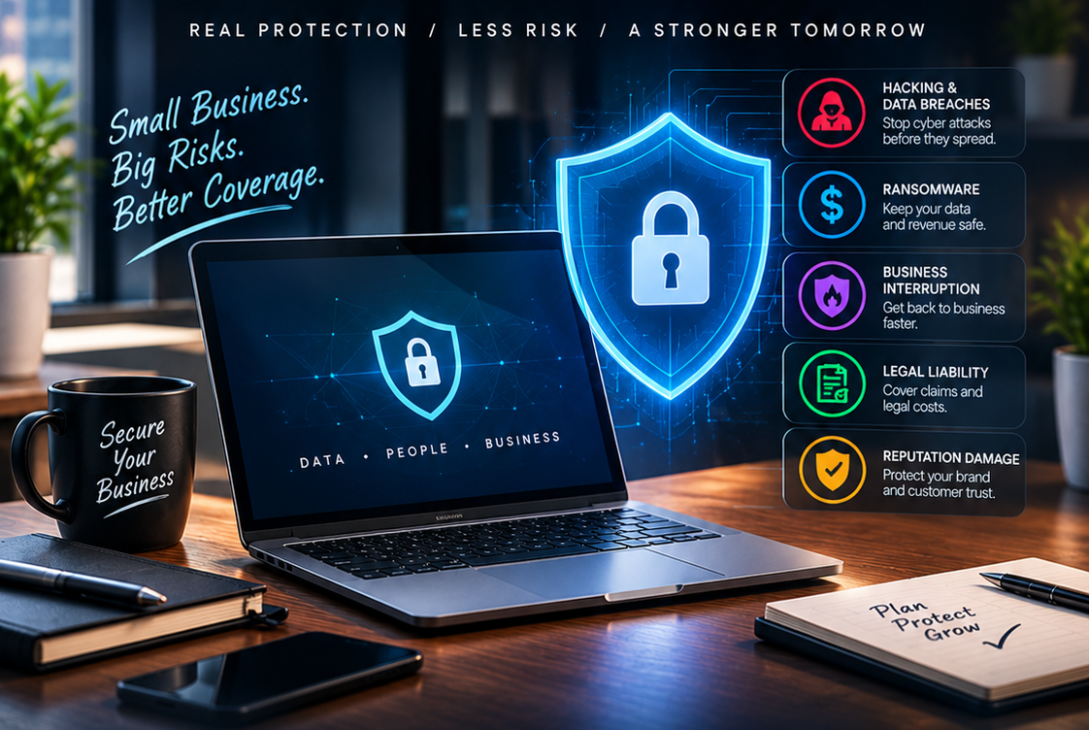
Cyberattacks are no longer a problem limited to large corporations. Small companies increasingly depend on websites, cloud platforms, email, payment systems, customer databases, and online services, which means a single security incident can interrupt operations and create significant financial costs. For many owners, cyber insurance for small business can provide an additional layer of financial protection when prevention alone is not enough.
The right policy can help with expenses associated with data breaches, ransomware, business interruption, legal claims, notification costs, forensic investigations, and certain cyber-related liabilities. However, coverage varies significantly between insurers and policies, so buying the cheapest option without understanding the terms can leave important gaps.
This guide explains how cyber insurance for small business works, what it can cover, what it may exclude, how much coverage a company may need, what insurers look for, and how to compare policies before buying.
Table of Contents
- What Is Cyber Insurance for Small Business?
- Why Small Businesses Need Cyber Insurance
- What Does Cyber Insurance Cover?
- First-Party vs. Third-Party Coverage
- What Cyber Insurance Usually Does Not Cover
- How Much Does Cyber Insurance Cost?
- What Determines Cyber Insurance Pricing?
- What Security Requirements Do Insurers Expect?
- How to Choose the Right Cyber Insurance Policy
- Cyber Insurance vs. General Business Insurance
- Does Every Small Business Need Cyber Insurance?
- How to Prepare Before Applying
- Common Mistakes to Avoid
- Frequently Asked Questions
- Final Verdict
- SEO Details
What Is Cyber Insurance for Small Business?
Cyber insurance for small business is specialized insurance designed to help a company manage certain financial losses and liabilities resulting from cyber incidents.
A cyber incident can include events such as ransomware, malware infections, phishing-related compromises, unauthorized access, data breaches, and certain technology-related disruptions.
The exact protection depends on the policy. Some policies focus heavily on data-breach response, while others provide broader protection for business interruption, cyber extortion, digital asset restoration, liability claims, and regulatory expenses.
The Insurance Information Institute explains that cyber policies can provide both first-party and third-party coverage for different costs associated with cyber incidents.
For a small company, this distinction matters because the financial impact of an attack may extend far beyond the cost of repairing a computer.
A business could potentially face:
- Investigation expenses
- Legal fees
- Customer notification costs
- Data restoration expenses
- Business interruption losses
- Cyber extortion expenses
- Public-relations costs
- Claims from affected customers
- Certain regulatory expenses
Not every policy covers all of these items, however. Coverage limits, deductibles, exclusions, waiting periods, and conditions can vary substantially.
Why Small Businesses Need Cyber Insurance
Many small businesses assume that hackers only target large companies. That assumption can be dangerous.
Small businesses often operate with fewer cybersecurity resources, smaller IT teams, and limited budgets. The U.S. Small Business Administration specifically warns that small businesses can be attractive targets and recommends assessing cybersecurity risks and implementing protective measures.
The need for cyber insurance for small business becomes particularly obvious when a company relies heavily on digital operations.
Consider a small online retailer.
If ransomware prevents employees from accessing order systems for several days, the business could lose sales while also paying for investigation, recovery, technical assistance, and potentially customer communications.
Now consider a professional services company that stores customer information in cloud applications. A compromised employee account could expose sensitive information and create legal or notification obligations.
Insurance cannot prevent these incidents, but appropriate coverage may help reduce the financial consequences.
Cybersecurity Still Comes First
Insurance should not be treated as a replacement for cybersecurity.
Strong passwords, multi-factor authentication, employee training, secure backups, software updates, access controls, endpoint protection, and incident-response planning remain essential.
The SBA recommends measures such as employee cybersecurity training, risk assessments, protecting email systems, and securing business information.
A company with strong security controls may also be viewed more favorably by insurers.
What Does Cyber Insurance Cover?
One of the most important things to understand about cyber insurance for small business is that policies can differ considerably.
Some common areas of coverage include the following.
Data Breach Response
A policy may help pay for expenses related to responding to a covered data breach.
Depending on the policy and applicable laws, this could include:
- Forensic investigation
- Legal consultation
- Customer notification
- Credit or identity monitoring
- Public-relations assistance
- Data restoration
The policy wording determines which services are covered and how much the insurer will pay.
Ransomware and Cyber Extortion
Ransomware can prevent a company from accessing files, applications, or systems.
Some cyber policies provide coverage for certain cyber-extortion expenses. This may include investigation and response costs and, where legally permitted and specifically covered, ransom-related expenses.
However, businesses should never assume that every ransomware event or payment will automatically be covered.
The insurer may require specific security controls, incident reporting, approval procedures, or cooperation with investigators.
Business Interruption
A cyberattack can interrupt normal operations.
If a company cannot process orders, access important systems, communicate with customers, or operate an online platform, revenue can potentially be affected.
Some policies provide business-interruption coverage for qualifying cyber incidents. The exact waiting period, covered losses, duration, and limits can vary.
Data Restoration
Malware or unauthorized access can damage or encrypt business information.
Cyber coverage may help with certain costs involved in restoring or recreating affected data.
Businesses should still maintain independent backups because insurance is not a substitute for a reliable recovery strategy.
Legal and Liability Costs
A cyber incident may result in claims from customers, business partners, or other affected parties.
Third-party cyber liability coverage can potentially help with defense costs, settlements, and certain covered claims.
The Insurance Information Institute notes that third-party coverage can help businesses respond to lawsuits and other claims arising from cyber incidents.
Reputation and Crisis Management
Some policies include access to public-relations or crisis-management services following a covered incident.
This can be valuable because a breach can affect customer trust even after the technical problem has been resolved.
First-Party vs. Third-Party Coverage
Understanding the difference between first-party and third-party coverage makes cyber insurance for small business much easier to evaluate.
First-Party Coverage
First-party coverage generally relates to the company’s own direct losses following a covered cyber event.
Examples may include:
- Data recovery
- Business interruption
- Cyber extortion
- Forensic investigation
- Breach response
- Certain crisis-management expenses
Third-Party Coverage
Third-party coverage generally addresses claims made against the business by other parties.
For example, a customer could claim that the company’s failure to protect information caused financial harm.
Depending on the policy, third-party coverage may help with:
- Legal defense
- Settlements
- Certain liability claims
- Certain regulatory proceedings
The exact definitions vary, so businesses should read the policy rather than relying on the general labels.
What Cyber Insurance Usually Does Not Cover
Another important part of understanding cyber insurance for small business is knowing what may be excluded.
No cyber policy covers every possible technology-related loss.
Common exclusions or limitations can involve:
Known Security Problems
If a company knowingly ignores a serious security issue, the insurer may impose limitations depending on the policy language.
Unapproved Payments
Some cyber-extortion coverage requires insurer approval or specific procedures before certain payments are made.
Intentional Acts
Intentional wrongdoing by the insured may be excluded.
Certain Infrastructure Failures
A general technology failure may not automatically qualify as a covered cyber incident.
War and Certain State-Sponsored Events
Cyber policies can contain complex exclusions relating to war, hostile acts, or state-sponsored attacks. These provisions vary and have become increasingly important as cyber incidents become more sophisticated.
Inadequate Security Controls
Some policies require businesses to maintain particular security practices.
Failing to meet those conditions could create coverage problems after an incident.
Always review exclusions, conditions, sublimits, and definitions with a qualified insurance professional.
How Much Does Cyber Insurance Cost?
The cost of cyber insurance for small business varies significantly.
There is no universal price because insurers evaluate the company’s risk profile before determining premiums.
Factors can include:
- Industry
- Annual revenue
- Number of employees
- Amount of sensitive data
- Payment processing
- Security controls
- Remote access
- Cloud usage
- Previous claims
- Coverage limits
- Deductible
- Geographic exposure
- Business model
A small local business with limited digital operations may have very different insurance needs from an online company processing thousands of customer transactions every month.
Instead of choosing a policy solely because it has the lowest premium, compare the actual protection offered.
A cheaper policy with a low limit or major exclusions may provide less useful protection when a serious incident occurs.
What Determines Cyber Insurance Pricing?
Insurers often want to understand how a business manages cyber risk before offering coverage.
Multi-Factor Authentication
MFA can make compromised passwords less useful to attackers.
Some insurers may ask whether MFA protects important systems, email accounts, remote access, and administrative accounts.
Backups
Reliable backups are critical for recovering from ransomware and other incidents.
Businesses should know what data is backed up, how frequently backups occur, where they are stored, and whether recovery has been tested.
Employee Training
Employees can accidentally click malicious links, disclose credentials, or approve fraudulent requests.
Security awareness training can reduce some of these risks.
Endpoint Security
Insurers may ask about antivirus or endpoint detection tools, patching practices, firewalls, and device management.
Access Controls
Businesses should limit access to sensitive systems according to job responsibilities.
Incident Response
Having a documented incident-response plan can make the recovery process more organized.
These controls can also make an application for cyber insurance for small business more straightforward because the insurer has clearer information about the company’s security posture.
How to Choose the Right Cyber Insurance Policy
When comparing cyber insurance for small business, start with the risks that could cause the greatest financial damage.
Do not begin with price.
Begin with exposure.
Step 1: Identify Your Data
Determine what information your business stores.
This could include:
- Customer names
- Email addresses
- Payment information
- Employee records
- Health information
- Financial records
- Intellectual property
- Login credentials
The sensitivity and quantity of information can influence your insurance requirements.
Step 2: Identify Your Dependence on Technology
Ask what would happen if your systems stopped working for one day, three days, or two weeks.
Could employees work manually?
Could customers still place orders?
Could you process payments?
Could you access essential records?
The answers can help determine whether business-interruption protection is important.
Step 3: Compare Coverage Limits
Look at the maximum amount the insurer will pay.
Also examine individual sublimits.
A policy might have a large overall limit but much smaller limits for particular expenses.
Step 4: Compare Deductibles
A deductible is the amount the business may need to pay before insurance responds.
A lower deductible can increase premiums, while a higher deductible can reduce premiums.
Choose an amount the business could realistically afford after an incident.
Step 5: Read the Exclusions
Exclusions can be just as important as the benefits.
Pay particular attention to ransomware, social engineering, business interruption, regulatory costs, third-party liability, and security-control requirements.
Step 6: Check the Claims Process
Find out how the insurer handles cyber incidents.
Some insurers provide access to breach-response specialists, lawyers, forensic firms, crisis-management professionals, and incident-response providers.
That support can be valuable during a stressful event.
Cyber Insurance vs. General Business Insurance
A common question is whether a normal business insurance policy is enough.
Usually, businesses should not assume that general liability or property insurance automatically covers every cyber risk.
The SBA explains that businesses should assess their specific risks and compare the coverage they need.
The Insurance Information Institute also notes that some Business Owners Policies can include certain cyber-related protections, but businesses seeking broader cyber liability protection may need a dedicated policy.
A BOP can provide useful coverage for property, liability, and business income, but it does not automatically replace specialized cyber coverage.
For businesses heavily dependent on digital systems, cyber insurance for small business may therefore complement rather than replace existing business insurance.
https://www.sba.gov/counseling/launch-your-business
Does Every Small Business Need Cyber Insurance?
Not every company has identical insurance needs.
A business with minimal digital exposure may have different requirements from an online retailer, medical practice, financial service provider, SaaS company, or professional firm handling large amounts of sensitive information.
However, almost every modern business should at least evaluate its cyber risk.
Ask:
- Do we store customer information?
- Do we accept online payments?
- Do employees use cloud applications?
- Would ransomware stop our operations?
- Do we depend on email?
- Could a compromised account cause financial damage?
- Would customers or partners make claims after a breach?
If the answer to several of these questions is yes, cyber insurance for small business may deserve serious consideration.
How to Prepare Before Applying
Businesses can make the insurance application process easier by preparing accurate information about their cybersecurity controls.
Create a simple inventory covering:
- Hardware
- Software
- Cloud services
- Customer information
- Employee accounts
- Payment systems
- Backup systems
- Security controls
- Incident-response procedures
- Previous cyber incidents
Do not exaggerate your security practices on an application.
If an application states that MFA is enabled everywhere but the business does not actually use it, that discrepancy could create serious problems during a claim.
The goal of cyber insurance for small business is to transfer some financial risk while the company continues improving its security.
Common Mistakes to Avoid
Buying Only on Price
The cheapest policy may not provide the protection you actually need.
Ignoring Sublimits
Always check whether specific coverages have smaller limits than the overall policy.
Assuming Every Attack Is Covered
A cyber policy still has exclusions and conditions.
Failing to Maintain Security Controls
If a policy requires specific safeguards, keep them operational.
Not Testing Backups
Backups that cannot be restored are not a reliable recovery strategy.
Waiting Until After an Incident
Insurance needs to be in place before the event occurs. Buying coverage after discovering a breach does not turn an existing incident into an insured event.
Forgetting Third-Party Risk
A business can face claims even when the direct loss is relatively small.
Frequently Asked Questions
What is cyber insurance for small business?
Cyber insurance for small business is specialized coverage that can help a company manage certain financial losses and liabilities resulting from covered cyber incidents.
Is cyber insurance worth it for a small business?
It can be valuable for businesses that rely heavily on digital systems, store sensitive information, process online payments, or could suffer significant losses from downtime. The value depends on the company’s risk and the policy’s actual coverage.
What does cyber insurance cover?
Depending on the policy, coverage can include breach response, forensic investigation, data recovery, business interruption, cyber extortion, legal defense, and certain third-party liability claims.
Does general liability insurance cover cyberattacks?
Not necessarily. Some business policies may provide limited cyber-related coverage, but businesses should review the actual policy language. Dedicated cyber coverage may be needed for broader protection.
How much does cyber insurance cost?
Premiums vary based on factors such as revenue, industry, security controls, data exposure, claims history, coverage limits, and deductible. There is no single price that applies to every small company.
Does cyber insurance cover ransomware?
Some policies can cover certain ransomware and cyber-extortion expenses, subject to policy terms, exclusions, limits, and applicable laws.
Does cyber insurance cover phishing?
Some policies may cover certain losses resulting from phishing or social-engineering attacks, but coverage varies considerably. Businesses should specifically ask about this risk before purchasing a policy.
Do small businesses really need cyber insurance?
Any business that depends on computers, cloud services, email, online payments, or customer data should evaluate its cyber exposure. Whether insurance is appropriate depends on the company’s specific risks and financial capacity.
Can cyber insurance replace cybersecurity?
No. Insurance is a financial risk-transfer tool, not a cybersecurity strategy. Businesses still need security controls, employee training, backups, MFA, patching, and an incident-response plan.
What should I look for in a cyber insurance policy?
Look at coverage limits, deductibles, exclusions, business-interruption protection, breach-response services, ransomware coverage, third-party liability, social-engineering coverage, security requirements, and the claims process.
Final Verdict
Cyber insurance for small business can be an important part of a broader risk-management strategy, particularly for companies that rely heavily on digital systems or store sensitive customer information.
The right policy can potentially help with the financial impact of covered incidents such as data breaches, ransomware, business interruption, forensic investigations, legal expenses, and certain liability claims. However, coverage is never identical across insurers.
The best approach is to assess your company’s actual exposure first, strengthen basic cybersecurity controls, and then compare policies based on coverage rather than price alone.
Remember that insurance does not prevent attacks. Strong security practices remain the first line of defense. But when prevention fails, appropriate cyber insurance for small business can provide financial and professional support during a difficult recovery.
For most digitally dependent companies, the question is not simply whether cyber insurance is cheap. The better question is whether the business could comfortably absorb the financial consequences of a serious cyber incident without it.