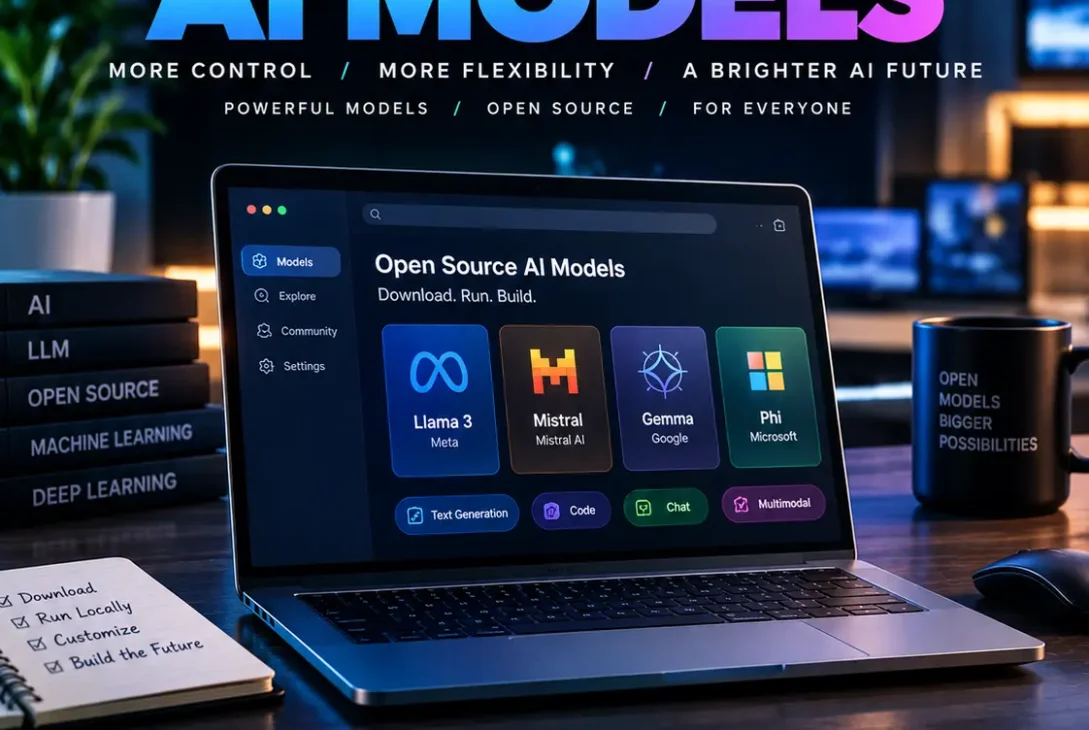
Open weight AI models have become one of the most important parts of the artificial intelligence ecosystem. Instead of keeping trained model weights completely behind a private API, open-weight releases allow developers and organizations to download models, run them on their own infrastructure, customize them, and build applications around them, depending on the model’s license.
The open-weight landscape has expanded rapidly. Meta’s Llama family, OpenAI’s gpt-oss models, Google’s Gemma 4, DeepSeek-V4, and Mistral’s open models give developers more choices for local AI, coding, reasoning, agents, research, and enterprise applications.
In 2026, the discussion is no longer simply about whether developers can run powerful AI models themselves. The bigger question is which model, license, hardware setup, and deployment method make sense for a particular project.
Table of Contents
- What Are Open Weight AI Models?
- Open Weight vs Open Source AI
- Why Open Weight AI Models Matter
- Best Open Weight AI Models in 2026
- Meta Llama
- OpenAI gpt-oss
- DeepSeek-V4
- Google Gemma 4
- Mistral Open Models
- What Can You Do With Open Weight AI Models?
- Running Models Locally
- Hardware Requirements
- Benefits and Limitations
- How to Choose the Right Model
- Frequently Asked Questions
- Final Verdict
- SEO Details
What Are Open Weight AI Models?
Open weight AI models are AI models whose trained parameters, commonly called weights, are made available for developers to download and use under specified license terms.
The weights contain the learned numerical parameters that allow a neural network to generate outputs.
When weights are publicly available, developers can potentially:
- Download the model
- Run it locally
- Host it on private servers
- Fine-tune it
- Quantize it
- Integrate it into applications
- Experiment with different inference systems
- Build specialized AI tools
However, open weights do not automatically mean that every part of an AI system is open.
The training dataset, training code, evaluation infrastructure, and development process may remain unavailable. Licensing can also place conditions on how a model can be used.
This distinction is important when evaluating open weight AI models for commercial projects.
Open Weight vs Open Source AI
The terms “open weight” and “open source” are often used interchangeably, but they aren’t necessarily identical.
An open-weight model makes its trained parameters available. Open-source AI can imply a broader level of transparency, potentially including source code, training information, data details, documentation, and other components.
For example, OpenAI describes gpt-oss as an open-weight model and makes its weights available under Apache 2.0, while noting that some surrounding infrastructure can remain proprietary.
Similarly, different model families use different licenses.
Before deploying open weight AI models commercially, developers should read the specific model license rather than assuming that every model has identical permissions.
Why Open Weight AI Models Matter
There are several reasons developers and businesses are increasingly interested in open weight AI models.
More Control
Running a model yourself can provide greater control over where data is processed.
This can be useful for organizations with privacy, compliance, or data-residency requirements.
Customization
Developers can fine-tune or otherwise adapt some models for specialized applications.
Instead of relying entirely on a general-purpose hosted model, a company can build a model around its own terminology, workflows, or domain.
Local AI
Smaller models can run on local computers, workstations, and edge devices.
This can reduce dependence on an internet connection and allow developers to experiment without sending every prompt to a remote service.
Deployment Flexibility
A model can potentially be deployed through local inference software, private servers, cloud GPUs, or third-party hosting platforms.
That flexibility is one of the main reasons open weight AI models are becoming important to developers.
Best Open Weight AI Models in 2026
The current ecosystem includes models designed for different workloads rather than one universal model that is ideal for everything.
Some of the major families include:
| Model family | Main strengths | Notable characteristics |
|---|---|---|
| Meta Llama | General AI, multimodal applications | Llama 4 Scout and Maverick |
| OpenAI gpt-oss | Reasoning, coding, agents | 20B and 120B models |
| DeepSeek-V4 | Reasoning, coding, long context | Up to 1M-token context |
| Google Gemma 4 | Reasoning, multimodal and efficient deployment | Multiple sizes |
| Mistral | General AI, coding, enterprise workloads | Apache 2.0 open models |
The appropriate choice depends on hardware, license requirements, context length, performance needs, and intended application.
https://openai.com/index/introducing-gpt-oss/
Meta Llama
Meta’s Llama family remains one of the best-known examples of open weight AI models.
Llama 4 Scout and Llama 4 Maverick are natively multimodal models that support image and text understanding.
Meta lists Llama 4 Scout at 17 billion active parameters with 109 billion total parameters, while Llama 4 Maverick has 17 billion active parameters and 400 billion total parameters.
Llama 4 Scout is designed to be particularly efficient, with Meta stating that it can fit on a single H100 GPU when using Int4 quantization.
Meta also provides model resources through its own platform and partners such as Hugging Face.
This makes the Llama ecosystem useful for developers who want to experiment with multimodal AI, build assistants, create research projects, or integrate models into custom applications.
OpenAI gpt-oss
OpenAI entered the open-weight model space with gpt-oss-20b and gpt-oss-120b.
The models are designed around reasoning, coding, tool use, and agentic workloads.
According to OpenAI, gpt-oss-120b has 117 billion total parameters and activates about 5.1 billion parameters per token. gpt-oss-20b has 21 billion total parameters and activates approximately 3.6 billion parameters per token.
Both support context lengths of up to 128K tokens.
One of the most interesting aspects of gpt-oss is deployment flexibility.
OpenAI states that gpt-oss-20b can run within 16GB of memory, while gpt-oss-120b can run within 80GB of memory when using the provided MXFP4 quantization.
The models are available under the Apache 2.0 license, subject to OpenAI’s usage policy.
They are not served through the OpenAI API or ChatGPT, meaning developers who want to use them need to deploy them through supported infrastructure or hosting platforms.
DeepSeek-V4
DeepSeek has also become a major name in open weight AI models.
DeepSeek-V4 Preview was released in April 2026 with an emphasis on long-context processing and efficient inference.
DeepSeek lists two major versions:
- DeepSeek-V4-Pro
- DeepSeek-V4-Flash
The Pro model has 1.6 trillion total parameters with 49 billion active parameters, while the Flash model has 284 billion total parameters with 13 billion active parameters.
One of the most notable features is the model family’s support for a context length of up to one million tokens.
Long context can be useful for applications involving large documents, software repositories, research material, and complex multi-step tasks.
Developers interested in DeepSeek should still review the exact model documentation and license before using a particular release commercially.
Google Gemma 4
Google’s Gemma family provides another important option for developers interested in open weight AI models.
Google released Gemma 4 in 2026 in several configurations, including 31B and 26B A4B models, followed by additional releases such as Gemma 4 12B Unified.
Gemma is designed to bring advanced AI capabilities to developers who want models that can be deployed outside Google’s largest proprietary systems.
The ecosystem also includes specialized models and tools built around the Gemma family.
Google provides documentation for running supported Gemma models through different environments, including local development and hosted APIs.
The smaller variants can be particularly interesting for developers who want to balance model capability against available hardware.
Mistral Open Models
Mistral AI is another major contributor to the open-model ecosystem.
Mistral 3 introduced several open models, including 3B, 8B, and 14B dense models, along with Mistral Large 3.
Mistral states that the models in the Mistral 3 family were released under the Apache 2.0 license.
The company has continued developing open models and infrastructure throughout 2026, including work around coding, agents, multilingual AI, safety, and enterprise deployment.
Mistral’s approach is particularly interesting for businesses that want more control over where models run and how they are integrated into private systems.
What Can You Do With Open Weight AI Models?
There are many practical applications for open weight AI models.
AI Chatbots
Developers can build conversational assistants without relying entirely on a third-party chatbot interface.
Coding Assistants
Open models can be integrated into coding tools for:
- Code generation
- Debugging
- Documentation
- Refactoring
- Code explanation
- Repository analysis
Private Enterprise Assistants
Businesses can deploy models inside controlled environments and connect them to internal documents or databases.
Research
Researchers can inspect model behavior, experiment with fine-tuning, compare architectures, and evaluate different inference techniques.
AI Agents
Models can also serve as reasoning engines inside agents that interact with tools, APIs, databases, and software environments.
The growing availability of open weight AI models has therefore made it easier to experiment with AI beyond conventional chatbot applications.
Running Models Locally
One of the biggest advantages of open weight AI models is the ability to run them locally.
Tools such as Ollama, llama.cpp, LM Studio, vLLM, and Transformers can make local or self-hosted inference considerably easier.
However, hardware requirements vary dramatically.
A small 3B or 7B model may be practical on consumer hardware, while a very large model can require substantial GPU memory or multiple accelerators.
Quantization can reduce memory requirements by representing model weights with fewer bits.
For example, a model that is too large to fit comfortably in its original precision may become practical after quantization.
The trade-off is that lower-precision versions can affect performance or output quality depending on the model and workload.
Hardware Requirements
Before downloading open weight AI models, check the model’s actual hardware requirements.
Important factors include:
- GPU VRAM
- System RAM
- Storage capacity
- CPU performance
- Memory bandwidth
- Operating system
- Quantization format
- Context length
Parameter count is useful, but it isn’t the only factor.
Mixture-of-experts models can have very large total parameter counts while activating only a smaller subset of parameters for each token.
That can make some large models more efficient during inference than their total parameter count might suggest.
For example, OpenAI’s gpt-oss models use a mixture-of-experts architecture with only a fraction of their total parameters activated for each token.
Benefits and Limitations
The growing popularity of open weight AI models comes with both advantages and trade-offs.
Benefits
Greater control: You can decide where the model runs.
Customization: Some models can be fine-tuned or adapted.
Privacy: Private deployment can reduce the need to send sensitive prompts to an external API.
Flexibility: Developers can choose their own inference stack.
Experimentation: Researchers can inspect and modify model behavior more easily than with closed API-only systems.
Potential cost savings: High-volume workloads may benefit from self-hosting, depending on infrastructure costs.
Limitations
Hardware costs: Large models can require expensive GPUs.
Maintenance: Self-hosting means managing infrastructure, updates, monitoring, and security.
Licensing: Different models have different usage conditions.
Performance: A model that runs locally may not match the speed or quality of a larger hosted system.
Technical complexity: Deployment can require knowledge of GPUs, inference engines, quantization, networking, and model formats.
For these reasons, open weight AI models aren’t automatically the right solution for every organization.
How to Choose the Right Model
Choosing between open weight AI models should start with your actual workload.
For General Chat
Look at general-purpose models with strong instruction following and multilingual capabilities.
For Coding
Focus on coding benchmarks, context length, tool use, and repository-level performance.
For Reasoning
Look for models specifically trained or optimized for reasoning tasks.
For Local Computers
Smaller models and efficient quantized versions are usually easier to deploy.
For Enterprise
Pay particular attention to licensing, privacy, security, deployment options, and support.
For Long Documents
Context length becomes especially important.
A model with a very large context window can process more information in a single interaction, although real-world performance still depends on how effectively the model uses that context.
Frequently Asked Questions
What are open weight AI models?
Open weight AI models are models whose trained parameters are publicly available under specific license terms. Developers can download and run them, and some can also be fine-tuned or modified.
Are open weight AI models free?
The model weights may be available without a purchase price, but running them can still cost money. Large models may require expensive GPUs, servers, electricity, or cloud infrastructure.
Are open weight AI models the same as open source AI?
Not necessarily. Open weights mean the trained parameters are available. Open source can refer to broader access to source code and other components. Always check the individual model’s license.
Can I run open weight AI models on my PC?
Yes, depending on the model and your hardware. Smaller models can run on consumer computers, while larger models may require substantial GPU memory or multiple GPUs.
Can open weight AI models be used commercially?
Some can, but licensing varies. Models released under permissive licenses may allow commercial use, while others have additional conditions. Check the exact license before deployment.
Which companies release open weight AI models?
Major contributors include Meta, OpenAI, Google, DeepSeek, and Mistral, among others.
Can I fine-tune open weight AI models?
Many open-weight models can be fine-tuned or adapted, but the exact technical process and licensing permissions vary by model.
Are open weight AI models good for coding?
Many are specifically designed or optimized for coding. Developers should compare coding performance, context length, tool use, hardware requirements, and licensing before selecting one.
Can open weight AI models work offline?
Yes. If the model and required software are installed locally, many open-weight models can operate without sending prompts to a remote AI service.
Do open weight AI models require powerful GPUs?
Not always. Smaller models can run on modest hardware, especially when quantized. Very large models, however, can require substantial GPU memory.
Final Verdict
Open weight AI models have changed how developers can build and deploy artificial intelligence.
Instead of relying exclusively on hosted APIs, developers can download model weights, run AI locally, customize models, and deploy them on private infrastructure when the license and technical requirements allow it.
The 2026 ecosystem includes major families such as Llama, gpt-oss, DeepSeek-V4, Gemma 4, and Mistral. Each takes a somewhat different approach to model size, reasoning, multimodal capabilities, licensing, context length, and deployment.
The most important thing is not simply choosing the largest model. Developers should consider the workload, available hardware, context requirements, licensing, privacy needs, and operating costs.
As model quality continues improving, open weight AI models are likely to remain an important option for developers, researchers, startups, and organizations that want more control over their AI infrastructure.