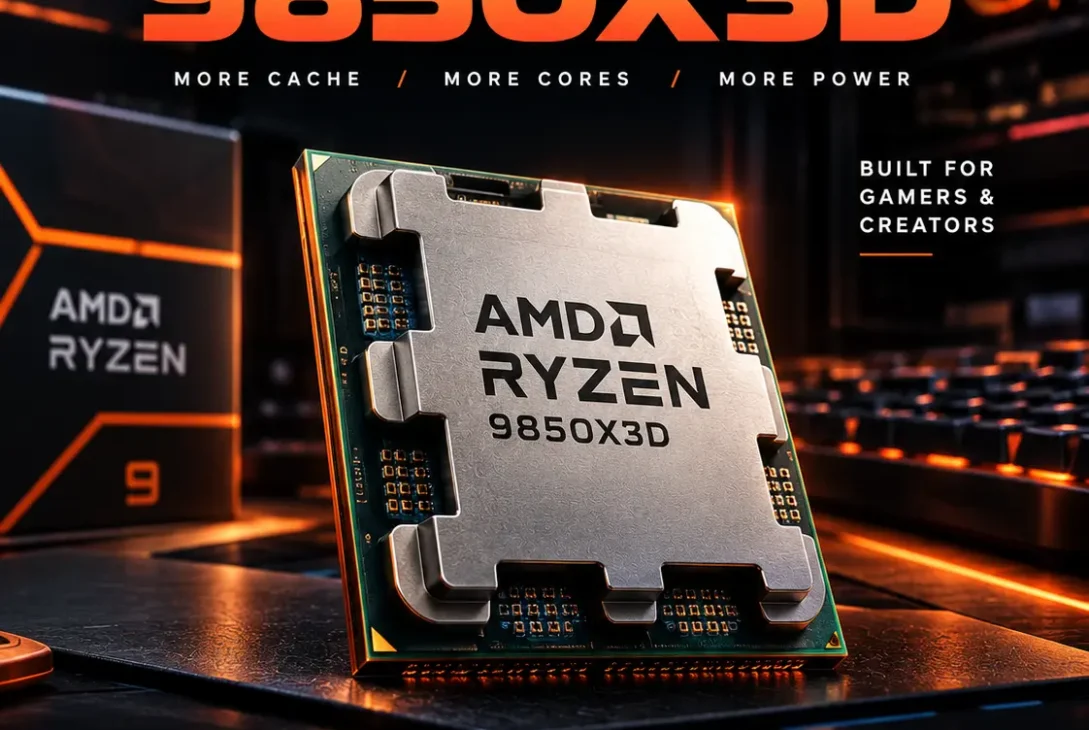
The Ryzen 9850X3D is AMD’s latest enthusiast desktop gaming processor, built around Zen 5 architecture and second-generation 3D V-Cache technology. With 8 cores, 16 threads, a boost clock of up to 5.6 GHz, and 104 MB of total cache, AMD designed the chip specifically for demanding gaming systems and high-refresh-rate PCs.
The Ryzen 9850X3D is also interesting because it is not a completely new architecture compared with the Ryzen 7 9800X3D. Instead, AMD has taken the same general Zen 5 X3D formula and pushed clock speeds higher. That makes the important question less about whether the processor is fast and more about how much faster it is, where the improvement appears, and whether it makes sense for a new PC or an upgrade.
This guide covers the Ryzen 9850X3D specifications, 3D V-Cache, gaming performance, productivity results, cooling, AM5 compatibility, memory support, comparisons with previous X3D processors, and the type of gamer who can actually benefit from it.
Table of Contents
- What Is the Ryzen 9850X3D?
- Ryzen 9850X3D Specifications
- How 3D V-Cache Works
- Ryzen 9850X3D Gaming Performance
- Ryzen 9850X3D vs 9800X3D
- Ryzen 9850X3D vs 7800X3D
- Gaming at 1080p, 1440p and 4K
- Productivity and Everyday Performance
- Cooling and Power Requirements
- AM5, DDR5 and Motherboard Compatibility
- Pros and Cons
- Who Should Consider the Ryzen 9850X3D?
- Who Should Skip It?
- Frequently Asked Questions
- Conclusion
What Is the Ryzen 9850X3D?
The Ryzen 9850X3D is officially named the AMD Ryzen 7 9850X3D. It belongs to AMD’s Ryzen 9000 desktop family and uses the Zen 5 architecture.
It has eight CPU cores and supports simultaneous multithreading for a total of 16 threads. The processor operates at a 4.7 GHz base clock and can reach up to 5.6 GHz under suitable conditions. AMD gives it a default TDP of 120W and equips it with 96 MB of L3 cache.
The defining feature is AMD’s 3D V-Cache technology.
Instead of relying only on the cache available in a conventional desktop processor, AMD adds a large amount of additional cache to the chip. This is particularly useful for some games because game engines frequently access relatively small pieces of data repeatedly.
The Ryzen 9850X3D launched on January 29, 2026, and AMD positions it as an enthusiast desktop processor rather than a mainstream chip.
That positioning is important because buyers should look at the entire PC configuration rather than judging the processor in isolation.
A powerful gaming CPU paired with a modest graphics card will not necessarily produce better gaming performance than a balanced system.
Ryzen 9850X3D Specifications
Here are the core specifications published by AMD:
| Specification | Ryzen 7 9850X3D |
|---|---|
| Architecture | Zen 5 |
| Cores | 8 |
| Threads | 16 |
| Base clock | 4.7 GHz |
| Max boost clock | Up to 5.6 GHz |
| L2 cache | 8 MB |
| L3 cache | 96 MB |
| Total cache | 104 MB |
| Default TDP | 120W |
| Socket | AM5 |
| Memory | DDR5 |
| PCIe | PCIe 5.0 |
| Integrated graphics | Radeon Graphics |
| iGPU cores | 2 |
| iGPU frequency | Up to 2.2 GHz |
| Launch date | January 29, 2026 |
AMD also lists support for Precision Boost Overdrive, Curve Optimizer, EXPO memory overclocking, and Ryzen Master. The processor is unlocked for overclocking, although X3D processors require more care than conventional CPUs when tuning voltage and thermals.
One important detail is that AMD does not include a thermal solution with the boxed processor. AMD recommends liquid cooling for optimal performance, and the maximum operating temperature is listed at 95°C.
Image placement: After this section
Suggested image: Ryzen 7 9850X3D processor product photo
ALT text: Ryzen 9850X3D Zen 5 desktop gaming processor
How 3D V-Cache Works
The biggest reason the Ryzen 9850X3D is designed differently from many standard desktop CPUs is its large cache.
CPU cache is extremely fast memory located close to the processor cores. It stores frequently accessed information so the CPU does not always have to retrieve it from system RAM.
Games can benefit from this because their workloads often involve repeatedly accessing information related to game worlds, characters, physics, artificial intelligence, and other engine processes.
AMD’s 3D V-Cache technology increases the amount of cache available to the processor by using vertically stacked cache technology.
The Ryzen 9850X3D provides 96 MB of L3 cache and 104 MB of total cache when its L2 cache is included.
This does not mean that every application becomes dramatically faster.
Cache-sensitive workloads can benefit much more than applications that depend primarily on raw multi-core throughput.
That is one reason X3D processors are particularly interesting for gaming.
Why cache matters for gaming
Consider a game that repeatedly needs information stored in memory.
If more of that information can remain available inside fast CPU cache, the processor may spend less time waiting for data from slower system memory.
The result can be higher frame rates or improved frame-time consistency in workloads that respond well to additional cache.
However, the graphics card can still be the limiting factor.
If the GPU is already operating at its maximum capacity, a faster CPU may have very little effect on the final frame rate.
This distinction becomes especially important when comparing results at different resolutions.
Ryzen 9850X3D Gaming Performance
The main reason to buy the Ryzen 9850X3D is gaming.
AMD claims that its new X3D processor can deliver up to 27% better gaming performance than Intel’s Core Ultra 9 285K in the company’s selected testing. That figure represents AMD’s testing methodology rather than a universal result for every game.
Independent testing provides a more detailed picture.
TechSpot tested the processor across 14 games and found that the Ryzen 9850X3D was about 5% faster than the 9800X3D on average in its primary comparison. With higher-quality settings that pushed the RTX 5090 toward GPU-limited performance, the average advantage dropped to around 3%.
That is a useful distinction.
The processor is extremely fast, but its improvement over the previous generation is not equally visible in every game.
Some titles respond strongly to CPU performance and additional cache.
Others become limited by the graphics card before the CPU can make a meaningful difference.
Games that benefit from the architecture
TechSpot’s testing showed several games where the Ryzen 9850X3D produced noticeable gains over the 9800X3D.
For example, Battlefield 6 showed a 7% improvement in its Medium preset testing, while Counter-Strike 2 was approximately 6% faster. Assetto Corsa Competizione also showed a 7% gain in the tested configuration.
Other games showed much smaller differences.
In Spider-Man 2, the Medium preset produced only about a 1.5% increase in TechSpot’s testing, while Mafia: The Old Country was essentially unchanged.
This demonstrates why CPU reviews should not be reduced to a single benchmark.
Image placement: After this section
Suggested image: High-end gaming PC benchmark setup
ALT text: Ryzen 9850X3D gaming performance benchmark
Ryzen 9850X3D vs 9800X3D
The most important comparison for many buyers is the Ryzen 9850X3D versus the Ryzen 7 9800X3D.
Both processors use Zen 5, have eight cores and 16 threads, feature 104 MB of total cache, and carry a 120W default TDP.
The main specification difference is clock speed.
The newer processor reaches up to 5.6 GHz, while the 9800X3D has a maximum boost clock of 5.2 GHz.
| Feature | Ryzen 9850X3D | Ryzen 9800X3D |
|---|---|---|
| Architecture | Zen 5 | Zen 5 |
| Cores / Threads | 8 / 16 | 8 / 16 |
| Max boost | 5.6 GHz | 5.2 GHz |
| Total cache | 104 MB | 104 MB |
| TDP | 120W | 120W |
| Socket | AM5 | AM5 |
| 3D V-Cache | Yes | Yes |
The higher clock speed gives the newer chip additional performance headroom.
However, TechSpot’s 14-game testing found an average gaming advantage of approximately 5% for the Ryzen 9850X3D over the 9800X3D, with the exact difference changing considerably between individual games.
That means existing 9800X3D owners should not expect a completely different gaming experience after upgrading.
For someone building a new PC, the comparison depends heavily on current market pricing.
If both processors are close in price, the newer model provides a straightforward way to obtain the higher clock speeds.
If the older model is substantially cheaper, the performance difference becomes more important to consider against the price difference.
Ryzen 9850X3D vs 7800X3D
The Ryzen 7 7800X3D is an older X3D processor, but it remains relevant because many gaming PCs still use it.
The Ryzen 9850X3D offers a newer Zen 5 architecture, higher clock speeds, and the benefits of AMD’s newer platform design.
TechSpot’s testing found the 9850X3D around 14–15% faster than the 7800X3D on average in its CPU-focused gaming testing, depending on the comparison methodology.
The improvement varies by game.
CPU-heavy games can show a much larger difference, while GPU-limited titles may show very little.
This is important for anyone considering an upgrade.
Someone moving from an older CPU may notice a more meaningful improvement than a person who already owns a 9800X3D.
For that reason, upgrade decisions should be based on the current processor, graphics card, monitor, games, and actual frame rates rather than the processor generation alone.
https://www.amd.com/en/products/processors/desktops/ryzen/9000-series/amd-ryzen-7-9850x3d.html
Gaming at 1080p, 1440p and 4K
Resolution has a major effect on CPU comparisons.
At 1080p, particularly with a very powerful graphics card, the CPU can become a significant performance limiter.
This is where a processor like the Ryzen 9850X3D can show its strongest advantage.
At 1440p, the balance shifts toward the GPU, although CPU performance remains important for high-refresh-rate gaming.
At 4K, demanding games are often heavily GPU-limited.
This does not mean a high-end CPU is irrelevant at 4K. It means that increasing CPU performance may produce a smaller frame-rate improvement when the graphics card is already struggling to render each frame.
For example, a competitive gamer using a 360Hz display may prioritize CPU performance because the goal is extremely high frame rates.
A player using a 4K 60Hz display may have very different priorities.
The same processor can therefore make sense for one system and be unnecessary for another.
Productivity and Everyday Performance
The Ryzen 9850X3D is not designed primarily as a workstation processor.
Its eight cores and 16 threads are enough for everyday multitasking, gaming while streaming, photo editing, software development, browsing, and many creator workloads.
However, users who regularly perform heavily threaded tasks should also consider CPUs with larger core counts.
TechSpot’s testing showed only modest productivity gains over the 9800X3D. Cinebench 2024 multi-core performance increased by around 2%, while 7-Zip compression improved by about 1.5% and decompression by roughly 4% in its testing.
That result makes sense.
The primary changes between the two X3D processors are not enough to transform heavily multi-threaded workloads.
If your computer is mainly a workstation for CPU rendering, large-scale video encoding, or other heavily parallel tasks, a higher-core-count processor may be more appropriate.
If gaming is the priority, however, the X3D design makes much more sense.
Cooling and Power Requirements
The Ryzen 9850X3D has a default TDP of 120W.
AMD lists a maximum operating temperature of 95°C and recommends liquid cooling for optimal performance.
The actual power used by a processor can be different from its TDP.
Motherboard settings, boost behavior, workload, temperature, and power limits all influence real-world consumption.
TechSpot measured around 162W through the EPS connectors during a particular Cinebench 2024 workload, illustrating why buyers should not select cooling based only on the 120W specification.
A good cooling solution also helps maintain consistent boost behavior.
For a high-end gaming PC, pairing the processor with a quality liquid cooler or appropriately powerful air-cooling solution is sensible.
The exact cooler should also be selected according to the case, motherboard, ambient temperature, and desired noise level.
AM5, DDR5 and Motherboard Compatibility
The Ryzen 9850X3D uses AMD’s AM5 socket.
AMD lists support for chipsets including A620, B650, B650E, X670, X670E, B840, B850, X870, and X870E.
The processor supports DDR5 memory and PCIe 5.0.
AMD lists official memory support of up to DDR5-5600 under certain two-DIMM configurations, with lower official speeds for four-DIMM configurations. EXPO technology is also supported for compatible memory kits.
For a new gaming PC, memory selection should therefore be considered together with the motherboard.
A reliable DDR5 kit, current BIOS, adequate power delivery, and suitable cooling are all part of a stable X3D build.
The CPU also includes basic integrated Radeon graphics.
This is not intended to replace a discrete gaming GPU, but it can be useful for basic display output and troubleshooting when a dedicated graphics card is unavailable.
Image placement: After this section
Suggested image: Ryzen processor installed on an AM5 motherboard with DDR5 memory
ALT text: Ryzen 9850X3D AM5 motherboard with DDR5 RAM
Pros and Cons
Pros
Strong gaming performance: The X3D architecture is specifically optimized for workloads where additional cache can improve CPU-side performance.
High 5.6 GHz boost clock: The increased clock speed gives the processor an advantage over the 9800X3D in suitable workloads.
Large cache capacity: AMD provides 96 MB of L3 cache and 104 MB of total cache.
Modern AM5 platform: The chip supports DDR5 and PCIe 5.0.
Useful tuning features: Precision Boost Overdrive, Curve Optimizer, EXPO, and Ryzen Master are supported.
Cons
Limited improvement over 9800X3D: The average gaming improvement is relatively modest in many scenarios.
Eight cores: Excellent for gaming, but not the ideal configuration for every heavily threaded workstation workload.
Cooling is required: No thermal solution is included, and AMD recommends liquid cooling for optimal performance.
GPU limitations remain: At higher resolutions, the graphics card can become the main bottleneck.
Premium positioning: The processor is aimed at enthusiast systems rather than budget gaming PCs.
Who Should Consider the Ryzen 9850X3D?
The Ryzen 9850X3D is primarily aimed at people building high-end gaming PCs.
It is particularly relevant for gamers using powerful graphics cards and high-refresh-rate displays.
Competitive gamers can benefit from the processor’s strong CPU performance when games are capable of running at very high frame rates.
It can also make sense for someone building a new AM5 system who wants a gaming-focused CPU without moving to a higher-core-count workstation processor.
The situation is different for existing 9800X3D owners.
The newer chip is faster, but the improvement is generally incremental rather than transformational.
If your current system already produces the frame rates you need, the money may be better spent on a faster GPU, monitor, storage, or other component.
Who Should Skip It?
The Ryzen 9850X3D may not be necessary for every PC.
If your graphics card is already the bottleneck, upgrading the CPU may produce only a small improvement.
The same applies to gamers who primarily play at 4K with demanding graphical settings.
Users focused heavily on CPU rendering, professional video production, or other multi-threaded applications should also compare higher-core-count CPUs before choosing an X3D model.
Finally, buyers working with a limited budget should consider the entire platform cost.
A less expensive processor combined with a stronger graphics card can sometimes produce a better-balanced gaming PC than spending a disproportionate amount on the CPU.
Frequently Asked Questions
What is the Ryzen 9850X3D?
The Ryzen 9850X3D is AMD’s Ryzen 7 9850X3D desktop processor, using Zen 5 architecture and second-generation 3D V-Cache. It has 8 cores, 16 threads, and a boost clock of up to 5.6 GHz.
Is the Ryzen 9850X3D good for gaming?
Yes. The Ryzen 9850X3D is specifically designed for enthusiast gaming and performs particularly well in CPU-limited workloads. Actual performance varies depending on the game, graphics card, resolution, and settings.
How many cores does the Ryzen 9850X3D have?
The Ryzen 9850X3D has 8 CPU cores and 16 threads. It has a 4.7 GHz base clock and can boost to up to 5.6 GHz.
How much cache does the Ryzen 9850X3D have?
The processor has 104 MB of total cache, including 8 MB of L2 cache and 96 MB of L3 cache. The large L3 cache is a key part of AMD’s 3D V-Cache design.
Is the Ryzen 9850X3D faster than the 9800X3D?
Yes, but the difference is relatively small in many games. TechSpot’s 14-game testing found an average improvement of about 5% over the 9800X3D under its primary test conditions, with results varying between games.
Does the Ryzen 9850X3D use AM5?
Yes. The processor uses AMD’s AM5 socket and supports DDR5 memory and PCIe 5.0. AMD lists compatibility with multiple AM5 chipsets, including B650, B650E, X670, X670E, B850, X870, and X870E.
Does the Ryzen 9850X3D include a CPU cooler?
No. AMD does not include a thermal solution with the processor and recommends liquid cooling for optimal performance.
Conclusion
The Ryzen 9850X3D is a highly specialized desktop processor aimed at gamers who want very high CPU performance.
Its combination of Zen 5 architecture, 8 cores, 16 threads, 5.6 GHz maximum boost frequency, and 96 MB of L3 cache gives it the hardware needed for demanding gaming workloads.
The biggest advantage comes in games that can take advantage of strong CPU performance and additional cache. However, the improvement over the 9800X3D is generally modest, which means existing owners should carefully consider whether the performance increase justifies an upgrade.
For a new high-end gaming PC, the Ryzen 9850X3D provides a strong AM5 foundation. For users with older X3D processors or mainstream CPUs, the potential improvement can be more substantial, particularly when paired with a powerful graphics card and a high-refresh-rate monitor.
The key takeaway is that the Ryzen 9850X3D is not simply about having the newest processor. Its value depends on the games you play, the GPU you use, your monitor resolution and refresh rate, and the price of the complete system.