
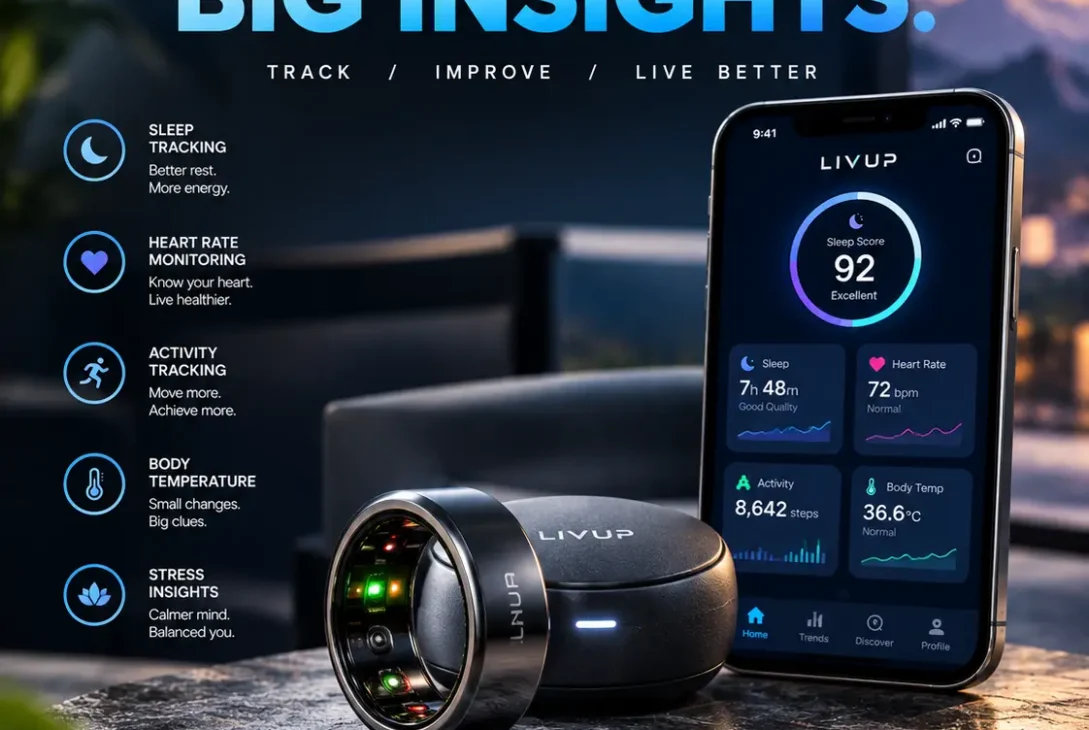
Smart rings have become an interesting alternative to traditional fitness trackers and smartwatches. Instead of wearing a screen on your wrist, a smart ring puts sensors directly on your finger and quietly collects information throughout the day and night.
The LivUp Smart Ring is positioned as a budget-friendly wearable for people who want basic health and activity tracking without buying a premium smart ring. It focuses on features such as heart-rate monitoring, blood oxygen tracking, steps, sleep monitoring, and sports activity.
The ring connects to a smartphone through Bluetooth and uses a companion application to display collected information. Recent listings also show the product at a considerably lower price than premium smart rings, although pricing and availability can vary by retailer.
This guide explains what the device offers, how it works, what to know about its accuracy, how to set it up, and what buyers should consider before purchasing.
Table of Contents
- What Is the LivUp Smart Ring?
- How Does It Work?
- LivUp Smart Ring Features
- Health and Activity Tracking
- Sleep Tracking
- Sports Tracking
- Blood Oxygen and Heart Rate Monitoring
- Blood Pressure and Glucose Claims
- Design and Comfort
- Water Resistance
- Battery Life
- Companion App and Connectivity
- How to Set Up the Ring
- LivUp Smart Ring Price
- Accuracy and Limitations
- LivUp Smart Ring vs Premium Smart Rings
- Who Should Buy It?
- Frequently Asked Questions
- Final Verdict
- SEO Details
What Is the LivUp Smart Ring?
The LivUp Smart Ring is a Bluetooth-connected wearable designed to track various health and activity measurements.
Instead of using a screen, the ring relies on sensors and a smartphone application. The collected information is synchronized with the app, where users can view their measurements and activity history.
Available product documentation identifies a Livup model as the SWZEC CNN68D6. The documentation describes features including heart-rate monitoring, SpO2, blood-pressure readings, step counting, sports modes, and sleep tracking.
The device is aimed more at affordable everyday wellness tracking than at replacing professional medical equipment.
How Does It Work?
The ring uses sensors positioned against the finger to collect physiological and movement-related data.
Bluetooth connects the wearable to a compatible smartphone. The companion software then synchronizes the collected information and presents it in a more understandable format.
The setup documentation recommends connecting through the SmartHealth application rather than pairing the ring directly through the phone’s Bluetooth settings.
This type of setup is common with smart rings because the companion application manages synchronization, settings, and recorded measurements.
LivUp Smart Ring Features
The main features associated with the device include:
- Heart-rate monitoring
- Blood oxygen monitoring
- Step counting
- Sleep tracking
- Sports modes
- Activity tracking
- Calories
- Distance
- Pace
- Bluetooth synchronization
- Smartphone connectivity
- IP68 water resistance
The exact features available can depend on the specific model, firmware, and companion application.
The Android Livup Smart Ring application was updated in August 2026 and describes Bluetooth pairing, synchronization, device management, automatic reconnect support, and configuration options for compatible rings.
Health and Activity Tracking
One of the main reasons people buy smart rings is convenience.
A ring can remain on your finger throughout the day without the larger size of a smartwatch. This makes it possible to collect activity information while working, walking, exercising, or sleeping.
The available documentation lists heart rate, steps, calories, distance, and pace among the supported measurements and sports-tracking functions.
The information can help users understand general activity patterns over time.
However, users should treat wearable measurements as wellness information rather than automatically assuming that every measurement is medically accurate.
Sleep Tracking
Sleep tracking is another major feature.
The ring’s documentation lists several sleep categories, including:
- Deep sleep
- Light sleep
- REM sleep
- Awake periods
The companion application can present sleep information as a graph, allowing users to review patterns across the night.
The lightweight ring design is also useful for overnight wear because there is no large display or wrist-mounted body.
Third-party reviews have highlighted sleep tracking as one of the more noticeable features of the device, while also pointing out that measurement accuracy can vary.
Sports Tracking
The device can also be used during different types of physical activity.
Available documentation lists sports-related measurements such as heart rate, calories, distance, pace, and steps.
This makes the ring useful for people who want a simple activity overview without wearing a traditional smartwatch.
However, serious athletes should understand the limitations of inexpensive wearable sensors. If precise training measurements are important, dedicated sports watches and professional equipment may offer more advanced tracking.
https://play.google.com/store/apps/details?id=com.qorvynix.livupsmartringapp
Blood Oxygen and Heart Rate Monitoring
Heart-rate monitoring is one of the standard features associated with the ring.
The device also lists SpO2, or blood oxygen saturation, tracking.
Optical sensors are commonly used in wearable devices for these measurements. Results can be influenced by movement, fit, skin contact, temperature, and other factors.
For this reason, readings should be interpreted as general wellness information unless the manufacturer provides validated medical-device certification for a specific measurement.
The LivUp Smart Ring should not be treated as a replacement for a clinical pulse oximeter, blood-pressure monitor, or other medical equipment.
Blood Pressure and Glucose Claims
Some LivUp product listings and third-party reviews mention blood-pressure and blood-glucose estimation.
This is an area where buyers should be especially careful.
A wearable estimate is not automatically equivalent to a medically validated measurement. Blood pressure normally requires appropriate measurement methodology, while glucose monitoring has strict medical requirements when used for diagnosis or treatment.
Some user discussions have reported seeing approximate glucose or blood-pressure readings from the device, but these reports are not the same as independent clinical validation.
Therefore, users should not make medical decisions based on readings from this type of inexpensive wearable.
If accurate blood-pressure or glucose information is medically important, use an appropriate validated medical device and follow professional medical advice.
Design and Comfort
The ring follows the basic philosophy of most smart rings: keep the hardware small enough for continuous wear.
Available listings describe the product as lightweight and designed for everyday use.
Unlike a smartwatch, there is no large screen competing for attention. The data is viewed later through the smartphone application.
This can make a ring particularly convenient for people who do not want to wear a watch all day.
The main challenge is finding the correct size.
Because sensors need consistent contact with the finger, an excessively loose or tight ring can affect comfort and potentially influence readings.
The product documentation recommends measuring finger size before ordering and provides size information for the available models.
Water Resistance
The product documentation lists an IP68 water-resistance rating.
That makes the device more practical for everyday activities involving water.
However, buyers should still check the instructions supplied with their exact model. Water-resistance ratings do not necessarily mean that every type of swimming, diving, or prolonged exposure is recommended.
The safest approach is to follow the manufacturer’s specific limitations.
Battery Life
Battery life is important for any wearable that is intended to track sleep and daily activity.
Third-party reviews have reported roughly several days of use between charges, with some claiming around six to seven days depending on size and usage.
Actual battery life can vary based on sensor activity, synchronization frequency, Bluetooth connection, and other factors.
If you want continuous sleep and activity tracking, charging habits matter because a dead ring cannot record data.
Companion App and Connectivity
The ring depends heavily on its smartphone software.
The current Android application description says it supports pairing, Bluetooth synchronization, device management, settings, automatic reconnect, and compatibility updates for supported Livup Smart Ring devices.
The setup documentation also describes using a SmartHealth application for connecting the ring to smartphones on Android and iOS.
Because third-party listings and documentation can refer to different app names, buyers should verify which application is specified for their exact ring model before setup.
This is particularly important with inexpensive smart rings because different sellers can sometimes use different model numbers or companion applications.
How to Set Up the Ring
Setting up the device is relatively straightforward.
Step 1: Measure Your Finger
First, determine the correct ring size.
The sensors need proper contact with your finger, so avoid choosing a size based only on appearance.
Step 2: Charge the Ring
Charge the device before the initial setup if necessary.
A full charge gives you more time to complete pairing and synchronization.
Step 3: Install the Correct App
Download the application specified for your particular Livup model.
Do not automatically assume that every Livup-branded ring uses the same application.
Step 4: Enable Bluetooth
Turn on Bluetooth on your smartphone.
Step 5: Pair Through the App
Follow the application’s pairing instructions.
The available setup documentation specifically recommends connecting through the app rather than manually pairing the ring from the phone’s Bluetooth menu.
Step 6: Wear the Ring Correctly
Wear the ring comfortably and make sure the sensors have proper contact with your skin.
A consistent fit can help produce more consistent readings.
LivUp Smart Ring Price
The price is one of the most interesting parts of the product.
Recent retailer listings show the ring at significantly different prices depending on the store and size. For example, Marshalls currently lists a LIVUP Smart Ring at $24.99, while other third-party listings and reviews have referenced prices around $50.
This means there is no single universal retail price that applies everywhere.
Buyers should compare the exact model, size, seller, return policy, and warranty before ordering.
A very low purchase price can make the product attractive as an entry-level wearable, but after-sales support is also important.
Accuracy and Limitations
Accuracy is probably the most important issue to understand before buying an inexpensive smart ring.
The device can provide useful trends, but not every measurement should be considered equally reliable.
Third-party reports are mixed. Some reviewers report useful heart-rate and sleep information, while other user-feedback aggregators document complaints involving inaccurate measurements and inconsistent tracking.
Several factors can affect wearable readings:
- Incorrect ring size
- Loose sensor contact
- Movement during measurement
- Temperature
- Skin conditions
- Sensor quality
- Software algorithms
- Individual differences
The safest approach is to use the ring for general wellness tracking and trends rather than treating individual measurements as medical diagnoses.
LivUp Smart Ring vs Premium Smart Rings
Premium products such as the Oura Ring and Samsung Galaxy Ring occupy a different part of the market.
They generally cost considerably more and offer more mature ecosystems, established companion applications, and broader software features.
The LivUp Smart Ring instead focuses on affordability.
That makes it interesting for someone who wants to experiment with smart-ring technology without immediately spending several hundred dollars.
The trade-off is that users may encounter fewer advanced features, less polished software, inconsistent support, or less confidence in certain measurements.
In other words, the two categories are aimed at different buyers.
Who Should Buy It?
This ring may appeal to people who:
- Want an inexpensive smart ring
- Want basic activity tracking
- Want sleep information
- Prefer a ring instead of a smartwatch
- Do not want a monthly subscription
- Want to experiment with wearable technology
- Need simple Bluetooth-based tracking
It may be less suitable for people who:
- Need clinically validated measurements
- Require advanced athletic analytics
- Want a highly polished health ecosystem
- Expect premium customer support
- Need advanced smartwatch-style features
Understanding these differences can prevent unrealistic expectations.
Frequently Asked Questions
What does the LivUp Smart Ring track?
Depending on the model and software, it can track heart rate, SpO2, steps, sleep, calories, distance, pace, and other activity information.
Does LivUp Smart Ring work with Android?
Yes. The current Android application is specifically designed to connect compatible Livup Smart Ring devices through Bluetooth.
Does it work with iPhone?
Available product documentation lists compatibility with both iOS and Android smartphones.
Is the LivUp Smart Ring waterproof?
The available manual lists an IP68 rating. However, users should follow the water-resistance limitations for their exact model.
How long does the battery last?
Third-party reports commonly place battery life around several days, with some reports reaching approximately six to seven days depending on use.
Does it require a subscription?
Available third-party reviews report that the basic device does not require a recurring subscription for its companion-app features. However, buyers should verify the terms associated with their exact model and seller.
Can the ring measure blood pressure?
The product documentation lists blood-pressure monitoring, but users should not assume that these readings are clinically equivalent to measurements from a validated blood-pressure monitor.
Can it measure blood glucose?
Some listings and reviews mention glucose estimation. These readings should be treated cautiously and should not replace medically approved glucose-monitoring equipment.
Final Verdict
The LivUp Smart Ring is an interesting option for shoppers who want to explore smart-ring technology without spending the amount normally associated with premium wearables.
Its compact design, Bluetooth connectivity, activity tracking, sleep monitoring, heart-rate features, SpO2 tracking, and water resistance give it a useful collection of features for everyday wellness tracking.
Its biggest advantage is affordability.
Its biggest limitation is that buyers should keep expectations realistic. Independent information about the product is more limited than it is for established smart-ring brands, and reports about measurement accuracy are mixed.
For basic activity and sleep trends, the device can be an inexpensive way to experiment with a smart ring. For medical monitoring or advanced fitness analysis, a validated medical device or more established wearable may be a better fit.