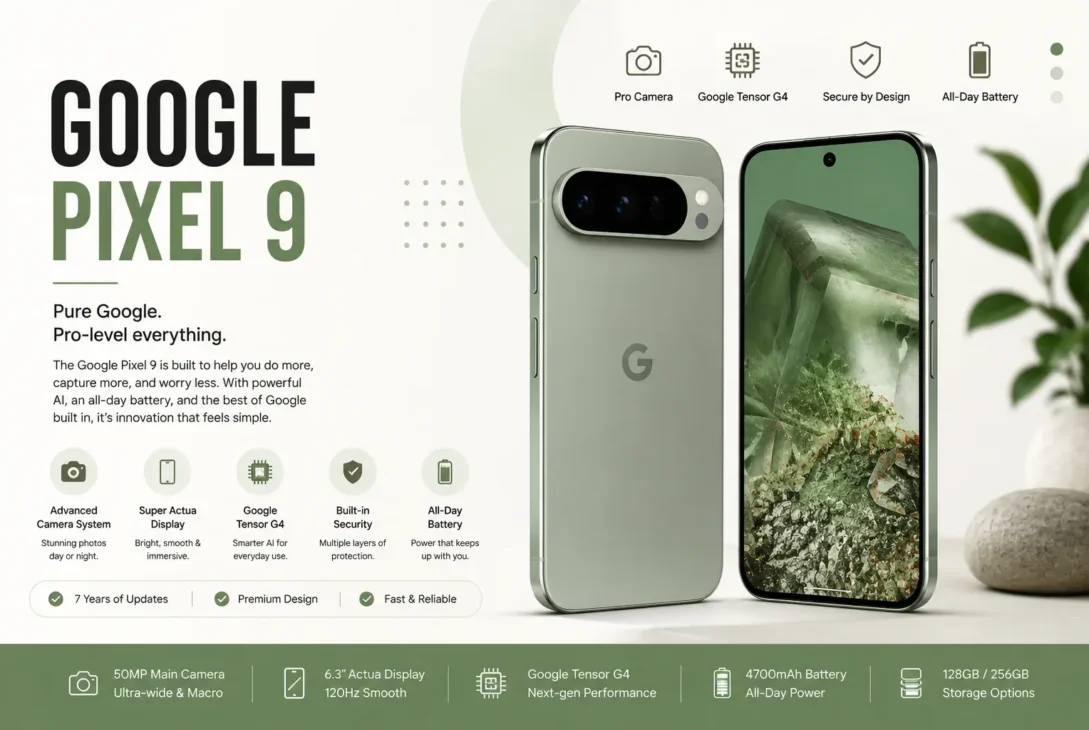
The Google Pixel 9 is designed as a mainstream flagship-style smartphone that combines Google’s Tensor G4 processor, a 6.3-inch Actua display, a dual rear-camera system, 12GB of RAM, and a 4,700mAh typical battery. Google lists 128GB and 256GB storage options for the phone.
For anyone researching the Google Pixel 9 specs, the important thing is to look beyond individual numbers. Display quality, camera hardware, processor performance, battery capacity, connectivity, dimensions, software features, and security all contribute to the overall experience.
In this guide, we’ll break down the major specifications and explain what each one means in everyday use.
Table of Contents
- Google Pixel 9 Overview
- Design and Build
- Display Specifications
- Processor and Performance
- RAM and Storage
- Camera Specifications
- Front Camera
- Battery and Charging
- Software and AI Features
- Connectivity
- Security Features
- Dimensions and Weight
- Colors
- Who Should Buy the Pixel 9?
- Frequently Asked Questions
- Final Verdict
Google Pixel 9 Overview
The Pixel 9 sits in Google’s standard flagship Pixel lineup and focuses heavily on photography, artificial intelligence, display quality, and Google’s software experience.
According to Google’s official specifications, the phone features a 6.3-inch OLED Actua display with a 1080 × 2424 resolution and 60–120Hz Smooth Display. It also uses the Google Tensor G4 processor and includes 12GB of RAM.
The main hardware highlights include:
- 6.3-inch Actua OLED display
- 1080 × 2424 resolution
- 60–120Hz refresh rate
- Google Tensor G4
- 12GB RAM
- 128GB or 256GB storage
- 50MP wide camera
- 48MP ultrawide camera
- 4,700mAh typical battery
- Qi-certified wireless charging
- USB-C connectivity
- Titan M2 security chip
These specifications make the Pixel 9 a balanced device rather than a phone focused exclusively on one feature.
Design and Build
Google gave the Pixel 9 a redesigned appearance with a polished glass back and satin metal frame. The phone is available in four colors: Peony, Wintergreen, Porcelain, and Obsidian.
The front uses Corning Gorilla Glass Victus 2.
The design is relatively compact compared with many large flagship smartphones, making the 6.3-inch display easier to handle than phones built around much larger panels.
Google’s design approach also gives the phone a recognizable Pixel identity, particularly through its distinctive camera bar.
Display Specifications
The display is one of the most important parts of the Google Pixel 9 specs.
It uses a 6.3-inch Actua OLED panel with a 20:9 aspect ratio.
The resolution is 1080 × 2424 pixels, producing a pixel density of 422 pixels per inch. Google also lists a Smooth Display refresh rate ranging from 60Hz to 120Hz.
Brightness
Google rates the display at up to 1,800 nits for HDR and up to 2,700 nits of peak brightness.
High peak brightness can make outdoor viewing easier, particularly under strong sunlight.
The display also supports HDR and 24-bit color depth.
Refresh Rate
The 60–120Hz refresh range allows the phone to provide smoother scrolling and animations compared with a conventional 60Hz display.
The higher refresh rate can be particularly noticeable when scrolling through websites, social media feeds, and application menus.
https://store.google.com/us/product
Processor and Performance
The Pixel 9 uses Google’s Tensor G4 processor.
Google designed the Tensor G4 with Google’s AI capabilities in mind, rather than positioning it simply as a conventional performance-focused chip.
The processor is paired with a Titan M2 security coprocessor.
For everyday tasks, the hardware is designed to handle applications, multitasking, photography, video, gaming, and Google’s AI features.
The 12GB RAM configuration also gives the phone plenty of memory for running multiple applications.
RAM and Storage
Google lists the Pixel 9 with 12GB of RAM.
Storage options include:
- 128GB
- 256GB
The 128GB version can be sufficient for users who mainly stream media and use cloud storage.
The 256GB model makes more sense for people who regularly record high-resolution videos, take large numbers of photos, download games, or keep extensive files stored locally.
One important consideration is that users should choose their storage capacity carefully because the phone does not provide a traditional microSD card expansion option.
Camera Specifications
Photography is one of the major strengths of the Pixel lineup, and the camera hardware is an important part of the Google Pixel 9 specs.
Google lists an advanced dual rear-camera system consisting of a 50MP wide camera and a 48MP ultrawide camera with Macro Focus.
50MP Wide Camera
The main camera uses a 50MP Octa PD wide sensor.
Google lists:
- 50MP resolution
- f/1.68 aperture
- 82-degree field of view
- 1/1.31-inch image sensor
- Super Res Zoom up to 8x
The wide camera is the primary option for everyday photography.
Its relatively large sensor and wide aperture are designed to capture more light and provide Google’s computational photography system with detailed image data.
48MP Ultrawide Camera
The second rear camera is a 48MP Quad PD ultrawide camera with autofocus.
It has:
- f/1.7 aperture
- 123-degree field of view
- 1/2.55-inch sensor size
- Macro Focus capability
The ultrawide camera is useful for landscapes, architecture, group photographs, and situations where you need to capture a larger scene.
Its autofocus capability also enables macro photography.
Front Camera
The Pixel 9 includes a front-facing camera designed for selfies and video calls.
Google’s software processing also plays an important role in the phone’s photography experience.
Rather than relying only on sensor specifications, Pixel devices use computational photography to process images and improve exposure, detail, colors, and other aspects of photographs.
This is one reason comparing smartphone cameras purely by megapixel count can be misleading.
Battery and Charging
Battery capacity is another major part of the Google Pixel 9 specs.
Google lists a typical battery capacity of 4,700mAh, with a minimum capacity of 4,558mAh.
Google rates the phone for more than 24 hours of battery life under its stated testing conditions.
With Extreme Battery Saver enabled, Google says the device can provide up to 100 hours of battery life.
Wired Charging
Google says the Pixel 9 can reach up to 55% charge in approximately 30 minutes when using Google’s 45W USB-C charger, which is sold separately.
Actual charging performance can vary depending on temperature, battery level, charger, cable, and other conditions.
Wireless Charging
The phone also supports fast wireless charging through Qi certification.
It includes Battery Share as well, allowing the device to wirelessly share power with compatible accessories and devices.
Software and AI Features
Google’s Pixel phones are heavily focused on software and artificial intelligence.
The Tensor G4 provides hardware designed to support Google’s AI features, while Pixel software adds photography tools, productivity features, and other intelligent functions.
Google also highlights Gemini and AI-powered photography features as part of the Pixel experience.
This means the phone’s capabilities aren’t defined only by its processor speed.
The combination of Google’s hardware and software ecosystem is a major part of the Pixel experience.
Connectivity
The Pixel 9 supports modern connectivity standards.
Google’s specifications list Wi-Fi 7, Bluetooth 5.3, NFC, Google Cast, and dual-band GNSS.
The device also uses USB Type-C 3.2.
Depending on the market and model, cellular support includes 5G connectivity.
The phone supports Dual SIM functionality through a combination of one physical Nano SIM and eSIM.
Security Features
Security is another area where Google puts considerable emphasis.
The Pixel 9 includes the Titan M2 security coprocessor alongside Google’s Tensor security architecture.
Google describes the device as using multiple layers of hardware security, including the Tensor security core, Titan M2, and Trusty Trusted Execution Environment.
The phone also includes protections against malware, phishing, and spam.
For users who store personal information, banking applications, photographs, messages, and other sensitive data on their smartphone, these security features can be particularly important.
Dimensions and Weight
The Pixel 9 measures approximately:
- 152.8mm tall
- 72mm wide
- 8.5mm thick
- 198g in weight
These dimensions place it in a relatively manageable size category.
The 198g weight also keeps it from feeling excessively heavy compared with some larger smartphones.
Colors
Google offers four official Pixel 9 color options:
- Peony
- Wintergreen
- Porcelain
- Obsidian
Color availability can vary depending on market and storage configuration.
Who Should Buy the Pixel 9?
The Pixel 9 makes the most sense for users who prioritize Google’s software, photography, AI features, display quality, and a relatively compact flagship-style design.
It can be a strong choice for people who:
- Take lots of photographs
- Want Google’s Android experience
- Use AI-powered smartphone features
- Prefer a 6.3-inch display
- Want 12GB of RAM
- Need wireless charging
- Want modern Wi-Fi connectivity
- Prefer a smaller flagship phone
However, buyers who prioritize maximum gaming performance, extremely fast charging, or a dedicated telephoto camera may want to compare other flagship smartphones before making a decision.
Frequently Asked Questions
What are the main Google Pixel 9 specs?
The main specifications include a 6.3-inch 1080 × 2424 OLED display, Tensor G4 processor, 12GB RAM, 128GB or 256GB storage, 50MP wide and 48MP ultrawide rear cameras, and a 4,700mAh typical battery.
How much RAM does the Pixel 9 have?
The Pixel 9 has 12GB of RAM.
What processor does the Pixel 9 use?
It uses Google’s Tensor G4 processor with a Titan M2 security coprocessor.
How big is the Pixel 9 display?
The phone has a 6.3-inch Actua OLED display with a 20:9 aspect ratio and a 60–120Hz refresh rate.
How large is the Pixel 9 battery?
Google lists a typical battery capacity of 4,700mAh and a minimum capacity of 4,558mAh.
Does the Pixel 9 support wireless charging?
Yes. Google lists fast wireless charging with Qi certification and Battery Share.
How many cameras does the Pixel 9 have?
The rear system has two cameras: a 50MP wide camera and a 48MP ultrawide camera with Macro Focus.
Does the Pixel 9 have expandable storage?
Google lists 128GB and 256GB internal storage configurations. There is no microSD expansion option listed in Google’s official specifications.
Final Verdict
The Google Pixel 9 specs show a well-balanced smartphone built around Google’s Tensor G4 platform, strong camera hardware, a bright 120Hz-capable OLED display, 12GB RAM, wireless charging, and a 4,700mAh battery.
Its biggest appeal isn’t one specification by itself.
Instead, Google combines hardware with its software, computational photography, AI capabilities, and security features to create a complete Pixel experience.
For users who want a compact flagship-style Android phone with strong cameras and Google’s software ecosystem, the Pixel 9 remains an interesting option.
The most important thing before buying is to compare its features with competing phones at the price available in your market.