
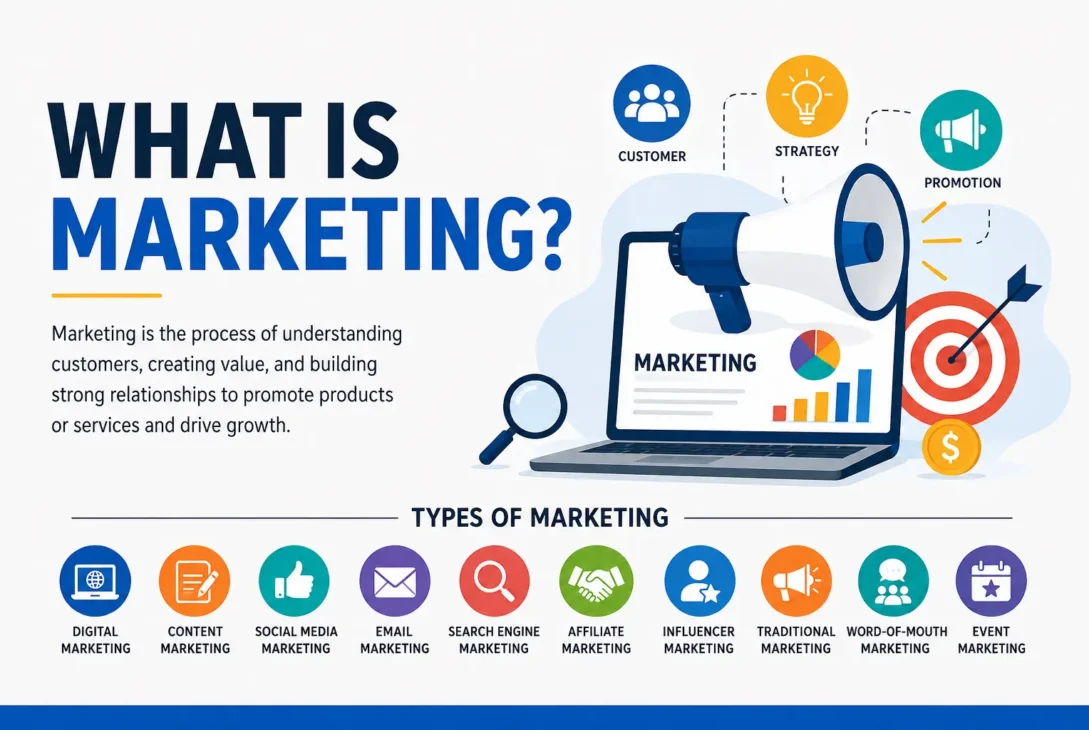
If you’re wondering what is marketing, the simplest answer is that marketing is the process of understanding customers, communicating the value of a product or service, and encouraging people to choose it.
Marketing is much more than advertising.
It includes researching what people want, developing the right offer, choosing the right price, creating useful content, building awareness, communicating with customers, and measuring results.
Almost every successful business uses some form of marketing.
Whether it’s a small local shop, an online store, a software company, or a global brand, marketing helps businesses connect what they sell with people who may need or want it.
What Is Marketing?
So, what is marketing in practical terms?
Marketing is a collection of activities businesses use to attract, engage, convert, and retain customers.
It starts before a product is even launched.
A business may first research its target audience to understand:
- What customers need
- What problems they have
- What they are willing to pay
- Which competitors they consider
- Where they search for information
- What influences their buying decisions
The business can then use that information to create a product, service, or offer that better matches customer needs.
Marketing continues after a customer makes a purchase.
Businesses may use email, social media, customer support, loyalty programs, and other communication methods to keep customers engaged.
Why Is Marketing Important?
Understanding what is marketing also means understanding why businesses invest in it.
A great product doesn’t automatically become successful.
People need to know that the product exists, understand what it does, and see why it could be useful to them.
Marketing helps create that connection.
Marketing Builds Awareness
A new business needs people to discover it.
Marketing can introduce a company, product, or service to potential customers.
The more relevant people become aware of a brand, the greater the opportunity to attract customers.
Marketing Helps Generate Sales
Marketing can guide potential customers through the buying process.
A campaign might first introduce a product, then explain its benefits, answer common questions, and eventually encourage the customer to purchase.
Marketing Builds Brand Recognition
Consistent marketing can help people remember a company.
Over time, customers may begin to associate certain colors, messages, designs, products, or experiences with a particular brand.
Marketing Helps Understand Customers
Marketing isn’t only about communicating with customers.
It also provides businesses with valuable information about what people want and how they respond to different offers.
https://www.ama.org/what-is-marketing/
How Does Marketing Work?
Marketing usually involves several connected stages.
1. Research
Businesses research their market and target audience.
They look at customer needs, competitors, industry trends, and potential opportunities.
2. Planning
The business decides what it wants to achieve and how it plans to reach its audience.
3. Positioning
The company determines how it wants customers to perceive its product or brand compared with competitors.
4. Promotion
The business communicates its message through appropriate marketing channels.
5. Conversion
The goal is to turn interested people into customers.
6. Retention
After a purchase, businesses can continue communicating with customers to encourage repeat purchases and loyalty.
This process shows why marketing is much broader than simply creating advertisements.
10 Types of Marketing
Now that we understand what is marketing, it’s important to know that businesses can use many different marketing methods.
The right approach depends on the target audience, budget, product, industry, and business goals.
1. Digital Marketing
Digital marketing uses online channels to reach potential customers.
It can include websites, search engines, social media, email, online advertising, and other digital platforms.
For many modern businesses, digital marketing is one of the most important ways to reach customers.
2. Content Marketing
Content marketing focuses on creating useful or interesting content for a specific audience.
Examples include:
- Blog articles
- Videos
- Guides
- Tutorials
- Infographics
- Podcasts
- Social media posts
Instead of directly asking someone to buy something, useful content can help build trust and attract people who are already interested in a particular topic.
3. Social Media Marketing
Social media marketing uses platforms such as Instagram, Facebook, TikTok, LinkedIn, and other social networks to communicate with an audience.
Businesses can use social media to:
- Build brand awareness
- Share content
- Promote products
- Answer questions
- Communicate with customers
- Generate leads
- Drive website traffic
4. Email Marketing
Email marketing involves sending targeted messages to people through email.
Businesses can use email for newsletters, promotions, product announcements, educational content, and customer follow-ups.
A well-managed email list can become a valuable long-term marketing channel.
5. Search Engine Marketing
Search engine marketing focuses on reaching people through search engines.
It can include paid search advertising as well as strategies designed to improve a website’s visibility in search results.
The goal is to reach people when they are actively searching for information, products, or services.
6. Influencer Marketing
Influencer marketing involves working with people who have an established audience.
An influencer may promote a product through videos, posts, reviews, demonstrations, or other content.
The effectiveness of influencer marketing depends heavily on whether the influencer’s audience matches the business’s target customers.
7. Affiliate Marketing
Affiliate marketing allows individuals or businesses to promote products and earn a commission when their referrals generate qualifying sales or actions.
It can help companies reach audiences they may not have been able to reach on their own.
8. Traditional Marketing
Traditional marketing uses offline channels.
Examples include:
- Television
- Radio
- Newspapers
- Magazines
- Billboards
- Brochures
- Direct mail
Although digital marketing has grown significantly, traditional marketing can still be useful for certain audiences and industries.
9. Word-of-Mouth Marketing
Word-of-mouth marketing happens when customers recommend a product or business to other people.
A positive customer experience can encourage people to share their opinions with friends, family, coworkers, or online communities.
This type of marketing can be particularly powerful because recommendations often feel more personal than advertisements.
10. Event Marketing
Event marketing uses events to connect businesses with potential or existing customers.
Examples include:
- Trade shows
- Product launches
- Conferences
- Workshops
- Local events
- Demonstrations
Events can give businesses an opportunity to interact with customers directly and create memorable experiences.
Digital Marketing vs Traditional Marketing
One common question when learning what is marketing is whether digital marketing has replaced traditional marketing.
The answer is no.
Digital marketing offers advantages such as detailed analytics, precise targeting, and the ability to reach audiences online.
Traditional marketing can still be effective when businesses want to reach local audiences or use channels such as television, radio, print, and outdoor advertising.
Many companies combine both approaches instead of relying on only one.
The 4 Ps of Marketing
The 4 Ps of marketing are another important concept.
They are:
Product
What is the business selling?
The product should solve a problem or satisfy a need for the target customer.
Price
How much does the customer pay?
Pricing can influence how customers perceive the product and whether they consider it affordable or valuable.
Place
Where is the product available?
This can include physical stores, websites, marketplaces, or other distribution channels.
Promotion
How does the business communicate with customers?
Promotion includes advertising, content, social media, email, public relations, and other communication methods.
Together, these four elements help businesses develop a complete marketing approach.
Benefits of Marketing for Businesses
Now that we understand what is marketing and the different types businesses can use, the next step is understanding what marketing actually does for a business.
A strong marketing strategy can help a company attract new customers, increase sales, build trust, and compete more effectively.
1. Increases Brand Awareness
Marketing helps people discover a business.
A company can use social media, search engines, advertising, content, or other channels to introduce its brand to potential customers.
The more often people see a relevant brand, the more familiar it can become.
2. Attracts New Customers
Marketing helps businesses reach people who may be interested in their products or services.
For example, a company can create content around questions that potential customers are already searching for.
This can bring new visitors to the business website and create opportunities for future sales.
3. Increases Sales
One of the main goals of marketing is to generate more business.
A good campaign can explain the benefits of a product, address customer concerns, and give people a reason to take action.
However, effective marketing isn’t simply about selling aggressively.
The message needs to match what the audience actually wants.
4. Builds Customer Relationships
Marketing isn’t only about finding new customers.
Businesses also need to maintain relationships with existing customers.
Email newsletters, social media, loyalty programs, helpful content, and personalized communication can keep customers connected with a brand.
5. Builds Trust
People are more likely to purchase from businesses they trust.
Useful content, customer reviews, professional branding, transparent communication, and consistent experiences can help establish that trust.
6. Helps Businesses Understand Their Audience
Marketing provides valuable information about customers.
Businesses can analyze which products people view, which content receives attention, which advertisements generate clicks, and which offers produce sales.
This information can help businesses make better decisions.
What Is a Marketing Strategy?
A marketing strategy is a plan that explains how a business intends to reach its target customers and achieve its marketing goals.
A basic strategy usually includes several important elements.
Define the Target Audience
The business needs to understand who it wants to reach.
This may include information such as:
- Age
- Location
- Interests
- Profession
- Buying behavior
- Problems
- Needs
- Budget
The more clearly a business understands its audience, the easier it becomes to create relevant marketing.
Set Marketing Goals
A business should know what it wants to achieve.
Common goals include:
- Increasing website traffic
- Generating leads
- Increasing sales
- Growing social media followers
- Improving brand awareness
- Increasing repeat purchases
Goals should be measurable whenever possible.
Choose Marketing Channels
Not every business needs to use every platform.
A company should focus on channels where its target audience is most likely to spend time.
For example, a professional software company might focus heavily on search engines and LinkedIn, while a fashion brand may benefit more from visual social platforms.
Create the Marketing Message
The marketing message should clearly communicate why the product or service matters.
Instead of simply listing features, businesses should explain the benefits and problems the product can solve.
Measure Results
Marketing should be measured regularly.
Businesses can track metrics such as:
- Website visitors
- Leads
- Conversion rate
- Sales
- Customer acquisition cost
- Return on advertising spend
- Email engagement
- Social media engagement
These measurements help determine which strategies are working and which need improvement.
What Is a Target Market?
A target market is the specific group of people a business wants to reach.
For example, a company selling professional laptops may target students, designers, developers, or business professionals rather than trying to market to everyone.
Defining a target market allows businesses to create more relevant products, messages, and campaigns.
Trying to appeal to everyone can make marketing messages too general.
A clearly defined audience usually makes it easier to communicate a strong value proposition.
What Is Digital Marketing?
When people ask what is marketing today, digital marketing is usually one of the first areas that comes to mind.
Digital marketing refers to marketing activities performed through online channels and digital devices.
Businesses can use websites, search engines, social media, email, online advertising, and other digital platforms to reach potential customers.
Search Engine Optimization
Search engine optimization, or SEO, focuses on improving a website’s visibility in search engine results.
For example, a business may create useful articles around topics its potential customers are searching for.
A strong SEO strategy can help attract organic traffic without paying for every individual visitor.
Social Media
Social media gives businesses a direct way to communicate with their audience.
Companies can publish educational content, product updates, videos, offers, and other posts to build relationships with potential customers.
Online Advertising
Businesses can pay to display advertisements on search engines, websites, social platforms, and other digital channels.
Paid advertising can help companies reach specific audiences and generate traffic or sales quickly.
Email Marketing
Email remains useful for maintaining relationships with customers.
Businesses can send newsletters, promotions, product updates, educational information, and personalized offers.
What Is Content Marketing?
Content marketing is the process of creating and distributing useful content for a specific audience.
The goal isn’t always to make an immediate sale.
Instead, content can attract people, answer their questions, demonstrate expertise, and build trust.
Examples of Content Marketing
A business might create:
- Blog posts
- YouTube videos
- Tutorials
- Case studies
- Ebooks
- Guides
- Podcasts
- Infographics
- Social media content
For example, a company selling cameras could publish a guide explaining how to choose a camera for beginners.
Someone searching for that information may discover the company through the guide and later become a customer.
What Is Social Media Marketing?
Social media marketing uses social networking platforms to promote a business, communicate with customers, and build brand awareness.
Businesses can use organic posts, short videos, live streams, community engagement, and paid advertisements.
The most effective platform depends on the target audience.
A business should not automatically create an account on every social platform.
Instead, it should focus on platforms where its potential customers are actually active.
What Is Marketing vs Advertising?
Marketing and advertising are related, but they aren’t the same thing.
Marketing is the broader process.
It can include market research, product development, pricing, distribution, branding, customer relationships, content, SEO, social media, and advertising.
Advertising is one part of marketing.
Advertising involves paying to promote a product, service, or brand through a specific channel.
For example, a company might spend money on an online advertisement.
That advertisement is advertising, while the broader plan surrounding the product, audience, pricing, positioning, and promotion is marketing.
What Is Marketing Research?
Marketing research involves collecting and analyzing information about customers, competitors, products, and markets.
Businesses use research to make better decisions.
Research can include:
- Customer surveys
- Interviews
- Competitor analysis
- Online research
- Customer feedback
- Sales data
- Website analytics
- Market reports
Good research can reduce the risk of launching a product that customers don’t actually want.
It can also help businesses identify new opportunities.
Common Marketing Mistakes to Avoid
Understanding what is marketing isn’t enough to build a successful campaign. Businesses also need to avoid mistakes that can waste time, money, and opportunities.
1. Trying to Reach Everyone
One of the most common mistakes is targeting everyone.
A marketing message becomes less effective when it tries to appeal to completely different audiences at the same time.
A clearly defined target audience makes it easier to create relevant content and offers.
2. Focusing Only on Selling
Marketing shouldn’t always be a direct sales pitch.
Customers also want useful information, solutions, entertainment, and answers to their questions.
Providing value can help build trust before asking someone to make a purchase.
3. Ignoring Customer Feedback
Customer feedback can reveal problems that businesses may not notice themselves.
Ignoring complaints, reviews, and suggestions can make it harder to improve products and customer experiences.
4. Using Every Marketing Channel
More platforms don’t automatically mean better marketing.
A small business doesn’t need to maintain every social media account, run every type of advertisement, and publish content everywhere.
It’s usually better to focus on a few channels that actually reach the target audience.
5. Not Measuring Results
Without tracking results, a business may continue spending money on strategies that aren’t working.
Important metrics can show whether a campaign is generating traffic, leads, customers, or revenue.
6. Copying Competitors
Competitor research is useful, but copying another company’s marketing strategy completely can make a brand look unoriginal.
Businesses should study competitors and then develop their own positioning and message.
How to Create a Simple Marketing Plan
A basic marketing plan doesn’t have to be complicated.
Start by answering five questions.
Who Are You Targeting?
Define your ideal customer and understand their needs, interests, problems, and buying behavior.
What Are You Offering?
Clearly explain the product or service and the problem it solves.
Why Should Customers Choose You?
Identify what makes your business different from competitors.
This could be price, quality, customer service, convenience, expertise, features, or another advantage.
Where Will You Reach Customers?
Choose the channels that match your target audience.
These could include search engines, social media, email, websites, advertising, events, or offline channels.
How Will You Measure Success?
Choose specific metrics before launching your campaign.
For example, you might measure website traffic, leads, sales, conversion rates, or customer acquisition costs.
The Future of Marketing
Marketing continues to change as technology and customer behavior evolve.
Businesses now have access to more data, automation tools, artificial intelligence, social platforms, and digital channels than ever before.
Artificial intelligence can help marketers analyze data, generate ideas, personalize experiences, automate repetitive tasks, and improve campaign efficiency.
However, technology doesn’t replace the need to understand customers.
Successful marketing still depends on creating something valuable and communicating it clearly to the right people.
Frequently Asked Questions
What is marketing in simple words?
Marketing is the process of understanding customers, promoting products or services, communicating their value, and building relationships that can lead to sales and long-term loyalty.
What are the main types of marketing?
Common types include digital marketing, content marketing, social media marketing, email marketing, search engine marketing, influencer marketing, affiliate marketing, traditional marketing, word-of-mouth marketing, and event marketing.
What is the main purpose of marketing?
The main purpose is to connect a business with potential customers, communicate value, generate demand, increase sales, and build long-term customer relationships.
Is advertising the same as marketing?
No. Advertising is one part of marketing. Marketing covers a much broader range of activities, including research, branding, pricing, product positioning, promotion, and customer relationships.
Why is marketing important for small businesses?
Marketing helps small businesses become visible, attract customers, compete with larger companies, build their reputation, and generate sales.
What is digital marketing?
Digital marketing uses online channels such as websites, search engines, social media, email, and online advertising to reach customers.
Final Verdict
So, what is marketing?
Marketing is much more than advertising a product.
It is the complete process of understanding an audience, creating value, communicating with potential customers, generating demand, making sales, and building relationships.
Businesses can use many different approaches, from SEO and content marketing to social media, email, advertising, events, and word-of-mouth recommendations.
The most effective strategy depends on the business, its goals, its budget, and its target audience.
A successful marketing strategy doesn’t simply try to reach as many people as possible. It reaches the right people with the right message at the right time.