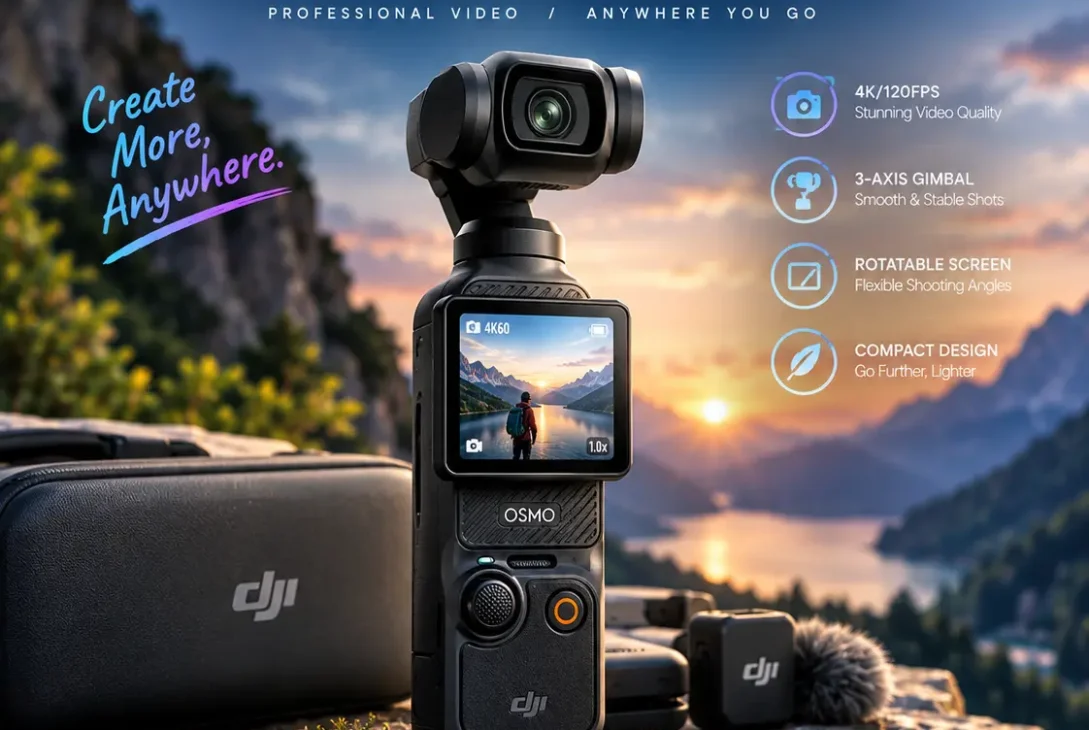
The dji pocket 3 is one of the most interesting compact cameras for vloggers, travelers, content creators, and anyone who wants stabilized video without carrying a traditional camera and gimbal separately. Its combination of a large 1-inch sensor, three-axis mechanical stabilization, rotating touchscreen, and 4K video makes it considerably more capable than its tiny size suggests.
The dji pocket 3 was designed around a simple idea: put a stabilized camera with serious video capabilities into a device small enough to carry almost anywhere. Instead of attaching a smartphone to a separate gimbal, users can simply turn on the camera and start recording.
DJI equipped the dji pocket 3 with a 1-inch CMOS sensor, a 20mm-equivalent f/2.0 lens, and a three-axis mechanical gimbal. The camera can record regular 4K video at up to 60fps and supports 4K/120fps slow-motion recording.
The dji pocket 3 also has a 2-inch rotatable touchscreen that can switch between horizontal and vertical shooting. This makes it especially useful for modern social-media content, where creators frequently switch between widescreen videos and vertical formats.
So, is the dji pocket 3 still worth buying in 2026? For many vloggers and travel creators, the answer is yes. However, it is not perfect, and there are some important limitations you should understand before buying one.
Table of Contents
- DJI Pocket 3: Latest Overview
- DJI Pocket 3 Specifications
- Design and Build Quality
- 1-Inch Camera Sensor
- Video Quality
- 4K/120fps Slow Motion
- Three-Axis Gimbal Stabilization
- Rotating Touchscreen
- Autofocus and ActiveTrack
- Audio and Microphone Support
- Battery Life and Charging
- Storage
- Low-Light Performance
- DJI Pocket 3 for Vlogging
- DJI Pocket 3 for Travel
- DJI Pocket 3 vs Smartphone
- DJI Pocket 3 vs Action Cameras
- DJI Pocket 3 Price
- Pros and Cons
- Is DJI Pocket 3 Worth Buying?
- Frequently Asked Questions
- Final Verdict
- SEO Details
DJI Pocket 3: Latest Overview
The dji pocket 3 remains one of DJI’s strongest compact video products.
Unlike a traditional action camera, it uses a three-axis mechanical gimbal. Unlike a conventional mirrorless camera, it does not require a separate stabilizer for smooth walking footage.
That combination gives the dji pocket 3 a very specific advantage.
It is designed primarily for creators who want stabilized footage without carrying a large setup.
The camera weighs approximately 179 grams and measures 139.7 × 42.2 × 33.5 mm. DJI also provides a 2-inch touchscreen with 700-nit brightness and support for microSD cards up to 1TB.
The dji pocket 3 therefore sits between several categories.
It can function as:
- A travel camera
- A vlogging camera
- A handheld gimbal camera
- A compact cinematic camera
- A social-media camera
- A lightweight B-roll camera
That versatility is one of its biggest strengths.
DJI Pocket 3 Specifications
Here are the major specifications of the dji pocket 3:
| Specification | DJI Pocket 3 |
|---|---|
| Sensor | 1-inch CMOS |
| Lens | 20mm equivalent |
| Aperture | f/2.0 |
| Stabilization | Three-axis mechanical gimbal |
| Main Video | 4K up to 60fps |
| Slow Motion | 4K/120fps |
| Screen | 2-inch rotating touchscreen |
| Weight | 179g |
| Battery | 1300mAh |
| Storage | microSD up to 1TB |
| Video Formats | H.264 / HEVC |
| Maximum Bitrate | 130 Mbps |
| Color Modes | 10-bit D-Log M and HLG |
| Wireless | Wi-Fi and Bluetooth |
These are official DJI specifications rather than rumored specifications.
Design and Build Quality
The design of the dji pocket 3 is one of the first things you’ll notice.
It is considerably smaller than a conventional camera-and-gimbal combination.
The vertical body gives you a natural grip, while the camera module sits above the handle on its mechanical gimbal.
The compact design is particularly useful for travel.
You can place the dji pocket 3 in a small bag or jacket pocket and have a stabilized camera available without preparing a larger setup.
The camera weighs only 179 grams, which also makes it comfortable to hold during longer recording sessions.
However, the compact design comes with a trade-off.
The dji pocket 3 is not designed to be as rugged as an action camera. DJI’s official specifications do not list an IP waterproof rating, so users should be careful around rain, water, sand, and other environments where a sealed action camera would be more appropriate.
For normal city travel, indoor recording, walking tours, and controlled outdoor shooting, the design is excellent.
1-Inch Camera Sensor
The 1-inch sensor is arguably the biggest hardware upgrade that makes the dji pocket 3 so appealing.
Larger sensors can capture more light and generally provide greater flexibility than the smaller sensors commonly found in tiny cameras.
DJI upgraded from the smaller sensor used in the previous Pocket generation to a 1-inch CMOS sensor. DJI specifically highlights improved image quality, low-light performance, and high-dynamic-range capability.
For creators, this means the dji pocket 3 can produce footage that looks considerably more substantial than what you might expect from such a small camera.
The 20mm-equivalent f/2.0 lens provides a wide perspective that works well for:
- Selfie videos
- Walk-and-talk content
- Travel footage
- Street scenes
- Indoor recording
- Product demonstrations
The fixed lens is also simple.
You do not have to worry about changing lenses or balancing a separate camera on a gimbal.
Video Quality
Video is where the dji pocket 3 really stands out.
The camera supports 4K recording at 24, 25, 30, 48, 50, and 60fps. It also supports 4K/120fps slow motion.
The maximum bitrate is 130 Mbps, and the camera supports H.264 and HEVC recording.
For creators who want more flexibility during editing, the dji pocket 3 supports 10-bit D-Log M and 10-bit HLG recording.
These modes provide greater flexibility for color grading compared with ordinary 8-bit footage. DJI says D-Log M can capture a much wider range of colors and preserve detail for post-production.
This makes the dji pocket 3 suitable for creators who want to move beyond basic automatic video.
4K/120fps Slow Motion
One of the headline features of the dji pocket 3 is 4K/120fps recording.
This mode is designed for slow-motion footage.
You can use it to capture:
- Sports
- Water movement
- Cars
- Walking shots
- Dancing
- Travel scenes
- Action sequences
However, there is an important detail.
DJI specifies that 4K/120fps recording is available in Slow Motion mode rather than as a normal 120fps recording mode. DJI also notes that continuous recording time in this mode can be limited by operating conditions.
Even with that limitation, 4K/120fps gives the dji pocket 3 a major creative advantage for cinematic slow-motion footage.
Three-Axis Gimbal Stabilization
The mechanical gimbal is another major reason to consider the dji pocket 3.
Instead of relying exclusively on electronic stabilization, the camera physically moves to compensate for unwanted motion.
This can create smooth footage while walking.
The gimbal controls pan, tilt, and roll, giving the dji pocket 3 a level of stabilization that is difficult to reproduce with a tiny fixed-lens camera without additional hardware.
For vloggers, this can be extremely useful.
You can walk through a city, hold the camera in one hand, and record yourself without carrying a full-size gimbal.
The gimbal can also help create smoother cinematic movements.
Rotating Touchscreen
The 2-inch rotating touchscreen is another feature that makes the dji pocket 3 different from many compact cameras.
Rotate the screen horizontally and you can record conventional widescreen footage.
Rotate it vertically and you can create content for:
- TikTok
- Instagram Reels
- YouTube Shorts
- Other vertical platforms
DJI designed the interface so that rotating the screen can also power the camera on or off.
This makes the dji pocket 3 especially convenient for social-media creators.
Instead of mounting the camera vertically or changing settings manually, you can simply rotate the display.
Autofocus and ActiveTrack
Autofocus is particularly important for vloggers.
If you are walking toward the camera, moving through a busy environment, or changing distance from the lens, the camera needs to maintain focus.
The dji pocket 3 uses full-pixel fast focusing.
It also includes ActiveTrack 6.0, which can keep a selected subject centered in the frame. DJI says ActiveTrack 6.0 includes features such as Face Auto-Detect and Dynamic Framing.
This makes the dji pocket 3 useful for solo creators.
You can place the camera on a tripod or handle, walk around, and allow the tracking system to help maintain framing.
Audio and Microphone Support
Good video is only half of a successful vlog.
Audio quality is equally important.
The dji pocket 3 includes three built-in microphones and supports wireless microphone accessories including DJI Mic 2 and DJI Mic Mini.
This allows creators to improve audio quality without carrying a separate recorder.
For casual videos, the built-in microphones can be convenient.
For professional content, pairing the pocket 3 with a dedicated wireless microphone can provide better voice quality, particularly in noisy environments.
The camera also supports stereo recording.
Battery Life and Charging
The pocket 3 uses a 1300mAh battery.
DJI rates the camera for up to 166 minutes of operating time under specific laboratory conditions: 1080p/24fps, Wi-Fi disabled, and the screen turned off.
Real-world battery life will vary.
Recording at 4K, using the screen continuously, enabling wireless features, and recording in demanding conditions can reduce runtime.
Charging is relatively quick.
DJI says the camera can reach 80% in approximately 16 minutes and 100% in approximately 32 minutes when tested with its 65W PD charger.
For travel, carrying a power bank or additional battery accessory can still be useful.
Storage
The pocket 3 does not have traditional built-in storage for your recordings.
Instead, it uses microSD cards.
DJI lists support for microSD cards up to 1TB.
Because 4K footage can consume a large amount of storage, choosing a fast and reliable card is important.
A high-speed V30-class card is generally a sensible choice for high-bitrate video.
If you’re recording long trips, events, or multiple days of footage, carrying an extra card is also a good idea.
Low-Light Performance
Low-light performance is another area where the dji pocket 3 benefits from its 1-inch sensor.
A larger sensor can provide better light-gathering capability than the smaller sensor used by the previous generation.
DJI specifically highlights improved low-light performance and night video capabilities.
The pocket 3 is therefore particularly useful for:
- Night markets
- Restaurants
- City streets
- Indoor events
- Evening travel
- Nighttime vlogs
However, it is still a compact camera.
It cannot completely replace a professional interchangeable-lens camera with a fast large-aperture lens in extremely dark environments.
DJI Pocket 3 for Vlogging
The pocket 3 is arguably best suited to vlogging.
Its small size means you can start recording quickly.
The gimbal provides smooth movement, the tracking system helps keep you centered, and the rotating screen makes framing yourself easier.
A typical vlog setup could include:
Pocket 3 + mini tripod + wireless microphone
That combination can be enough for an entire YouTube channel.
The pocket 3 is especially useful for creators who frequently record while walking.
It removes much of the friction associated with traditional cameras.
DJI Pocket 3 for Travel
Travel is another excellent use case.
When traveling, carrying a large camera, lenses, batteries, and a gimbal can become inconvenient.
The dji 3 reduces that equipment burden considerably.
You can use it for:
- Walking tours
- Hotel reviews
- Food videos
- City footage
- Family memories
- Cinematic B-roll
- Short-form content
The main limitation is durability around water.
Because the dji pocket 3 is not marketed as a waterproof action camera, users should be more careful around beaches, swimming pools, heavy rain, and water sports.
DJI Pocket 3 vs Smartphone
Modern smartphones have excellent cameras.
So why would anyone buy a dji pocket 3?
The answer is stabilization and shooting experience.
A smartphone can produce excellent footage, but the Pocket 3 combines:
- Mechanical stabilization
- A dedicated camera body
- A rotating screen
- Subject tracking
- A larger sensor
- Dedicated physical controls
The dji 3 is also easier to hold naturally while walking.
A smartphone remains more versatile for photography, multiple focal lengths, and everyday communication, but the Pocket 3 is purpose-built for video creation.
DJI Pocket 3 vs Action Cameras
Action cameras are better suited to extreme environments.
They are designed for:
- Water
- Cycling
- Skiing
- Hiking
- Motorsports
- Mounting
- Adventure sports
The dji 3 is better suited to:
- Vlogging
- Travel
- Cinematic walking shots
- Interviews
- Street footage
- Indoor recording
- Social media
This is an important distinction.
If you need waterproofing and ruggedness, an action camera may be the better choice.
If you want cinematic stabilized footage from a tiny device, the dji 3 is more attractive.
Price
DJI’s US store currently lists the dji pocket 3 from $439. Pricing can vary by region, retailer, taxes, and accessory bundle.
The price is higher than many basic action cameras.
However, you’re not simply paying for a small camera.
The package combines a 1-inch sensor, mechanical gimbal, rotating display, autofocus, tracking, advanced video modes, and compact design.
The Creator Combo can cost more because it includes additional accessories designed for content creators.
Before buying, compare the standard package with the Creator Combo based on whether you actually need the additional microphone and accessories.
Pros and Cons
Pros
- Large 1-inch sensor
- Excellent stabilization
- 4K video up to 60fps
- 4K/120fps slow motion
- 10-bit D-Log M
- Rotating touchscreen
- ActiveTrack 6.0
- Compact 179g design
- Strong autofocus
- Wireless microphone support
Cons
- No waterproof rating
- Fixed wide-angle lens
- Digital rather than optical zoom
- Smaller physical controls than a traditional camera
- Battery life varies significantly with shooting settings
- More expensive than basic action cameras
Is DJI Pocket 3 Worth Buying?
The dji pocket 3 remains an excellent option for creators who prioritize portability and stabilized video.
It is particularly compelling for YouTubers, vloggers, travelers, and social-media creators.
If your main goal is cinematic walking footage, the mechanical gimbal is a major advantage.
If you mostly record extreme sports or underwater footage, an action camera would make more sense.
If you primarily take still photographs, a smartphone or mirrorless camera may be more appropriate.
The dji pocket 3 works best when you understand what it was designed to do.
It is a compact video-production tool rather than a universal replacement for every type of camera.
https://www.dji.com/support/product/osmo-pocket-3
Frequently Asked Questions
What is the DJI Pocket 3?
The dji pocket 3 is a compact handheld gimbal camera with a 1-inch CMOS sensor, three-axis mechanical stabilization, a rotating 2-inch touchscreen, and advanced 4K video capabilities.
Is DJI Pocket 3 good for YouTube?
Yes. The dji pocket 3 is particularly well suited to YouTube vlogging because of its stabilization, tracking, microphone support, compact design, and rotating screen.
Does DJI Pocket 3 shoot 4K?
Yes. The camera supports 4K recording up to 60fps and 4K/120fps in Slow Motion mode.
Does DJI Pocket 3 have a 1-inch sensor?
Yes. The dji pocket 3 uses a 1-inch CMOS sensor, which is a major upgrade over the previous Pocket generation.
Is DJI Pocket 3 waterproof?
No official waterproof rating is listed for the dji pocket 3, so it should not be treated like a waterproof action camera.
How long does DJI Pocket 3 battery last?
DJI rates the battery for up to 166 minutes under specific 1080p/24fps laboratory conditions with Wi-Fi and the screen off. Real-world runtime varies.
Can DJI Pocket 3 record vertical video?
Yes. The rotating touchscreen allows the camera to switch between horizontal and vertical shooting modes.
Does DJI Pocket 3 have ActiveTrack?
Yes. The camera includes ActiveTrack 6.0 with features designed to keep subjects centered while recording.
Does DJI Pocket 3 support DJI microphones?
Yes. The camera supports DJI Mic 2 and DJI Mic Mini accessories.
How much does DJI Pocket 3 cost?
DJI currently lists the standard dji pocket 3 from $439 in the United States. Regional pricing and bundles can differ.
Is DJI Pocket 3 better than a smartphone?
For stabilized video and dedicated vlogging, the dji pocket 3 can be more convenient. Smartphones remain more versatile for photography, multiple lenses, and everyday use.
Is DJI Pocket 3 worth buying in 2026?
Yes, if your priority is compact stabilized video. Its 1-inch sensor, gimbal stabilization, 4K recording, tracking, and rotating display remain highly competitive.
Final Verdict
The dji pocket 3 remains one of the strongest compact cameras for creators who want professional-looking stabilized video without carrying a large camera rig.
Its 1-inch sensor provides a strong foundation for image quality, while the three-axis mechanical gimbal delivers smooth footage during movement.
The rotating 2-inch display is another major advantage, particularly for vloggers and social-media creators who regularly switch between horizontal and vertical video.
The dji pocket 3 also offers serious video features, including 4K/60fps recording, 4K/120fps slow motion, 10-bit D-Log M, HLG, ActiveTrack 6.0, and wireless microphone compatibility.
There are limitations.
The fixed lens gives you less flexibility than an interchangeable-lens camera, the camera is not designed as a rugged waterproof action camera, and the small battery means heavy users may want additional power.
But those compromises are understandable considering the size.
For travel, YouTube, TikTok, Instagram, walking tours, interviews, and everyday cinematic footage, the dji pocket 3 offers an unusually strong combination of portability, stabilization, image quality, and ease of use.
If you want a camera that you can carry almost everywhere and start recording within seconds, the dji pocket 3 is still one of the easiest recommendations in its category.