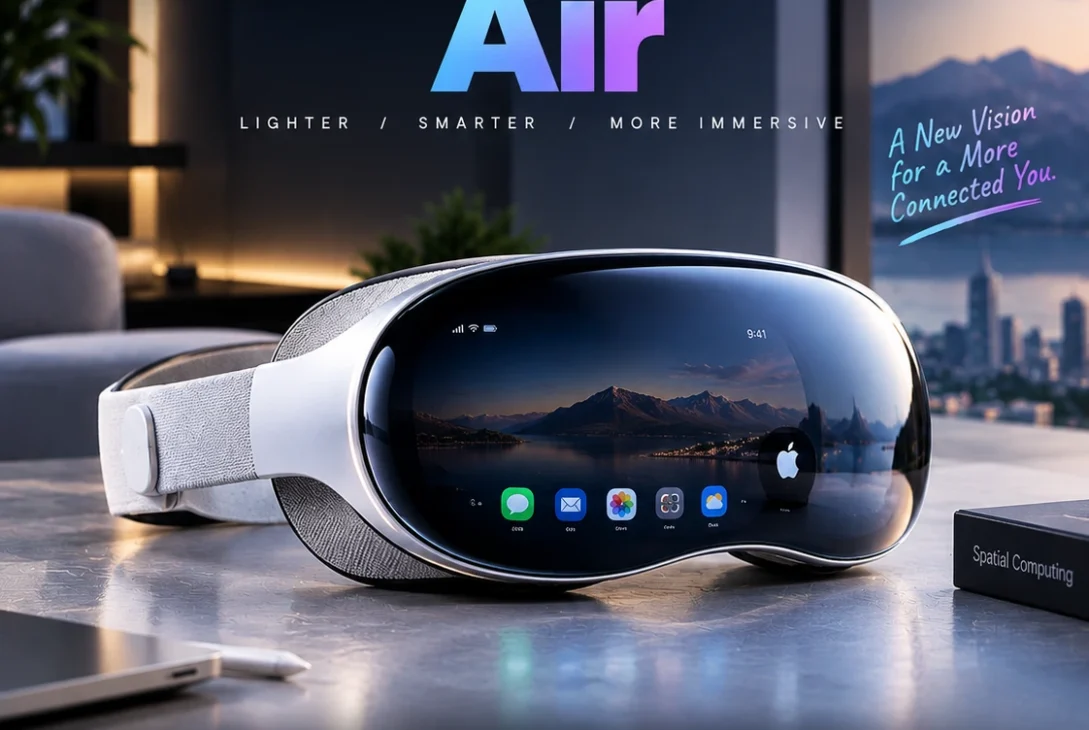
The apple vision air was once expected to become Apple’s cheaper and lighter alternative to the Vision Pro, potentially making spatial computing accessible to a much wider audience. Early reports described a thinner headset with a significantly lower weight, a lower price, and a design that would be easier to wear for longer periods.
However, the situation has changed significantly in 2026.
The apple vision air project is now widely reported as canceled or discontinued rather than an upcoming product. Apple has shifted much of its wearable-computing focus toward lightweight smart glasses, while work on a cheaper Vision Pro-style headset has reportedly been paused or abandoned.
That makes the apple vision air story particularly interesting. Instead of being a simple product-launch article, it has become a look at Apple’s changing strategy for spatial computing.
The original idea behind the apple vision air was compelling: take the technology developed for Vision Pro, reduce the weight and cost, simplify the hardware, and create a headset that could appeal to ordinary consumers.
Early rumors suggested that Apple was experimenting with lighter materials, including titanium and other structural changes, while trying to create a more comfortable headset.
This guide explains what happened to the apple vision air, what its rumored specifications were, why Apple reportedly canceled it, what the device could have offered, and what Apple’s decision means for the future of Vision products and smart glasses.
Table of Contents
- Apple Vision Air: Latest Update
- What Was Apple Vision Air?
- Why Was Apple Vision Air Cancelled?
- Original Apple Vision Air Rumors
- Expected Design
- Expected Weight
- Expected Display
- Expected Processor
- Expected Cameras and Sensors
- Expected Battery
- Expected Price
- Apple Vision Air vs Vision Pro
- Why Apple Shifted Toward Smart Glasses
- What Happened to Vision Pro?
- Could Apple Vision Air Return?
- Apple’s Future Wearable Strategy
- Frequently Asked Questions
- Final Verdict
- SEO Details
Apple Vision Air: Latest Update
The biggest update is that the apple vision air is no longer considered an active upcoming product.
Earlier rumors suggested Apple was developing a lighter and cheaper headset under the Vision Air name. The goal was reportedly to reduce the weight and manufacturing cost of the Vision Pro while retaining enough of its mixed-reality functionality to create a more accessible device.
By 2026, however, multiple reports indicated that Apple had moved away from that plan.
Bloomberg’s Mark Gurman reported that the Vision Air project had been canceled, while Apple redirected resources toward smart glasses. Other reporting has similarly described the cheaper headset project as being on hold or discontinued.
This means there is currently no confirmed apple vision air release date.
There is also no official Apple price, retail specification sheet, preorder page, or launch announcement for the device.
Anyone claiming that the headset has a confirmed 2026 or 2027 launch date should therefore be treated cautiously.
What Was Apple Vision Air?
The apple vision air was the rumored name for a lighter and cheaper version of Apple’s Vision Pro headset.
The original Vision Pro demonstrated Apple’s approach to spatial computing, combining high-resolution displays, eye tracking, hand tracking, cameras, sensors, and powerful Apple silicon.
The problem was accessibility.
Vision Pro launched at an extremely high price and with a relatively heavy design.
The rumored apple vision air was supposed to address both issues.
Instead of competing directly with Vision Pro as Apple’s most advanced headset, it could have been positioned as a more consumer-friendly product.
The basic idea was simple:
Vision Pro technology + lower weight + lower cost = broader consumer appeal.
That concept made the apple vision air one of the most interesting rumored Apple products of the past few years.
Why Was Apple Vision Air Cancelled?
There does not appear to be one publicly confirmed reason for the cancellation.
However, reports point toward several challenges.
Weight
The Vision Pro’s weight has been one of its biggest criticisms.
Apple’s current headset weighs more than many ordinary glasses or lightweight headsets, making long sessions less comfortable.
A lighter version would require major changes to the internal architecture.
Cost
Vision Pro launched at $3,499, placing it far above mainstream consumer electronics.
A cheaper apple vision air would have needed significantly lower manufacturing costs without destroying the experience that made Vision Pro unique.
That is difficult when the product depends on expensive displays, cameras, sensors, processors, and custom components.
Power Consumption
Spatial computing requires substantial processing power.
Multiple cameras and sensors continuously monitor the user’s surroundings, eyes, hands, and head position.
Reducing the size of the hardware while maintaining that performance creates a difficult engineering problem.
Smart Glasses
Apple also appears to believe that lightweight smart glasses have greater mass-market potential.
Reports indicate that Apple has shifted resources toward smart glasses that could compete more directly with products such as Meta’s Ray-Ban smart glasses.
That strategic shift reduced the reason to continue investing heavily in the apple vision air.
Original Apple Vision Air Rumors
Before the project was reportedly canceled, the apple vision air had been described as a substantially lighter headset.
One early rumor suggested that Apple was experimenting with titanium for some internal structures and the battery enclosure.
The same report suggested a Midnight-style dark finish rather than the silver appearance associated with Vision Pro.
These reports were never confirmed by Apple.
They nevertheless provided an interesting look at what the company may have been exploring.
The proposed apple vision air was not expected to simply be a smaller Vision Pro.
Instead, Apple appeared to be considering major material and structural changes.
Expected Design
The rumored apple vision air design was expected to be thinner and lighter than Vision Pro.
A thinner headset would have several advantages.
It could:
- Feel less bulky
- Improve balance on the user’s face
- Reduce pressure during long sessions
- Make transportation easier
- Look more like conventional eyewear
The original rumors also suggested a darker Midnight-like exterior.
That would have differentiated the product visually from Vision Pro.
However, because the apple vision air was never officially announced, none of these design details can be considered final specifications.
Expected Weight
Weight reduction was arguably the most important feature associated with the apple vision air.
Some earlier reports suggested that Apple wanted to reduce the headset’s weight by a very substantial amount.
One 2025 roadmap from analyst Ming-Chi Kuo described a future Vision Air concept with more than a 40% weight reduction compared with Vision Pro, achieved partly through replacing glass with plastic, using magnesium alloy, and reducing the number of sensors.
That would have been a major improvement.
A lighter headset could make spatial computing more practical for:
- Watching movies
- Gaming
- Working
- Traveling
- Browsing
- Virtual meetings
- Extended mixed-reality sessions
The challenge was achieving that weight reduction without removing too many capabilities.
Expected Display
Display technology was another major question.
Vision Pro uses extremely advanced micro-OLED displays with very high pixel density.
A cheaper apple vision air would probably have needed a less expensive display system.
Reports later indicated that Apple had explored a cheaper display technology for a lighter Vision Pro-style headset, but work on that display project was eventually suspended.
That suggests cost reduction was one of the major technical challenges.
A cheaper headset could potentially have used lower-resolution displays or a different display manufacturing process.
However, reducing display quality too aggressively could make the product feel significantly worse than Vision Pro.
Expected Processor
The original apple vision air roadmap was also interesting because it was not necessarily expected to use the same Mac-class processor as Vision Pro.
One earlier roadmap suggested that Apple could use its latest flagship iPhone processor rather than an M-series chip in the lighter headset.
That would have made sense from an efficiency perspective.
An iPhone-class processor could potentially provide enough performance for many wearable workloads while consuming less power and producing less heat.
It could also reduce the size of the cooling system.
However, the exact processor was never officially confirmed.
Expected Cameras and Sensors
Vision Pro depends heavily on cameras and sensors.
The headset tracks the user’s:
- Eyes
- Hands
- Head movement
- Surrounding environment
Reducing the number of sensors was one possible way Apple could have reduced the cost and weight of the apple vision air.
But fewer sensors could also reduce functionality.
Apple would have needed to determine which features were essential and which could be removed without making the product feel incomplete.
This would have been particularly difficult because the Vision platform’s identity depends heavily on spatial interaction.
Expected Battery
Battery technology was another challenge.
The headset requires substantial power because it continuously processes camera feeds, display output, spatial mapping, eye tracking, and other tasks.
The apple vision air would have needed better efficiency if Apple wanted to make the headset lighter.
A smaller battery could reduce weight, but it would also reduce operating time.
A more efficient processor could help compensate.
Apple could also have redesigned the external battery system.
However, the final solution never reached an official product launch.
Expected Price
The biggest potential advantage of the apple vision air was supposed to be price.
Vision Pro launched at $3,499, making it inaccessible to most consumers.
A cheaper headset could potentially have brought Apple’s spatial-computing platform to a much larger audience.
Earlier reports described the product as significantly cheaper than Vision Pro, although there was never a confirmed retail price.
That means all specific prices previously reported online should be treated as estimates rather than official information.
The apple vision air could have been positioned closer to premium consumer electronics rather than workstation-level hardware.
Apple Vision Air vs Vision Pro
The biggest difference would have been Apple’s target audience.
Vision Pro was designed as Apple’s premium spatial-computing platform.
The apple vision air was expected to target a broader consumer market.
| Feature | Vision Pro | Vision Air concept |
|---|---|---|
| Positioning | Premium spatial computer | Consumer-focused headset |
| Weight | Heavy | Much lighter |
| Price | Very expensive | Expected to be significantly cheaper |
| Processor | Mac-class Apple silicon | Potentially iPhone-class silicon |
| Materials | Premium glass/aluminum | Lighter materials |
| Sensors | Extensive | Potentially reduced |
| Target user | Professionals/enthusiasts | Mainstream consumers |
The important point is that the apple vision air was never officially launched, so this comparison is based on reported plans rather than final retail specifications.
Why Apple Shifted Toward Smart Glasses
Apple’s shift toward smart glasses appears to be one of the biggest reasons the apple vision air project lost momentum.
Smart glasses have several advantages over full headsets.
They can be:
- Much lighter
- Easier to wear
- More socially acceptable
- Less expensive
- Easier to carry
- More suitable for everyday use
Reports suggest Apple is working on AI-focused smart glasses that could compete with products such as Meta’s Ray-Ban lineup.
The initial Apple smart glasses are expected to focus on AI, audio, cameras, and environmental awareness rather than offering a full integrated display.
That approach could allow Apple to enter the wearable market without solving the weight and power challenges of a full spatial-computing headset.
https://www.apple.com/apple-vision-pro/
What Happened to Vision Pro?
Apple has not completely abandoned the Vision Pro platform.
The company refreshed Vision Pro with an M5 chip in October 2025.
However, reports in 2026 suggested that the headset had struggled to achieve broad consumer adoption.
The apple vision air could have helped address some of Vision Pro’s biggest problems, especially price and weight.
But Apple appears to have concluded that a lighter headset alone may not be enough to create a mass-market product.
That may explain the shift toward smart glasses.
Could Apple Vision Air Return?
Technically, Apple could revive the project.
Apple frequently cancels, pauses, and revisits hardware concepts.
However, current reporting does not provide a strong reason to expect the apple vision air to return soon.
In June 2026, reports indicated that Apple was still considering future Vision hardware, but a cheaper and lighter successor was not expected before late 2028 or 2029.
More recent reporting in September 2026 said Apple was exploring several completely redesigned Vision Pro concepts, but those devices were also not expected in the near term.
That makes an immediate apple vision air comeback unlikely.
Apple’s Future Wearable Strategy
Apple’s future wearable strategy now appears to be broader than simply building another Vision Pro.
The company is reportedly exploring:
- AI smart glasses
- Advanced AR glasses
- Future Vision headsets
- AI-powered wearables
- Camera-equipped AirPods
The smart-glasses strategy could become particularly important.
Instead of asking consumers to wear a large computer on their face, Apple could start with a lightweight product that adds AI and contextual features to everyday life.
The apple vision air concept may therefore have helped Apple identify the limitations of the current headset approach even though it never became a commercial product.
Frequently Asked Questions
What is Apple Vision Air?
The apple vision air was a rumored lighter and cheaper Apple headset intended to make the Vision platform more accessible than Vision Pro.
Is Apple Vision Air coming out?
Current reports indicate that the project was canceled or discontinued, so there is no confirmed release date.
Why was Apple Vision Air canceled?
The likely factors include weight, cost, power consumption, technical complexity, and Apple’s decision to prioritize lightweight smart glasses.
How much would Apple Vision Air have cost?
Apple never announced an official price. Reports only suggested that it would be significantly cheaper than Vision Pro.
Would Apple Vision Air be lighter than Vision Pro?
Yes. Weight reduction was one of the central goals of the project, with earlier reports suggesting a substantially lighter design.
Would Apple Vision Air use an M-series chip?
Not necessarily. One earlier roadmap suggested an iPhone-class processor could have been used to improve efficiency and reduce weight.
Would Apple Vision Air have an OLED display?
The exact display was never confirmed. Apple reportedly explored cheaper display technology for a lighter headset, but that work was later suspended.
Is Apple still making Vision products?
Apple appears to still be exploring future Vision hardware, although the current roadmap is much less certain than earlier reports suggested.
What is Apple focusing on instead?
Apple is reportedly focusing more heavily on lightweight AI smart glasses, with a first generation expected around 2027 according to current reporting.
Will Apple make another Vision Pro?
A future Vision Pro-style headset remains possible, but current reports suggest that any major successor is still years away.
Final Verdict
The apple vision air was one of the most promising rumored Apple wearable products because it appeared to address the two biggest weaknesses of Vision Pro: price and weight.
A lighter and cheaper headset could have made Apple’s spatial-computing technology far more accessible.
Unfortunately for consumers waiting for such a product, current reports indicate that Apple canceled or discontinued the original Vision Air project and shifted its resources toward smart glasses.
That does not mean Apple’s interest in spatial computing has disappeared completely.
The company is still exploring future headset concepts, and reports indicate that redesigned Vision hardware could eventually return.
However, the company’s immediate priority appears to be lightweight AI-powered glasses.
For now, the apple vision air should therefore be treated as a canceled or discontinued Apple project rather than an upcoming product.
The biggest lesson from the project is that Apple appears to recognize that future wearable computers need to become dramatically lighter, cheaper, and easier to wear.
Whether Apple eventually solves those problems through a new Vision headset or through smart glasses remains one of the most interesting questions in the company’s hardware roadmap.