
Introduction
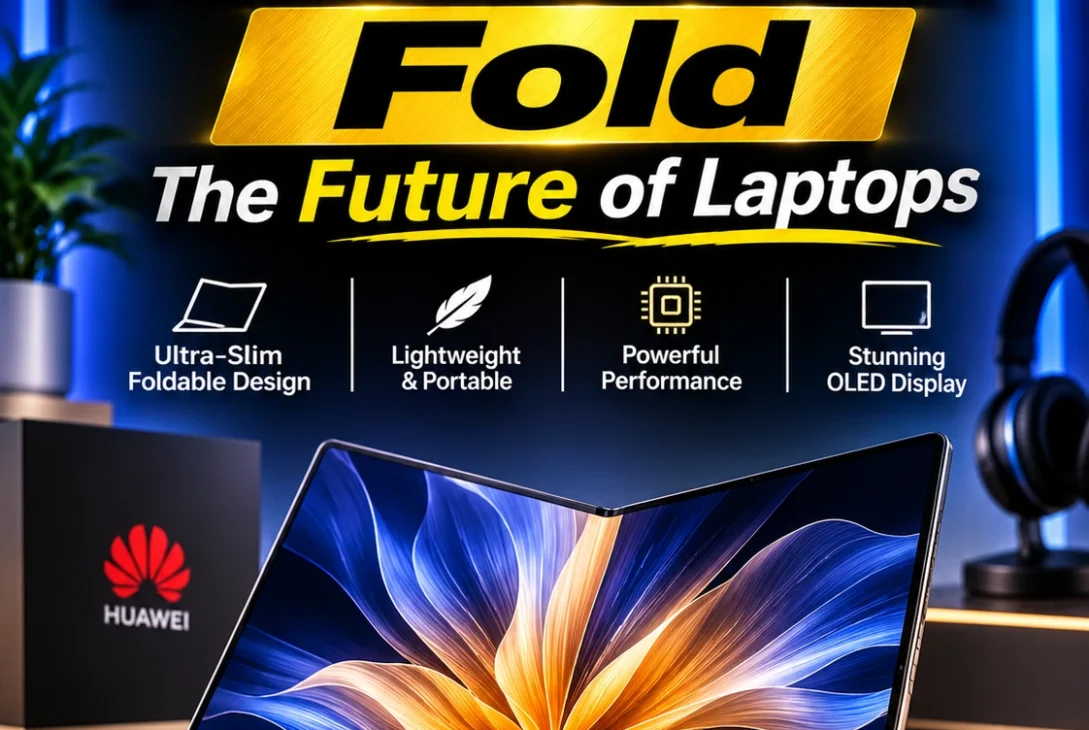
Foldable screens are moving beyond smartphones, and Huawei is bringing the idea to personal computers. The MateBook Fold is a premium laptop that opens into a large 18-inch display and folds into a more compact notebook-sized device. It is designed for people who want a large workspace while travelling, studying, or working away from a desk.
The Huawei MateBook Fold first appeared in 2025 with an 18-inch flexible OLED panel and HarmonyOS 5, as detailed by Gadgets 360. In August 2026, Huawei announced a second-generation version with a Kirin X90 Plus processor, HarmonyOS 6.1, a redesigned hinge, and support for an AI-powered M-Pencil. These are two distinct generations, so buyers should check which model a retailer is offering.
This guide explains the design, screen, performance, software, battery, accessories, price, availability, strengths, and limitations. It also considers who should buy a foldable computer and what to check before importing one.
Table of Contents
- What Is the Huawei MateBook Fold?
- Design and Build Quality
- Display and Screen Technology
- Performance and Processor
- HarmonyOS and Software Compatibility
- Keyboard, Touchpad, and Stylus
- Battery, Charging, and Connectivity
- 11 Important Features
- Price and Availability
- Advantages and Disadvantages
- Who Should Buy It?
- Frequently Asked Questions
- Final Verdict
What Is the Huawei MateBook Fold?
The Huawei MateBook Fold Ultimate Design is a premium computer built around one flexible display. Fully opened, the panel measures 18 inches diagonally. Folded, it becomes approximately the size of a 13-inch notebook. Instead of using two separate displays, it uses a single flexible OLED panel that bends around a central hinge.
The device can be used as a large-screen workspace, a partially folded laptop with a virtual keyboard, or a computer paired with a separate physical keyboard. The design aims to combine the portability of a smaller notebook with the working area of a much larger screen.
The Huawei MateBook Fold sits in Huawei’s ULTIMATE DESIGN family. It is aimed at professionals, frequent travellers, and technology enthusiasts who value screen space and are willing to pay for an unusual form factor. The 2025 model runs HarmonyOS 5, while the 2026 generation uses HarmonyOS 6.1 and a newer processor.
Design and Build Quality
Portability is one of the most interesting aspects of the design. The first-generation computer weighs about 1.16kg without its physical keyboard. The Huawei MateBook Fold has a listed thickness of approximately 7.3mm when unfolded and 14.9mm when folded. These measurements help explain how the Huawei MateBook Fold can provide a large display while remaining manageable in a travel bag.
A waterdrop-style hinge guides the flexible panel through its folding motion. A foldable computer places different mechanical demands on its body compared with a traditional notebook. Hinge alignment, pressure distribution, dust protection, and repeated opening cycles all influence long-term reliability.
For the 2026 generation, the Huawei MateBook Fold received a larger redesigned hinge with zirconium-based liquid-metal components. The company says this improves durability and makes opening and closing smoother.
The rear uses a premium finish, and an integrated stand supports different working arrangements. Still, the thin construction deserves careful handling. Owners should use a protective sleeve, avoid placing sharp objects against the panel, and follow the manufacturer’s instructions when opening or closing it.
Display and Screen Technology
The display is the defining feature. The first generation has an 18-inch flexible dual-layer OLED panel with a 3.3K resolution of 3296 × 2472 pixels when fully opened. Its 4:3 aspect ratio provides a broad workspace for reading, editing, and viewing multiple windows.
When folded, the visible screen becomes approximately 13 inches, with a 2472 × 1648 resolution and a 3:2 aspect ratio. This smaller arrangement is more familiar for notebook-style work while keeping the overall device compact.
The Huawei MateBook Fold advertises peak brightness of up to 1,600 nits for HDR content. The panel supports LTPO technology and HDR, while OLED pixels can produce deep blacks and strong contrast. These characteristics can benefit films, photographs, presentations, and interfaces with dark backgrounds.
The 2026 generation retains the 18-inch dual-layer OLED format and adds LTPO adaptive refresh-rate support and HDR refinements. The Huawei MateBook Fold retains a quoted HDR peak brightness of up to 1,600 nits when enabled. The actual viewing experience depends on content, brightness settings, ambient light, and software.
Performance and Processor
Performance differs between generations. The first-generation model launched with 32GB of memory and storage options of 1TB or 2TB. The Huawei MateBook Fold had no complete processor specification published at launch. Subsequent reporting identified the original model’s chip as the Kirin X90.
The second-generation 2026 version uses the Kirin X90 Plus. The Huawei MateBook Fold is claimed to deliver around 25% smoother performance than the previous generation. Configurations include 24GB or 32GB of RAM and SSD storage options from 512GB to 2TB.
These specifications should support multitasking, office applications, web research, presentations, and many productivity workflows. A large memory capacity can help keep browser tabs and applications open during busy sessions, while solid-state storage helps with booting, opening files, and transferring data.
However, memory capacity and a manufacturer’s performance claim do not tell the whole story. Real-world results depend on application support, processor efficiency, cooling, sustained workloads, and software optimisation. Professionals should look for independent benchmarks using the exact generation and configuration they plan to buy.
The thin chassis also creates thermal challenges. The 2026 version includes an ultra-thin vapor-chamber cooling system. The Huawei MateBook Fold’s cooling system is said to control temperatures and reduce slowdowns during demanding workloads. Long-duration testing will show how well it handles large projects, extended multitasking, and sustained processing.
HarmonyOS and Software Compatibility
Software compatibility is one of the most important questions for international buyers. The first generation introduced HarmonyOS 5 on a Huawei PC, while the 2026 model runs HarmonyOS 6.1. The Huawei MateBook Fold is part of an ecosystem in which computers, phones, tablets, and accessories can work together.
The interface is designed to switch between layouts. Users can work with the full display, use the lower section as a virtual keyboard when the screen is partly folded, or connect a physical keyboard. The operating system also supports split-screen arrangements that make use of the large panel.
These modes can help users read a document while keeping notes open, compare spreadsheets, research with several browser windows, or prepare presentations. The flexible form factor becomes more useful when software makes intelligent use of the available screen space.
HarmonyOS is not Windows or macOS. Buyers who depend on specialist Windows applications, professional creative tools, enterprise software, or particular games should verify compatibility before purchasing. Some applications may have native versions, while others may require alternatives or workarounds. Compatibility should never be assumed simply because an application works on another Huawei device.
People whose work is mainly browser-based, document-focused, or supported by HarmonyOS applications may find the transition easier; TechRadar’s hands-on report also discusses the device’s appeal and software limitations. Businesses with managed software environments should consult their IT teams before adopting the Huawei MateBook Fold.
Keyboard, Touchpad, and Stylus
The foldable design supports several input methods. The lower part of the screen can display a virtual keyboard and touchpad when the Huawei MateBook Fold is partly folded. This allows basic work without carrying a separate keyboard at all times.
The Huawei MateBook Fold also supports a thin physical keyboard with a touchpad. It provides a more familiar typing experience for long documents, email, and spreadsheets. The keyboard can be positioned in front of the display, allowing the Huawei MateBook Fold to behave more like a conventional laptop.
The second-generation model adds support for a new AI-powered M-Pencil stylus. This expands its appeal to people who take handwritten notes, annotate documents, sketch ideas, or mark up presentations. Its usefulness depends on pressure response, palm rejection, supported applications, and writing accuracy.
Battery, Charging, and Connectivity
The first-generation device includes a battery rated at approximately 74.69Wh and supports 140W wired fast charging. The Huawei MateBook Fold retains a high-power wired charging approach in the newer generation, designed to reduce the time spent connected to an outlet.
Actual battery life depends on brightness, refresh rate, wireless use, application workload, video playback, and how often the Huawei MateBook Fold is folded or unfolded. An 18-inch OLED display can consume more power when showing bright content across a large area than a smaller conventional laptop screen.
The first generation includes two USB-C ports, Wi-Fi 6E, Bluetooth 5.2, a fingerprint reader, an 8-megapixel front camera, six speakers, and four microphones. The 2026 generation retains a premium multimedia approach, including an 8MP front camera and six-speaker audio.
Before buying, check the exact ports and wireless specifications for the generation being offered. Retail listings can sometimes mix details from different versions.
11 Important Features to Know
1. An 18-Inch Flexible Display
The large screen gives users more room for multitasking, reading, and editing without carrying a conventional 18-inch laptop.
2. Compact Folded Form
The display folds down to approximately a 13-inch notebook size, making the Huawei MateBook Fold easier to place in a travel bag.
3. Dual-Layer OLED Technology
The flexible OLED panel offers deep contrast, vivid colours, and a high-resolution viewing experience.
4. 3.3K Resolution
The original display’s 3296 × 2472 resolution provides detailed text and images across the large unfolded panel.
5. Multiple Working Modes
Users can switch between full-screen, partly folded, and keyboard-assisted arrangements depending on the task.
6. Redesigned Hinge
The waterdrop hinge manages the display’s folding motion, while the 2026 generation introduces an updated mechanism.
7. Large Memory Options
Configurations with up to 32GB of RAM support multitasking and demanding productivity workflows.
8. High-Capacity SSD Storage
Storage options reaching 2TB provide room for documents, media, and large work files.
9. 140W Wired Charging
Fast wired charging helps reduce downtime when the battery needs to be replenished.
10. Integrated Multimedia Hardware
The camera, microphones, and six-speaker system support video meetings and entertainment.
11. Stylus Support on the New Generation
The 2026 version supports Huawei’s new AI-powered M-Pencil, adding handwriting and drawing possibilities.
Price and Availability in 2026
The original 2025 model launched in China at CNY 23,999 for the 32GB RAM and 1TB storage configuration. The 32GB and 2TB version was priced at CNY 26,999. These were first-generation launch prices and should not be confused with the newer model.
The second-generation Huawei MateBook Fold arrived in August 2026, according to Notebookcheck’s launch coverage. China pricing starts at CNY 24,999 for 24GB RAM and 512GB storage. The 24GB and 1TB version costs CNY 26,999, while the 32GB and 2TB configuration costs CNY 29,999.
The newer model has been reported as available in China, but Huawei MateBook Fold international availability remains unconfirmed. Buyers in the United States, United Kingdom, Europe, or Pakistan should not assume local stock, warranty support, or official software services are available.
Importing a computer can involve taxes, shipping costs, regional charger differences, and limited repair options. Check the seller’s return policy and confirm the exact model number before paying.
Advantages and Disadvantages
The biggest advantage is flexibility. One device can provide a large display for focused work and fold into a more compact form for travel. The OLED panel, premium construction, memory configurations, and stylus support make it an interesting productivity device.
There are trade-offs. The price is considerably higher than many conventional laptops. The flexible display needs careful handling, and long-term durability should be judged through extended real-world testing. Software compatibility is another major concern for users who rely on Windows applications.
Who Should Buy It?
The device is most appealing to people who value a large portable workspace. Frequent travellers, executives, writers, researchers, students, and professionals who work with documents may appreciate an 18-inch screen that folds into a smaller device.
It may also interest Huawei ecosystem users who already own compatible phones, tablets, or accessories. Integration between devices can make transferring files and continuing tasks more convenient, provided the required features are supported in their region.
It is less suitable for buyers who need Windows-only software, extensive physical ports, a low-cost laptop, or a machine designed primarily for high-end gaming. People who mostly work at a fixed desk may get better value from a conventional notebook and an external monitor.
Huawei MateBook Fold vs Traditional Laptops
A conventional laptop usually offers a rigid display, built-in keyboard, and familiar operating system. It is often easier to repair, less expensive, and supported by a wider selection of applications. Many models also provide more ports and predictable typing comfort.
However, a foldable panel introduces mechanical complexity and different durability considerations. It also makes the keyboard experience more dependent on positioning and accessories. Buyers should decide whether the large flexible screen solves a real daily problem or simply looks impressive in demonstrations.
Frequently Asked Questions
Is the Huawei MateBook Fold available worldwide?
The original and second-generation models have launched in China. Huawei has not confirmed broad international availability for the 2026 version.
What size is the display?
The flexible display measures 18 inches when fully unfolded. When folded, it provides an approximately 13-inch working area.
Does it run Windows?
No. The first-generation model runs HarmonyOS 5, while the 2026 second-generation version runs HarmonyOS 6.1.
How much RAM does it offer?
The original model launched with 32GB of RAM. The 2026 version offers configurations with 24GB or 32GB, depending on the selected model.
Does it support a stylus?
The second-generation 2026 model supports Huawei’s new AI-powered M-Pencil. Buyers should confirm whether the stylus is included or sold separately in their market.
How much does the 2026 model cost?
China pricing starts at CNY 24,999 for the 24GB RAM and 512GB storage version. Higher configurations cost more.
Is it suitable for professional work?
It can suit document editing, research, presentations, and compatible productivity applications. Users should check that essential software works with HarmonyOS.
Is the display durable?
The Huawei MateBook Fold uses a specialised hinge and flexible OLED panel, but foldable displays require careful handling. Long-term independent durability testing is important before making assumptions about lifespan.
Final Verdict
The Huawei MateBook Fold is one of the most distinctive laptop designs in the premium computer market. Its 18-inch flexible OLED display, compact folded form, multiple working modes, and high-end construction make it compelling for people who want a large workspace in a portable device.
The 2026 second-generation model improves the concept with a Kirin X90 Plus processor, HarmonyOS 6.1, a redesigned hinge, and M-Pencil support. It offers configurations with up to 32GB of RAM and 2TB of storage. Independent testing is still essential for judging real-world performance and durability.
The biggest questions are price, software compatibility, and international support. At a premium China-market price, it is not an easy recommendation for every laptop buyer. People who depend on Windows applications should verify their workflow before importing it.
For professionals who can use HarmonyOS applications and genuinely benefit from a flexible 18-inch display, the Huawei MateBook Fold offers an unusual and forward-looking computing experience.
The Huawei MateBook Fold should be assessed as a specialised productivity machine rather than a universal replacement for every notebook. Check application availability, keyboard comfort, repair coverage, local pricing, and the seller’s warranty before deciding whether its flexible screen justifies the premium for everyday workloads. For everyone else, a conventional premium laptop may remain the safer and more affordable purchase.