
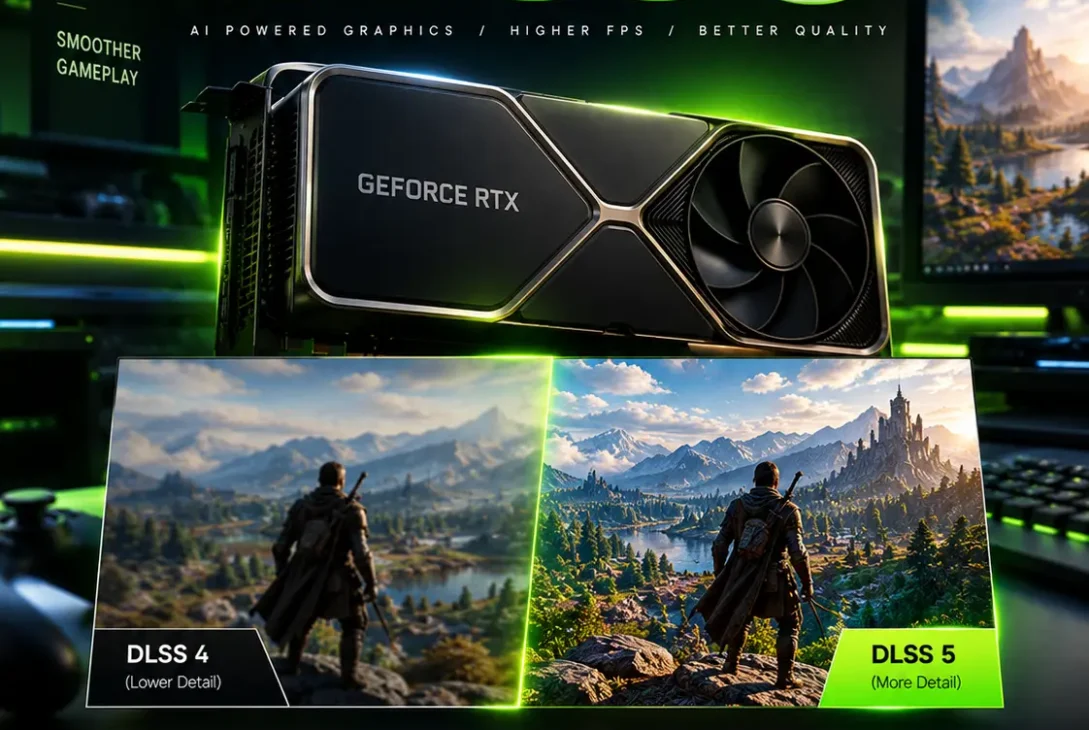
If you have been following the latest NVIDIA graphics technology, you may be wondering what is DLSS 5 and why it is generating so much attention among PC gamers. NVIDIA’s newest DLSS generation goes beyond traditional image upscaling and frame generation by using AI to improve lighting, materials, and visual detail in real time.
DLSS has evolved significantly since its original launch. Earlier versions focused heavily on reconstructing higher-resolution images from lower-resolution inputs, while newer versions introduced AI-generated frames and more advanced transformer models. DLSS 5 takes another major step by adding 3D-Guided Neural Rendering, which works as a final neural-rendering stage in the graphics pipeline.
Instead of simply trying to reconstruct pixels, the technology uses information from the game engine to add more realistic lighting and material detail while preserving the underlying geometry and artistic direction created by developers.
So, what is DLSS 5 actually doing inside a game? How is it different from DLSS 4.5, which graphics cards support it, and does it improve performance or mainly image quality? Here’s everything you need to know.
Table of Contents
- What Is DLSS 5?
- How Does DLSS 5 Work?
- DLSS 5 vs DLSS 4.5
- 3D-Guided Neural Rendering
- Better Lighting
- More Realistic Materials
- Developer Control
- DLSS 5 and Ray Tracing
- DLSS 5 and Frame Generation
- Supported GPUs
- Performance and VRAM
- Supported Games
- Is DLSS 5 Worth Using?
- Frequently Asked Questions
- Final Verdict
- SEO Details
What Is DLSS 5?
So, what is DLSS 5 in simple terms?
DLSS 5 is NVIDIA’s latest neural-rendering technology designed to make game graphics look more realistic by using AI to generate enhanced lighting and material details.
The technology is part of NVIDIA’s broader DLSS ecosystem, but it is different from traditional DLSS Super Resolution. Super Resolution reconstructs a higher-resolution image from lower-resolution input, while DLSS 5’s 3D-Guided Neural Rendering works as an additional rendering stage that enhances the final image.
NVIDIA describes the technology as using the game’s rendered frame, including artist-created geometry, textures, lighting information, and motion data, as the foundation. The AI model then adds realistic visual details while attempting to preserve the structure and identity of the original scene.
This distinction is important because DLSS 5 is not simply a faster version of DLSS Super Resolution.
It is a new approach to neural rendering.
How Does DLSS 5 Work?
To understand what is DLSS 5, it helps to understand the traditional graphics pipeline.
A game engine first creates a scene containing geometry, textures, lighting, characters, objects, and other visual information. The GPU then renders that scene into an image.
DLSS 5 adds another AI-powered stage after the game engine has produced its rendered frame.
The neural-rendering model analyzes information from the frame and uses data supplied by the game engine to determine how certain areas should appear.
NVIDIA says DLSS 5 uses the rendered frame and motion vectors while maintaining a strict one-frame-in, one-frame-out approach. This is designed to provide stable real-time output rather than functioning like an offline generative AI model that can process large groups of frames together.
The result can include more detailed lighting, reflections, surface properties, shadows, and other visual characteristics.
DLSS 5 vs DLSS 4.5
One of the easiest ways to understand what is DLSS 5 is to compare it with the previous generation.
DLSS 4.5 introduced important improvements to NVIDIA’s neural graphics technologies, including Dynamic Multi Frame Generation and a second-generation transformer model for Super Resolution and Ray Reconstruction.
DLSS 5 adds another layer.
Instead of focusing primarily on reconstructing the image or generating additional frames, its headline feature is 3D-Guided Neural Rendering.
That means the two technologies can complement one another.
A game can use DLSS Super Resolution to reconstruct the image, Frame Generation or Multi Frame Generation to increase displayed frame rates, and DLSS 5 to enhance lighting and materials.
This makes the overall DLSS ecosystem more modular than simply being one single graphics feature.
1. 3D-Guided Neural Rendering
The biggest reason people are asking what is DLSS 5 is its 3D-Guided Neural Rendering technology.
Traditional rendering techniques require developers to make compromises. Extremely realistic lighting and material effects can require significant GPU resources, particularly when games use complex ray tracing or path tracing.
DLSS 5 attempts to use AI to reproduce some of those expensive visual characteristics more efficiently.
The important part is that the AI is not simply generating an unrelated image.
The game engine remains the foundation.
NVIDIA says the engine frame provides the geometry, textures, and lighting information that define the scene. Developers can then direct the neural-rendering model toward the desired visual result.
This approach helps distinguish DLSS 5 from general-purpose image-generation models.
2. Better Lighting
Lighting is one of the most noticeable areas where the technology can improve visuals.
DLSS 5 can enhance lighting characteristics that would otherwise require significant rendering resources.
This can include more convincing illumination on characters, richer shadows, and subtle interactions between light and surfaces.
NVIDIA describes DLSS 5 as adding lifelike lighting and material details to rendered scenes.
The difference can be particularly noticeable in scenes with complex lighting.
A character standing indoors, for example, may show more convincing light interaction across skin, clothing, hair, and nearby surfaces.
The goal is not simply to make the entire scene brighter or darker.
The goal is to make the lighting response appear more natural.
3. More Realistic Materials
Another major part of what is DLSS 5 is its ability to enhance materials.
Modern games contain thousands of different surface types.
Metal should reflect light differently from plastic. Skin should behave differently from glass. Fabric should not look like polished stone.
These differences require sophisticated rendering techniques.
DLSS 5’s neural-rendering system can enhance material characteristics such as micro-reflections, surface detail, and other subtle visual properties. NVIDIA says the technology can improve lighting and material detail while remaining guided by the game engine.
This can make characters and objects appear less artificial, especially in scenes with detailed lighting.
4. Developer Control
A common concern with AI-generated graphics is loss of artistic control.
NVIDIA designed DLSS 5 with developer controls intended to address this issue.
Developers can choose different models, adjust structure and tone intensity, and use semantic or engine-level masks to control where the neural-rendering effect is applied.
This means a studio can decide that certain objects should receive stronger enhancement while other elements should remain closer to the original rendering.
For example, developers could control how the technology affects characters, foliage, glass, water, or other scene elements.
This is one of the most important aspects of what is DLSS 5 because the technology is not designed to operate as a completely uncontrolled visual filter.
5. DLSS 5 and Ray Tracing
DLSS 5 does not replace ray tracing.
Instead, the technologies can work together.
Ray tracing calculates how light interacts with objects in a scene. Path tracing takes this concept even further by simulating more complete light transport.
DLSS 5 can then operate as a neural-rendering stage that enhances the resulting image.
NVIDIA specifically says DLSS 5 complements ray tracing and path tracing.
This combination could become especially important for high-end games.
Ray tracing can provide physically based lighting information, while neural rendering can help add visual detail that would otherwise be extremely expensive to calculate conventionally.
The result is potentially more realistic graphics without requiring every visual detail to be calculated entirely through traditional rendering methods.
6. DLSS 5 and Frame Generation
It is important not to confuse DLSS 5 with Frame Generation.
Frame Generation creates additional frames between traditionally rendered frames to increase the displayed frame rate.
DLSS 5’s Neural Rendering is different.
It works on the visual content of a rendered frame and enhances lighting and material characteristics.
NVIDIA’s current DLSS ecosystem includes Super Resolution, Ray Reconstruction, Frame Generation, Multi Frame Generation, Dynamic Multi Frame Generation, and Neural Rendering.
These technologies can complement one another.
For example, a compatible game could use Super Resolution to reduce the internal rendering workload, Multi Frame Generation to produce additional frames, and DLSS 5 Neural Rendering to enhance the appearance of those rendered scenes.
This is why asking what is DLSS 5 should not be answered simply with “AI frame generation.”
That description would be inaccurate.
7. Supported GPUs
Hardware compatibility is another important part of what is DLSS 5.
NVIDIA’s official FAQ says DLSS 5 is supported across GeForce RTX 50 Series GPUs and laptops, with GeForce NOW Ultimate also providing access through compatible cloud hardware.
NVIDIA has also changed its plans regarding older hardware, with RTX 40-series support announced for DLSS 5. However, availability can depend on the specific DLSS 5 implementation and game.
This is different from community modifications that attempt to run DLSS 5 on unsupported GPUs.
Those projects are unofficial and should not be confused with NVIDIA’s supported implementation.
If you’re buying a GPU specifically for DLSS 5, check the game’s requirements and NVIDIA’s current compatibility information rather than assuming that every RTX card receives every DLSS 5 feature.
8. Performance and VRAM
A major question surrounding what is DLSS 5 is whether the technology actually increases FPS.
The answer is more complicated than a simple yes or no.
DLSS 5’s primary purpose is visual enhancement through neural rendering. It is not the same technology as Super Resolution or Multi Frame Generation, which are specifically designed to increase output frame rates.
In some implementations, DLSS 5 can introduce additional GPU workload.
NVIDIA has been optimizing the neural-rendering model since launch. In its October 2026 update, NVIDIA said the newer model reduced its footprint by 24%, lowered 4K VRAM usage by 20%, and reduced GPU overhead by about half compared with the September version while maintaining comparable visual fidelity. NVIDIA also said the newer model processes neural-rendering workloads up to twice as fast.
That is an important development because neural rendering is computationally demanding.
So, if someone asks what is DLSS 5 purely as an FPS technology, the answer is that its main purpose is not simply to increase frame rates.
Its primary goal is to improve visual quality.
9. Supported Games
DLSS 5 needs game-level integration to provide its intended Neural Rendering experience.
NVIDIA initially introduced the technology with NBA 2K27, and the company has since expanded availability to additional games and projects.
NVIDIA announced DLSS 5 support for games including:
- NBA 2K27
- Hogwarts Legacy
- Where Winds Meet
- Portal with RTX
- Half-Life 2 RTX
- Metro Redux
The exact implementation can differ between games.
NVIDIA’s October update also announced additional DLSS 5 support and a faster neural-rendering model for NBA 2K27, along with new integrations for other titles.
This means users should check each game’s graphics settings and official support information instead of assuming that owning a compatible GPU automatically enables DLSS 5 in every game.
Is DLSS 5 Worth Using?
Now that we have answered what is DLSS 5, the next question is whether you should actually enable it.
For compatible games and hardware, DLSS 5 can be worthwhile if you want improved visual quality and your GPU has enough performance headroom.
The technology is particularly interesting for games that already use demanding lighting techniques.
However, the best setting depends on the game.
If enabling Neural Rendering causes a significant performance reduction on your system, you may prefer to prioritize higher frame rates.
This is particularly relevant on laptops, where GPU power and cooling are more limited than on high-end desktop systems.
Players should also compare the native image, DLSS Super Resolution, and DLSS 5 results at their normal viewing distance.
Some improvements can be subtle during fast gameplay but much easier to notice in screenshots, character close-ups, or slower scenes.
What Makes DLSS 5 Different?
The biggest difference is that NVIDIA is using AI not only to reconstruct pixels or generate frames, but also to enhance the visual properties of a rendered scene.
Earlier DLSS technologies already demonstrated that neural networks could improve graphics performance and image quality.
DLSS 5 pushes the concept toward neural rendering.
The game engine still creates the foundation, but AI becomes more deeply involved in the final appearance of lighting and materials.
That is why NVIDIA describes DLSS 5 as a major step in computer graphics rather than simply another upscaling preset.
https://www.nvidia.com/en-us/geforce/technologies/dlss/
Frequently Asked Questions
What is DLSS 5?
DLSS 5 is NVIDIA’s neural-rendering technology that uses AI to enhance lighting and material detail in supported games. It uses 3D-Guided Neural Rendering as a final stage of the graphics pipeline.
Is DLSS 5 the same as DLSS Super Resolution?
No. Super Resolution reconstructs higher-resolution images from lower-resolution input. DLSS 5 adds neural rendering that can enhance lighting and material characteristics.
Does DLSS 5 increase FPS?
DLSS 5 primarily focuses on visual enhancement. Other DLSS technologies, such as Super Resolution and Multi Frame Generation, are responsible for major frame-rate improvements.
What GPU do I need for DLSS 5?
NVIDIA officially lists GeForce RTX 50 Series GPUs and laptops for DLSS 5, with additional compatibility developments being announced over time. Check the specific game’s requirements before assuming support.
Does DLSS 5 work with ray tracing?
Yes. NVIDIA says DLSS 5 can complement ray tracing and path tracing, using the rendered scene as the foundation for neural rendering.
Is DLSS 5 AI generated?
DLSS 5 uses an AI neural-rendering model to enhance the rendered frame. However, it is guided by game-engine information rather than generating an unrestricted scene from nothing.
Does DLSS 5 replace Frame Generation?
No. Frame Generation and Multi Frame Generation generate additional frames, while DLSS 5 Neural Rendering enhances lighting and material detail.
Which games support DLSS 5?
Support includes games and projects such as NBA 2K27, Hogwarts Legacy, Where Winds Meet, Portal with RTX, Half-Life 2 RTX, and Metro Redux, with availability depending on the game’s implementation and current updates.
Can I turn DLSS 5 off?
Yes. NVIDIA says DLSS 5 is optional. If you prefer native rendering or higher performance, you can disable the feature when the game provides the relevant setting.
Is DLSS 5 better than DLSS 4.5?
They serve different purposes. DLSS 4.5 introduced major improvements to Super Resolution, Ray Reconstruction, and Dynamic Multi Frame Generation, while DLSS 5 adds 3D-Guided Neural Rendering for enhanced lighting and materials.
Final Verdict
So, what is DLSS 5?
It is NVIDIA’s next-generation neural-rendering technology designed to make games look more realistic by using AI to enhance lighting and material detail.
The most important difference is that DLSS 5 is not simply another upscaling technology or frame-generation feature. Its 3D-Guided Neural Rendering model operates as a final stage of the graphics pipeline, using the game engine’s rendered information as a foundation and applying AI-driven enhancements to the final image.
The technology is particularly interesting because it gives developers control over how neural rendering affects their games. Studios can tune models, adjust intensity, and use masks to target specific parts of a scene.
At the same time, DLSS 5 is computationally demanding, so performance should be evaluated on a game-by-game basis. NVIDIA’s continuing model optimizations show that the company is actively working to reduce its overhead and improve efficiency.
For gamers with compatible hardware and supported games, DLSS 5 represents an important direction for real-time graphics. Instead of relying entirely on traditional rendering techniques, future games can combine conventional graphics, ray tracing, and neural rendering to produce increasingly detailed and realistic worlds.