
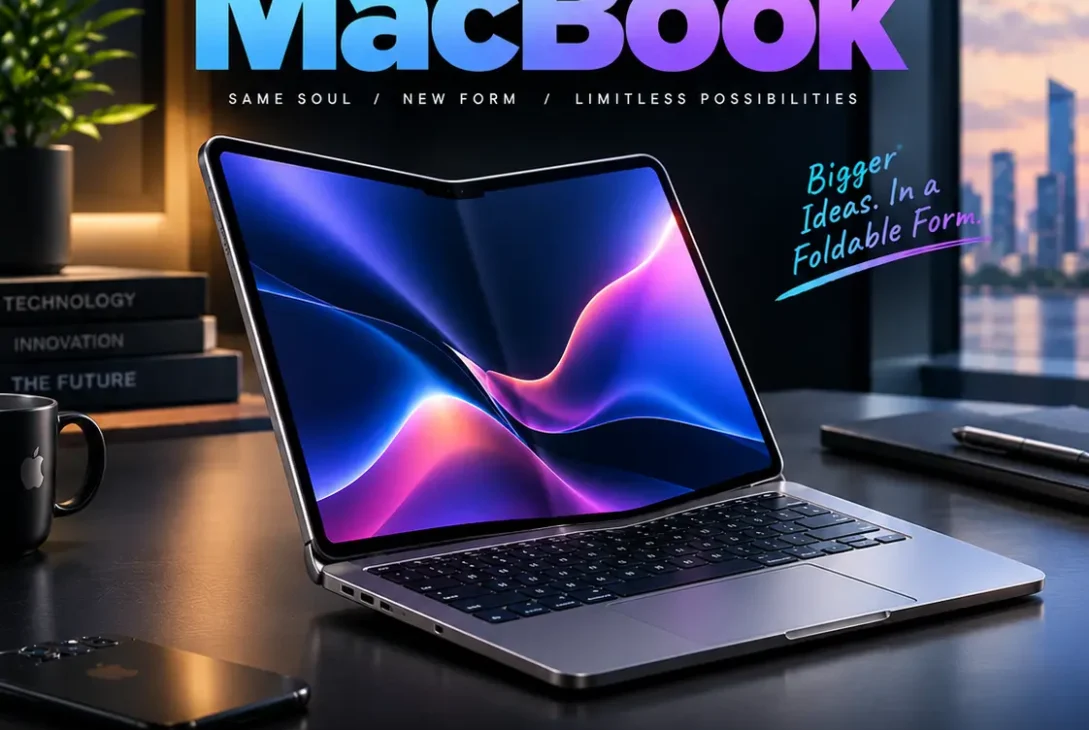
The foldable macbook has been one of Apple’s most interesting rumored products in recent years. Unlike the company’s traditional laptops, the rumored device was expected to replace the conventional keyboard-and-display arrangement with a large folding screen, creating a MacBook that could transform from a compact notebook into a much larger display.
However, the latest foldable macbook news is not entirely positive.
In September 2026, research firm Omdia reportedly said Apple had scrapped development of a large foldable MacBook that was expected to measure between approximately 16.1 and 18 inches when unfolded. The project had already faced delays after earlier reports suggested Apple was struggling with the cost and weight of the folding display.
That means the foldable macbook should not currently be treated as a confirmed upcoming Apple product.
Before the reported cancellation, multiple analysts and Apple-focused publications had described a large foldable device that could feature an approximately 18.8-inch OLED screen. Some reports described it as a MacBook, while others suggested Apple could position it as a large foldable iPad or a hybrid device running macOS.
The idea remains fascinating because Apple has already built an ecosystem where MacBooks, iPads, and iPhones increasingly overlap in hardware capabilities.
A foldable macbook could take that convergence much further.
Instead of carrying a conventional laptop with a fixed keyboard and display, users could potentially unfold one large screen, use a virtual keyboard, connect an external keyboard, or use the device as a giant portable display.
So what happened to Apple’s rumored folding MacBook, and could the company eventually bring the concept back?
Here’s everything you need to know.
Table of Contents
- Foldable MacBook: Latest Update
- Is the Foldable MacBook Cancelled?
- What Was Apple’s Original Foldable MacBook Plan?
- Expected Foldable MacBook Display
- Why Apple Wanted an 18.8-Inch Screen
- Foldable MacBook Design
- Virtual Keyboard vs Physical Keyboard
- macOS on a Foldable MacBook
- Performance and Apple Silicon
- Foldable MacBook Display Technology
- The Biggest Engineering Challenges
- Foldable MacBook Price
- Foldable MacBook Release Date
- Foldable MacBook vs MacBook Pro
- Foldable MacBook vs iPad Pro
- Could Apple Bring It Back?
- Frequently Asked Questions
- Final Verdict
- SEO Details
Foldable MacBook: Latest Update
The latest foldable macbook development significantly changes the story surrounding Apple’s rumored large-screen folding computer.
According to a September 2026 report citing Omdia, Apple has canceled development of a large foldable MacBook that would have measured approximately 16.1 to 18 inches when unfolded.
This is important because previous reports had suggested the project was still being developed.
Apple had reportedly been exploring a much larger foldable device for several years.
Earlier rumors suggested an 18.8-inch OLED panel, while another reported configuration involved a 20.2-inch display. Apple’s goal was reportedly to create a folding screen with an extremely subtle crease.
The project faced several challenges.
A very large folding OLED panel would be expensive to manufacture, difficult to protect, and potentially heavy.
Apple would also need to create a hinge mechanism capable of supporting a huge flexible display without creating an obvious crease.
Those challenges appear to have contributed to delays.
What Does This Mean?
The current situation means the foldable macbook is not a product consumers should expect to buy in the immediate future.
It also does not necessarily mean Apple has abandoned foldable technology forever.
Apple has continued researching foldable displays for different product categories, and the company has been linked to both foldable iPhone and larger foldable iPad concepts.
The technology could eventually return when manufacturing costs and durability improve.
Is the Foldable MacBook Cancelled?
Based on the latest Omdia report, the specific large foldable macbook project appears to have been canceled.
However, Apple has not publicly announced that it canceled the product because Apple never officially announced the product in the first place.
This distinction matters.
Most information about the foldable macbook came from analysts, supply-chain reports, and Apple-focused publications rather than Apple itself.
Therefore, there is no official Apple statement saying:
“The Foldable MacBook has been canceled.”
Instead, the current information comes from reports tracking Apple’s hardware development.
That means Apple could potentially revive the project later under a different design or product category.
The company could also decide that a large folding device makes more sense as an iPad rather than a MacBook.
What Was Apple’s Original Foldable MacBook Plan?
The rumored foldable macbook was very different from today’s MacBook Air and MacBook Pro.
Instead of having a fixed keyboard and separate display, Apple was reportedly exploring a device with one large folding display.
When closed, the device could resemble a traditional laptop.
When opened, the screen would become dramatically larger.
One possible design would allow the device to operate like a notebook when partially folded and like a large monitor when fully opened.
Another concept involved an all-screen design with no permanent physical keyboard.
Users could potentially place an external keyboard in front of the screen when working at a desk.
This approach would give the foldable macbook a major advantage in screen size while keeping its folded footprint relatively compact.
Expected Foldable MacBook Display
The display was always expected to be the defining feature.
Reports from Apple analysts suggested a folding OLED panel measuring approximately 18.8 inches when fully opened.
An 18.8-inch screen would be enormous compared with Apple’s current portable MacBooks.
For comparison, Apple’s conventional MacBook Pro lineup has traditionally topped out at around 16 inches.
An 18.8-inch foldable macbook could therefore provide substantially more workspace.
That would be useful for:
- Video editing
- Coding
- Graphic design
- Music production
- Multitasking
- Large spreadsheets
- Photo editing
- Research
- Business applications
The challenge would be maintaining high image quality while allowing the OLED panel to fold repeatedly.
Why Apple Wanted an 18.8-Inch Screen
An 18.8-inch folding screen sounds excessive at first.
But folding changes the equation.
A traditional 19-inch laptop would be enormous and difficult to carry.
A folding device could theoretically divide that large screen into two sections when closed.
The result could be a device that has a relatively portable footprint while offering desktop-class screen real estate when opened.
This is one of the main reasons the foldable macbook concept attracted so much attention.
Imagine opening a laptop and having nearly 19 inches of continuous display available.
For professional users, that could reduce the need for an external monitor.
A video editor could place a large timeline across the bottom half of the screen while keeping the preview and tools visible above.
A developer could run code on one side and documentation on the other.
A designer could use a large canvas without carrying a second monitor.
Foldable MacBook Design
The physical design would have been one of Apple’s biggest engineering challenges.
A conventional MacBook has two rigid halves connected by a hinge.
A foldable macbook would instead require a flexible display capable of bending repeatedly.
The hinge would have to control the folding radius very precisely.
A poor hinge design could create:
- Visible creasing
- Screen stress
- Uneven folding
- Mechanical wear
- Display damage
- Increased thickness
Apple reportedly wanted the crease to be as subtle as possible.
That requirement is one reason the project was considered technically difficult.
Apple would also need to protect the flexible OLED panel from scratches and impacts.
Virtual Keyboard vs Physical Keyboard
One of the most interesting questions surrounding the foldable macbook was the keyboard.
If the entire interior surface became a display, Apple could not use the traditional physical keyboard found on current MacBooks.
Instead, the company could use a virtual keyboard displayed directly on the lower section of the screen.
This would create several advantages.
The keyboard could:
- Change languages
- Adapt to different applications
- Display shortcuts
- Support gaming layouts
- Provide contextual controls
But there would also be a major disadvantage.
Physical keyboards provide tactile feedback.
Many MacBook users type thousands of words every day and prefer physical keys.
Apple could potentially solve this with haptic feedback.
The virtual keyboard could use localized vibrations to simulate key presses.
However, it would still not feel exactly like a physical keyboard.
Another possibility would be supporting an external Magic Keyboard.
That would allow the foldable macbook to function more like a desktop workstation when needed.
macOS on a Foldable MacBook
Software would be just as important as the hardware.
A foldable macbook would require macOS to adapt dynamically to different screen configurations.
When folded, the operating system might display a traditional laptop interface.
When fully opened, macOS could provide a larger desktop workspace.
Apple could also introduce specialized multitasking features.
For example:
Laptop mode
A virtual keyboard could occupy the bottom section while applications run above it.
Desktop mode
The entire display could become one large workspace when connected to an external keyboard and mouse.
Tablet mode
The device could potentially support touch interactions for certain applications.
This could make the foldable macbook more flexible than any current MacBook.
Performance and Apple Silicon
Performance would likely be handled by Apple silicon.
Apple’s M-series chips have already demonstrated that powerful processors can operate efficiently in thin laptops.
A future folding Mac could potentially use an Apple silicon chip optimized for a combination of:
- CPU performance
- GPU performance
- AI workloads
- Battery efficiency
- Thermal management
However, a folding computer would have unique cooling challenges.
A large screen does not necessarily mean a large internal chassis.
Apple would need to keep the device thin while providing enough cooling for sustained workloads.
This becomes especially important for professional applications such as:
- Final Cut Pro
- Adobe Premiere Pro
- Photoshop
- Xcode
- Blender
- Logic Pro
- 3D applications
The foldable macbook would need to perform like a genuine Mac rather than simply becoming a giant iPad.
Foldable MacBook Display Technology
OLED was widely expected to be central to Apple’s large folding device.
OLED provides several advantages for this type of product.
Each pixel generates its own light, allowing OLED displays to offer:
- Deep blacks
- High contrast
- Excellent color
- Fast response times
- Thin panel construction
But folding OLED technology is significantly more complicated than conventional OLED.
The protective layer has to remain flexible.
The panel also needs to survive thousands of folding cycles.
Apple reportedly wanted to use advanced materials to reduce the visibility of the crease.
Earlier reports discussed LG Display as a potential supplier, while Samsung Display has also been linked to Apple’s foldable-display development.
The Biggest Engineering Challenges
The foldable macbook concept looks exciting, but several problems could make it difficult to launch.
Display Durability
A folding OLED must survive repeated movement.
Even a small weakness in the flexible panel could become a serious problem over time.
Crease
The folding area naturally wants to develop a visible crease.
Apple’s reputation for polished hardware means the company may be unwilling to launch a product with a distracting crease.
Weight
A large folding display requires additional structural materials.
That can increase weight.
A laptop that is extremely large when open but heavy when carried would lose some of the portability benefit.
Cost
Large flexible OLED panels are expensive.
A premium Apple device with a huge folding display could cost significantly more than a standard MacBook Pro.
Software
macOS would need to adapt to multiple physical configurations.
That requires both interface changes and application support.
These challenges help explain why the foldable macbook project reportedly experienced delays and eventually faced cancellation reports.
Foldable MacBook Price
There is no official price because Apple never announced the product.
Earlier reports suggested the large folding MacBook could be extremely expensive.
MacRumors previously noted that Apple’s large foldable device could potentially cost up to three times the price of a 13-inch iPad Pro, which would place it firmly in the premium category.
That would make sense considering the cost of:
- Large OLED panels
- Flexible display materials
- Advanced hinges
- Apple silicon
- Custom engineering
- Low-volume manufacturing
A hypothetical foldable macbook could therefore have started well above the price of a conventional MacBook Pro.
That high price may also have been one of the reasons the product was difficult to justify commercially.
Foldable MacBook Release Date
There is currently no confirmed release date.
Earlier predictions varied considerably.
Some analysts originally suggested 2026.
Later reports pushed the timeline toward 2027.
Other reports suggested 2028.
More recent reporting has gone even further, with the large foldable project reportedly canceled according to Omdia.
This demonstrates why exact release-date claims surrounding the foldable macbook should be treated cautiously.
Apple has not announced a launch window.
Could It Still Launch Later?
Yes, theoretically.
Apple could revive the concept after improving:
- Display durability
- Manufacturing costs
- Hinge technology
- Weight
- Software
- Battery efficiency
The company could also redesign the product as an iPad rather than a MacBook.
Foldable MacBook vs MacBook Pro
A foldable macbook would have offered a very different experience from the MacBook Pro.
| Feature | Foldable MacBook Concept | MacBook Pro |
|---|---|---|
| Display | Large flexible OLED | Conventional display |
| Keyboard | Potentially virtual/external | Physical keyboard |
| Screen size | Around 18.8 inches rumored | Up to 16 inches |
| Folding | Yes | No |
| Touch | Potentially | Current models traditionally limited |
| Portability | Compact when folded | Conventional laptop |
| Durability | Major concern | Mature design |
| Price | Potentially extremely high | Established premium pricing |
The MacBook Pro remains much more practical for professionals who need predictable performance and durability.
The foldable macbook would have been more attractive to users who prioritize screen size and flexibility.
Foldable MacBook vs iPad Pro
The concept also creates an interesting comparison with the iPad Pro.
An iPad Pro is already extremely thin and portable.
A large folding Mac could potentially combine some of the iPad’s portability with macOS functionality.
That would create a new category between Apple’s laptops and tablets.
The biggest difference would be software.
An iPad uses iPadOS.
A MacBook uses macOS.
A foldable macbook would make the most sense if Apple gave users access to full desktop applications rather than simply creating a larger iPad.
That could include professional software such as Final Cut Pro, Xcode, Logic Pro, and full desktop versions of creative applications.
Could Apple Bring It Back?
The cancellation reports do not necessarily mean Apple has abandoned foldable computing permanently.
Apple has a long history of working on products internally for years before launching them—or abandoning them entirely.
The company’s foldable research could eventually produce a different product.
For example, Apple could develop:
- A foldable iPad
- A large hybrid Mac
- A touchscreen MacBook
- A foldable external display
- A new notebook form factor
Recent reports also indicate Apple is working on touchscreen Macs, including future MacBook Pro designs.
That development could eventually make a folding Mac more practical.
The foldable macbook may therefore be better understood as a concept that could evolve rather than a product with a guaranteed future.
Frequently Asked Questions
Is the Foldable MacBook real?
Apple has reportedly worked on a large folding Mac-like device, but it was never officially announced. Recent reporting says Omdia believes Apple canceled development of the large foldable MacBook project.
When will the Foldable MacBook release?
There is currently no confirmed release date. Earlier rumors suggested 2026, 2027, or 2028, but the latest reports indicate the large project may have been canceled.
How big would the Foldable MacBook screen be?
Earlier reports suggested an approximately 18.8-inch folding OLED display, while other reports discussed displays around 20 inches.
Would the Foldable MacBook have a physical keyboard?
The exact design was never confirmed. One possibility was an all-screen design with a virtual keyboard, while another concept involved using an external physical keyboard.
Would it run macOS?
Some reports suggested the large foldable could function as a MacBook-iPad hybrid running macOS. However, Apple never confirmed the operating system or final product category.
How much would the Foldable MacBook cost?
There is no official price. Earlier reports suggested it could be significantly more expensive than a conventional MacBook because of its large flexible OLED display and complex hinge system.
Why was the Foldable MacBook reportedly canceled?
The latest reporting points to Apple’s decision to scrap the project, while previous reports highlighted the cost and weight challenges associated with a very large folding display.
Will Apple make a foldable MacBook in the future?
It is possible, but there is no confirmation. Apple could revisit the technology when flexible displays become cheaper, lighter, thinner, and more durable.
Is the Foldable MacBook the same as a foldable iPad?
Not necessarily. Reports have used both descriptions for Apple’s large folding device, which is why its eventual product category has remained uncertain.
Should I wait for a Foldable MacBook?
No specific waiting decision makes sense right now because there is no confirmed product or release date. If you need a Mac today, Apple’s current MacBook lineup is the practical choice.
https://www.apple.com/mac/
Final Verdict
The foldable macbook remains one of Apple’s most fascinating hardware concepts, but the latest news has changed its outlook considerably.
For years, reports suggested Apple was developing a large folding device with an approximately 18.8-inch OLED screen.
The concept promised to combine the portability of a laptop with the workspace of a much larger monitor.
An 18.8-inch foldable macbook could have transformed productivity for professionals, designers, developers, video editors, and anyone who regularly works with multiple windows.
But making that idea practical is extremely difficult.
Apple would need to solve the crease problem, improve flexible OLED durability, control weight, reduce manufacturing costs, develop a sophisticated hinge, and adapt macOS to a completely new form factor.
The latest Omdia report suggests Apple has now canceled the large foldable MacBook project.
That does not necessarily mean Apple’s foldable ambitions are finished.
The company is still rumored to be exploring foldable displays and new Mac designs, while future touchscreen Macs could make the boundary between Apple’s laptop and tablet platforms more flexible.
For now, however, consumers should not expect to see a foldable macbook arrive as an imminent retail product.
The most realistic conclusion is that Apple experimented with the idea, encountered significant engineering and cost challenges, and may have decided that the technology is not ready for a mass-market Mac.
If flexible OLED technology improves dramatically over the next few years, Apple could always revisit the concept.
And if it does, the eventual foldable macbook could be considerably more polished than the original rumors suggested.