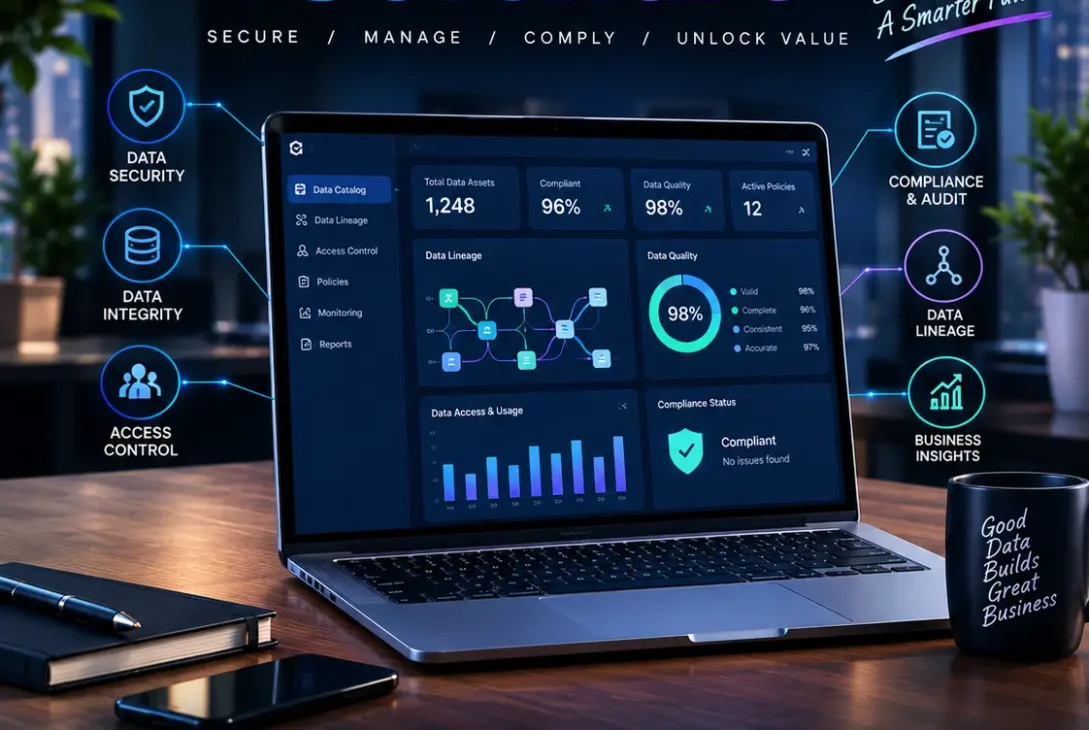
Modern businesses generate enormous amounts of information across cloud platforms, databases, SaaS applications, analytics systems, customer platforms, and AI tools. Managing that information effectively requires more than traditional data storage. Organizations need to know what data they have, where it came from, who can access it, whether it is accurate, and how it is being used. This is where data governance software becomes increasingly important.
A modern data governance software platform can help organizations create a structured approach to data discovery, classification, access management, quality, lineage, privacy, and compliance. Instead of relying on disconnected spreadsheets and manual processes, businesses can use centralized governance capabilities to understand and manage their data estate.
Data governance has also become more important as companies adopt artificial intelligence. AI systems depend heavily on the quality and reliability of the information they consume. Microsoft notes that data governance helps organizations make data discoverable, accurate, trusted, and protected, while IBM describes governance as a discipline focused on data quality, security, availability, privacy, and defined policies.
This guide explains what data governance software is, how it works, the most important features to look for, its benefits for different departments, common implementation mistakes, and how to choose the right platform for your organization.
Table of Contents
- What Is Data Governance Software?
- Why Data Governance Matters
- How Data Governance Software Works
- 9 Essential Features
- Benefits of Data Governance Software
- Data Governance for Security Teams
- Data Governance for Compliance
- Data Governance for AI
- Data Governance for Finance and Business Teams
- How to Choose the Right Platform
- Common Implementation Mistakes
- Data Governance Best Practices
- Frequently Asked Questions
- Final Verdict
- SEO Details
What Is Data Governance Software?
Data governance software is a category of technology designed to help organizations manage how data is discovered, understood, classified, accessed, protected, monitored, and used.
The goal is not simply to store information.
Instead, governance creates rules and processes around data so that employees can confidently find and use the information they need while organizations maintain appropriate security, privacy, and compliance controls.
A typical platform can help manage:
- Data catalogs
- Business glossaries
- Data ownership
- Access policies
- Data classification
- Sensitive information
- Data lineage
- Data quality
- Metadata
- Audit information
- Compliance requirements
Modern governance platforms increasingly connect information from multiple environments rather than focusing on a single database.
For example, Microsoft Purview provides capabilities for data discovery, classification, lineage, governance domains, data products, access policies, and data quality.
This makes data governance software particularly useful for organizations operating across multiple cloud providers, databases, analytics platforms, and SaaS applications.
Why Data Governance Matters
Data is only valuable when an organization can trust and use it appropriately.
A company may have millions of records but still struggle to answer basic questions:
- Where is customer information stored?
- Which database contains the most accurate revenue data?
- Who owns a particular dataset?
- Which employees can access sensitive information?
- Where did a number in a business report originate?
- Is personal information being handled appropriately?
- Can employees safely use this data for AI applications?
Without clear governance, different departments may create their own definitions, processes, and access rules.
This can produce inconsistent reports and increase security risks.
A data governance software platform provides a centralized framework for answering these questions.
Data Is Becoming More Distributed
Businesses increasingly operate hybrid and multicloud environments.
Information may exist in:
- Cloud data warehouses
- Object storage
- Databases
- CRM systems
- ERP platforms
- Data lakes
- Business intelligence platforms
- AI systems
- SaaS applications
This creates a visibility challenge.
A governance platform can connect metadata from different sources and provide a broader picture of the organization’s data environment.
How Data Governance Software Works
A data governance software platform generally works by collecting and organizing metadata about an organization’s data assets.
Metadata can describe:
- Dataset names
- Data owners
- Columns
- Classifications
- Locations
- Relationships
- Access permissions
- Business definitions
- Data quality information
- Lineage
The platform can then make this information searchable and useful to different teams.
Data Discovery
Data discovery helps employees find relevant information without asking IT teams to manually locate every dataset.
For example, a marketing analyst searching for customer information might discover several datasets and compare their descriptions, ownership, quality information, and access requirements.
Data Classification
Classification helps organizations identify sensitive information.
Examples include:
- Personal information
- Financial information
- Health-related information
- Credentials
- Confidential business information
Some platforms can automatically identify and classify sensitive information.
Databricks Unity Catalog, for example, provides classification capabilities for sensitive data and governance controls across data and AI assets.
Data Lineage
Lineage shows how information moves from its original source to downstream systems.
This can help answer questions such as:
Where did this report number come from?
A lineage view may show the journey from a source database through transformation pipelines into a warehouse and eventually into a dashboard.
Microsoft describes lineage as a way to understand how data transforms and flows from its origin to its destination, supporting troubleshooting, quality analysis, compliance, and impact analysis.
9 Essential Features of Data Governance Software
Not every governance platform provides the same functionality. However, several capabilities are particularly important when evaluating a solution.
1. Data Catalog
A data catalog creates an organized inventory of data assets.
Instead of forcing employees to search through different systems manually, the catalog provides a central discovery experience.
A useful catalog can include:
- Dataset descriptions
- Owners
- Business definitions
- Classifications
- Quality information
- Usage information
- Access options
The catalog becomes a searchable map of the organization’s data environment.
2. Business Glossary
Different departments can use different terms for the same concept.
For example, the word “customer” might have different definitions between sales, finance, and marketing.
A business glossary creates standardized definitions.
This improves communication and reduces confusion when teams build reports, analytics models, or AI applications.
3. Data Classification
Classification helps organizations identify important and sensitive information.
A data governance software platform may allow administrators to create classification rules and automatically identify specific categories of data.
This can help security teams prioritize sensitive assets and apply appropriate controls.
4. Access Management
Organizations need to control who can access data.
Governance platforms can provide visibility into permissions and, depending on the product, help implement access policies.
Modern governance systems increasingly support fine-grained controls such as row-level and column-level restrictions. Databricks Unity Catalog, for example, documents fine-grained access controls, row filters, and column masks.
5. Data Lineage
Lineage is one of the most valuable capabilities for large data environments.
When a source changes, teams need to understand which reports, applications, or models could be affected.
A data governance software platform with lineage can visualize relationships between upstream and downstream assets.
This makes impact analysis considerably easier.
6. Data Quality Monitoring
Bad data can lead to bad decisions.
Data quality monitoring can identify issues involving:
- Missing values
- Unexpected changes
- Duplicate records
- Incorrect formats
- Freshness problems
- Inconsistent information
Some modern platforms can monitor data quality continuously and surface anomalies.
Unity Catalog, for example, includes data quality monitoring and anomaly detection capabilities.
7. Metadata Management
Metadata provides context around data.
Without metadata, a database table may simply contain technical names that are difficult for business users to understand.
Metadata management can connect technical information with business descriptions, owners, classifications, and governance policies.
8. Auditing and Monitoring
Organizations need visibility into data access.
Audit capabilities can help answer:
- Who accessed a dataset?
- When was it accessed?
- What actions occurred?
- Which users have access?
- What changes were made?
This information can be useful for security investigations and compliance processes.
9. Policy Management
Governance requires policies.
A data governance software platform can help organizations define and communicate rules around data access, retention, classification, ownership, and acceptable use.
Policies become particularly important when organizations operate across multiple jurisdictions or industries with specific regulatory requirements.
Benefits of Data Governance Software
Implementing data governance software can provide benefits across the organization rather than only within the IT department.
Better Data Visibility
The first major benefit is visibility.
Organizations can create a clearer inventory of their data assets and understand how different systems connect.
This is especially useful when information is distributed across multiple environments.
Improved Data Quality
When organizations can monitor data quality consistently, problems can be identified earlier.
Instead of discovering inaccurate information after a report has already been distributed, teams can establish checks and ownership processes.
Stronger Security
Governance and security are closely connected.
Understanding where sensitive information exists and who can access it makes it easier to apply appropriate security controls.
Faster Data Discovery
Employees spend less time searching for information.
A searchable catalog can help users find relevant datasets and understand what those datasets contain.
Better Compliance
Governance can support compliance by helping organizations document data ownership, classifications, access, policies, and lineage.
However, governance software does not automatically make an organization compliant. Companies still need appropriate policies, controls, processes, and legal guidance.
Reduced Data Silos
A data governance software platform can provide a unified view across systems that were previously managed independently.
This can help organizations identify duplicate datasets and improve collaboration between departments.
More Reliable AI
AI systems depend on reliable information.
If an organization feeds inaccurate, poorly understood, or improperly governed data into an AI system, the resulting outputs may be unreliable.
Governance can help establish trusted datasets and clearer controls around AI data usage.
Data Governance for Security Teams
Security teams can use governance tools to understand the organization’s data environment.
One of their biggest challenges is knowing where sensitive information exists.
A governance platform can help identify assets containing sensitive information and connect those assets with ownership and access information.
This can improve risk assessment.
Identifying Excessive Access
Employees don’t always need access to every dataset available within an organization.
Governance teams can review permissions and identify access that may be broader than necessary.
This supports the principle of least privilege.
Supporting Security Investigations
When a security incident occurs, lineage and audit information can help investigators understand what happened.
They may need to determine:
- Which data was affected
- Where it originated
- Which systems received it
- Who accessed it
- Which downstream systems depend on it
A centralized governance platform can make this investigation easier.
Data Governance for Compliance
Regulatory requirements differ by industry and jurisdiction, but many organizations need to demonstrate that sensitive information is handled appropriately.
A data governance software platform can support compliance workflows by providing visibility into data ownership, classifications, access, lineage, and policies.
For example, organizations may need to identify personal information before applying retention or access rules.
Governance can also provide documentation that helps internal teams understand how information moves throughout the business.
The exact compliance requirements still depend on the organization’s industry, location, and applicable regulations.
Data Governance for AI
Artificial intelligence has made governance even more important.
Companies are increasingly using AI for:
- Customer support
- Analytics
- Software development
- Marketing
- Document processing
- Business intelligence
- Automation
These systems often depend on large amounts of organizational data.
If the underlying information is inaccurate or poorly governed, AI systems may produce unreliable results.
Microsoft specifically highlights the importance of trusted, high-quality data for AI and positions governance as part of responsible innovation.
AI Creates New Governance Questions
Organizations now need to ask:
- Which data can AI systems access?
- Can sensitive information be sent to external models?
- Which datasets were used to train or evaluate a model?
- Who owns AI-generated data?
- How should AI-related data be classified?
- Can users access confidential information through AI tools?
A modern data governance software platform can help establish the visibility needed to answer these questions.
Data Governance for Finance and Business Teams
Data governance is not only a technical concern.
Finance teams rely on accurate information for forecasting, reporting, budgeting, and decision-making.
If different departments use different definitions of revenue, customers, or expenses, financial reporting can become inconsistent.
A shared glossary and clear data ownership can reduce these problems.
Business teams also benefit from being able to discover trusted datasets without relying entirely on technical teams.
https://learn.microsoft.com/en-us/purview/data-gov-classic-lineage
How to Choose the Right Data Governance Software
Choosing the right data governance software requires more than comparing feature lists.
Start by identifying the organization’s actual problems.
Define Your Governance Goals
Ask what you want to improve first.
Possible goals include:
- Data discovery
- Data quality
- Security
- Compliance
- AI governance
- Data lineage
- Access management
- Metadata management
A company focused on compliance may prioritize classification and auditing, while an analytics-heavy company may prioritize cataloging, quality, and lineage.
Check Data Source Integrations
The platform should support the systems your organization actually uses.
Look at integrations with:
- Cloud storage
- Databases
- Data warehouses
- BI tools
- ETL platforms
- SaaS applications
- Identity systems
- AI platforms
Poor integration can make governance incomplete.
Evaluate Automation
Manual governance becomes difficult as the data environment grows.
Look for automation around:
- Data discovery
- Classification
- Metadata collection
- Quality monitoring
- Policy enforcement
- Lineage collection
- Alerts
Consider Ease of Use
A technically powerful platform can still fail if business users don’t understand how to use it.
The interface should make it easy to search, understand, request, and manage data.
Review Scalability
The governance platform should be capable of growing with the organization.
Consider:
- Number of data sources
- Number of users
- Cloud environments
- Data volume
- AI workloads
- Future integrations
Common Implementation Mistakes
Trying to Govern Everything Immediately
Organizations often make the mistake of attempting to catalog and classify every data asset on day one.
A better approach is to start with important business domains and expand gradually.
Ignoring Data Ownership
Governance requires accountability.
Every important dataset should have clear ownership.
Without owners, quality issues and access questions can remain unresolved.
Treating Governance as an IT-Only Project
IT can provide the technology, but governance also involves business users, security teams, legal departments, compliance professionals, and data owners.
Creating Too Many Policies
Overly complicated policies can make governance difficult to follow.
Policies should be understandable and practical.
Ignoring Data Quality
A catalog full of inaccurate or outdated datasets doesn’t create much value.
Governance should include quality monitoring and remediation processes.
Forgetting AI Applications
Organizations that build governance strategies without considering AI may quickly find themselves dealing with unmanaged data flows into AI systems.
Data Governance Best Practices
A successful governance program should begin with clear responsibilities.
Establish Data Ownership
Assign responsible owners to important datasets and business domains.
Create Consistent Definitions
Use a business glossary to standardize important terms.
Prioritize Sensitive Data
Identify and classify information that creates the greatest security or compliance risk.
Monitor Data Quality
Establish measurable quality standards and monitor important datasets continuously.
Track Data Lineage
Use lineage information to understand where data comes from and where it goes.
Review Access Regularly
Permissions should be reviewed periodically rather than granted permanently without oversight.
Start Small and Expand
Begin with a high-value business area, prove the governance model, and then expand across the organization.
Frequently Asked Questions
What is data governance software?
Data governance software is technology that helps organizations discover, classify, understand, secure, monitor, and manage their data assets through centralized governance capabilities.
Why is data governance important?
Data governance helps organizations improve data quality, security, privacy, accessibility, ownership, and compliance while making trusted information easier to discover and use.
What features should data governance software have?
Important features include data catalogs, business glossaries, classification, access controls, metadata management, lineage, quality monitoring, auditing, policy management, and integrations.
Can data governance software improve data security?
Yes. It can provide visibility into sensitive data, ownership, classifications, permissions, and access activity. It should complement broader cybersecurity controls rather than replace them.
Does data governance software help with compliance?
It can support compliance by providing information about data locations, classifications, ownership, access, lineage, and governance policies. Actual compliance depends on the organization’s complete controls and applicable regulations.
What is data lineage?
Data lineage describes how data moves and changes from its original source through processing systems to downstream destinations such as reports, applications, or AI models.
Why is data lineage important?
Lineage helps organizations troubleshoot data problems, perform impact analysis, understand transformations, and investigate how information moves through their environment.
Can data governance software help AI projects?
Yes. Governance can help organizations identify trusted datasets, manage access, classify sensitive information, and understand how data is used by AI systems.
Is data governance only for large enterprises?
No. Smaller organizations can also benefit from clear data ownership, catalogs, quality processes, and access controls. The platform should be scaled according to the organization’s needs.
How do I choose the best data governance platform?
Identify your primary governance goals first, then compare supported data sources, integrations, catalog capabilities, lineage, classification, quality monitoring, automation, security controls, scalability, and total cost.
What is the difference between data governance and data management?
Data management is the broader discipline of collecting, storing, processing, protecting, and maintaining data. Data governance establishes the rules, responsibilities, policies, and standards that guide how data should be managed and used.
Final Verdict
Data governance software has become increasingly important as organizations manage larger, more distributed, and more complex data environments.
A modern platform can bring together data discovery, cataloging, classification, access management, lineage, quality monitoring, auditing, and policy management. These capabilities can help organizations build a clearer understanding of their data and make information more trustworthy.
The biggest value does not come from simply purchasing a governance platform.
Organizations also need clear ownership, practical policies, consistent definitions, quality standards, security controls, and employee participation.
For companies adopting AI, governance is becoming even more important. Trusted data is essential for reliable analytics and responsible AI, while visibility into sensitive information and access helps reduce unnecessary risk.
The best approach is usually to start with the organization’s highest-value data and most important business problems. Once the governance framework proves useful, it can be expanded across additional departments, data sources, and AI workloads.
For businesses looking to turn increasingly complex data environments into a more organized, trusted, and usable resource, the right data governance software can become a central part of the modern data strategy.