
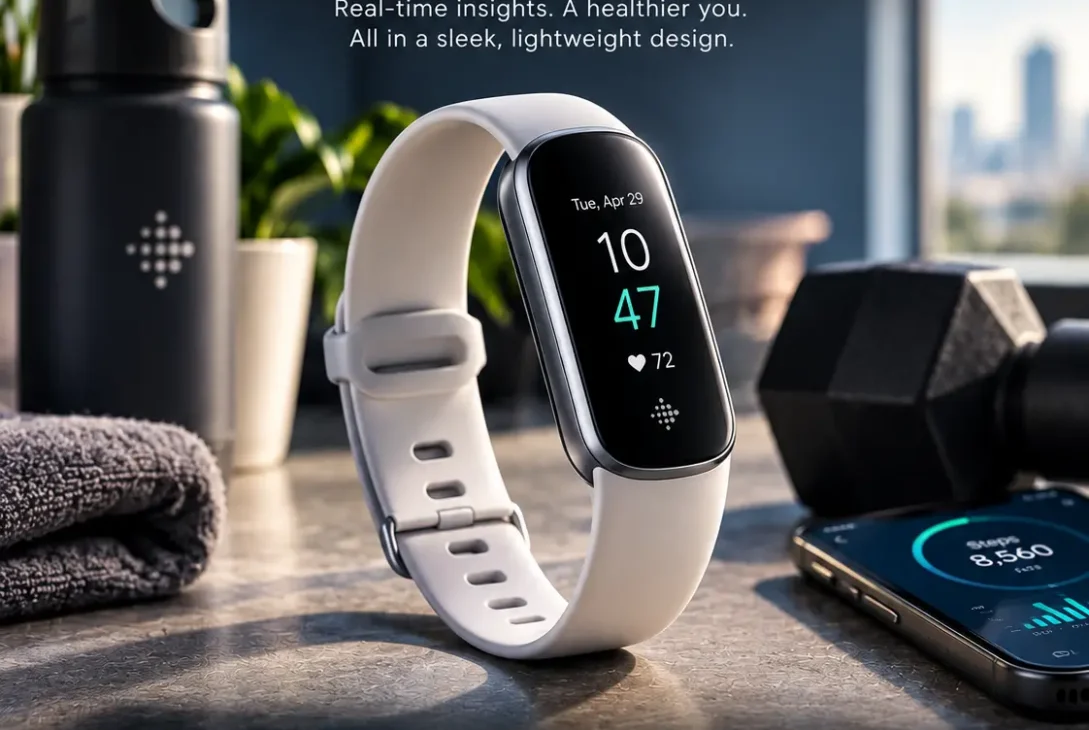
The Google Fitbit Air is Google’s new screenless fitness tracker designed for people who want continuous health and activity tracking without wearing a traditional smartwatch. Instead of adding a display, notifications, apps, and a large watch body to your wrist, it focuses on sensors, comfort, battery life, and the Google Health app.
Google introduced the tracker in May 2026 as its smallest Fitbit tracker, with a lightweight pebble-style design intended for 24/7 wear. It starts at $99.99 in the United States and includes three months of Google Health Premium.
The company has also expanded the device’s capabilities through Google Health. It can track heart rate, activity, sleep, SpO2, heart-rate variability, breathing rate, skin-temperature variation, Cardio Load, Readiness, and other wellness metrics.
In India, Google announced that the tracker will go on sale October 2, 2026, for ₹13,999.
So, is this compact tracker worth considering, and what exactly does it offer?
Table of Contents
- What Is Google Fitbit Air?
- Google Fitbit Air Price and Availability
- Design and Comfort
- Screenless Approach
- Battery Life and Charging
- Health Tracking Features
- Fitness and Activity Tracking
- Sleep Tracking
- Google Health App
- Gemini-Powered Health Coach
- Health Guardian Features
- Google Fitbit Air Compatibility
- Water and Sweat Resistance
- Fitbit Air Special Editions
- Google Fitbit Air vs Smartwatch
- Pros and Limitations
- Who Should Buy It?
- Frequently Asked Questions
- Final Verdict
- SEO Details
What Is Google Fitbit Air?
The Google Fitbit Air is a screenless wearable designed around continuous health and fitness tracking.
Unlike the Pixel Watch, there is no traditional display to interact with directly.
Instead, the tracker collects data throughout the day and sends that information to the Google Health app on your smartphone.
Google describes it as a discreet wearable designed to be comfortable enough for 24/7 use. Its small size also makes it suitable for sleeping, workouts, work, and everyday activities.
The idea is straightforward:
Wear the tracker → collect health data → view insights on your phone → use Google Health for guidance.
This approach also removes many of the distractions associated with a smartwatch.
There are no constant notifications or apps competing for your attention on your wrist.
Google Fitbit Air Price and Availability
The starting US price is $99.99.
Google also sells a Stephen Curry Special Edition at a higher price, while additional bands and styles are available separately.
In India, Google announced a price of ₹13,999, with retail availability beginning October 2, 2026. The Indian version includes three months of Google Health Premium.
| Feature | Google Fitbit Air |
|---|---|
| Starting US price | $99.99 |
| India price | ₹13,999 |
| Display | Screenless |
| Battery | Up to one week |
| Health app | Google Health |
| Premium trial | 3 months |
| Phone required | Yes |
| Android compatibility | Android 11 or newer |
| iPhone compatibility | iOS 16.4 or newer |
| Water/sweat resistance | Yes |
The price puts the tracker well below many premium smartwatches while still giving users access to a broad set of health-monitoring features.
Design and Comfort
One of the biggest selling points of the Google Fitbit Air is its compact design.
Google calls it its smallest tracker yet, using a discreet pebble-shaped sensor module that sits inside a flexible band.
The company designed the wearable to remain comfortable during both daytime and nighttime use.
The tracker can be worn while:
- Working
- Exercising
- Walking
- Sleeping
- Traveling
- Relaxing
- Performing everyday activities
Because there is no screen, the device can remain visually minimal.
That could appeal to people who don’t want a traditional smartwatch on their wrist.
Interchangeable Bands
Google offers several band styles.
These include:
- Performance Loop
- Active Band
- Elevated Modern Band
- Special Edition designs
The Performance Loop is designed around a flexible fit, while the Active Band uses silicone for workouts and wetter environments.
This makes it possible to change the appearance depending on the situation.
Screenless Approach
The screenless design is central to the product.
Instead of looking at your wrist for notifications or statistics, you use your phone to view detailed information.
That creates a very different experience from a Pixel Watch or Apple Watch.
The advantages include:
- Less distraction
- Lower profile
- Simpler design
- Better sleep comfort
- No watch-style notifications
- Potentially lower power consumption
The trade-off is that you cannot quickly check your steps, heart rate, or workout information directly on the wearable.
For users who prefer a traditional smartwatch interface, this could be a major limitation.
For people who want a tracker that mostly stays out of the way, the approach makes more sense.
Battery Life and Charging
Battery life is one of the strongest features of the Google Fitbit Air.
Google officially advertises up to one week of battery life. The company says the maximum figure is based on testing using pre-production hardware and software with default settings and a median user profile. Actual battery life can vary depending on enabled features, usage, environment, and other conditions.
Google also says fast charging can provide a full day of power in approximately five minutes.
This is particularly useful for sleep tracking.
Instead of needing to remove the tracker for long charging sessions, users can quickly top it up before going to bed.
For people who want continuous health monitoring, the combination of long endurance and fast charging is an important advantage.
Health Tracking Features
The Google Fitbit Air includes a wide selection of health and wellness sensors.
Google says the tracker can continuously monitor heart rate and provide information including:
- Heart rate
- Heart-rate variability
- Resting heart rate
- Blood oxygen levels
- Breathing rate
- Skin-temperature variation
- Heart rhythm
- Sleep metrics
It can also track steps, distance, calories, Cardio Load, and Readiness.
The information is processed through Google Health so users can see longer-term patterns rather than isolated readings.
https://blog.google/products-and-platforms/products/google-health/google-health-fitbit/
Heart Rate Tracking
Heart rate monitoring runs continuously in the background.
The tracker can use this information to provide a broader picture of activity, exercise, and rest.
Google also says the wearable can monitor heart rhythm while users are still or sleeping and look for signs associated with atrial fibrillation.
However, Google clearly states that the device is not intended for medical purposes, and accuracy can vary depending on physiology, device position, movement, and activity.
Fitness and Activity Tracking
The Google Fitbit Air is also designed for everyday fitness tracking.
It can monitor activity and automatically recognize common exercises.
Users can also start workouts through the Google Health app or manually log activities.
Google says automatic activity detection can improve over time and become more personalized.
The tracker can contribute to metrics such as:
Cardio Load
Cardio Load is intended to help users understand the amount of cardiovascular stress associated with activity.
Readiness
Readiness provides a daily indication intended to help users understand how prepared they may be for activity based on tracked data.
Activity Tracking
The device tracks common information such as steps, distance, calories, and active-zone minutes.
Together, these features make the tracker more useful for people who want a broad overview of their daily movement.
Sleep Tracking
Sleep tracking is one of the most natural use cases for a screenless tracker.
Because the Google Fitbit Air has no bright display and is designed for 24/7 wear, it can remain on the wrist throughout the night.
Google Health can provide information about:
- Sleep duration
- Sleep stages
- Sleep Score
- Sleep schedule
- Breathing-related metrics
- Recovery-related information
Google specifically highlights sleep tracking as part of the device’s everyday health experience.
The long battery life also makes nighttime tracking more convenient.
A user can wear the device overnight and recharge it quickly when necessary.
Google Health App
The companion software is a major part of the overall experience.
Google has transitioned the Fitbit experience into the Google Health app, bringing health information from compatible sources together in one place.
The app can combine information from:
- Fitbit devices
- Pixel Watch
- Health Connect
- Apple Health
- Other supported health information
The goal is to provide a more comprehensive view of wellness instead of keeping individual measurements separated between different apps.
A Google Account is required to set up and pair the tracker.
Gemini-Powered Health Coach
One of the more interesting aspects of the Google Fitbit Air is its connection to Google Health Coach.
Google Health Coach uses Gemini technology to provide personalized fitness, sleep, and wellness guidance through the Google Health app.
Google says Premium users can receive:
- Personalized fitness plans
- Workout recommendations
- Sleep insights
- Proactive guidance
- Health questions and answers
- Wellness recommendations
- Medical-record summaries
- Access to workout content
Google Health Premium starts at $9.99 per month or $99 per year in the United States.
The tracker includes three months of Premium with purchase.
After that period, users can decide whether they want to continue the subscription.
This means the device’s overall value isn’t determined entirely by the hardware price.
The subscription model is an important part of Google’s strategy.
Health Guardian Features
Google is also expanding Health Guardian features to Fitbit Air.
Google announced that these features include:
- Blood Pressure Trends
- Insulin Resistance Trends
- Sleep Breathing Quality
The features are designed to identify changes over time rather than provide a one-time medical diagnosis.
TechRadar reported in September 2026 that these features were rolling out to Fitbit Air through Google’s Health Guardian suite.
It’s important to distinguish wellness trends from medical measurements.
Google states that the wearable is not intended to replace professional medical equipment or medical advice.
Google Fitbit Air Compatibility
The Google Fitbit Air requires a smartphone for setup and synchronization.
Google says it works with most phones running:
- Android 11 or newer
- iOS 16.4 or newer
A Google Account and the Google Health app are also required.
This means iPhone users can also use the tracker.
You do not need to own a Pixel phone.
That gives the device a wider potential audience than Google’s smartphone ecosystem alone.
Water and Sweat Resistance
The tracker is designed for everyday activity and exercise.
Google describes the wearable and its bands as sweatproof and wetproof, with a durable silicone option intended for higher-intensity workouts and exposure to the elements.
That makes it suitable for:
- Gym sessions
- Running
- Walking
- Cycling
- Everyday exercise
- Sleep
- General daily wear
Users should still follow Google’s care and water-exposure guidance rather than assuming that any wearable can withstand every type of liquid exposure indefinitely.
Fitbit Air Special Editions
Google has also introduced special editions of the tracker.
One notable version is the Stephen Curry Fitbit Air Special Edition, created in partnership with NBA star Stephen Curry. Google positioned the edition toward fitness and sports users.
Google has also introduced a Pokémon Sleep edition designed around sleep tracking.
These editions mainly change the styling and band experience rather than turning the tracker into a completely different device.
Google Fitbit Air vs Smartwatch
The biggest difference between this tracker and a smartwatch is the user experience.
| Feature | Fitbit Air | Typical Smartwatch |
|---|---|---|
| Screen | No | Yes |
| Notifications | Phone-based | Wrist-based |
| Health tracking | Yes | Yes |
| Sleep tracking | Yes | Yes |
| Apps | No traditional apps | Yes |
| Battery | Up to one week | Usually shorter |
| Calls | No | Some models |
| GPS | Phone/app dependent | Some watches have built-in GPS |
| Distraction level | Low | Higher |
The Google Fitbit Air is therefore better understood as a health tracker rather than a miniature smartwatch.
Its purpose is to collect information quietly.
A smartwatch tries to do much more directly from the wrist.
Pros and Limitations
Pros
- Compact screenless design
- Up to one week of battery life
- Fast charging
- 24/7 heart-rate tracking
- Sleep tracking
- SpO2 tracking
- Heart rhythm monitoring
- Activity tracking
- Google Health integration
- Gemini-powered Health Coach
- Works with Android and iPhone
- Starting price of $99.99
Limitations
- No screen
- Requires a smartphone
- Google Account required
- Some advanced features require Google Health Premium
- No traditional smartwatch apps
- Health measurements are not medical diagnoses
- Actual battery life varies by usage
- Some features may have regional availability restrictions
Who Should Buy It?
The Google Fitbit Air makes the most sense for people who want health and fitness tracking without wearing a full smartwatch.
It could be particularly useful for:
- Sleep tracking
- Daily activity monitoring
- Gym workouts
- Running
- General wellness
- People who dislike smartwatch notifications
- Users who want long battery life
- Android users
- iPhone users interested in Fitbit’s health ecosystem
It may not be ideal for someone who wants apps, calls, notifications, maps, music controls, or a screen on their wrist.
Frequently Asked Questions
What is Google Fitbit Air?
Google Fitbit Air is a screenless fitness and wellness tracker designed for continuous activity, heart-rate, sleep, and health tracking through the Google Health app.
How much does Google Fitbit Air cost?
The tracker starts at $99.99 in the United States. Google announced a price of ₹13,999 in India, where it is scheduled to become available October 2, 2026.
How long does the Fitbit Air battery last?
Google advertises up to one week of battery life. Actual endurance varies depending on features, usage, environment, and other factors.
Does Fitbit Air have a screen?
No. It is intentionally designed as a screenless tracker.
Does Google Fitbit Air work with iPhone?
Yes. Google says it works with compatible iPhones running iOS 16.4 or newer. A Google Account and Google Health app are required.
Does Fitbit Air require a subscription?
Basic tracking features are available through Google Health, while Google Health Premium adds features such as Gemini-powered Health Coach and additional personalized guidance.
Can Fitbit Air track sleep?
Yes. It tracks sleep duration, sleep stages, Sleep Score, and other sleep-related metrics.
Can Fitbit Air track heart rate?
Yes. Google says the tracker provides 24/7 heart-rate tracking and also monitors other cardiovascular metrics.
Is Google Fitbit Air waterproof?
Google describes the tracker as designed for sweat and wet conditions, but users should follow Google’s care instructions for water exposure.
Does Fitbit Air have GPS?
The device is designed to work with the Google Health ecosystem and smartphone, rather than functioning like a full smartwatch with a large on-device interface. Users should check Google’s current specifications for the latest location-tracking functionality.
Final Verdict
The Google Fitbit Air takes a different approach to wearable technology.
Instead of trying to replace a smartwatch, it focuses on being a small, quiet health tracker that can remain on your wrist throughout the day and night.
Its biggest advantages are the screenless design, long battery life, health sensors, sleep tracking, Google Health integration, and access to Gemini-powered coaching.
The starting price of $99.99 also makes it considerably less expensive than many full-featured smartwatches.
However, users should remember that some of the more advanced coaching features require a Google Health Premium subscription.
The device is also not designed for people who want apps, calls, notifications, or a traditional smartwatch interface.
For someone who wants simple, discreet, long-lasting health tracking, the tracker offers a very different proposition from a conventional smartwatch.