
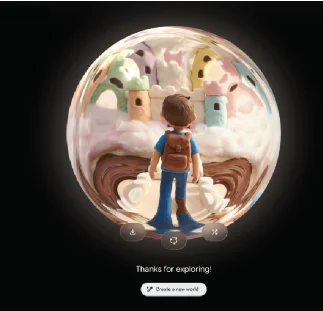
When Google unveiled its new AI-world generator, the promise sounded ambitious: create entire digital worlds from simple prompts. Landscapes, architecture, characters, physics — all generated by AI in real time. To test just how far this technology could go, I decided to build something intentionally ridiculous yet complex: marshmallow castles. What started as a playful experiment quickly became a revealing look at how AI-generated worlds may redefine creativity, game design, and digital storytelling. This wasn’t just about fluffy white towers — it was about understanding where human imagination ends and AI construction begins.
The Main Concept: What Is Google’s AI-World Generator?
Google’s AI-world generator is designed to turn natural language into fully realized virtual environments. Instead of manually modeling assets or writing complex scripts, users describe what they want, and the system generates:
- Terrain and environments
- Materials and textures
- Structural logic
- Interactive elements
- Lighting and atmosphere
It’s not just image generation or static scenes — this tool aims to create living, navigable worlds that feel coherent and intentional.
Explanation: Turning an Idea Into a World
To begin, I entered a simple prompt:
“A fantasy castle made entirely of marshmallows, with soft towers, sugary bridges, and a dreamy pastel sky.”
Within moments, the AI generated:
- Rounded white towers with realistic squish physics
- Sticky-looking marshmallow walls that reflected light softly
- Candy-like paths and melted sugar details
- A surreal but consistent fantasy atmosphere
What stood out wasn’t just the visuals — it was the structural logic. The castle didn’t collapse into nonsense. It followed architectural rules while still embracing absurdity.
Example: Where AI Surprised Me Most
I pushed the generator further with follow-up prompts:
- “Make the marshmallows slightly melting under the sun”
- “Add a soft bounce when characters walk on the ground”
- “Turn the drawbridge into toasted sugar”
Instead of breaking, the system adapted. Textures changed. Physics adjusted. The world evolved logically. This showed that the AI wasn’t just assembling assets — it was reasoning about materials, space, and cause-and-effect.
That’s where this stopped feeling like a toy and started feeling like a glimpse into the future.
Why This Matters for Creators
Google’s AI-world generator lowers barriers that once defined entire industries.
Game Designers
Small teams or solo developers can prototype entire worlds in hours instead of months.
Storytellers & Filmmakers
Scenes can be visualized instantly, turning ideas into explorable environments rather than static storyboards.
Educators
Interactive worlds can be generated for history, science, or creative learning without technical expertise.
Artists
AI becomes a collaborator — not a replacement — expanding ideas faster than manual tools ever could.
The Role of Humans in AI-Generated Worlds
Despite the power of the generator, one thing became clear: AI still needs direction.
The most interesting results came from:
- Precise wording
- Iterative prompting
- Human taste and judgment
The marshmallow castle worked because I knew what I wanted to feel, even if the AI figured out how to build it. Without intent, the outputs quickly became generic.
Creativity didn’t disappear — it shifted from execution to conceptual leadership.
Mistakes and Limitations I Noticed
Overly Vague Prompts
Generic prompts led to bland, forgettable worlds.
Style Drift
Without guidance, the AI sometimes mixed aesthetics inconsistently.
Lack of Narrative Context
The world existed beautifully, but meaning still had to be added by a human.
Optimization Gaps
Some generated assets were visually impressive but impractical for real-time performance.
These flaws don’t weaken the tool — they highlight where human input still matters.
What This Experiment Says About the Future
Building marshmallow castles may sound silly, but it reveals something serious: AI is becoming a world-builder, not just a content generator.
In the near future:
- Games may be generated on demand
- Virtual spaces could adapt in real time
- Creativity will focus more on ideas than tools
- AI literacy will become as important as design skills
Google’s AI-world generator suggests a shift from making assets to shaping realities.
Conclusion
Creating marshmallow castles in Google’s AI-world generator was more than a fun experiment — it was a preview of a new creative paradigm. The technology doesn’t replace imagination; it amplifies it. While AI can build worlds at incredible speed, it still relies on humans to give those worlds meaning, emotion, and direction. The future of creativity won’t belong to AI alone — it will belong to those who know how to guide it.