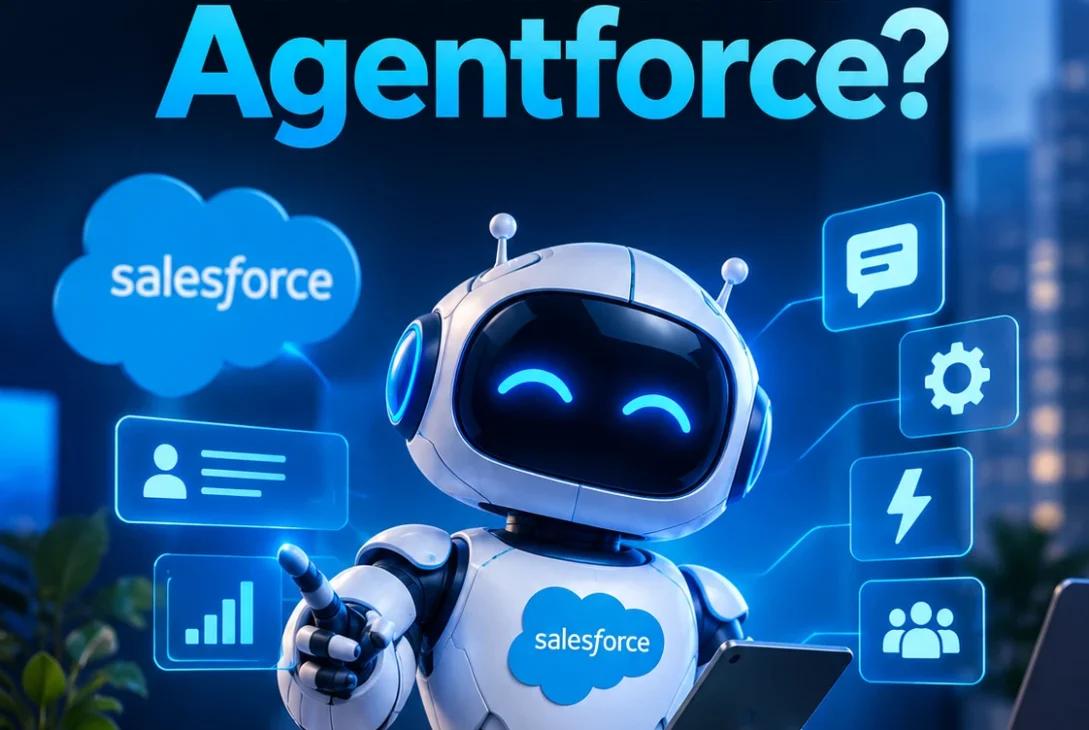
What Is Salesforce Agentforce is becoming an important question as businesses move from simple AI chatbots toward autonomous AI agents that can actually perform tasks. Salesforce Agentforce is designed to help companies deploy AI agents that can understand requests, use business data, take actions, and support employees and customers.
Instead of using AI only to generate text or answer basic questions, businesses can use Agentforce to automate parts of customer service, sales, IT, employee support, and other workflows.
Salesforce describes Agentforce as a proactive, autonomous AI application that can answer questions, take actions, and improve productivity. The platform can use business knowledge and Salesforce tools to allow agents to perform tasks based on their assigned roles.
The idea behind What Is Salesforce Agentforce is therefore closely connected to the rise of agentic AI.
Traditional chatbots usually wait for a question and provide an answer. AI agents are designed to go further by understanding a goal, determining what needs to happen, using available tools, and completing actions within defined permissions.
But how exactly does Salesforce Agentforce work, what can it do, and is it worth using for businesses?
This guide explains What Is Salesforce Agentforce, how its AI agents work, its main features, real-world use cases, pricing, benefits, limitations, security considerations, and what Agentforce could mean for the future of business automation.
Table of Contents
- What Is Salesforce Agentforce?
- How Salesforce Agentforce Works
- Salesforce Agentforce vs Traditional Chatbots
- Agentforce AI Agents and Autonomous Work
- Key Features of Salesforce Agentforce
- Salesforce Agentforce Use Cases
- Agentforce for Customer Service
- Agentforce for Sales
- Agentforce for IT and Employee Support
- Agentforce and Business Data
- Salesforce Agentforce Pricing
- Benefits of Salesforce Agentforce
- Limitations and Challenges
- Is Salesforce Agentforce Secure?
- How to Get Started With Salesforce Agentforce
- The Future of AI Agents
- Frequently Asked Questions
- Final Verdict
- SEO Details
What Is Salesforce Agentforce?
So, What Is Salesforce Agentforce?
Salesforce Agentforce is an AI agent platform that allows businesses to build, customize, and deploy autonomous AI agents for different business roles and workflows.
These agents can answer questions, retrieve business information, perform actions, and work toward specific goals.
Salesforce says Agentforce can reason through complex requests, retrieve business knowledge, take actions on behalf of users, and scale across teams and departments. Its current platform uses the Atlas Reasoning Engine to break an initial request into smaller tasks and develop a plan for completing the request.
This is an important difference from conventional AI assistants.
For example, imagine a customer asks:
“Can you check my order and tell me why it hasn’t shipped yet?”
A traditional chatbot might search a knowledge base and respond with a general shipping policy.
An Agentforce agent could potentially identify the customer, retrieve the relevant order information, check its status, explain the reason for the delay, and perform an authorized action such as updating a case or escalating the issue.
The exact actions depend on how the business configures the agent.
This means What Is Salesforce Agentforce can be summarized in a simple way:
Salesforce Agentforce is a platform for creating AI agents that can understand business requests, use company information, and take authorized actions instead of only generating answers.
How Salesforce Agentforce Works
The technology behind What Is Salesforce Agentforce combines generative AI, business data, reasoning, instructions, and business actions.
When a user sends a request, the agent needs to understand more than the words themselves.
It needs to determine the intent, identify relevant information, decide what actions are necessary, and then complete the task.
Understanding the Request
The first step is understanding what the user actually wants.
Users do not always communicate using structured commands.
Someone might say:
“I need to know whether this customer’s refund has been processed.”
The agent needs to understand that this request relates to a particular customer, a refund, and a specific business record.
Breaking the Request Into Tasks
Agentforce uses reasoning capabilities to break complex requests into smaller tasks.
Salesforce says the Atlas Reasoning Engine evaluates the request and proposes a plan for completing the required work.
For example, an agent might need to:
- Identify the customer
- Find the relevant order
- Check payment information
- Verify the refund status
- Determine whether further action is needed
- Respond to the user
The AI agent can work through these steps rather than treating the entire request as a simple question.
Accessing Business Information
The agent then needs relevant information.
This is where Salesforce’s CRM and data ecosystem becomes important.
Agentforce can use authorized Salesforce data and business knowledge to provide context for its responses and actions.
This means an agent can be configured around information that is specific to a company rather than relying entirely on general information from an AI model.
Taking Action
The most important part of an AI agent is the ability to act.
Depending on its configuration, an Agentforce agent can use actions, Salesforce Flows, prompts, Apex, APIs, and other connected tools. Salesforce’s Agent Builder is designed to allow businesses to configure these capabilities without necessarily building every workflow from scratch.
Human Oversight
Autonomous does not mean uncontrolled.
Businesses can define instructions, permissions, actions, and escalation paths.
When a request is too complicated or requires human judgment, the agent can involve a person instead of attempting to handle everything independently.
This makes Agentforce more suitable for business environments where AI needs to operate within specific rules.
Salesforce Agentforce vs Traditional Chatbots
One of the easiest ways to understand What Is Salesforce Agentforce is to compare it with traditional chatbots.
Traditional chatbots have been used by businesses for years.
They can answer frequently asked questions, direct users to resources, and provide basic customer support.
However, many chatbots are primarily focused on conversation.
Agentforce is designed around conversation plus action.
| Feature | Traditional Chatbot | Salesforce Agentforce |
|---|---|---|
| Answer questions | Yes | Yes |
| Natural-language interaction | Yes | Yes |
| Business data access | Varies | Yes |
| Multi-step reasoning | Limited | Yes |
| Take business actions | Limited | Yes |
| Salesforce integration | Requires integration | Built into Salesforce |
| Autonomous workflows | Limited | Yes |
| Human escalation | Yes | Yes |
| Custom actions | Limited | Yes |
| Multi-agent workflows | Rare | Supported |
Salesforce itself describes Agentforce as offering a higher level of autonomy than conventional chatbots and copilots, allowing agents to handle broader tasks independently.
That does not mean every Agentforce interaction is completely autonomous.
Businesses decide what the agent can access and which actions it can perform.
Agentforce AI Agents and Autonomous Work
The term AI agent is becoming increasingly common across the technology industry.
An AI chatbot generally responds to a user.
An AI agent is designed to work toward an objective.
This difference is important.
Suppose an employee asks:
“Find the customer’s open service cases and summarize the most urgent issue.”
A basic AI assistant might summarize information that the employee provides.
An AI agent can potentially retrieve the relevant records, identify the open cases, determine which issue is most urgent, and produce the requested summary.
Now consider a more advanced workflow.
A customer could report a technical issue.
The agent might:
- Identify the customer.
- Review the account.
- Find previous support cases.
- Check the relevant knowledge article.
- Recommend troubleshooting steps.
- Create or update a case.
- Escalate the issue if required.
This is the type of workflow that makes Agentforce part of the broader movement toward autonomous business software.
Key Features of Salesforce Agentforce
Now that we have covered What Is Salesforce Agentforce, it is worth looking at the features that make the platform useful for businesses.
Agent Builder
Agentforce includes a low-code Agent Builder for creating and customizing AI agents.
Salesforce says businesses can use existing tools such as Flows, Prompts, Apex, and MuleSoft APIs when configuring agents. Users can define subagents, instructions, and actions and test how an agent responds.
This can reduce the amount of traditional development required for some AI-agent projects.
Subagents
Agentforce can divide responsibilities among specialized subagents.
For example, a business could have separate capabilities for:
- Customer support
- Order management
- Billing
- Technical troubleshooting
- Scheduling
This approach can make complex workflows easier to organize.
Salesforce’s current documentation uses the term subagents for what was previously called agent topics.
Business Actions
Agents can be connected to actions that allow them to do more than provide information.
Actions can include tasks such as updating records, answering questions using knowledge, executing flows, or performing custom operations.
This is one of the most important differences between an AI agent and a basic conversational assistant.
Reasoning
Agentforce uses Salesforce’s Atlas Reasoning Engine to analyze complex requests and develop a plan.
The system can evaluate steps along the way rather than simply producing one response.
This makes Agentforce better suited to workflows involving multiple operations.
Observability
Businesses need to know how their AI agents are performing.
Agentforce provides tools for testing and observing agents so organizations can identify problems, understand behavior, and improve configurations.
Salesforce also highlights Agent Optimizer as a capability for finding bottlenecks and recommending improvements to agent performance.
Long-Horizon Workflows
Salesforce is also expanding Agentforce beyond short conversations.
Its current platform highlights Long-Horizon Runtime, which is designed to allow agents to pursue goals over longer periods, retain context, adapt plans, and complete multi-touch workflows with human oversight.
This could become particularly useful for complicated business processes that cannot be completed in a single interaction.
Salesforce Agentforce Use Cases
The practical value of What Is Salesforce Agentforce becomes clearer when looking at the different tasks businesses can automate.
Agentforce can be used across departments rather than being limited to customer support.
Agentforce for Customer Service
Customer service is one of the most obvious applications.
An AI agent can help customers find information, troubleshoot problems, check order details, and handle other routine requests.
For example, a customer might ask:
“Where is my replacement order?”
The agent can potentially retrieve the relevant customer and order information and provide an answer.
If the problem requires additional assistance, it can escalate the conversation to a human representative.
This can allow human support teams to spend more time on complicated cases.
Agentforce for Sales
Sales teams can also use AI agents to reduce repetitive work.
An agent could help sales representatives research accounts, summarize customer information, prepare outreach, answer questions, and support sales workflows.
Salesforce currently offers Agentforce for Sales as an add-on designed to combine agentic, generative, and predictive AI for sales productivity.
Instead of manually searching through multiple CRM records, sales employees can use AI to retrieve and organize relevant information.
Agentforce for IT
IT support is another strong use case.
Employees frequently need help with:
- Password and access problems
- System alerts
- Software issues
- Help-desk requests
- Account access
Salesforce specifically lists IT-service examples such as resolving help-desk tickets, patching system alerts, and resetting user access.
Automating these repetitive requests could reduce the workload on IT teams.
Agentforce for Employee Support
Businesses can also deploy agents for internal employee workflows.
An employee could ask:
“What is our company’s policy for remote work?”
Or:
“How do I request a new laptop?”
An agent could provide information from authorized internal sources or help initiate the appropriate workflow.
Agentforce for Field Service
Field-service organizations have many processes that require coordination.
AI agents can potentially help with technician scheduling, work orders, customer communication, and parts information.
This is particularly useful when employees need information quickly while working outside the office.
Agentforce and Business Data
One of the biggest reasons companies may choose Agentforce instead of a standalone AI chatbot is its relationship with business data.
An AI model may be excellent at understanding language, but it does not automatically know a company’s latest customer records, internal policies, orders, or workflows.
Agentforce is designed to operate within the Salesforce ecosystem.
This allows businesses to provide agents with relevant context and connect them to the systems where work already happens.
Salesforce’s current Agentforce platform also integrates with Data 360 and other business information sources, allowing agents to work with broader enterprise context.
This can be especially important for large organizations.
A customer-service agent, for example, needs more than general knowledge about customer service.
It needs to know the company’s actual return policy, account information, product details, and support procedures.
Salesforce Agentforce Pricing
Pricing is one of the most important parts of What Is Salesforce Agentforce, especially for businesses considering deployment.
Salesforce currently offers several Agentforce pricing models.
The company lists consumption-based pricing through Flex Credits and Conversations, as well as per-user licensing options.
Flex Credits
Salesforce currently lists Flex Credits at $500 per 100,000 credits.
The company says standard Agentforce actions use 20 Flex Credits, while Agentforce Voice actions use 30 Flex Credits.
Conversations
Salesforce also lists a conversation-based option at $2 per conversation for supported Agentforce use cases.
Salesforce Foundations
Businesses can also get started with Agentforce through Salesforce Foundations at no additional cost for the listed starting capabilities.
Salesforce currently lists Agentforce Builder, Prompt Builder, Agent Script, Agentforce Coworker, and Agentforce Vibes within its free Foundations offering.
Per-User Options
Salesforce also offers employee-focused licensing.
Its current pricing page lists an Agentforce User License at $5 per user per month, requiring Flex Credits, and an Agentforce Coworker User License at $50 per user per month.
For larger deployments, Salesforce also lists Agentforce add-ons starting at $125 per user per month, while Max Editions start at $550 per user per month.
Pricing can change, and the final cost depends on the Salesforce edition, number of users, usage, deployment model, and features required.
https://www.salesforce.com/agentforce
Benefits of Salesforce Agentforce
There are several reasons businesses are paying attention to Agentforce.
24/7 Availability
AI agents can operate outside normal business hours.
This can help companies provide support across different time zones without requiring employees to work around the clock.
Faster Responses
Customers and employees can receive immediate assistance for supported tasks.
This can reduce the time spent waiting for a human employee to respond.
Automation
Agentforce can automate repetitive processes that would otherwise consume employee time.
This can allow teams to focus on higher-value work.
Better Productivity
Instead of manually searching through CRM records and internal information, employees can ask an agent to find and summarize relevant information.
Scalability
An AI agent can potentially handle large numbers of routine interactions without requiring the business to increase its support staff at the same rate.
Salesforce Integration
For businesses already using Salesforce, Agentforce can operate within the same broader platform rather than requiring an entirely separate AI infrastructure.
Limitations and Challenges
Despite the potential of What Is Salesforce Agentforce, businesses should not assume that AI agents can solve every problem automatically.
Implementation Complexity
Creating a useful agent requires careful planning.
Companies need to decide what the agent should do, which information it can access, which actions it can perform, and when a human should take over.
Data Quality
Poor-quality business data can lead to poor AI results.
If CRM records are outdated or internal knowledge is incomplete, the agent may not have enough reliable information to complete a request.
AI Errors
AI systems can still make mistakes.
An agent could misunderstand a request, use incorrect information, or take an inappropriate action if its configuration is not properly designed and tested.
Cost Management
Consumption-based pricing can make AI usage more flexible, but companies still need to monitor how many actions or conversations their agents are handling.
Large-scale deployments can require careful cost planning.
Human Oversight
Not every business decision should be automated.
Sensitive financial, legal, security, or customer decisions may require human approval.
Is Salesforce Agentforce Secure?
Security is critical when AI agents are connected to business information.
Salesforce provides security, governance, permissions, and controls around Agentforce deployments.
The company positions its platform around trusted business data, governance, and enterprise security. Its newer Salesforce editions also package security and governance capabilities alongside agentic AI.
However, businesses should not treat AI security as something that can simply be switched on.
Organizations still need to:
- Define appropriate permissions
- Restrict sensitive data
- Test agent behavior
- Monitor activity
- Create escalation procedures
- Review AI-generated results
- Establish governance policies
The more access an AI agent receives, the more important these controls become.
How to Get Started With Salesforce Agentforce
Businesses interested in What Is Salesforce Agentforce do not necessarily need to automate their entire organization immediately.
A better approach is to start with one specific workflow.
For example, a company could begin with:
Customer support → Order-status questions
Once the agent performs reliably, the business could expand into other workflows.
A practical implementation process might look like this:
Step 1: Choose One Repetitive Task
Find a process that happens frequently and follows relatively predictable rules.
Step 2: Prepare the Data
Make sure the information required by the agent is accurate and accessible.
Step 3: Define Agent Instructions
Clearly explain what the agent is responsible for and what it should not do.
Step 4: Configure Actions
Connect the agent to the appropriate Salesforce tools, flows, APIs, and business processes.
Step 5: Test the Agent
Use different types of requests to determine whether the agent responds correctly.
Step 6: Add Human Escalation
Create clear rules for situations where the agent should transfer work to an employee.
Step 7: Monitor Performance
Track errors, successful outcomes, user feedback, and usage costs.
This gradual approach can help businesses avoid trying to automate too much too quickly.
The Future of AI Agents
The development of What Is Salesforce Agentforce reflects a larger change in enterprise software.
For years, business software mainly waited for humans to tell it what to do.
Employees opened CRM systems, searched records, updated fields, created cases, sent messages, and moved information between applications.
AI agents are changing that model.
The future could look more like:
Employee goal → AI agent → Reasoning → Business data → Actions → Result
Instead of manually completing every step, employees may increasingly describe the desired outcome and allow specialized AI agents to handle parts of the workflow.
Salesforce is already expanding Agentforce toward longer-running tasks, specialized agents, reusable AI skills, and broader enterprise workflows.
However, human oversight will remain important.
The most successful enterprise AI systems are unlikely to be those that simply remove humans from every process.
Instead, they will combine AI’s speed and scalability with human judgment.
Frequently Asked Questions
What is Salesforce Agentforce?
Salesforce Agentforce is an AI agent platform that allows businesses to create autonomous AI agents capable of answering questions, using business knowledge, performing actions, and supporting employees and customers.
Is Salesforce Agentforce a chatbot?
Not exactly. Agentforce can provide conversational experiences, but its main difference is that its AI agents can reason through tasks and perform configured actions rather than simply answering questions.
What can Salesforce Agentforce do?
Agentforce can support customer service, sales, IT, employee support, field service, and other business workflows. The exact capabilities depend on how the agent is configured.
Does Salesforce Agentforce use CRM data?
Yes. Agentforce is designed to work with Salesforce business data and can connect agents with relevant business information and tools.
Does Agentforce require coding?
Not necessarily. Salesforce provides a low-code Agent Builder for configuring agents. Developers can also extend agents using tools such as Apex, Flows, APIs, and MuleSoft.
How much does Salesforce Agentforce cost?
Salesforce currently offers multiple pricing options. Flex Credits are listed at $500 per 100,000 credits, while conversation-based pricing is listed at $2 per conversation for supported use cases. Salesforce also offers per-user options and free starting capabilities through Salesforce Foundations.
Is Salesforce Agentforce free?
Salesforce currently provides a free way to get started through Salesforce Foundations, although larger or more advanced deployments can require paid usage, licenses, or add-ons.
Can Agentforce replace customer-service employees?
Agentforce can automate many repetitive customer-service tasks, but it does not necessarily replace the need for human employees. Complex, sensitive, or unusual cases may still require human judgment.
Is Salesforce Agentforce secure?
Salesforce provides enterprise security, governance, permissions, and data controls for Agentforce. However, businesses still need to configure access carefully, test agents, and monitor their behavior.
What is the difference between Agentforce and Salesforce Einstein?
Agentforce focuses on autonomous AI agents that can reason and take actions. Salesforce’s broader AI capabilities include predictive and generative AI features, while Agentforce represents the company’s move toward agentic AI and digital labor.
Who should use Salesforce Agentforce?
Agentforce is particularly relevant to businesses already using Salesforce that want to automate repetitive customer-service, sales, IT, employee-support, or operational workflows.
Final Verdict
So, What Is Salesforce Agentforce?
Salesforce Agentforce is a platform built around the idea that AI should do more than answer questions.
Its agents can understand requests, reason through multi-step tasks, access business information, use configured tools, and take actions on behalf of employees or customers.
That makes Agentforce significantly different from a traditional chatbot.
The biggest opportunity is automation.
A business could use Agentforce to handle repetitive customer questions, support sales teams, resolve IT requests, assist employees, or coordinate operational workflows.
The technology is also becoming more sophisticated.
Salesforce is expanding Agentforce with specialized agents, longer-running workflows, AI skills, observability, and other capabilities designed to make AI agents more useful inside real businesses.
However, businesses should approach Agentforce strategically.
Good data, clear instructions, strong permissions, human oversight, testing, and cost monitoring are all important.
For companies already deeply invested in Salesforce, Agentforce could become one of the most important ways to introduce AI into everyday business operations.
The larger trend is even more significant.
Software is moving from tools that simply store information toward systems that can understand goals and perform work.
That is ultimately why understanding What Is Salesforce Agentforce matters as businesses prepare for the next generation of AI-powered enterprise software.