
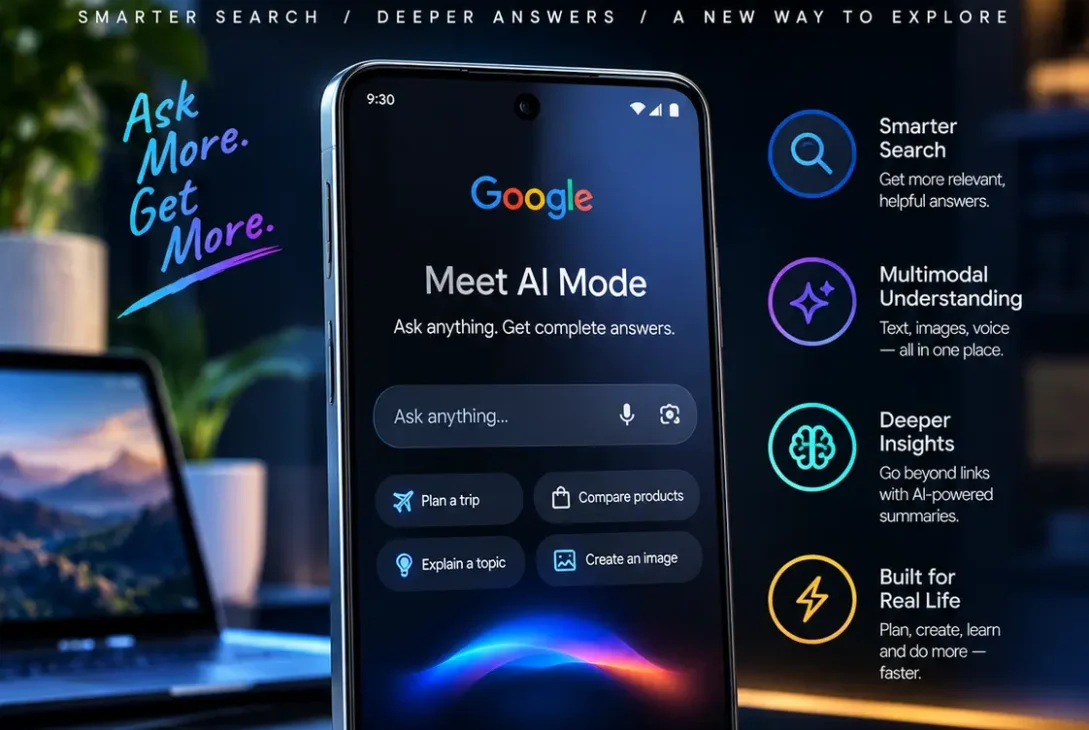
Google AI Mode is changing the way people use Google Search. Instead of typing a short query and opening several websites one by one, users can have a more conversational search experience that can understand complex questions, compare information, explore follow-up topics, and provide AI-generated responses.
Google introduced AI Mode as a more advanced way to search, initially making it available as an experiment through Google Search Labs before expanding access more broadly. The company describes AI Mode as an experience designed for questions that benefit from deeper exploration and follow-up interactions.
The idea behind Google AI Mode is different from traditional search.
A normal Google search might return a list of links, advertisements, maps, videos, and other search features. AI Mode instead tries to understand the user’s entire question and generate a more comprehensive response using information from multiple sources.
It can be particularly useful when a question does not have one simple answer.
For example, instead of searching separately for laptop specifications, battery life, processor performance, and pricing, a user can ask a longer question that combines all of those requirements.
Google can then break the question into different parts and search for information across multiple queries.
This approach is part of Google’s broader effort to make Search more capable of handling complex questions while still connecting users with useful web content.
But how exactly does Google AI Mode work, and is it actually better than traditional Google Search?
This guide explains its main features, how it differs from AI Overviews, how to use it effectively, its impact on websites and SEO, limitations, privacy considerations, and what the future of AI-powered search could look like.
Table of Contents
- What Is Google AI Mode?
- How Google AI Mode Works
- Google AI Mode vs Traditional Search
- Google AI Mode vs AI Overviews
- Deep Search and Complex Questions
- Follow-Up Questions and Conversations
- Multimodal Search
- Shopping With Google AI Mode
- Personalized Search
- Google AI Mode and Websites
- Google AI Mode for SEO
- Advantages of Google AI Mode
- Limitations and Accuracy
- Privacy and Data Considerations
- How to Use Google AI Mode
- Is Google AI Mode Free?
- The Future of AI Search
- Frequently Asked Questions
- Final Verdict
- SEO Details
What Is Google AI Mode?
Google AI Mode is an AI-powered search experience designed to handle more complex and conversational searches.
Instead of forcing users to break a complicated question into multiple searches, the system can analyze a longer request and generate a response based on information it finds across the web.
For example, imagine someone wants to buy a laptop for college.
A traditional search process might involve separate searches for:
- Best laptops for students
- Laptop battery life
- Best processors for college
- MacBook vs Windows
- Best laptop under a specific budget
With Google AI Mode, the user can combine those requirements into one detailed question.
The system can then break the question into smaller search tasks and bring the information together.
Google calls this process “query fan-out,” where AI Mode runs multiple related searches across different data sources to provide a broader answer.
This makes AI Mode especially useful for research, comparisons, planning, product discovery, and questions where context matters.
How Google AI Mode Works
The technology behind Google AI Mode combines Google’s search infrastructure with generative AI.
When a user enters a complicated question, the system does not necessarily treat it as one simple keyword search.
Instead, it can identify different aspects of the request and explore them separately.
For example, a question about choosing a smartphone might involve:
Price + camera + battery + software + performance + availability
The AI can use multiple searches to investigate these areas before generating a response.
This approach can provide a broader answer than a traditional single-query search.
However, the underlying search process remains important.
Google’s AI systems can still rely on information from websites, product databases, knowledge sources, and other search features.
That means websites remain an important part of the ecosystem even when users interact primarily with an AI-generated interface.
Google AI Mode vs Traditional Search
Traditional Google Search is built around finding information through search results.
You enter a query and Google returns relevant pages.
You then decide which result to open.
Google AI Mode changes the interaction by putting a conversational AI layer between the question and the information.
Instead of simply asking:
“best laptops for college”
a user can ask:
“What are the best laptops for a computer science student who needs strong battery life, occasional video editing, and at least 16GB of RAM under $1,500?”
That second query contains significantly more context.
AI Mode can analyze those requirements and produce a more tailored answer.
Traditional search is still extremely useful for navigating directly to websites, checking official pages, finding specific products, and exploring different opinions.
AI Mode is more useful when the user wants synthesis.
The two approaches are therefore not necessarily competitors.
They can work together.
Google AI Mode vs AI Overviews
One of the most important distinctions is between Google AI Mode and Google’s AI Overviews.
AI Overviews appear at the top of certain traditional search results and provide an AI-generated summary alongside links and other search features.
AI Mode is a more immersive search experience.
Instead of adding an AI response to the normal results page, AI Mode is designed around conversational interaction.
Users can ask follow-up questions and continue exploring a topic without starting over with a completely new search.
Google has described AI Mode as an evolution toward a more conversational and exploratory Search experience.
In simple terms:
AI Overview = AI summary inside Search
AI Mode = AI-centered conversational Search experience
Both use Google’s AI technology, but the interaction model is different.
Deep Search and Complex Questions
One of the most interesting capabilities connected with Google AI Mode is its ability to handle questions that require multiple searches.
Google has introduced deeper research capabilities designed to investigate complex topics by conducting multiple searches and synthesizing information.
This can be useful when a user wants to understand a subject rather than simply find one webpage.
For example, a person researching a new technology might ask about:
- How it works
- Main competitors
- Advantages
- Disadvantages
- Pricing
- Market adoption
- Future developments
A traditional search engine can answer these questions, but the user has to perform the research manually.
AI-powered search can potentially combine much of that work into one workflow.
The important limitation is that users should still verify important claims.
AI-generated summaries can contain errors, omissions, or outdated information.
Follow-Up Questions and Conversations
Another major advantage of Google AI Mode is conversational search.
Traditional search often requires users to repeat context.
For example:
Search 1: Best smartphones for photography
Search 2: Under $800
Search 3: Which has the best battery?
The user has to repeat or maintain context manually.
AI Mode is designed to make follow-up questions more natural.
A user can ask a question, receive an answer, and then refine the request.
For example:
“Which phone is best for photography?”
Then:
“What if battery life matters more?”
Then:
“Compare those two models.”
This conversational approach can make complex research feel more like talking to an expert assistant.
Multimodal Search
Modern AI search is not limited to text.
Google has increasingly incorporated images, voice, and other forms of input into Search.
This creates possibilities for more natural interactions.
For example, a user could provide an image and ask questions about what is shown.
A shopper might photograph a product and ask for information about it.
A traveler could use an image to identify a landmark and then ask follow-up questions.
Google AI Mode fits into this broader transition toward multimodal search, where users are not restricted to typing traditional keywords.
This could eventually make search more accessible to people who prefer speaking, photographing, or visually exploring information.
Shopping With Google AI Mode
Shopping is another area where AI-powered search can be useful.
People rarely make purchasing decisions based on one specification.
They may care about:
- Price
- Performance
- Battery life
- Reviews
- Size
- Features
- Brand
- Compatibility
- Availability
A conversational search system can potentially combine these requirements.
For example:
“Find me a lightweight laptop for university with 16GB RAM, long battery life, a good display, and enough performance for Photoshop.”
Instead of searching for each requirement separately, users can describe the entire need.
Google has also been expanding AI-powered shopping features that help users compare products and explore purchasing options.
This could make product discovery more personalized.
However, users should still verify prices and availability before purchasing because those details can change quickly.
Personalized Search
Personalization is another major direction for AI-powered search.
The more context a search system understands, the more relevant its answers can potentially become.
For example, a user might regularly search for:
- Technology products
- Programming tools
- Gaming hardware
- AI software
A future AI search experience could potentially use that context to make recommendations more relevant.
Google has also been developing personalization features that allow Search experiences to better understand individual preferences where those features are available.
However, personalization creates an important tradeoff.
More context can mean more useful results, but it also means users should understand how their information is being used.
Privacy controls therefore remain an important part of the AI-search conversation.
Google AI Mode and Websites
The growth of Google AI Mode has created an important question for publishers:
If AI answers the question directly, will users still visit websites?
This is one of the biggest changes happening in search.
Traditional search sends users to webpages.
AI search can potentially summarize information before a user clicks anything.
That could reduce some types of search traffic.
At the same time, AI-generated responses still need information sources.
Google’s AI search systems can surface links and supporting sources, giving websites opportunities to appear as part of the answer.
For publishers, this means creating useful, original content remains important.
Generic articles that simply repeat information available everywhere may have less value.
Content that provides firsthand experience, unique analysis, expert information, original data, useful comparisons, or genuinely helpful explanations can be more valuable.
Google AI Mode for SEO
For SEO professionals, Google AI Mode represents a significant shift.
Traditional SEO often focused heavily on ranking for individual keywords.
AI search makes context and topical authority increasingly important.
A website should not only target one keyword.
It should build comprehensive coverage around a subject.
For example, a technology website writing about a smartphone could cover:
- Specifications
- Performance
- Battery
- Camera
- Software
- Competitors
- Pricing
- Release information
- Real-world use
- Frequently asked questions
This gives search systems more useful information to understand.
Another important factor is accuracy.
AI systems can potentially compare multiple sources, so websites with inaccurate or misleading information may become less useful as sources.
For publishers, the goal should be:
Useful content first, optimization second.
That approach is especially important as search becomes more conversational.
Advantages of Google AI Mode
There are several reasons users may prefer Google AI Mode for certain searches.
Better for Complex Questions
Users can describe complicated requirements instead of reducing everything to a few keywords.
Conversational Follow-Ups
Users can continue a topic without starting from scratch.
Faster Research
AI can summarize information from multiple searches.
Better Comparisons
Users can ask the system to compare products, technologies, services, or ideas.
More Natural Search
People can search using normal language rather than carefully constructing keywords.
Multimodal Interaction
Images and other inputs can make search more intuitive.
Broader Exploration
AI can help users discover related information they might not have searched for themselves.
These benefits make AI-powered search particularly useful for research and decision-making.
Limitations and Accuracy
Despite its advantages, Google AI Mode is not perfect.
AI systems can produce incorrect information.
Potential problems include:
- Outdated information
- Incorrect summaries
- Missing context
- Misinterpreted sources
- Overconfident answers
- Conflicting information
- Incomplete comparisons
This is why users should not treat an AI-generated answer as automatically authoritative.
For simple questions, mistakes may have little impact.
For medical, financial, legal, security, or other high-stakes decisions, users should verify information through reliable primary sources and qualified professionals where appropriate.
AI search should be treated as a research assistant, not an infallible authority.
Privacy and Data Considerations
Privacy is another important consideration when using Google AI Mode.
Search queries can reveal a lot about a person.
A user’s searches may reveal:
- Interests
- Purchases
- Travel plans
- Work activities
- Technical problems
- Personal concerns
AI-powered search can potentially make these interactions more detailed because users may write longer, more conversational questions.
Users should therefore avoid entering sensitive information unless they understand how the relevant service handles that data.
Google provides account and activity controls that allow users to manage certain aspects of their Search activity and personalization.
Privacy settings can change over time, so users should review Google’s current documentation and account controls for the latest options.
https://blog.google/products/search/google-ai-mode-search/
How to Use Google AI Mode
Using Google AI Mode is straightforward when the feature is available to your account and region.
Instead of entering a short keyword phrase, describe the complete question.
For example, rather than:
“best gaming laptop”
try:
“What is the best gaming laptop under $1,500 for someone who wants strong 1440p performance, good cooling, and at least 16GB RAM?”
The second question gives the AI much more context.
You can then ask follow-ups.
For example:
“Compare the top two.”
Then:
“Which has better battery life?”
Then:
“Which one is better for college?”
This conversational approach is one of the main reasons AI search can be useful.
Is Google AI Mode Free?
Access to Google AI Mode depends on Google’s current rollout, account, region, and specific features.
Google has expanded AI search capabilities over time, with some features available broadly and others introduced through specific programs or plans.
Because availability and product features can change, users should check Google’s official Search information for the latest access requirements.
Some advanced AI capabilities may also depend on Google’s subscription offerings.
Therefore, avoid relying on old articles that describe the availability of AI Mode from its initial launch period.
The Future of AI Search
The development of Google AI Mode points toward a broader change in how people interact with search engines.
The old model was:
Question → Search results → Websites → Manual research
The emerging model is:
Question → AI research → Synthesized answer → Follow-up conversation → Sources
This does not mean traditional websites will disappear.
People will still need original sources, official documentation, news reporting, product pages, reviews, forums, and specialist publications.
But the search engine increasingly becomes an interface for exploring that information rather than simply a directory of links.
Google’s long-term goal appears to be making Search capable of handling increasingly complex questions while maintaining connections to the broader web.
For users, that could mean less time performing repetitive searches.
For publishers, it means competing for visibility in a search environment where the answer itself may be generated before the user clicks.
Frequently Asked Questions
What is Google AI Mode?
Google AI Mode is an AI-powered Google Search experience designed for complex, conversational questions and deeper exploration.
Is Google AI Mode different from AI Overviews?
Yes. AI Overviews provide an AI-generated summary within traditional Search results, while AI Mode is designed as a more conversational and interactive search experience.
Is Google AI Mode free?
Availability depends on Google’s current rollout, account, region, and feature requirements. Some AI search capabilities may be available broadly, while advanced features can have different requirements.
Can Google AI Mode answer complex questions?
Yes. One of its main purposes is handling questions that require multiple searches, comparisons, and follow-up exploration.
Can I ask follow-up questions?
Yes. Conversational follow-up questions are a major part of the AI Mode experience.
Does Google AI Mode replace normal Google Search?
Not completely. Traditional Search remains useful for finding specific websites, official pages, products, news, and direct sources. AI Mode provides another way to explore information.
Does Google AI Mode use multiple searches?
Google has described a “query fan-out” approach in which AI Mode can issue multiple related searches to investigate different parts of a complex question.
Is Google AI Mode accurate?
It can provide useful answers, but AI-generated information can contain mistakes. Important claims should be checked against reliable sources.
Will Google AI Mode reduce website traffic?
It may change how users interact with websites and could reduce clicks for some types of queries. However, websites can still appear as sources and links within AI-powered search experiences.
Is Google AI Mode useful for shopping?
Yes. Conversational product research can help users compare products based on multiple requirements such as price, specifications, performance, and features.
Can Google AI Mode understand images?
Google has been expanding multimodal Search capabilities, allowing users to combine visual information with questions in supported experiences.
Is Google AI Mode good for research?
It can be useful for research because it can help explore complex questions and synthesize information. Users should still verify important facts against primary or authoritative sources.
Final Verdict
Google AI Mode represents one of the biggest changes to Google Search in years.
Instead of treating search as a simple process of entering keywords and opening webpages, Google is moving toward a more conversational model where users can ask detailed questions and continue exploring a topic through follow-up requests.
The biggest advantage is convenience.
A complicated research task that previously required many separate searches can potentially be handled through one longer conversation.
The ability to compare information, explore related questions, investigate multiple aspects of a topic, and interact with Search more naturally could make the experience significantly more useful.
However, Google AI Mode is not a replacement for critical thinking.
AI-generated responses can contain errors, and users should verify important information using reliable sources.
For publishers and SEO professionals, the change is even more significant.
Search visibility is increasingly about being useful enough to become part of an AI-generated answer, not simply ranking for one keyword.
That makes original research, accurate information, strong topical coverage, expert insight, and genuinely helpful content more important than ever.
For everyday users, Google AI Mode is best viewed as another layer of Google Search rather than a complete replacement for the traditional results page.
Use it when a question is complex, comparative, or requires research.
Use normal Search when you need a specific website, official document, product page, or direct source.
Together, these experiences point toward a future where search is less about typing isolated keywords and more about having an ongoing conversation with the world’s information.